After a fall, you found no major injury yet could not get up independently. Later, once walking again, it is easy to recount the event as nothing being wrong in the end. Difficulty getting up is important information in its own right, however. It conveys something different from the fall’s cause, visible injury or ability to take a familiar walk.
This article offers orientation for understanding the event and arranging future help. It does not teach a general technique for standing after a recent fall or ask you to try getting down onto the floor at home. Appropriate action depends on injury, current condition and available assistance. Later professional learning may have a role, but differs from the situation in which someone currently cannot get up.
If the fall has just happened and you cannot get up
The NHS guidance on falls treats inability to get up independently and suspected head, back, neck or hip injury as situations requiring urgent help. Do not force yourself to stand as proof or try to follow movements from a phone video. Use the available means of seeking help and explain that you fell and cannot get up.
If someone is beside you, they should not simply try to lift you. The NHS also specifically warns against attempting the lift themselves. The person requesting help should remain in contact with appropriate care, describe the situation and follow instructions. With suspected injury, moving someone should not be decided through a general idea about physical strength.
While waiting, maintaining contact and warmth may matter in ways suited safely to the situation. This article provides no identical movement sequence for everyone because injury and current illness can substantially change the necessary action. The aim is for appropriate help to arrive, rather than someone proving as quickly as possible that they can get up unaided.
Why is getting up a different question from walking?
Rising from a familiar chair, walking along a level corridor and getting up from the floor are different tasks. The starting position, available support and required movements differ. Success in one does not automatically establish ability in all the others. This recognises differences between tasks rather than devaluing successful daily movement.
A recent fall may also involve pain, injury, fright or illness. These differ from the conditions of planned professional practice. The later assessment therefore needs the event’s whole history. You need not retrospectively label what you could not manage in that situation as mere weakness.
A sporting background does not solve every situation either. A regular runner may need different assistance or learning to rise from a low position. Kilometres do not describe every circumstance of the event on the floor. Appropriate assessment should begin with the specific task rather than expectations attached to being an athlete.
 Enlarge image
The guideline gives this history particular significance
The 2025 NICE falls-prevention guideline recommends comprehensive assessment and individual prevention for community-dwelling people in its relevant age groups who fell in the past year and could not get up independently afterwards. Its scope covers people aged at least 65 and those aged 50–64 with factors increasing risk. Visible injury is not the only consideration.
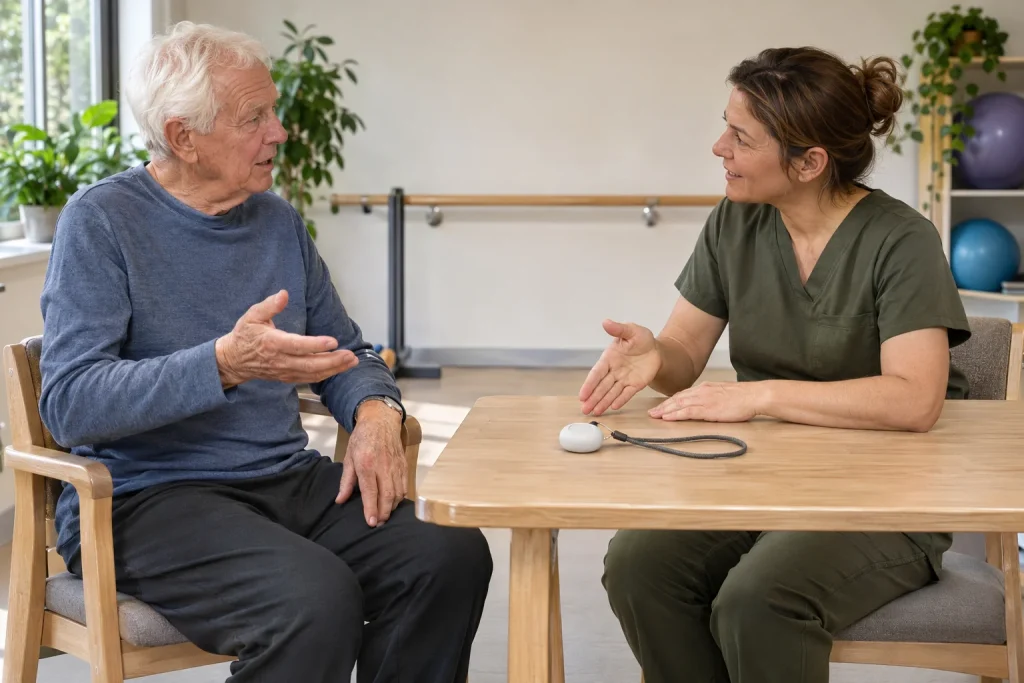
Assessment is not a judgement based on one skill test. History and individual circumstances may justify examining several areas. The aim is to make appropriately modifiable factors and necessary help visible. Mention such an event even if you can move more comfortably later.
Nor need you turn the later assumption I could have got up if only I had tried harder into a certain account. Describe what happened: the position you ended up in, what you experienced and the help needed. You need not prove bravery to yourself or your clinician. The actual event is the important information.
Access to a help-seeking device matters more than merely owning one
An original follow-up study published in 2008 examined difficulty getting up and seeking help after falls in 110 people over ninety. Available alarm devices did not automatically mean they were used in the actual situation. Participants’ accounts identified practical and personal barriers too. This concerns a specific, very old group, rather than describing every older runner’s risk.
The practical question remains clear: if needed, could you reach and use your means of seeking help? A phone in another room or a rarely used device may not provide the support expected on paper. Clarify how to use it and how contact works beforehand in a calm situation.
This requires neither a staged fall nor lowering yourself to the floor. Many aspects of access, operation and the contact plan can be discussed in safe everyday circumstances. If a question needs individual assessment, arrange appropriate help for it. Preparation aims to reduce the chance of being stuck rather than create another trial situation.
A shared help plan should be simple and real
Agree whom you contact, how and when that person is actually available. A relative’s good intentions do not mean they can always answer immediately. Urgent care needs must not depend solely on a personal contact calling back. The plan should clarify each form of help’s purpose and what happens if the first is unavailable.
Location information should also be usable. Which entrance to your home can be reached and how, or where are you relative to a designated outdoor route? Share information to the extent needed and with the person’s consent. Safety arrangements do not grant unlimited monitoring rights or make all personal data public.
Contact arrangements can change: the helper travels, you get a new number or spend the day elsewhere. Review the plan afterwards rather than merely remembering the previous agreement. If using a device, clarify its operation and conditions of use through its own instructions. No staged fall is needed. Technical checking and practising a physical task are separate activities, and one working does not remove the need for individual assistance with the other.
| Plan component | Question to clarify in a calm situation |
|---|---|
| Access | Where is the means of seeking help, and how is it used? |
| Contact | Who is genuinely available, and what happens without an answer? |
| Location | How can the place where you are be described clearly? |
| Role | A helper should not take on lifting an injured person independently. |
The table is not a general rescue protocol. Details suited to individual needs and the particular device require appropriate planning. The aim is shared understanding, rather than an overly complex system nobody uses in daily life. A written plan has value when those involved understand it and it relates to their real possibilities.
What is worth reporting at a later assessment?
Circumstances before the fall, injury, any illness and difficulty getting up can be retained as separate details. How long were you without help, and how did the situation end? State if the time is not precisely known. Do not turn an uncertain memory into a definite number afterwards; the actual history matters more than a round figure.
Where help-seeking broke down is information too. Could you not reach the phone, was there no signal, could you not give your location, or did you not want to bother others? These are different barriers and may need different solutions. You need not treat them all as personal faults. Assessment and organisation help precisely by making the situation understandable.
You can describe subsequent walking ability and concern about falling too. Neither replaces the history. If you have since avoided important activities, that may matter in individual goals. Support should ask both whether another accident occurred and how your own day works now.
 Enlarge image
Learning to get up can have an individual framework
Assistance after a fall differs from later skill learning. If an appropriate professional considers it indicated, certain tasks and assistance strategies can be learned in a way suited to the individual condition. Appropriate surroundings, support and attention to injury matter. The same movement sequence or support will not be usable for every reader.
Learning does not aim to race against the clock when getting up from the floor. Understanding, your own possibilities and recognising when to seek help can also belong to it. A general online video demonstration does not replace individual task selection, particularly after recent injury or repeated falls. You need not recreate difficulty at home to receive appropriate support.
If a learned task remains uncertain, request a clearer explanation and feedback. The aim is not guessing the steps from memory. Clarify which part can be done independently, which needs help and which changes require renewed discussion. A specific framework helps more than a general instruction to be stronger.
The running programme should connect with the whole situation too
An imaginary older man could get up from the floor after a fall only with assistance. He later walks well, but does not consider the event settled for that reason alone. He describes difficulty getting up at an appropriate assessment and separately discusses accessible help. With his community, he arranges a meeting that fits his current individual framework.
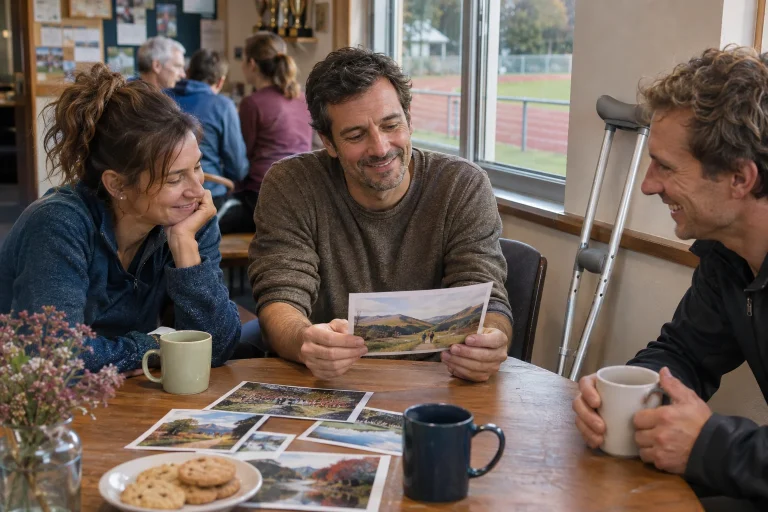
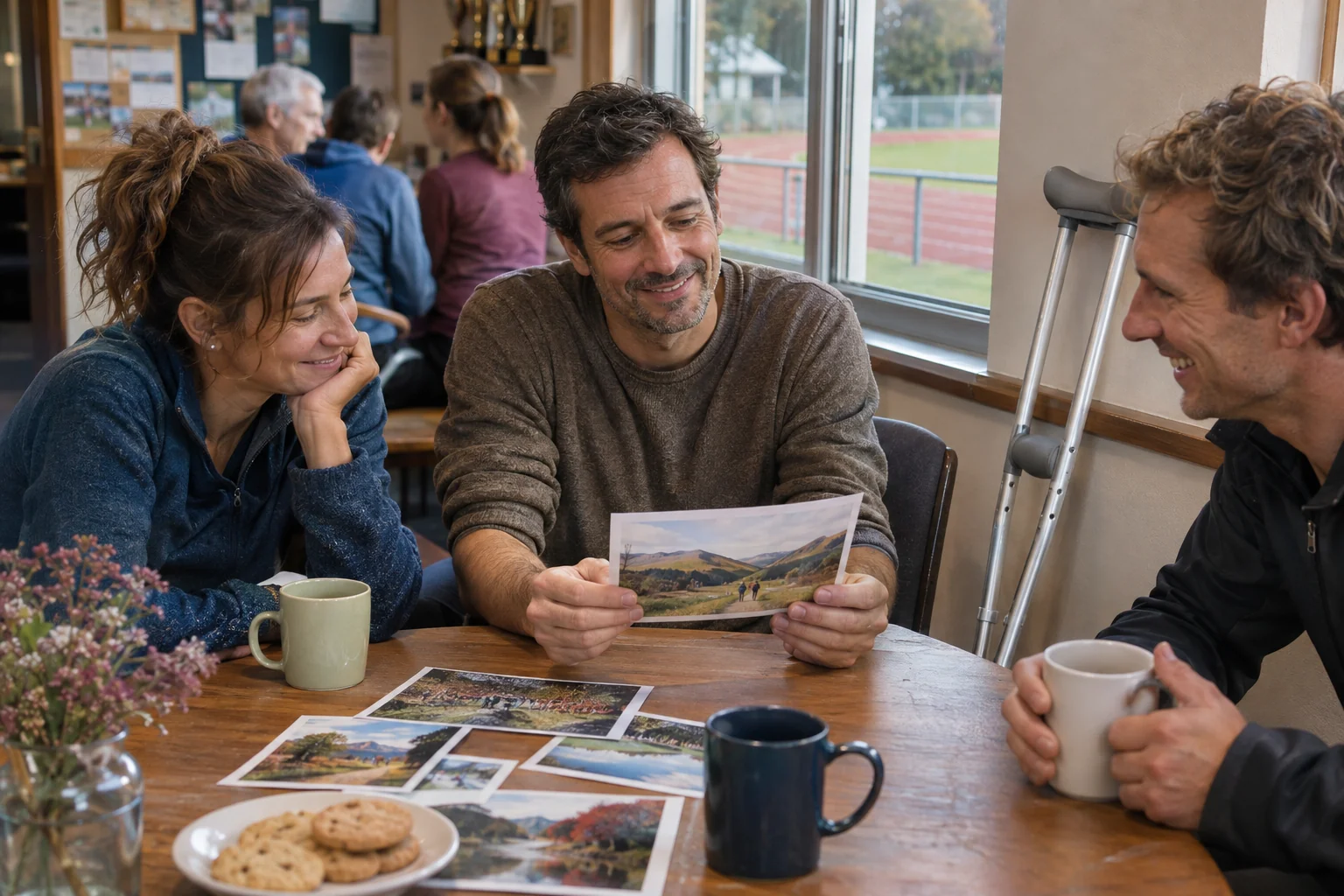
The example neither imposes a ban on sport nor gives automatic permission to return. It illustrates the information pathway between those decisions. Running’s place in an individual plan needs clarification, while social connection need not depend on completing a whole workout. Using assistance does not invalidate a sporting past.
Difficulty getting up after a fall therefore remains significant history even with little visible injury. The event, function and access to help together tell the story. Appropriate assessment and specific support help the next choice rest on more than a proof-seeking home trial or a label of clumsiness.
Sources
NICE NG249: the assessment significance of inability to get up independently after a fall; NHS: falls and seeking help; Fleming and Brayne: difficulty getting up and seeking help above ninety, original cohort study, 2008. Checked: 21 November 2026. The support list and story are original illustrations, rather than a rescue or individual getting-up protocol.
How Futószív articles are prepared: our editorial guidelines.