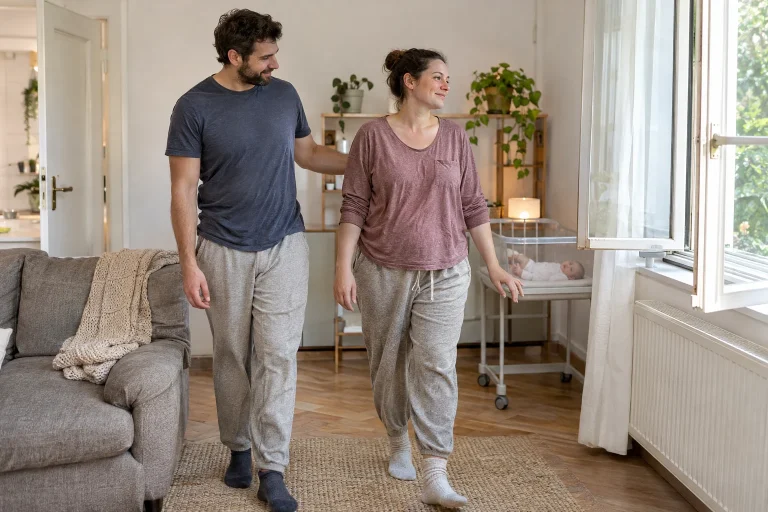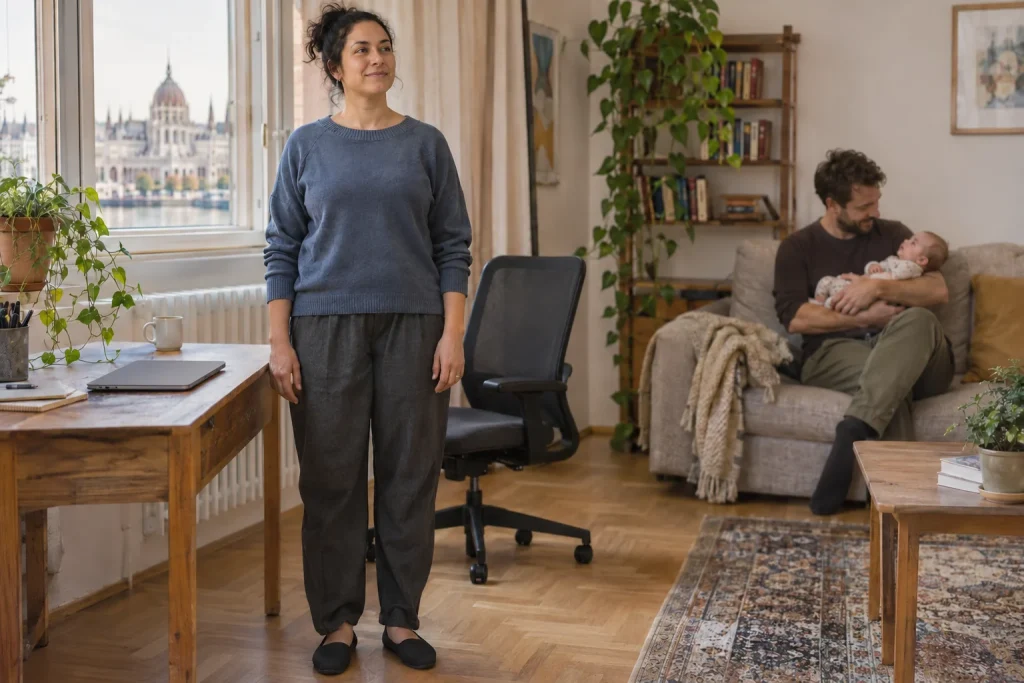
A day after childbirth can contain a great deal of sitting without feeling like real rest. You stay in one place while feeding, deal with messages afterwards, then try to finish a task at the computer. When a watch prompts movement, it can easily sound like another item to complete. Yet interrupting a long seated period and following a return-to-training plan are different things.
A brief change of position suited to you need not look like sport. You need not perform squats, a stretching sequence or another household chore during it. The aim may simply be to avoid spending the entire period in the same position, while recovery, symptoms and the need for genuine rest also receive room in the day.
What does the postnatal activity guideline say about sitting?
The 2025 Canadian guideline discusses physical activity, sedentary time and sleep within a shared whole-day framework. It recommends interrupting prolonged sitting when possible and emphasises that recommendations cannot always all be met in postnatal life. It also highlights support from partners, families and society. The official CSEP postnatal guideline page treats feasibility as part of the advice too.
The words when possible matter. They do not mean interrupting a feed or forcing a painful rise from sitting for a watch’s sake. Between public-health advice and your immediate task lie your condition, the child’s needs and available help. This article gives no identical standing interval or compulsory daily number of breaks for every mother.
The guideline separately addresses gradual movement adapted to symptoms and individual circumstances. This does not mean every interruption of sitting should be exercise. A gentle change of position need not become more intense to have a purpose in organising your day. Planning sporting load later can remain a separate conversation.
Not all sitting serves the same task
Review the day by purpose. Some sitting relates to caring for the child, some to work and some to deliberate rest. You need not rank these morally. Reviewing them helps find natural transition points and identify where someone else’s assistance would be needed.
During feeding, for example, a stopwatch ending does not finish the task. During computer administration, however, you may find it easier to pause between two messages. The difference comes from the situation, rather than your discipline. A break being feasible in one setting but not another need not become a judgement on the entire day.
Do not remove rest in the name of reducing sedentary time. When you finally have a chance to switch off or sleep, do not replace it with compulsive searching for activity. The Canadian guideline also treats sleep as a distinct area and recognises practical limits around infant care. A whole-day framework does not mean filling every calm moment with movement.
 Enlarge image
Find a natural transition rather than another alarm
Begin with one situation that often stretches out. Perhaps you sit for brief administration and then, without noticing, complete several tasks in the same place. A change might be to pause after the first matter is finished, consider what you need now and change position if appropriate for your condition. You need not immediately divide the entire day into minute-by-minute blocks.
An external prompt can help if it reminds you of a choice. If it instead annoys you, wakes you or displays another unmet target, modify its use. An app does not know whether you are feeding, preparing for an appointment or need rest. A prompt is not individual healthcare instruction, and a completed activity ring is not an assessment.
Separate the break from another compulsory task. If every time you stand up is immediately followed by laundry, tidying and carrying things, an interruption can easily become another work block. Perhaps what helps now is someone bringing a needed item and leaving you a choice between resting and changing position comfortably.
Make the home environment supportive rather than deliberately inconvenient
The placement of needed objects shapes the day too. You need not deliberately put water, your phone or childcare equipment out of reach to force more movement. During postnatal recovery, this could create unnecessary difficulty. Reviewing the environment may also mean making frequently needed things comfortably accessible without assistance.
When sitting at a computer, separate what needs doing from what follows merely because you are already there. A short list can help make administration finishable. If a task can be delegated, handing it over can form part of the change. Rethinking sitting time can therefore involve sharing work as well as rising from a chair.
If rising from an armchair or chair is painful or uncertain, a general article is not the place to learn the technique. Seek individual help for the situation causing difficulty. The NHS information on bodily changes after childbirth explains that lifting and bending during childcare can also relate to physical symptoms, and help can be requested at any time for troublesome problems. The NHS information on the body after childbirth is not limited to difficulties during sport.
Separating breaks from training in three everyday situations
The following examples concern organisation, rather than physiotherapy tasks. Each asks what the real goal is and which help it requires. None overrides your healthcare advice. If movement is painful, assessing the symptom matters more than achieving a transition on the plan.
| Situation | Possible purpose of the break | What need not be added |
|---|---|---|
| Prolonged computer administration | Change position comfortably after completing a task, if appropriate for you. | A compulsory squat sequence or an immediately raised daily step count. |
| A few minutes become available after childcare | Ask yourself whether you need rest, assistance or gentle movement. | A rule requiring every free minute to be active. |
| Extended evening screen use | Finish the matter and deliberately choose the next activity. | Punitive catch-up for missed movement instead of going to bed. |
Sitting associated with feeding should accommodate both the child’s care and your comfort. If the position is uncomfortable, request individual help to clarify appropriate support and your posture. Arranging a break may also involve a partner or another helper taking over the next caring task, so the same chain of demands does not continue uninterrupted.
With a young child in your arms, do not let a movement prompt immediately become a balancing or practice task. Arrange the child’s safe care and handover first. The idea of a movement break does not justify simultaneously carrying objects, completing a task and demonstrating an exercise. Fewer simultaneous expectations also have organisational value.
Current wound and pelvic-floor condition are separate considerations
The Canadian guideline accounts for healing and symptoms when increasing activity; wound healing, pelvic-floor and musculoskeletal symptoms may require further support. Calling something only a brief break therefore does not override an individual restriction or new symptom. The activity’s content matters, rather than how easy you call it.
If pain, leakage, heaviness or another new symptom occurs when rising from sitting, standing or moving briefly, describe it in healthcare. You need not use harder movement to discover the limit of your comfort. The description can be simple: your starting position, what happened and whether it differed from earlier experience.
New pain around a wound or another worrying change is not a problem to solve by buying an adjustable desk either. Clarify the healthcare question first. Alongside individual instructions, ask which changes of position may suit you and which signs should prompt renewed contact. An uncomfortable chair can be changed, but a better chair does not establish that a symptom’s cause has resolved.
 Enlarge image
Family assistance should be specific and genuinely transferable
Let me know if you need anything is well-intentioned, but often leaves organisation with you. Try handing over a clearly defined task: the next administrative matter, dinner preparation, something for an older child or an agreed stage of the baby’s care. You then receive more than encouragement to stand; there is actual room to spend time differently.
If alone at home, help can still be arranged on a smaller scale: someone deals with a matter in advance, brings necessary items or takes over organising something by phone. Not all of these create movement opportunities; some create opportunities for rest. Postnatal support need not serve only increased activity.
Limited available help is also a real constraint. Do not rename it a personal lack of motivation. The guideline explicitly recognises how infant care and fragmented sleep affect implementing recommendations. Daily circumstances belong in discussion with your clinician; usable advice depends on more than how much you want to return to sport.
Do not turn a movement break into a return certificate
Organising seated tasks differently may become easier while no decision about running has been made. These do not contradict each other. A day with more changes of position does not assess running’s own loading questions. Equally, a less active day does not erase previous experience or automatically mean a setback in recovery.
When sport comes up again, bring an account of the whole day: which seated tasks you have, what causes symptoms, how you rest and which help is available. Ask separately about conditions for running. Experience from walks, breaks and daily administration can be useful information, but does not form part of a readiness score you assemble yourself.
A good change may be entirely ordinary: a task ends sooner, someone genuinely takes over a responsibility or an entire afternoon no longer passes in the same position. This does not require another training identity. Your postnatal day becomes more liveable when recovery, childcare, rest and movement appropriate for you all receive recognition as tasks.
Sources
- CSEP: Postpartum – Canadian movement guideline
- NHS: Your post-pregnancy body
- CSEP: 2025 Canadian Postpartum Physical Activity Guideline – official summary
How Futószív articles are prepared: our editorial guidelines.