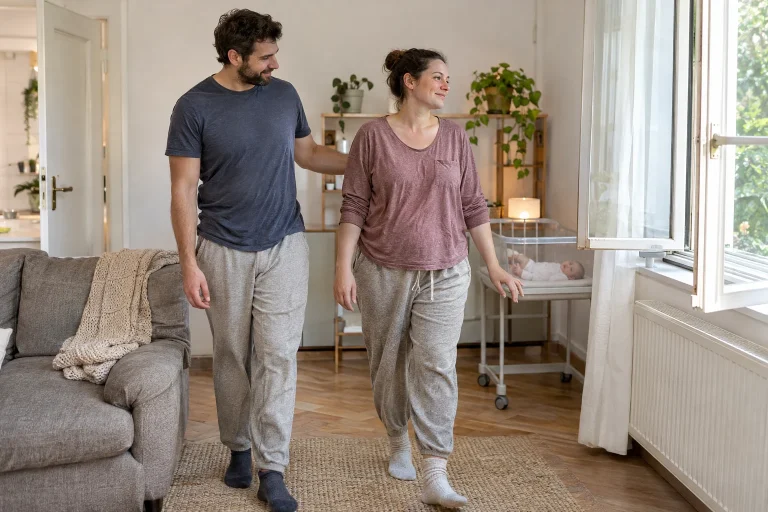
After a caesarean, conversations about activity often begin with running: when can training resume? Yet the first days and weeks are already full of physical tasks. Baby care, shopping, stairs, bags and household work are present even without a single sporting session in the calendar. To plan recovery, discuss these everyday demands with your care professional too. You do not have to silently manage every task because it does not count as training.
This article does not teach lifting technique after a caesarean or set an individual weight limit. The guidance received after surgery takes priority; uncertainty or new symptoms need discussion with your healthcare professional. The practical aim is to make the real tasks and their circumstances visible: what needs lifting, from where, how often and who can help? This can underpin a home routine that takes recovery into account too.
Coming home does not restore the entire previous routine
The NHS information on recovery after a caesarean emphasises gentle activity alongside avoiding overexertion. Leaving hospital does not authorise every household or sporting task. Interpret feasible activities according to individual condition, guidance received and the actual environment.
At home, many actions become invisibly compressed into one word. ‘Shopping’, for example, may mean ordering, receiving, carrying and putting things away. ‘Baby care’ covers several situations and recurring tasks. Requests for help become more precise when you see the parts separately rather than assigning the whole label to one person.
Supporting everyday movement and resting are not necessarily contradictory. The Irish HSE recovery guidance also discusses rest at home, family help and gentle movement. Your task is not to turn these independently into a rigid rule, but to put an individual recommendation into practice understandably in your own day.
Describe a baby-care task together with its actual situation
According to the NHS, you can generally hold and carry your baby after returning home, while lifting heavier objects and several other activities may need separate restrictions. Do not read this as unlimited permission for every action involving the baby. Holding the baby, lifting them from a low place and moving them together with equipment cannot be described precisely by the same short word.
Describe the circumstances you need advice about to your care professional or physiotherapist. At what height is the surface, do you need to turn, how tight is the space and is another adult nearby? You do not need to learn a general movement from the article and then apply it everywhere. Individual demonstration and reviewing your own surroundings may offer more.
Name equipment for the baby separately. Moving a carrier, bag or pushchair involves not only the child but the equipment and task too. Clarify this to interpret individual guidance. Do not automatically regard something as a light task simply because it involves childcare equipment.
Shopping can become a process shared between several people
Treating shopping as a single task can mean help extends only as far as the shop. Yet the difficulty may lie in receiving items, getting them upstairs or putting them away. Write out the process and agree who takes each part. Specific sharing requires less guesswork than a general request that someone be more helpful.
Online orders can still leave physical tasks. Who receives the package, where do they put it and who puts heavier items in their places? The service alone does not resolve every step. Equally, splitting things into smaller packages does not establish individual medical permission: keep interpreting your lifting conditions according to the guidance received.
Everyday help can be arranged in advance rather than requested only exceptionally. If a task recurs regularly, handing it over clearly for a while may be simpler than asking again every time. This is not a permanent allocation of roles, but arrangements adapted to present recovery. You can discuss again later what has changed and what is feasible.
| Task | What can hide behind the short name? | What should you agree? |
|---|---|---|
| Shopping | Ordering, receiving, carrying and putting away. | Know who is responsible for physical steps, not only who makes the purchase. |
| Baby-care task | Several surfaces, pieces of equipment and repeated movements. | Ask how individual guidance applies to the particular situation. |
| Laundry | Collecting clothes, moving a basket and hanging washing. | Which part will another person take over during recovery? |
| Leaving home | Bags, stairs, doors, a vehicle and waiting. | Who helps at each point, rather than only at the destination? |
 Enlarge image
The home’s arrangement is part of organisation too
The location of frequently used personal items and necessary baby equipment influences unnecessary searching and trips back and forth. The aim is not a perfectly rearranged home, but identifying a few real obstacles. What needs retrieving many times a day? Where is accessible storage missing? Which task always requires calling someone else?
The NHS page on the body after childbirth also mentions lifting and bending during childcare among possible circumstances of physical symptoms. Its general ideas do not need to be adopted unchanged in your own surgical situation. If a task is uncomfortable or uncertain, take the particular situation to the relevant professional.
The child’s safety must be maintained throughout any reorganisation. Do not leave them unattended on a raised surface or use improvised, unstable arrangements to make a task easier. If personal protection during recovery and environmental safety seem difficult to reconcile, ask for practical help. You do not have to devise alone a system for which appropriate equipment or support is missing.
Ask for help with a specific task and time
A useful sentence might be: ‘Today I need help receiving and putting away the shopping, not only someone going to the shop.’ Or: ‘When leaving, we need to manage the bags and stairs together.’ A specific request is easier to act on than asking everyone to try to pay more attention to you.
If you have a partner or regular helper, discuss what happens when they are not home. The arrangement need not be perfect at every moment, but it helps if heavier recurring situations do not arise entirely unexpectedly. Family or friends’ availability can vary; tell your care professional too if it affects whether guidance can be put into practice.
Independence does not necessarily mean doing as many tasks as possible alone. It can also include recognising what you need now and asking clearly for it. Sharing work during recovery is not a judgement on your later abilities. It helps make the current situation manageable.
Do not automatically turn discomfort into a training task
If new pain appears during lifting or another everyday movement, there is no need to immediately choose core strengthening or stretching for it. Report the individual symptom to your healthcare professional, particularly if it increases or you see changes around the wound. A difficult activity does not prove a particular muscle is weak or replace healthcare assessment.
HSE discusses a painful, red or swollen wound, fever and discharge as symptoms to report promptly. The NHS also warns of the importance of new wound symptoms and other postpartum symptoms. You do not need to wait until the next check merely because the account contains a movement that seems to explain it.
For severe acute illness, chest pain, significant difficulty breathing or fainting, you can call 112 in Hungary. Explain the recent birth and caesarean at the start of asking for help. Reaching care does not require finishing the household task first or establishing whether you really lifted too much.
Running workload sits alongside the whole day, rather than replacing it
When running arises later, also discuss the day’s other tasks with your care professional and, where necessary, an exercise professional. Baby care and housework do not disappear because a short sporting session appears. Nor do they need conversion into kilometres or workload points. The actual life situation matters for feasibility.
A freer day and one involving much travelling with little help may need different organisation. A sporting programme does not necessarily need the same amount inserted into every situation. Alongside the individual healthcare framework, keep time for rest and daily care visible too. The training diary does not automatically show every commitment.
Successfully managing a heavy shopping trip does not decide the conditions for starting running. Completing an everyday task is not a test of fitness for sport. If it required effort or discomfort, it is especially unhelpful to interpret it as meaning every workload is now possible. A later running plan should start from an appropriate individual assessment.
 Enlarge image
Three specific conversations can settle the key points
To your healthcare professional: ‘These are the tasks I do at home, and this situation is uncertain or causes symptoms. How should I apply the guidance I received, and is further help needed?’ You are then asking for an answer suited to your environment rather than a general lifting rule. The question remains appropriate even if the task is considered ordinary in the family.
To a partner or helper: ‘These three steps are difficult to manage alone now. Let us agree which you take over and what happens if you are not here.’ You do not need to reorganise everything at once. Identifying the most frequent or difficult situations can be the first meaningful step.
To a coach or running companion: ‘I am deciding how to continue based on individual recovery and care; my day is also full of other physical tasks now.’ This is relevant context, not an excuse. You do not have to make the work home life already requires invisible for the sake of a sporting calendar.
The next step should be simpler than the previous complete plan
Reviewing tasks helps when it leaves less uncertainty. You know what the healthcare professional said, which home situation still needs asking about and who performs each task. This does not need to become a permanent monitoring system or project measuring every movement. The aim is a more manageable everyday routine.
If help or your condition changes, task sharing can be discussed again too. Earlier arrangements are not an eternal contract, and reporting difficulty is not failure. Equally, gradually taking tasks back is not a compulsory race against your former independence. Your own guidance and real experience matter together.
Sharing demands after a caesarean ultimately involves more than what not to lift. It also means making room for recovery within a real family day. Baby care, shopping and later sport can each be named separately, with different help and individual discussions attached. The next conversation about running can then start from knowledge of your whole life situation rather than an empty calendar.
Sources
- NHS: recovery after a caesarean and everyday activity
- NHS: physical symptoms after childbirth and childcare situations
- HSE: rest, help and individual recovery after a caesarean
How Futószív articles are prepared: our editorial guidelines.