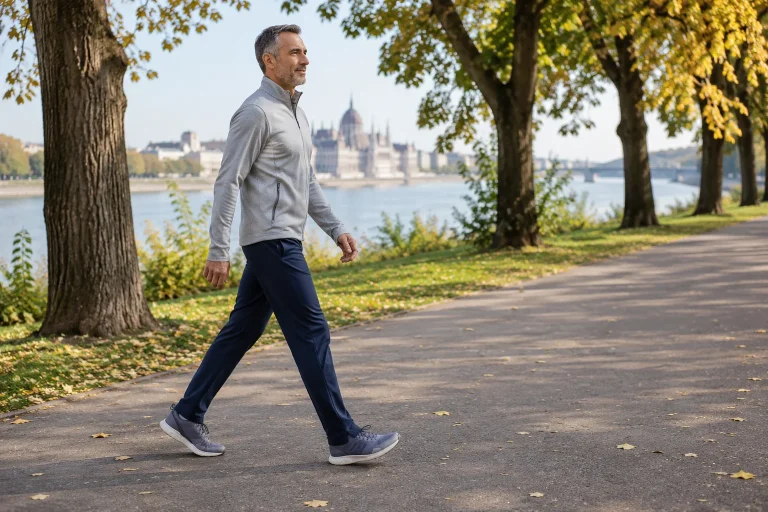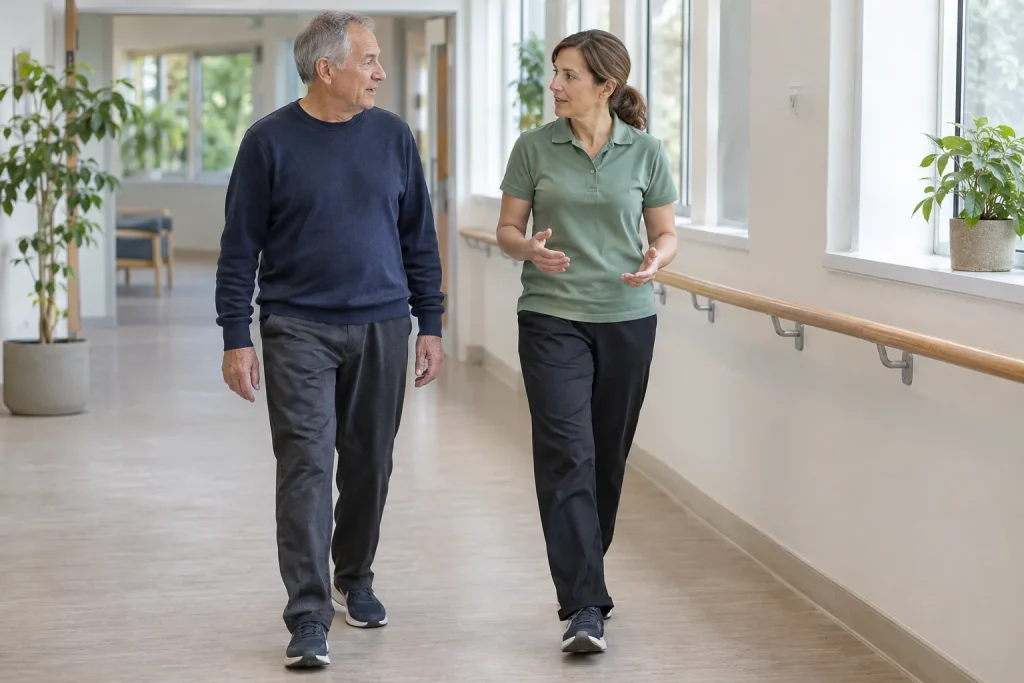
The graze from your fall is barely visible now, and walking feels more comfortable again. It is understandable to want to put the event behind you, particularly if running was part of your usual day. Improving walking is good news. Yet it does not tell you the same thing as clarifying the cause of the fall, the full condition of the injury or the requirements of your next sporting activity.
Visible healing on the skin is easy to regard as a sign of complete recovery because you can follow it with your eyes. Returning involves more than this, however. This article highlights distinctions worth keeping in mind: what happened before the fall, what changed afterwards and exactly what the next activity you undertake involves. It does not provide a single running timetable for every injury.
Do not let improvement obscure a new or severe symptom
If a serious head, neck, back or hip injury is suspected after a fall, you cannot get up or you become severely unwell, appropriate urgent help may be needed. The NHS guide to falls distinguishes these situations from general prevention advice. Instructions received in your own care take priority, rather than the fact that you could walk briefly the next day.
After hitting your head, new weakness, confusion, changes in walking or speech, difficulty staying alert or other concerning symptoms may also warrant urgent assessment. The NHS information on head injury also identifies taking medicines affecting blood clotting as an important circumstance. The size of an external wound does not alone reveal the consequences of the impact.
Severe pain, significant swelling, visible deformity or being unable to bear weight on the affected area should not be clarified through a trial run at home either. The NIAMS guide to injuries emphasises professional care for such symptoms and does not support working through injury pain. A new change appearing after earlier improvement can matter too.
What happened immediately before the fall?
Did you trip over a clearly identifiable object, slip or first feel dizzy and unwell? Do you remember the whole event? These are not minor details. The consequences of the fall and the situation preceding it need separate assessment. Healing of a graze, for example, does not tell you whether the cause of feeling unwell beforehand has been clarified.
The 2025 NICE guideline on falls prevention regards understanding the details of a fall as important. In older people, certain circumstances, such as loss of consciousness, repeated falls, an injury needing care or being unable to get up independently, may warrant a more comprehensive assessment. It is therefore unhelpful to judge the event solely by the mark left on the skin.
If the story is unclear, you can state that precisely too. You do not need to fill in missing details from memory or choose a definite explanation. ‘I do not know what happened immediately beforehand’ is useful information. Preserving uncertainty can support the right professional question, whereas inventing a trip afterwards could close it too soon.
You do not need to recreate the fall to review the environment later. If an object in the way or a section with poor visibility may have contributed, it can be identified and checked with help where necessary. Do not return alone to the same uncertain situation to find out whether you can manage it better now. Clarifying a feature of the location may be an organisational task, while dizziness before the fall remains a professional question. Both may have been present. Removing the object is therefore a useful change, but does not prove that every other circumstance of the event has been resolved.
 Enlarge image
The wound, walking and sporting task provide separate information
It is worth viewing skin condition, everyday walking and running as different tasks. Comfortably covering a short, level stretch is not the same as a longer route, a quick change of direction or moving on trails. The value of successful everyday movement need not be diminished, but neither should it become automatic justification for every further workload.
Likewise, a visible wound does not come with a universal healing clock. The injury may have been superficial, but could also have affected another tissue or area; that needs assessment in the particular case. Individual instructions do not become invalid because the external sign is less noticeable. If you do not understand which condition has changed, clarify this before undertaking another sporting task.
NIAMS also describes the need for rehabilitation in some cases before returning to sport. This may support the injured area’s function and help prevent later injury. Its specific content is an individual matter; it does not mean everyone must complete the same exercises after every fall. The point is preparation suited to the actual task, rather than a general trial assumed to be compulsory.
What did the fall change in everyday life?
There may be differences beyond pain. You turn more cautiously, use stairs differently, seek more support or feel less inclined to set off alone. Do not automatically treat these as either symptoms of illness or insignificant habits. Changes in your own functioning are worth naming because they may also influence whether the next outing is workable.
Worry about falling can be a real experience too. Even when an injury has improved, the previous route may still remind you of the event. You do not need a test of courage to prove you are over it. If fear greatly restricts participation, appropriate help can be sought with this too; meanwhile, physical and environmental questions should not be dismissed as purely emotional.
What became easier may also matter. You felt calmer at a particular location, company arranged in advance helped or simpler transport meant you did not have to rush. These are organisational observations, not assessments of your condition in their own right. They may be valuable when planning the next outing appropriately without resolving every healthcare question.
Think through the whole journey of the next outing
Once it is clear which activity fits your individual plan, look beyond the designated minutes. What do getting there, preparation, toilets, changing and returning home involve? Even a smooth activity area with clear sightlines may be reached through dark stairs or a crowded entrance. Make the whole outing workable, or the hardest part may remain immediately before or after the movement itself.
| Part of the outing | Organisational question |
|---|---|
| Getting there | Can you reach the location within your current individual framework for movement? |
| Location | Can you see the area clearly, and is there an appropriate way to ask for help? |
| Returning home | Can this be managed without rushing or unnecessary carrying? |
The table is not a safety rating. Favourable answers to all three questions still do not override an injury-related restriction. Its purpose is to reveal obstacles to actually carrying out an activity that is permitted. Individual conditions for activity and appropriate organisation complement one another rather than replacing each other.
New equipment should not be an automatic solution either. Different shoes, equipment or a route may help in certain situations, but do not on their own resolve illness preceding the fall or the state of the injury. First understand which obstacle you are trying to address. This makes it less likely that a purchase will carry the entire expectation of solving a professional or organisational question.
Agree roles with your companion beforehand
If someone joins you, explain which help you want. Shared travel, reassuring company, taking a bag or another specific kind of support? Their presence alone does not mean every task can be carried out safely. Nor are they obliged to assess an injury or decide how serious a new symptom is.
Be clear about how you will say you want a change and what your shared plan is if that happens. You do not need to treat every outing as an emergency, but ‘You will cope; you are walking well now’ is not useful support. The value of going together may also lie in retaining your choice and not having to prove your return for others’ sake.
You decide which health details to share. Information needed for organisation can be communicated briefly and specifically without your entire medical report becoming a group topic. Asking for help does not mean handing over your personal decisions. In a good shared arrangement, the person remains a participant in the discussion rather than its object.
 Enlarge image
Do not decide everything from one successful session
A successful next activity can be an important experience. Preserve the task, environment and support under which it happened. However, you do not need to infer an automatic return to every previous programme. Something working under particular conditions does not tell you how it would go on another surface, for longer or after more tasks.
Make the content of later changes specific. What stays the same, what changes and who helps interpret the new experience? This does not require a rigid plan taking everyone through identical steps. The next step can develop from individual conditions and your own goals, with an appropriate professional where needed.
If a new or recurring symptom appears, earlier success does not oblige you to continue. Overcoming pain or illness is not the programme’s purpose. A difference provides new information to assess in its proper setting. A modified or interrupted session can also be useful and clearly recorded in the diary, even if it does not produce the neat result you planned.
Returning can also mean reconnecting with the community
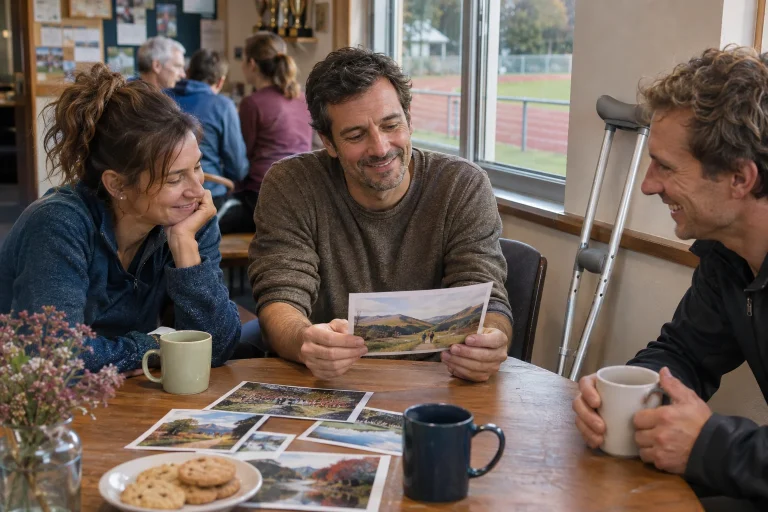
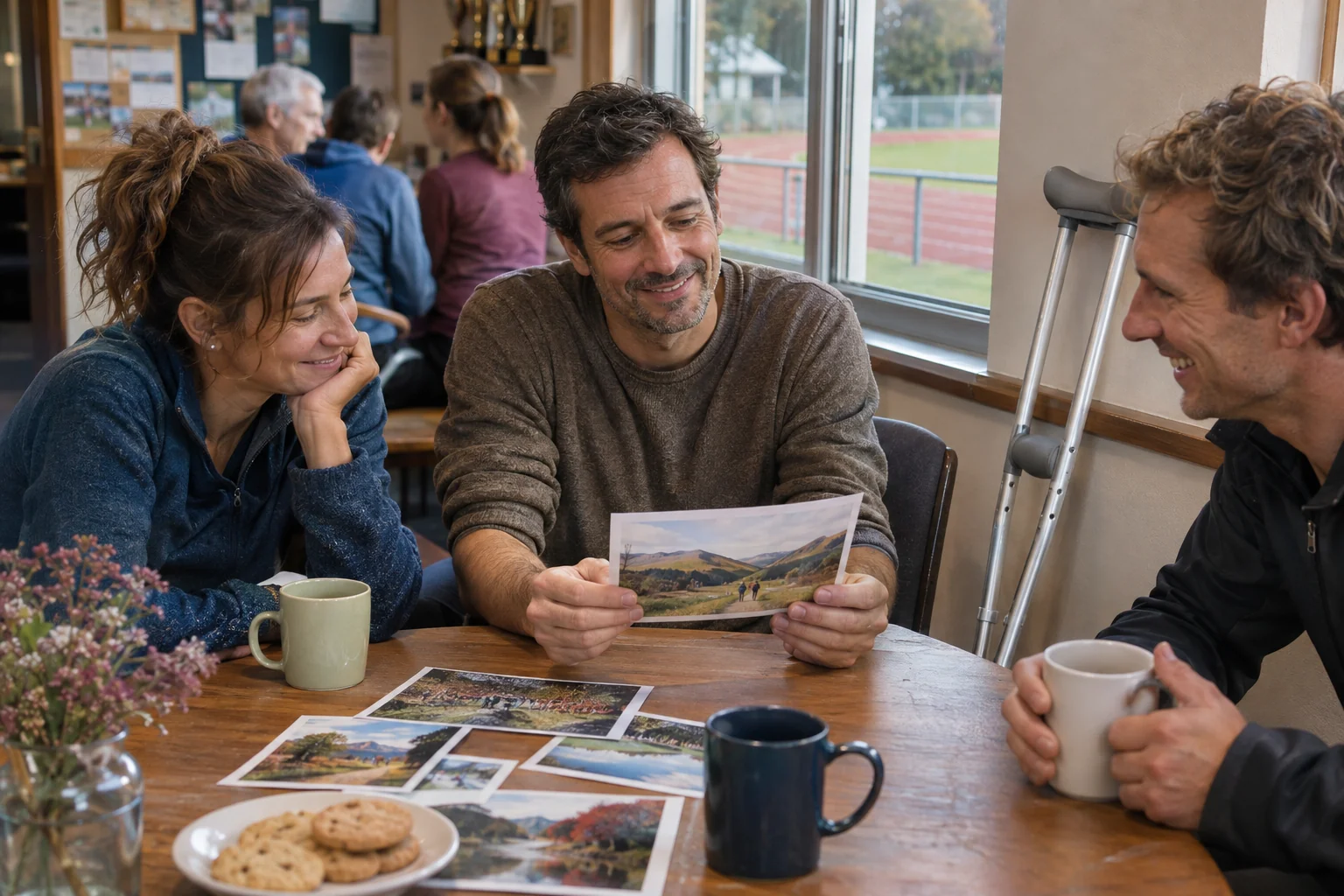
In a fictional example, a man who previously ran on trails is walking well around his home after a fall, but details of continuing sport are still being discussed. He first joins the group at an easily accessible meeting without running. This is not a failed return: social connection remains while unresolved activity questions do not have to be settled by experimenting at a community gathering.
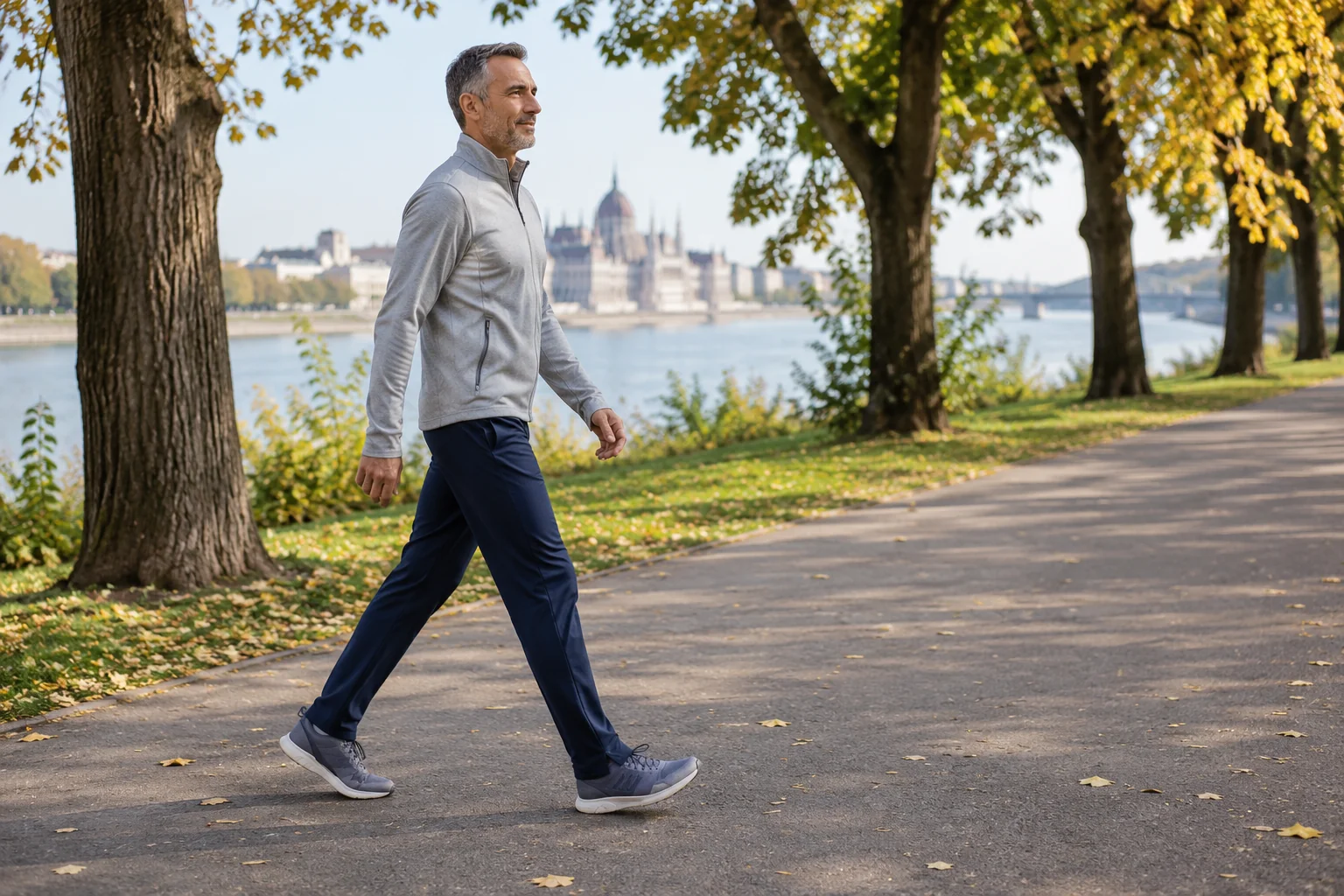
Later, activity can develop in line with his own individual plan. The example does not claim everyone should choose the same option or that good walking in a park already establishes readiness for trail running. It shows the value of an intermediate way to participate. A sporting community need not be accessible only through completing the full workout.
Improvement after a fall is therefore important, but involves several questions. The wound, injury, history and daily functioning each carry their own meaning. Keeping these separate can make decisions about continuing sport more precise, without organising the return around one visible sign or a run intended to prove readiness.
Sources
NICE NG249: details of a fall, assessment and individual prevention; NIAMS: injury assessment, pain and rehabilitation; NHS: falls and seeking urgent help; NHS: head injury and concussion. Checked: 21 November 2026. The return example is our own editorial illustration, not individual sports medical clearance or a protocol.
How Futószív articles are prepared: our editorial guidelines.