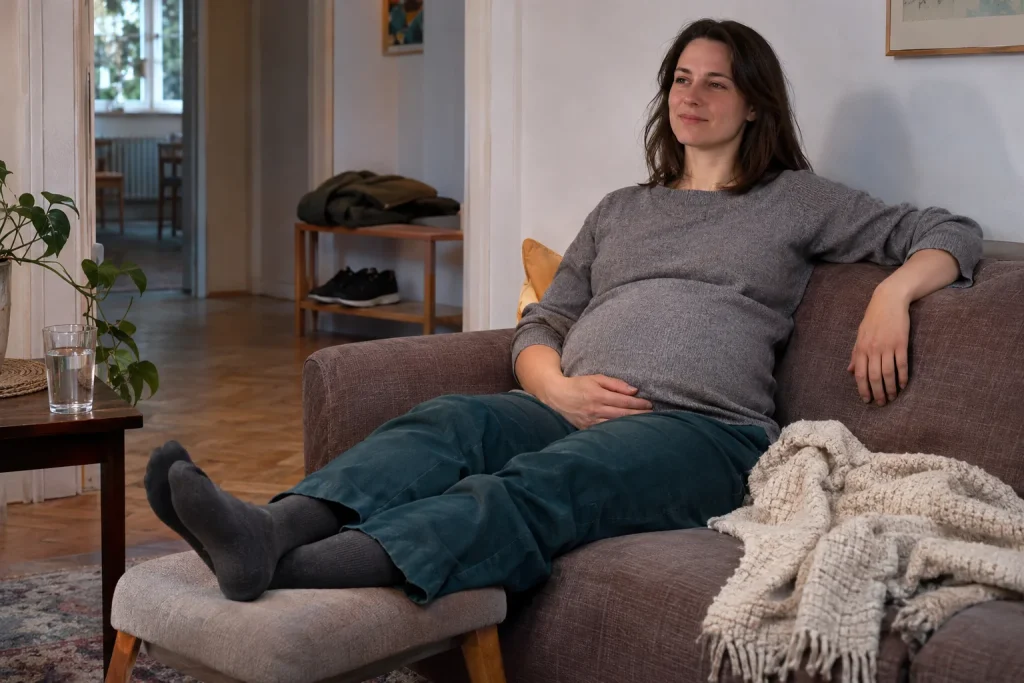
Your run is scheduled to start at six in the evening, but your day does not begin at six. You have got to work, dealt with tasks, travelled and perhaps cared for others too. During pregnancy, the same daily schedule may tire you differently from before. If you already want to rest before your planned activity, the question is not simply how to motivate yourself to set off. It is more about where recovery fits into the actual working day and what role your running goal has now.
Rest is not an accidental gap left at the end of the day. It can be a basic need around which other commitments must also adjust. Activity suited to you individually can still bring enjoyment, but there is no need to complete every session you previously planned. The following considerations help simplify the day; they do not turn tiredness into a calculation granting permission to train. With an unusual or worrying change, speaking to your maternity care professional matters more than changing the colours in your calendar.
Do not measure tiredness against your previous capacity for work
The NHS page on tiredness in pregnancy explains that tiredness is common, particularly in the early weeks, and the need for rest can change later too. The guidance makes room for rest, sleep and accepting help. The benchmark is not whether you used to finish this same working day with a run before pregnancy. Your current condition is not a copy of last month’s.
An old routine sometimes becomes an unnoticed requirement. If training after work used to be the fixed point you never missed, making a change may itself be difficult now. It is worth naming this separately: you miss not only the activity but also the familiar end to the day. Recognising that helps you avoid treating the evening decision purely as a question of willpower.
Tiredness does not require competition with others. A colleague’s day or another pregnant runner’s day can differ from yours even if it looks similar from outside. You do not have to prove you can fit in the same amount of work and sport. Your own experience and your care professional’s guidance can underpin the decision instead of measuring yourself against other people’s performance every day.
Map the fixed parts of the day before finding a new slot for running
In a simple description of your day, list the fixed points first: leaving home, work, travel, meals, maternity appointments and family tasks. Only then look at what is flexible. This is not a time-management competition in which every free minute has to be put to use. It may reveal precisely that an apparently free slot also needs to accommodate changing clothes, travelling, eating and slowing down.
The duration of a run and the time needed for the whole outing are not the same. Even a short session may involve getting there, preparation and showering. If the evening calendar counts only the minutes of movement, it can easily underestimate the entire commitment. You do not need to turn these into an energy cost or workload score; it is enough to see honestly how much time and organisation they require.
The answer is not always getting up earlier or going to bed later. If sport only fits at the expense of rest, it is worth reconsidering the plan. Perhaps another day, another form of activity or something shorter for now would be feasible, if it also fits your individual healthcare framework. A running goal does not oblige you to squeeze every other need of the day around it.
Create specific conditions for rest
‘Get more rest’ is well meant, but without practical change it can easily become another expectation. The question is what frees up real space. Can someone take over a shopping trip? Can an additional journey be avoided? Is there somewhere quiet for a short break? The NHS also mentions accepting help from family and at work; making this happen personally depends on specific tasks.
You do not have to keep looking for performance indicators while resting. It may involve sitting calmly, quiet time or relaxation that meets your own needs, taking healthcare guidance into account. It does not require a new device or a perfect home environment. Often what matters first is that, for a while, the next task genuinely is not assigned to you.
Reorganising household tasks should be shared if there is someone to share them with. Saying ‘I will try to get everything done faster’ is different from handing a task over in advance. The first approach assigns even more work to achieving rest. The second recognises that redistributing daily tasks is not solely the pregnant person’s organisational responsibility.
 Enlarge image
Build genuine options to shorten or miss a session into your running plan
The NHS page on exercise emphasises activity adapted to what is manageable and avoiding excessive exertion. General activity guidance does not have to be treated as a quota to be filled with running every week. Alongside individual health conditions, what is feasible on that particular day matters too. A plan is flexible when shortening or missing a session does not automatically trigger another session to make up for it.
You can agree with your coach or running companions beforehand that plans may change at present. You do not need to write a long explanation when you feel most tired. It may be enough to say that you are adapting activity to your pregnancy schedule and deciding according to how you feel that day and your individual guidance. A community helps when it does not turn sticking to the plan into a competition.
| Calendar item | Rigid interpretation | A more useful question |
|---|---|---|
| Evening run | It must happen regardless. | After the whole working day, does it fit your individual framework and your need for rest? |
| Shortening a session | An unfinished part that must be made up. | What is the feasible, agreed version of today’s session? |
| Missing a session | It increases the following day’s burden. | What should the next step in the plan be, without automatically doubling up? |
| Running goal | An unchanged deadline whatever the circumstances. | Which part still matters, and what needs to change now? |
You do not need to produce three separate training plans for every evening. Too many versions can create another decision-making burden. Instead, have a simple framework understood with your healthcare professional and, where necessary, your coach: what can change and which new symptoms or circumstances mean you need help. The process for deciding should be easier than the original task.
Movement can feel good, but it is not a universal treatment for tiredness
The NHS page on tiredness also mentions appropriate activity as a way to support wellbeing. This should not be interpreted as requiring you to set off on every tired day because activity will certainly resolve the feeling. Your individual condition, any symptoms and the framework agreed with your care professional still matter. Enjoyable movement is an option, not a universal replacement for rest or necessary assessment.
If at the end of the day you no longer want a run but would like some fresh air, you can name that need separately. An activity considered appropriate may differ from your previous session, but you do not have to automatically fill every missed run with a new activity. Choosing genuinely to rest that day can also be a fully valid decision. There is no need to complete a short bout of movement before you are allowed to rest.
Deciding to start and deciding to continue are not the same decision. If you begin moving but experience discomfort, overheating or feeling unwell, the NHS says to stop. The distance already covered or the equipment you prepared does not oblige you to finish. Respond to your current symptoms and individual guidance, rather than the time your watch says is left.
With unusual weakness, do more than put fewer tasks in the diary
The CDC guidance on maternal warning signs specifically mentions sudden, overwhelming tiredness and weakness that differs from usual tiredness and may make daily activities impossible. Seek medical help immediately for such a change. Knowing that tiredness is common in pregnancy is not a reason to place every new, severe symptom in the same category.
When asking for help, explain what has become unusual, when it started and whether there are other symptoms. Do not simply call it a ‘bad training day’. A change in how you feel matters even if you have not exercised that day. If it accompanies chest symptoms, significant difficulty breathing, fainting or another severe acute illness, you can call 112 for emergency help in Hungary.
If tiredness persistently disrupts your daily life or sleep, speak to your maternity care professional even if you do not experience it as an emergency. You do not need to work out the cause beforehand or start supplements or another treatment on your own initiative. You can describe the circumstances of your working day, but they do not replace a healthcare assessment.
Ask for specific help at work too
If you do not yet want to share the pregnancy widely, arranging adjustments may seem especially difficult. Consider which responsible or trusted person you can talk to about the arrangements you need. This article does not offer employment law advice; clarify the particular workplace procedure and how to implement individual healthcare recommendations with the appropriate professional.
Rather than saying generally ‘I cannot cope’, you can identify a specific obstacle: too many consecutive meetings, a task that is difficult to interrupt or tiring travel. This wording helps make the discussion about an achievable change rather than a judgement of your attitude. You do not need to share every medical detail to discuss how a task is organised.
If the agreed change does not work in practice, report back. A shorter day on paper may still involve just as much travelling, or another task may be assigned during the break. Sharing the real experience is not inconsistency. Adjustments help when they actually reduce the difficulty, rather than giving the same day a new name.
 Enlarge image
Three evening situations with different next steps
In the first situation, the day has simply become busier than planned. The pregnant runner experiences familiar, non-worrying tiredness and decides within the agreed individual framework to miss today’s run. This does not have to be treated as a punishment or a debt for tomorrow. The change in the calendar records reality, not a mistake.
In the second situation, the runner would like a short, appropriate spell outdoors after work, but the previous training session does not fit the evening. They simplify the outing according to their individual guidance and agree it with their companion in advance. The shorter session is neither a hidden replacement workout nor the equivalent of the missing kilometres, but an option chosen for the present circumstances.
In the third situation, much greater weakness than usual appears suddenly, perhaps with another new symptom. Here, the next task is not shortening the run but accessing medical help. The three situations are not separated by a tiredness score: the nature of the change, individual guidance and, where needed, professional assessment matter.
The goal can remain important without directing every day
Your running goal may be connected with much enjoyment, community experience or personal history. You do not need to devalue it in order to modify it now. You can say it still matters but needs to adapt to your pregnancy and actual daily schedule. A change does not necessarily mean giving it up permanently, and you do not need to define every detail of a later return today.
When planning next week, the useful questions may be where genuine help is available, where time remains for rest and within what individual framework activity can feature. The question is not how to squeeze the old amount of work, old running routine and new pregnancy needs into the same unchanged space. Sometimes the plan becomes smaller while the day becomes much easier to follow.
Making room for rest involves specific decisions: handing over a task, shortening a commitment, reporting a symptom or asking for a discussion. These are less visible than a completed session, yet they can matter. Running can remain a supportive part of this period if it does not automatically take away the time and attention your body and everyday life now need.
Sources
- NHS: tiredness, rest and sleep problems in pregnancy
- NHS: activity adapted to what is manageable and stopping when unwell
- CDC: unusual weakness and urgent maternal warning signs
How Futószív articles are prepared: our editorial guidelines.