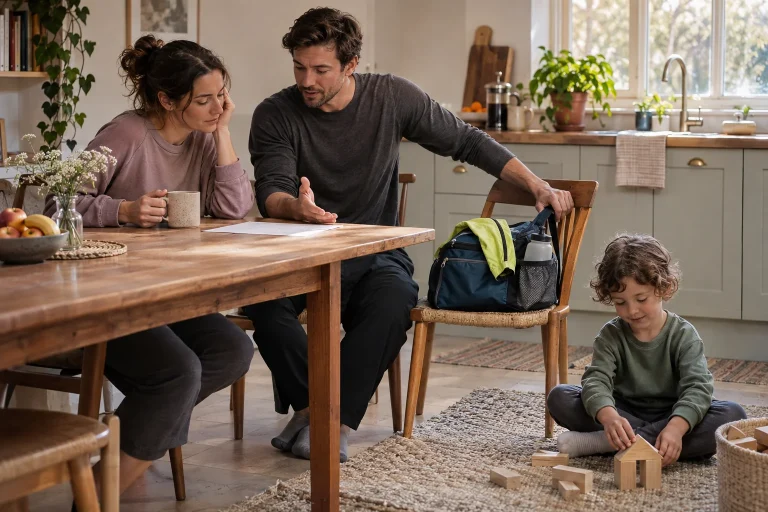
Your running diary shows a blank day, yet you spent the morning at the playground with your grandchild, carried the bags upstairs, bent down several times to look for toys and barely had a quiet break after lunch. Not starting a sports watch does not mean you spent the day motionless. Looking after grandchildren forms part of your whole day, and it is worth accounting for these activities alongside your own running plan.
This does not mean childcare has to be called training, or that every occasion spent together should be interpreted as a physical burden. Time together can be enjoyable, active and important. Yet alongside the value of that connection, your own time, rest and limits on movement are real too. A workable plan makes both visible.
The whole day involves more than the run in your diary
The WHO fact sheet on physical activity includes everyday movement, transport and household activities within physical activity. Deliberate exercise is not the only thing that counts. However, this does not mean every task has the same effect, or that time spent caring automatically meets all your personal activity goals.
Walking with a pushchair, reading a story while sitting on a bench, climbing stairs and briefly picking up a child are different activities. Naming them helps you understand the day. ‘I looked after them for five hours’ is important family information, but on its own it does not tell you how much movement, waiting, carrying or interruption it involved. The same amount of time can unfold very differently on two separate days.
Your running plan therefore does not need a precise conversion formula. There is no universally applicable rule equating an hour of childcare to a certain number of kilometres. The relevant questions are which tasks the day involved, how you feel, whether genuine time remains for your own plans and whether this fits your personal framework for activity.
What makes a caring day unpredictable?
The start and finish of a run can usually be planned in advance. A morning with a young child can change more easily: a nap does not happen, you need a different route, waiting takes longer or you have to find a new solution on the way home. Alongside movement, interruptions and continuous attention are features of the day. Not every task is difficult, but you do not necessarily choose their order.
In Vermote and colleagues’ original qualitative study from 2023, focus group discussions involved 37 Flemish grandparents: nine grandfathers and 28 grandmothers. Participants looked after grandchildren aged between zero and five. Their accounts described how their own condition, responsibility, the child’s characteristics, family cooperation and the weather all played a part in their activity.
This research did not measure how much running can safely fit into a grandparent’s day, and it offers no workload ratio applicable to everyone. It helps explain why a single label such as ‘active grandmother’ or ‘grandfather who sits a lot’ is an inaccurate description of the whole situation. Specific details of the caring environment matter more than a presumed uniform daily capacity based on age.
Do not let lifting remain an unnoticed background task
It is worth thinking ahead about the situations in which you usually lift or carry. Picking a toy up from the floor, bringing a bag home, moving a pushchair on stairs and picking up a child are different tasks. The child may move, hold on or change their mind in the process. This is why treating the task simply as the equivalent of an exercise with a dumbbell is not a good idea.
Your own restrictions and capabilities should be part of the family agreement. If you cannot manage a particular lift appropriately, you do not have to keep taking it on as a test of what you can do. You can discuss who carries the heavier bag, where the handover takes place and which locations avoid carrying a pushchair on stairs. Organisation can prevent many situations that could otherwise only be dealt with in a rush afterwards.
New or persistent pain, weakness or numbness accompanying difficulty with lifting is not a signal that family duty can override. If your own condition makes the task uncertain, individual professional advice may be needed. This article provides neither a lifting technique nor a weight limit: support informed by the environment and individual situation is worth more than a universal recipe for movement.
 Enlarge image
Handover time is not always the start of your run
It is easy to put childcare ending at four and a run starting at quarter past four next to each other in the calendar. In reality, a handover takes time too: you explain what happened, gather belongings, get home, eat or change. If you leave these out, the run can become a rushed task before it even begins.
Thinking in terms of a time window may work better, alongside clarifying in advance what happens if someone is late. You do not need a complicated contingency plan for every occasion, but a system of ‘it will fit in somehow’ can easily work at the expense of your own plans. The value of family support does not depend on your commitment being limitless. A stated start and finish give everyone involved a clearer framework.
If another adult takes over care of the child, the transfer of responsibility also needs to be clear. Time for running should not come from continuing to keep half an eye on the situation. Your own sporting activity can be planned when you are genuinely free to leave, rather than supervision having ended only in name. This is an organisational matter, not a measure of selfishness.
Shared activity should not become a hidden training task
Walking together, exploring the park or playing can be enjoyable, but your grandchild is not a tool for your running plan. Their own pace, interests, need for rest and supervision requirements need separate consideration. A walk full of stops is not a failed running session: it is time together with a different purpose. There is no need to speed up or extend it afterwards just to make it look better in your training diary.
When choosing somewhere to go together, the whole journey matters. Is there an appropriate, accessible place to rest, a toilet and a simple way home, and how much do you need to carry? On a particular day, a nearer park that is easier to use may be a better choice than a more impressive but complicated outing. Distance and step count do not alone determine the value of the activity.
If you have your own restrictions on movement, these need to be respected during shared activities too. You do not have to agree to running games of chase to be actively involved. There may be another activity you can share, another adult to involve or a setting where appropriate supervision is easier. The child’s safety and your own boundaries both deserve to be taken seriously.
Keep observations brief and useful
There is no need to record every movement involved in caring. However, noting a recurring difficulty can help with organisation. For example, you ended the journey home with too many bags; the handover regularly overran; there was no chance to eat calmly; or there were far more stairs than the afternoon plan had allowed for. These are details you can change specifically.
| Detail of the day | What does it tell you? |
|---|---|
| There was more carrying and stair climbing than planned. | A different handover, packing arrangement or help may be needed next time. |
| No free time remained between the handover and the run. | The running time window conflicts with the family commitment. |
| A new, recurring symptom appeared. | You can give a more precise account of events when seeking appropriate individual professional advice. |
The table is not a workload scale. There is no total from its rows that automatically tells you how many minutes you can run today. The notes help make a changeable circumstance visible in place of ‘somehow I always end up tired’. If something is a symptom rather than an organisational issue, it can be addressed in its proper context.
Do not judge a caring day by the absence of a run
If the evening run does not happen, it does not follow that the day was inactive or worthless. Your family role and your sporting goal can both matter. Difficulty arises when one makes the other entirely invisible: all caring tasks are treated as a natural background, while running is viewed solely as a matter of personal willpower.
Decisions about the day’s schedule can take account of the time actually left, your own experience, the individual framework prescribed for you and the following day’s plans. A missed run does not have to be moved automatically to the next day alongside another busy schedule. A change is useful when it has room within the whole week, rather than simply filling an empty training diary entry.
It also matters that your own activity does not always come last. If time for it only appears by chance over the longer term, it is worth discussing how family arrangements work. A protected time slot, taking turns with supervision or a less frequent but more clearly defined commitment may help. The solution is personal; stating the need gives it more chance than constantly adapting at the last minute.
 Enlarge image
What a family day agreed in advance might look like
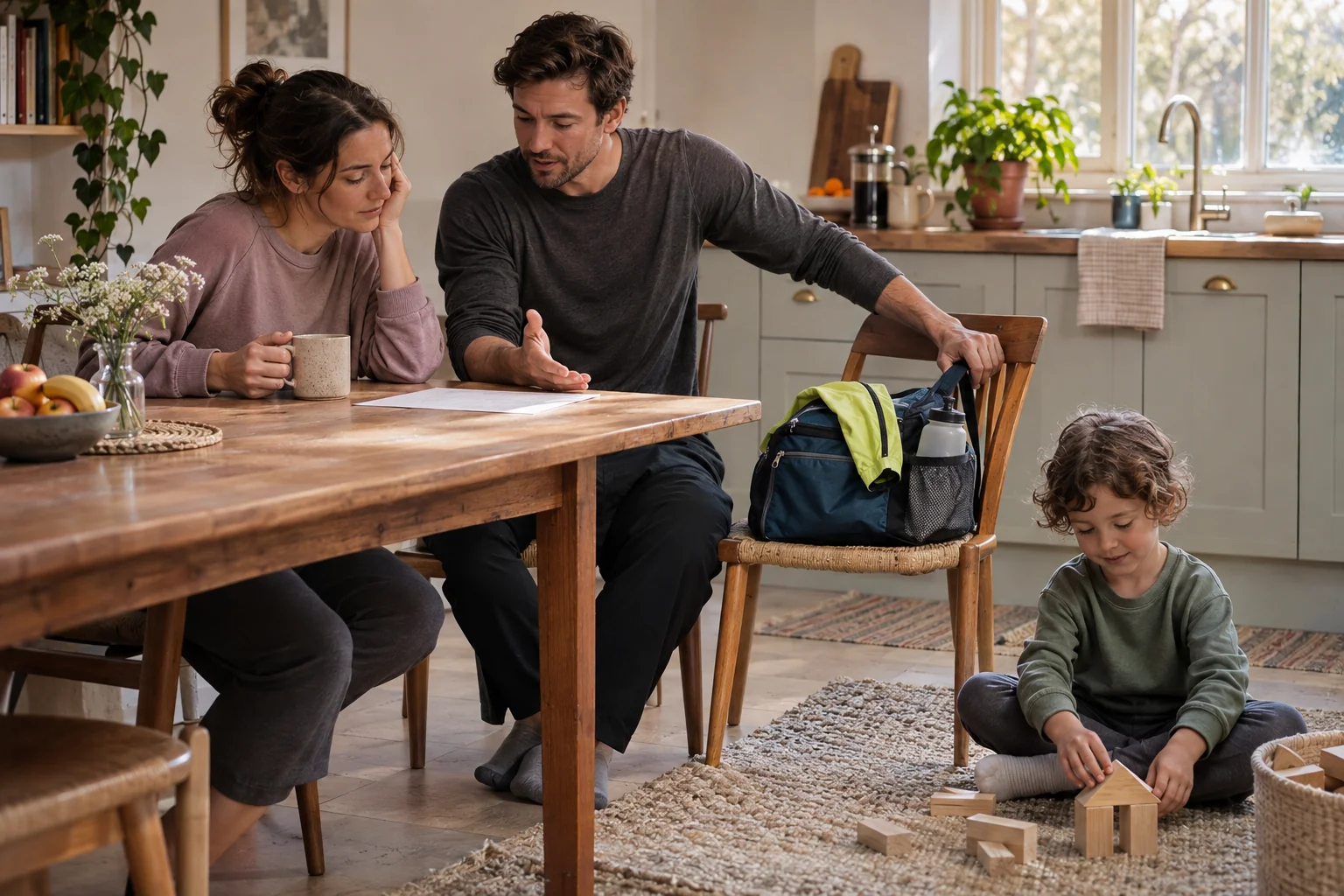
In a fictional example, a grandfather looks after his grandchild in the morning. They agree beforehand to meet at an entrance where there is no need to carry the pushchair on stairs, and the parent keeps the heavier bag. Their shared activity is a nearby park with clear sightlines. After getting home, separate time is allowed for the handover, and the grandfather’s own afternoon plans only begin afterwards.
The example does not mean running is appropriate after every such day. The point is that tasks are visible and can be shared. If the morning changes unexpectedly, the evening plan can be reconsidered without anyone feeling at fault. The family agreement already makes room for the real day to differ from the one on paper.
The NICE recommendation on personal goals and burdens recognises family participation and important daily activities as meaningful goals for people with multiple chronic conditions. This does not prescribe a duty to be a grandparent. Rather, it helps connect healthcare and activity plans to the life you consider important, taking account of your own limits and choices.
One specific change may be enough for next time
You do not need to reorganise the whole family system in one conversation. You can start with the detail that regularly causes difficulty: the bags, a late handover, the location or the fact that time for your own plans has not been stated. A specific request is more workable than the general statement that everyone should be mindful of your workload.
You can also raise changes in your own condition again. Something that used to be easy does not become compulsory because you once agreed to it. Equally, a task that has become easier does not have to remain avoided out of fear: the framework can change through professional and family discussions suited to your individual situation. Flexibility does not mean adaptation on only one side.
Your running diary can then sit alongside your real day. You do not have to rewrite caring as a sporting achievement, nor make your sporting goal invisible because of your family role. Understanding carrying, movement, rest and responsibility together helps you plan a week in which time together and your own needs can both be taken seriously.
Sources
WHO: everyday forms of physical activity; Vermote and colleagues: factors affecting physical activity in grandparents looking after grandchildren, original qualitative research, 2023; NICE NG56: personal goals and daily burdens with multiple chronic conditions. Checked: 21 November 2026. The family day described is a fictional editorial example, not an individual prescription for workload or lifting.
How Futószív articles are prepared: our editorial guidelines.