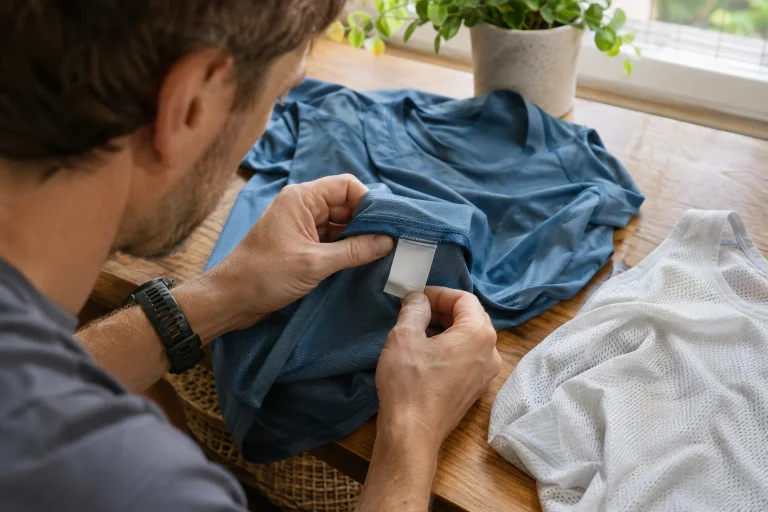
“Sweat-wicking” and “quick-drying” often appear on the same running shirt, yet they do not answer the same question. One directs attention to how liquid moisture moves within the fabric; the other concerns how water leaves it. A wet patch spreading does not automatically mean the water has already evaporated. Both processes can be useful together, but their names and associated data are worth reading separately.
As a runner, you do not need to maintain a textile laboratory to ask better questions about clothing. It is enough to distinguish a reported material-test result, your own impression while wearing it and the everyday task of drying it after washing. This guide offers a conceptual map, an example of reading specifications and points for your own notes. The examples produce neither a brand ranking nor a personal drying time valid for every run.
Liquid water can move while remaining in the fabric
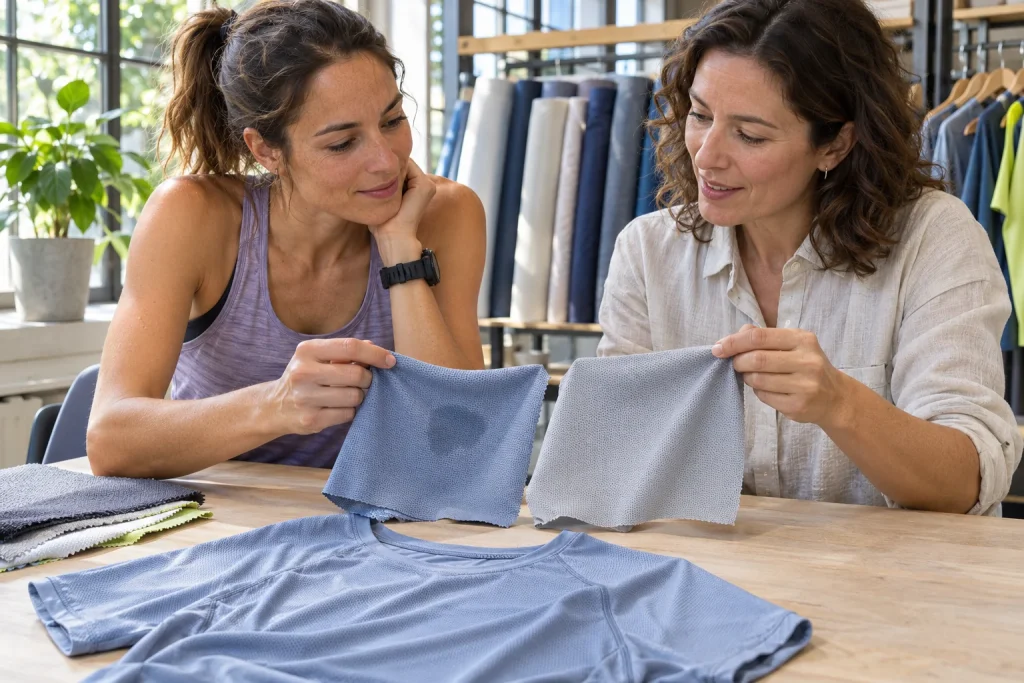
Movement of liquid moisture within textiles involves relationships between fibres, yarns and fabric structure. The term capillary spreading helps distinguish this liquid movement from evaporation. As a simple conceptual example, imagine moisture initially appearing over a small area and later becoming visible over a larger surface. A changing patch shape can inform you about liquid distribution, not by itself the amount of water that has left the textile.
The public description of AATCC TM195 identifies measurement and evaluation of textiles’ liquid moisture properties. It also considers structure and the moisture-movement characteristics of fibres and yarns. This provides a useful starting point for interpreting the label: such a test reference concerns liquid handling. If a specification gives this method, do not automatically read it as a promise of drying within a specified number of minutes.
Interpret the size of a patch on your own clothing within this distinction too. A larger visible area does not necessarily mean more sweat was produced; a smaller patch does not prove that your skin stayed drier. More information about water quantity and location would be needed. Describe the observation at its own level: where, when and in what condition you saw moisture, rather than immediately constructing a comprehensive clothing ranking.
Drying is the separate question of water leaving
Drying examines how water remaining in a textile changes under specified conditions. The AATCC TM201 summary, for example, mentions a prescribed water quantity and material in contact with a heated plate. This shows that conditions belong with the adjective “quick”. The test gives the fabric a defined task; the method name alone does not describe the complete actual situation of wearing your running clothes.
Drying time and drying rate should not be merged when reading a product description either. Check exactly which quantity is reported, what it is compared with and which method is named. If “quick-drying” appears without further data, you can read it as a qualitative product claim, not a detailed measurement report. The garment may still work well for you, but your next question differs from comparing two numbers reported using the same method.
Where the comparison ends also matters. Data for two fabric samples do not automatically include a whole shirt’s hems, thicker areas, layering and fit on you. In your drying routine, a fold or contact with another garment also changes the arrangement. Precise reading does not mean rejecting laboratory data, but using them for the question they actually address.
 Enlarge image
Three columns for reading labels: what moves, what is measured and where?
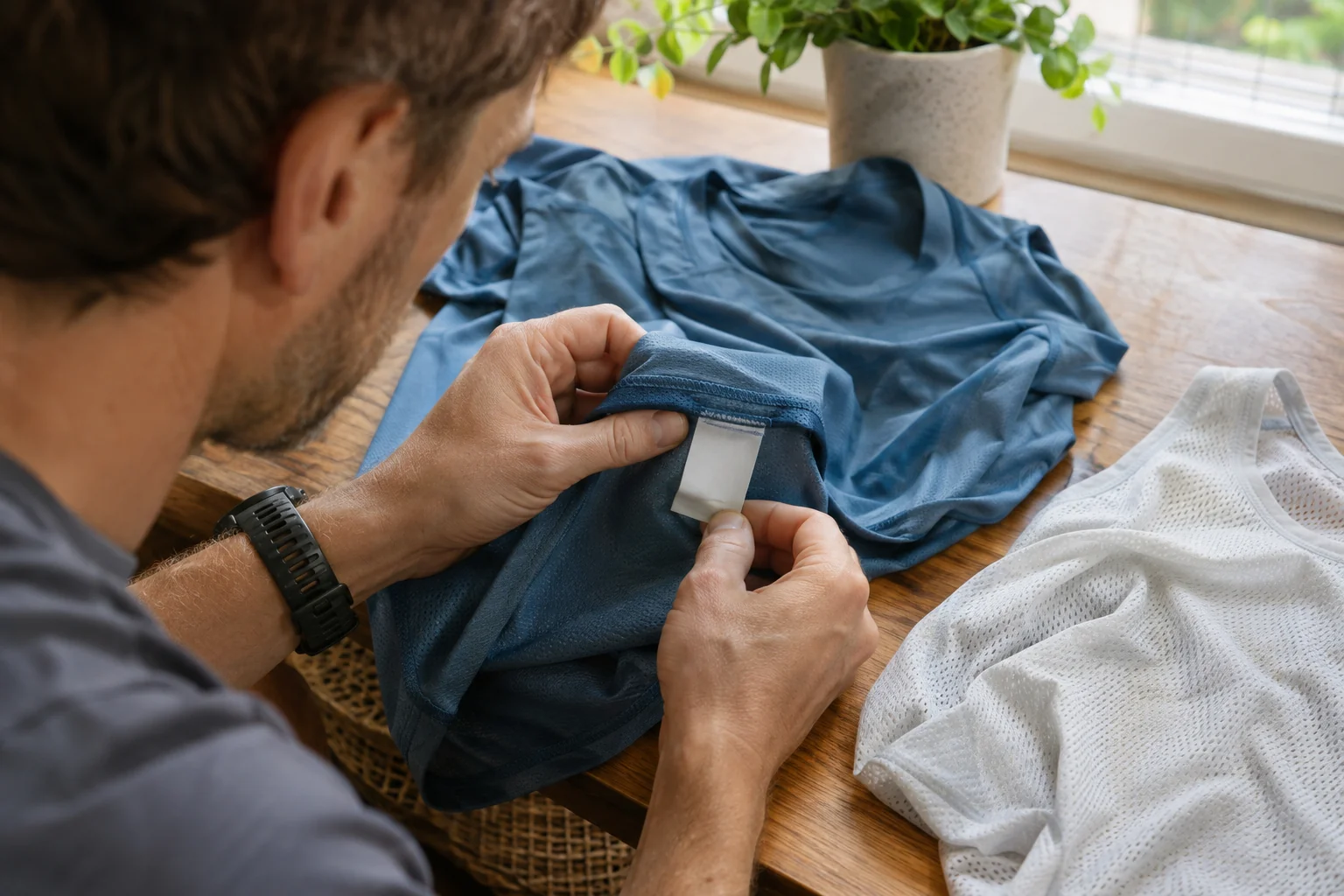
A specification becomes easier to interpret when arranged into three short columns. In the first, write the phenomenon examined: liquid moisture movement, drying or passage of water vapour. In the second, put the result and unit provided. In the third, record the test name and conditions to the extent the manufacturer actually supplies them. A missing field should remain missing, rather than being filled with data from another product you know.
The AATCC method list also illustrates the distinction: procedures concerning liquid moisture, drying and water vapour transmission appear separately. The three labels are therefore not three names for one shared score. If one shirt reports a moisture-management result and another a drying result from a different method, these are not data from the same event. Their shared marketing context does not make them directly interchangeable.
An original buying question might be: “Which test and comparison support the quick-drying claim?” Or: “Does the reported moisture-management result concern liquid water movement or vapour passage?” These are targeted, answerable questions. You do not need to accumulate technical abbreviations; the aim is to know which part of your own choice the information about the product addresses.
Fabric worn on the body is in a different situation from a free sample
The 2025 study Drying Performance of Fabrics on the Human Body examined different drying arrangements. It compared two-sided and one-sided drying, contact with a warm surface and stretched samples. One key message is that the arrangement contributes to the observed result. It is therefore unwise to read a free sample’s drying data as the automatic behaviour of a complete garment worn against the skin.
This was laboratory material research, not a training trial of your shirt. We do not convert its sample results into personal drying minutes or claim that all close-fitting garments behave identically. The study provides useful background for treating contact and material condition as important questions. If a manufacturer’s test arrangement is unclear, ask about precisely that before drawing a conclusion.
Give your own wear impression a separate place in the notes. What did you feel on your back, chest or beneath a vest, and when did you inspect the clothing? A complete running outfit contains more surfaces and layers than one sample. Separate observation is not less than laboratory data; it is different in nature, concerning your own use. Keeping both alongside each other avoids unjustified promises from one to the other.
Did the comparison start with the same amount of water?
The starting condition is fundamental when interpreting a drying claim. If two garments begin with different amounts of water, the time needed for complete disappearance alone says little about one property of the materials. One may already have been drier, wrung differently or wet in another area. Tests specifying a method define conditions precisely so the result belongs to a task that can be interpreted.
At home after washing, comparing unequal situations is easy. One shirt had more room, another hung folded and the environment changed meanwhile. This experience can inform your own drying habits, but should not become a controlled material test. Recording that a shirt became wearable by morning in yesterday’s arrangement is specific and honest. Identifying the absolutely fastest fabric would need different evidence.
Everyday decisions often do not need a complete ranking anyway. If you want to manage between an evening wash and a morning departure, your own recurring arrangement is the relevant question. Consider care according to the label and the actual storage location. You then frame the task precisely: does this garment fit my routine? That differs from its drying rate in a measuring instrument.
You are trying the whole garment, not just fibre content
Fibre composition is important product information, but do not equate the two labels with the name of one material. AATCC’s liquid moisture description also mentions textile structure together with fibre and yarn properties. “Polyester” or “blended fibres” cannot therefore reveal every moisture-management result. Garment design and actual reported test data add information to composition.
When trying clothing on, examine comfortable cut, position during movement and interaction with your layers. This matters even with a detailed specification. A familiar feature label does not answer whether a seam bothers you or the garment stays in the right place under a vest. Put everyday fit alongside moisture management. You do not need to reduce every decision to one material metric to choose knowledgeably.
When comparing two similar tops, first name your primary task. Do you want comfort for short summer runs, easy-care clothing for a multi-day trip or better cooperation with an existing layer? The three goals may emphasise different questions. Quick drying may be useful for one, but is not an automatic answer to all the others. Connecting information to a task reduces the temptation simply to collect features.
 Enlarge image
A personal clothing diary: feeling and condition on separate lines
A short clothing entry can give the feeling and the condition seen later separate lines. The first might say that the area beneath the vest felt wetter; the second records where you actually saw moisture on arriving home. These are not necessarily identical descriptions, and neither alone measures water quantity. Separating them helps you observe the same clothing situation more specifically next time.
A few details of context are enough: which top, which additional layer, whether there was a vest and when you noticed the phenomenon. You need not turn every run into a clothing experiment. If weather, route and movement differed, you cannot confidently attribute the difference to one label on the shirt. A note can remain a description of the situation, gradually accumulating personal experience without a forced scientific conclusion.
Keep the diary’s next step small and specific. You may simply want to wear the vest in another arrangement or ask the manufacturer about testing behind a feature claim. At other times, you may find the garment entirely appropriate for your task, with nothing further to do. The note is not intended to make you seek a new product after every run, but to separate a genuinely recurring question from a passing impression.
An everyday decision example: two benefits, two questions
Imagine two tops whose specifications emphasise different things. One reports a result for liquid moisture movement; the other reports drying under a named method. Do not automatically assign first and second place. Write down the stated claim, then add your own task. If morning departure after frequent washing matters, think about the drying routine too; if wearing comfort matters, a complete fitting is important.
More precise questions make a more useful comparison. You can request further method information, try the garment with your own layer or write a short observation about a top you already have. These are different information sources, so name them separately. If less data are available for one product, retain that uncertainty. You do not need invented percentages to fill it in while still making a decision for your own purpose.
The distinction between the labels ultimately becomes a simple pair of questions: how is liquid moisture distributed, and under which conditions does water leave? Your shirt’s value is complemented by comfortable personal use and care. Feature names then organise specific information instead of merging into one material promise that solves everything. Both buying questions and use of existing clothes can become more deliberate.
Primary sources and the original examples
For the concepts, we used the public description of AATCC TM195; for drying, the AATCC TM201 summary; and for separate testing areas, the official AATCC method list. The role of the arrangement is shown in the 2025 study Drying Performance of Fabrics on the Human Body. Checked: 21 November 2026. We do not claim to have carried out the full paid methods; the diary and buying examples are our own editorial explanations, with no original product measurement results reported.
How Futószív articles are prepared: our editorial guidelines.