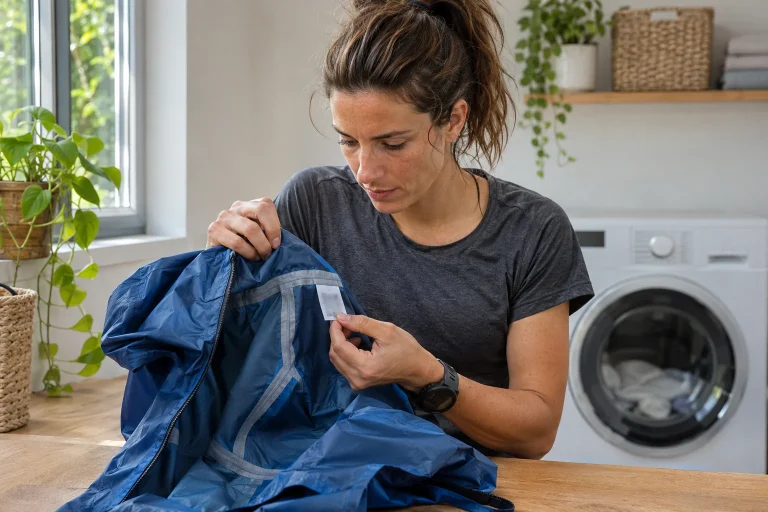
The jacket sleeve is wet inside, but no damage is visible in the fabric. You first feel water at the neck while the chest seems dry. The patch’s location is important information, but its cause remains an open question. Alongside water passing through a membrane, distinguish entry around openings, overlapping clothing layers, moisture from inside and the garment’s care condition. Precise observation helps you choose an appropriate next step.
Cuffs and the neck area are transitions between closed fabric and necessary openings. Hands, the head and movement need space, so a jacket is not a continuous sealed shell in every direction. The guide below shows calm checks of these details. It neither automatically blames the user nor rules out a material or construction fault. The aim is to describe what you see more precisely instead of starting random repairs from an unknown cause.
Name the patch first, then the cause
“My sleeve leaked” can cover several experiences. The outer fabric, inner jacket surface, cuff of the top underneath or back of your hand may be wet. Record separately which you observed and, where possible, which stayed dry. Naming layers is not splitting hairs: an outer surface wetting through raises a different checking question from a clearly defined patch repeatedly appearing inside.
Gore’s manufacturer information also distinguishes saturation of the outer fabric from actual water penetration through the garment. External wetness can feel unpleasant without itself proving a membrane leak. This distinction does not mean every instance of internal dampness is a harmless surface phenomenon. Do not replace your own observation in advance with one explanation: retain precisely where and in what condition you found it.
A short layer-by-layer account can help: “The outside edge of the left sleeve is wet, as is the base-layer cuff; I noticed no patch at the elbow.” Write only what you actually saw or felt. If you can no longer distinguish the layers afterwards, note that too. Naming uncertainty precisely provides a better basis for an enquiry than describing as certain a water route that was never established.
Water entering through an opening can bypass the fabric
Water entering an open part of a garment need not pass through its membrane. This is a simple structural distinction: continuous fabric provides one route, while the point where the jacket ends or opens provides another. A material waterproofness test does not answer how the cuff and glove sat on you. Alongside material data, garment opening design and the particular situation of use are therefore important observations.
A manufacturer example is the description of one of Montane’s Phase jackets, which separately names design around edges and openings when discussing reduced water entry. We do not generalise this to every jacket or recommend the model for running solely from a feature name. The example shows that managing openings is a distinct part of garment design. Learn about that detail on your own garment from its corresponding description.
When dry, inspect how the sleeve ends, its adjustment and where the cuff of your inner top sits. At the neck, similarly observe the collar, zip and hood meeting points. You do not need to pour water into clothing to learn these contact points. First map the known components and openings; you can then connect the actual problem to a much more specific location.
 Enlarge image
Cuff and glove: try the meeting point of the two edges
The glove and jacket sleeve end together form the wrist area of your outfit. Glove material, cuff length and jacket cuff can differ, so do not assume one correct order for every piece of kit. Check both manufacturers’ use recommendations if provided, then try your own items while standing. What matters is knowing where they meet and how well they remain arranged during natural hand movements.
Open and close your hand a few times, bend your elbow comfortably, then look at the sleeve end again. Does the base-layer edge emerge, does the jacket ride up or does a previously unnoticed crease form? Adjust for comfortable use. The aim is not to seal the wrist as tightly as possible, but to understand the combination and find a comfortable setting consistent with intended use.
Arm position can change the relationship between edges too. Materials may sit differently with your arm by your side than when checking your watch or retrieving something. Observe this separately in a dry, calm place. Such a trial does not predict the route of every raindrop, but helps you recognise where each edge remains after your own movement. You can include that detail in a later account of use.
The collar, hood and base layer are separate parts
For dampness around the neck, first establish the positions of the hood and front zip. Was it fully closed, partly open or adjusted during the outing? The state described matters more than what you retrospectively think was correct. A hat, neck scarf or top touching the collar presents its own fabric surface, so name these too. Contact between layers is part of the particular clothing system.
Try natural head turns and a gentle downward glance in the combination you usually wear. Observe whether comfortable space remains around the chin and whether an edge shifts. If adjusting the hood changes how the collar meets the neck, notice that too. You do not need to tighten everything further: closure, looking around and comfortable movement all belong to use together.
The inner condition of a high collar may deserve particular care attention. Montane mentions accumulated sweat and substances from skin as possible factors in collar-area problems, recommends cleaning according to instructions and asks for further contact if the problem persists. We do not apply this as a diagnosis to your jacket. It is a reminder to check neck fit and care condition separately in the particular model’s guidance.
Internal dampness does not always have a single source
On a rainy run, external water and moisture generated inside during activity can be present simultaneously. This makes observation harder, not pointless. A wet sensation alone cannot establish which route dominated at a particular point. Do not therefore clear or condemn the entire jacket on one assumed cause after a single run. First distinguish the details you can actually check.
Separate notes about the outer fabric’s water repellency, the patch inside and the base layer are more useful than one dampness score for the whole garment. Add the kind of activity, opening positions and where you first noticed the phenomenon. You do not need to fill in estimated numbers for sweat volume or rainfall intensity. If you did not measure something, an everyday description can be more precise than an invented value.
A recurring, clearly localised patch may be a question worth taking to the manufacturer or service centre. Repeated observation still does not prove a fault in a particular layer, but provides useful history. Explain the location and combination in which it appeared. Do not alter the garment to remove an assumed cause until you have clarified the necessary checking step through appropriate instructions or a professional contact.
A calm trial: one change at a time
For your first checks, start with a dry jacket, gloves, hat and top in a known condition. Moisture present when dressing then cannot be confused with something noticed later. Put together your usual outfit first and inspect the openings. Then change one thing, such as the jacket cuff adjustment, and repeat the same comfortable hand and arm movement.
Changing gloves, top, jacket size and zip position together makes the reason for a better impression hard to distinguish. Multiple changes are not forbidden; adjust the conclusion to fit: you have experience of a different complete combination. When you want to understand one particular edge’s behaviour, a step-by-step trial is easier to follow. Your notes can later show what you noticed after each change.
Do not use high-pressure water, press wet objects against the fabric or start experimenting with adhesive or chemicals in the name of fault-finding. Such intervention may create a different load or state from the one experienced on the run. Learning openings and edges at home is not a warranty waterproofness assessment. If the jacket needs actual testing, request the procedure and contact route specified for the model.
 Enlarge image
Identify the exact model before care or repairs
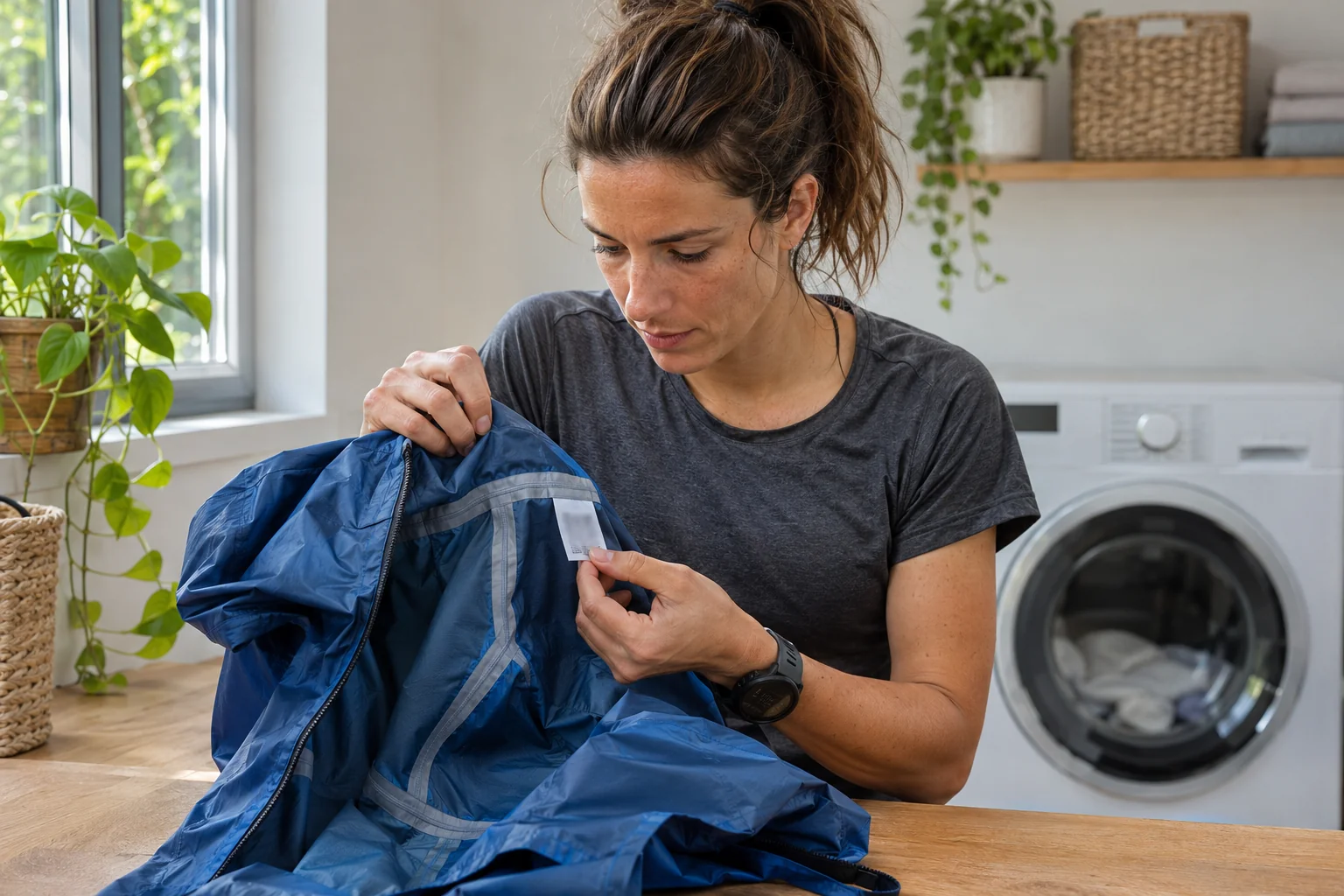
The jacket’s model name, inner label and manufacturer description together help select a care procedure. Do not automatically copy washing or heat-treatment advice read for another membrane garment. Different constructions may need different treatment, and the particular label matters too. If you are still investigating a wet patch, record the state before care; this retains the sequence of steps for a later enquiry.
Caring for a water-repellent surface and repairing an assumed structural fault are different tasks. Cleaning to manufacturer instructions may be important, but does not promise to solve every neck or cuff problem. Equally, an external patch does not automatically call for home sealing. First name the property or component about which you need help. This can prevent a question of interpretation becoming unnecessary intervention.
If requesting repair or a warranty assessment, follow the current retailer and manufacturer process. This article establishes no individual entitlement or fault. Your task is a factual description: exact model, affected location, conditions of use, care history and observed change. Orderly information helps beyond complaints; it is useful even when the answer is a simple adjustment or model-specific care step.
A short problem description that preserves real information
You can use this structure for an enquiry: “I ran in this jacket with these gloves and this top. The cuff was set like this, and I first noticed the problem here. On this layer I saw this; the attached image shows outer and inner faces separately. I have carried out these care steps. Which check do you recommend next?” The example does not suggest the answer or state as certain a cause not yet identified.
For a neck-area problem, give hood, collar, hat and zip positions instead of the glove arrangement. If you cannot remember a detail, do not fill it with guesswork. “I do not know when I opened it during the run” can be part of accurate history too. You can watch for that in later safe observation. A good problem description is not a perfect story, but verifiable facts with clearly stated uncertainties.
Examining moisture around cuffs and neck can thus create a useful clothing routine: you know the edges, your layers and comfortable settings, observe condition separately and know when to request help. The patch’s location becomes a specific starting point rather than an automatic verdict on the membrane. This attentive approach does not minimise a real fault, while also making room for openings and the situation of use.
Sources and verification date
To interpret external moisture and water repellency, we used the Gore manufacturer questions-and-answers page; for an example of separate opening design, the official Montane Phase description; and for collar care, the Montane waterproof-clothing care guide. Checked: 21 November 2026. The trials and enquiry template are our own editorial suggestions; we report no test findings about a particular jacket’s fault or warranty status.
How Futószív articles are prepared: our editorial guidelines.