Waterproof fabric does not automatically make every detail of a running jacket watertight. A garment assembled from pattern pieces may contain seams, a zip, openings and several joins. Where continuous material is stitched or interrupted, the complete construction needs a separate solution. Seam sealing may therefore be a more important question than how prominently the description highlights the membrane alone.
This guide explains finished-garment joins and helps you ask precise questions during fitting or when a problem arises. It provides no universal home-gluing recipe. Understanding construction lets you interpret material properties, seam design and the particular garment’s condition separately.
Stitching creates a mechanical join, and the needle passes through the fabric
A seam joins garment sections, but needle stitches create tiny holes through the material. Helly Hansen’s manufacturer construction information therefore separately discusses sealing the stitch line against water. Testing waterproof material and testing the finished sewn garment concern different objects: the join introduces a detail not present in the same way on an intact fabric sample.
This does not mean sewn garments must necessarily leak. It means designing the construction must also address water protection at seams. This solution contributes to the finished jacket’s function alongside its material. Read “Made from a waterproof membrane” together with the finished garment’s detailed description.
A practical question is: what does the manufacturer state about sealing this model’s seams? The answer should not come from another similarly named jacket. Cut, material variant and assembly belong to the particular product. A finished-garment claim helps more than repeating general information about the base material.
Seam tape is a separate protective element at the join
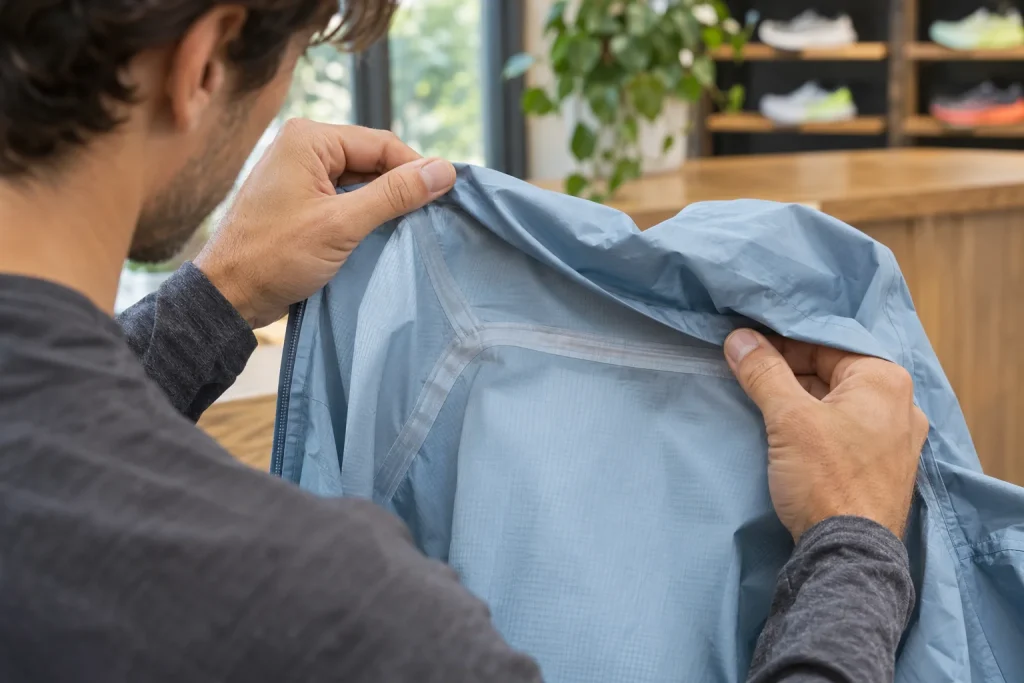
Tape used to seal seams against water may cover the stitch line inside. The manufacturing solution depends on an appropriate bond between tape and fabric, not merely an arbitrary strip of adhesive. Gore’s own product-system explanation separately names seam tape and finished-garment construction alongside laminated materials.
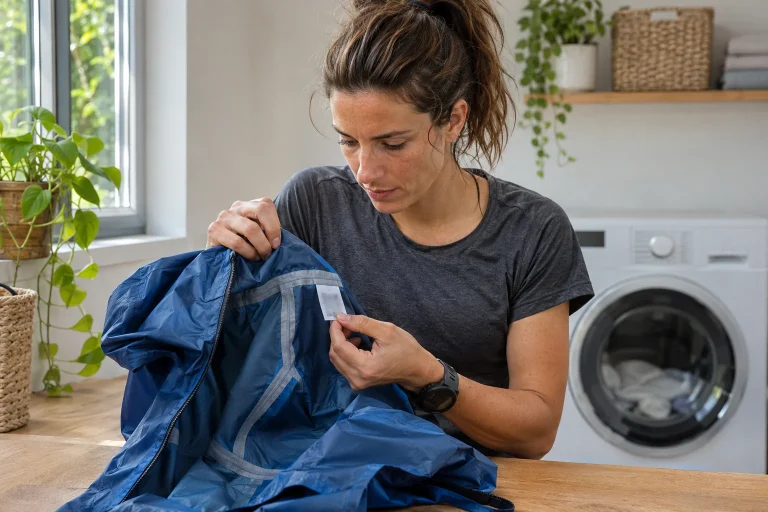
When inspecting the jacket inside as permitted, you may recognise taped lines. This does not let you visually rate every manufacturing detail or the sealing’s actual performance. Observation helps identify the part in question and compare it with the product’s description. An internal photograph does not replace assessing that garment.
Do not automatically rank brands by tape width either. The selected solution can relate to fabric, construction and manufacturing process. If a salesperson highlights such a figure, ask what it claims about the particular model. A visible size difference alone is not better or worse waterproofness established in use.
 Enlarge image
Fully or critically seam-sealed: the wording’s scope matters
Product descriptions may distinguish full sealing from sealing only specified critical seams. Helly Hansen’s own guide also differentiates these terms. The latter statement must not imply identical protection at every seam. The specified area and product purpose together determine the claim’s meaning.
Do not abbreviate both as simply “Taped seams” in purchasing notes, losing the difference. Record the stated scope and ask if the areas covered are unclear. Clarified wording helps you understand the garment without immediately creating one good–bad verdict for everyone.
In one example you seek a jacket for brief transitional use close to home; in another you would wear it longer during an outing. Different tasks may change your questions. They do not broaden the description: information about sealing only certain sections does not automatically become the same information about the remainder.
The zip and openings remain separate questions alongside seams
A garment’s water protection does not end at the stitch line. Zip, pockets, neck, cuffs and lower hem also influence use. Gore’s system description separately mentions suitable other components and finished-garment evaluation. A good material property is therefore not a complete answer about every opening.
During fitting, observe how sections close on your body with the planned base layer. Is there too large a gap at the neck, can the hood be adjusted well, and can you actually close the pocket? You can observe comfortable, appropriate fit yourself, but technical waterproof-performance details still require product documentation.
If a damp patch later appears beside a zip, do not automatically call it a seam fault. Describe its precise location and circumstances of first noticing it. A nearby component’s presence alone does not prove water’s route. Naming construction parts separately helps keep your customer-service question from narrowing to one preselected explanation.
External water repellency differs from sealing a join
Droplet behaviour on the outside and structural seam protection are separate questions. A water-repellent treatment does not automatically become seam tape, and an attractive droplet photograph does not establish every join. When reading care advice, identify which part’s function it addresses. Do not interchange different operations’ purposes.
If an inner tape edge changes, repeating exterior surface treatment does not examine the same problem. First clarify the condition and the next step recommended for your garment. General care articles and specific repair instructions may provide information at different levels. Good choice requires discussing the same task.
“It no longer repels water, so it leaks everywhere” and “It repels water again, so every join is repaired” are common possible misunderstandings. Both connect more claims than surface observation supports. Preserve accurate care history, but do not consider a structural question settled through improvement in another function.
A new stitched badge or emblem can introduce another join question
Sewing on a running-club badge may look harmless decoration, but the needle can pass through the material here too. Gore’s official FAQ specifically addresses how alterations and embroidery may affect waterproof function and require appropriate seam sealing for its products. Read this as the brand’s own information alongside further instructions for the particular garment.
Before personalising a jacket, ask which solution is permitted for your model. You need not assume every alteration is forbidden, but neither that every normal textile process applies unchanged. Waterproof garment construction may create different requirements from printing on an everyday T-shirt.
In discussing modification, identify the area to receive the marking and the provider’s technique. This gives a more useful starting point than “Can it have a logo?” Obtain the answer before intervention, so later interpretation of condition does not depend only on an assumption recalled afterwards.
 Enlarge image
What should you observe when a join raises questions?
First distinguish visible condition from running experience. A tape edge appearing lifted differs from feeling moisture near the shoulder on one occasion. They may relate, but appearing in the same story does not establish the connection. Describe each with its own precision.
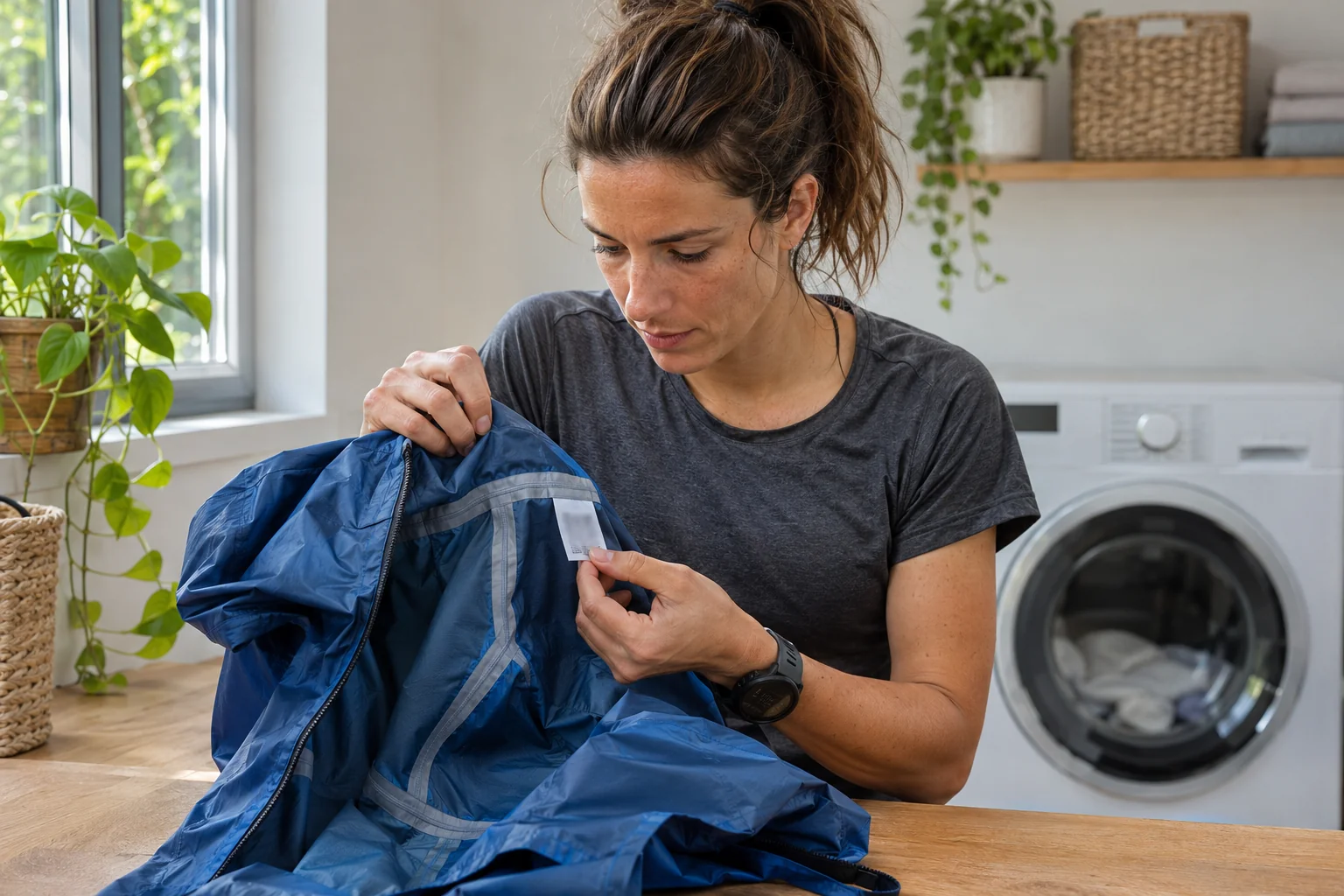
Take a picture identifying the affected part’s location and, if requested, a close-up of its condition. Do not pry at tape to make the difference more visible, or dismantle the garment to create a test sample. Observation records present condition. Appropriate evaluation requires clarifying that product’s assessment or repair procedure.
Record known care, repair and alteration history too. Leave uncertain details uncertain. “I think it was added then” differs from a documented date and operation. Honest, detailed observations help the process more than a certain-sounding explanation reconstructed afterwards.
Choose the next step for the material and fault question
A repair material or method working on one rain garment does not prove suitability for every membrane and seam. Correct bonding, surface condition and procedure may be system-specific. Guidance for your model is therefore needed before home heating, gluing or sewing. This article provides no universal settings or chemical recommendation.
| Situation | Useful next question |
|---|---|
| Choosing a new jacket. | What is stated about seam-sealing scope for this exact model? |
| Showing the condition of internal tape. | What photographs and history does the manufacturer request for assessment? |
| Planning embroidery or a stitched badge. | Which process is permitted, and how can appropriate garment function be preserved? |
| Finding a repair method online. | Is it actually recommended for this material and structural part? |
If repair is advised, retain the named operation and subsequent usage information. A temporary solution and intended permanent service repair are different statements. You can track the jacket’s later history accurately when actual steps remain distinct alongside your own observations.
Seams ultimately remind us that running clothing is used as a complete system. Material capabilities, join construction, openings and current condition all belong in the picture. Understanding construction makes the description more meaningful: instead of one magic word, you seek connected details explaining that jacket’s function.
Sources and application limits
For stitching and seam-sealing explanations, we used Helly Hansen’s own construction guide; for components of the finished-garment system, Gore’s official product FAQ; and for the alteration example, the relevant section of Gore’s Australian support information. The latter has a manufacturer-specific scope; check your own product’s instructions separately. The question table and scenarios are our own editorial aids, not repair instructions. Checked: 21 November 2026.
How Futószív articles are prepared: our editorial guidelines.