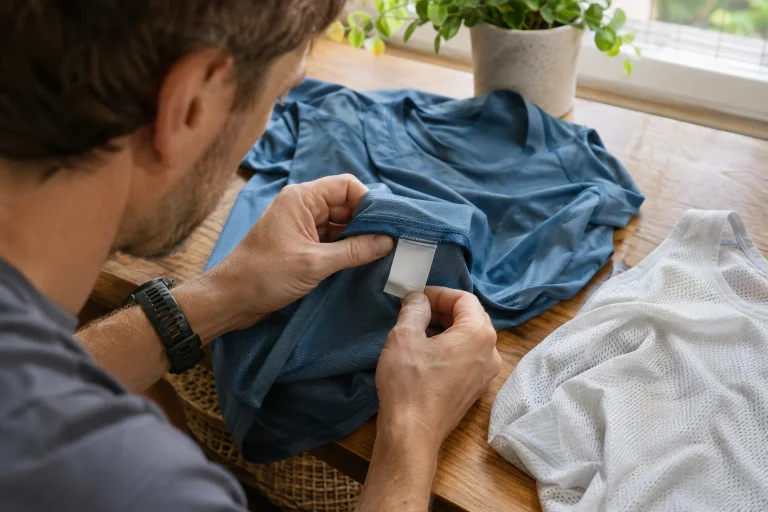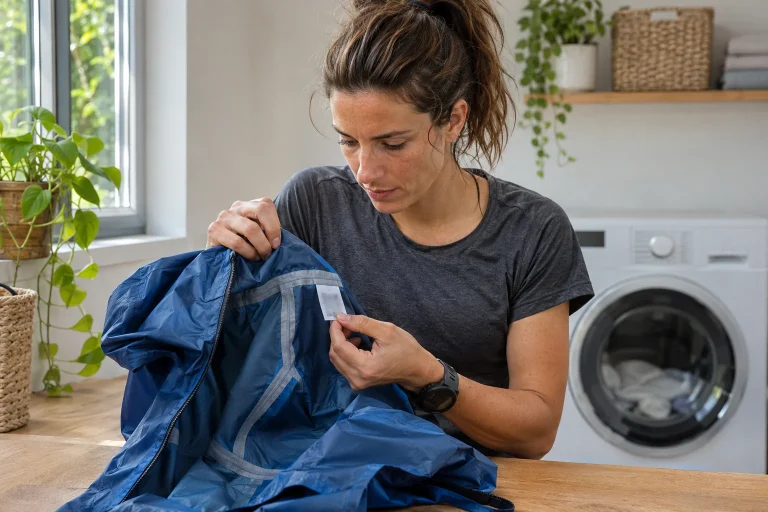
You read “PFAS-free DWR” beside a running jacket. This may be an important claim about materials, but first examine exactly what it concerns. DWR names the outer water-repellent surface treatment; the jacket may also contain a membrane, fabrics, fastenings and other components. A statement about one part must not automatically be extended to every ingredient of the whole product.
Three questions are central to reading this specification: which part is being discussed, what the precise wording of “free” means, and which particular product version the information concerns. This article does not estimate your personal health risk from wearing a garment. Our examples help you avoid adding a promise the manufacturer has not made to an environmentally important claim.
PFAS names a substance group; DWR names a treatment with a function
The German Federal Institute for Risk Assessment, BfR, discusses per- and polyfluoroalkyl substances as a group of industrial substances encompassing many different compounds. PFAS is therefore not the trade name of one substance. DWR, by contrast, identifies the role of a durable water-repellent treatment. The abbreviations describe different levels: one names a chemical family, the other a surface-treatment function.
The word DWR alone therefore does not reveal the complete chemical composition. For that, read the manufacturer’s specific statement about materials. Likewise, a “water-repellent” property does not establish which substance family was used. The function and the solution chosen to provide it are separate information, even when placed immediately beside one another on a product page.
For a short answer in a shop, do not ask only whether it has DWR. A more precise question is: what does the manufacturer claim about PFAS use in this model’s surface treatment? This asks about both the information’s subject and source. The answer can then begin with a document for the jacket you are considering rather than a general explanation of materials.
Do not swap the surface, membrane and whole product within a sentence
In a multilayer rain jacket, surface treatment concerns the outer fabric, while the membrane is a separate detail of garment construction. BfR’s outdoor-clothing section also mentions textile finishing and membrane materials separately. If a sentence explicitly concerns DWR, you still need to seek a separate statement about the membrane. A claim about the whole product may have broader scope.
Our fictional product page A states that its water-repellent surface treatment was made without intentionally added PFAS. Fictional page B separately names the membrane too, while C gives information concerning the whole product and specified components. These three statements do not provide identical amounts of information. First compare which parts actually have a claim attached and where questions remain.
You can literally write the sentence’s subject on a separate line: surface treatment, membrane, main fabric or complete product. Skipping this step can leave the most prominent green adjective in your memory, with a broader meaning imagined beside it. Accurate reading does not assume bad intentions; it simply preserves the boundary the statement actually sets.
 Enlarge image
No intentional addition differs from excluding every trace
Gore’s current DWR information clarifies the absence of intentionally added substances in the footnote to its PFAS-free wording, and also notes the possibility of trace amounts. This illustrates why small print belongs to the main claim. The manufacturer’s definition cannot be replaced by a stricter meaning we independently associate with “free”.
Logically, three separate statements are possible: a substance family was not chosen as an intentional ingredient; a test did not detect specified target substances; or someone claims the absolute absence of every possible trace. These are not interchangeable. A test result can have a method, sample and interpretive limit, so “not detected” alone should not become an unlimited statement either.
You can ask: does the product page communicate a manufacturing-material commitment, a test result or another kind of claim? If it references testing, does it identify what the test covered? You do not have to perform chemical analysis at home. Recognise the type of statement and, when necessary, ask the appropriate source for the missing explanation.
Without the precise model and version, the brand name is insufficient
Brands’ material practices can change over time, and product generations may differ. Patagonia’s own information, for example, includes transition claims tied to dates and new products. Such a commitment cannot automatically support the same conclusion for every old garment, used item or earlier production batch.
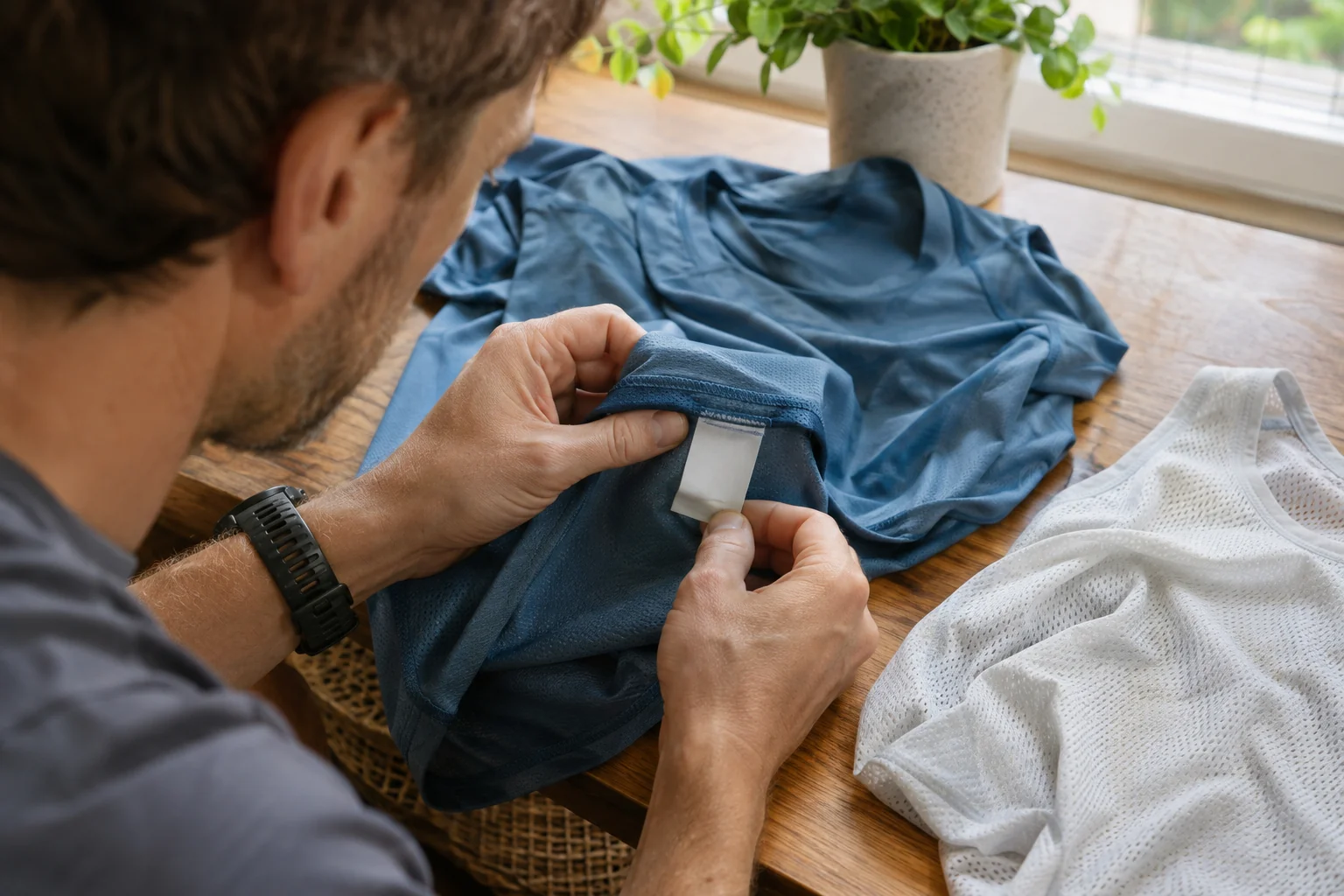
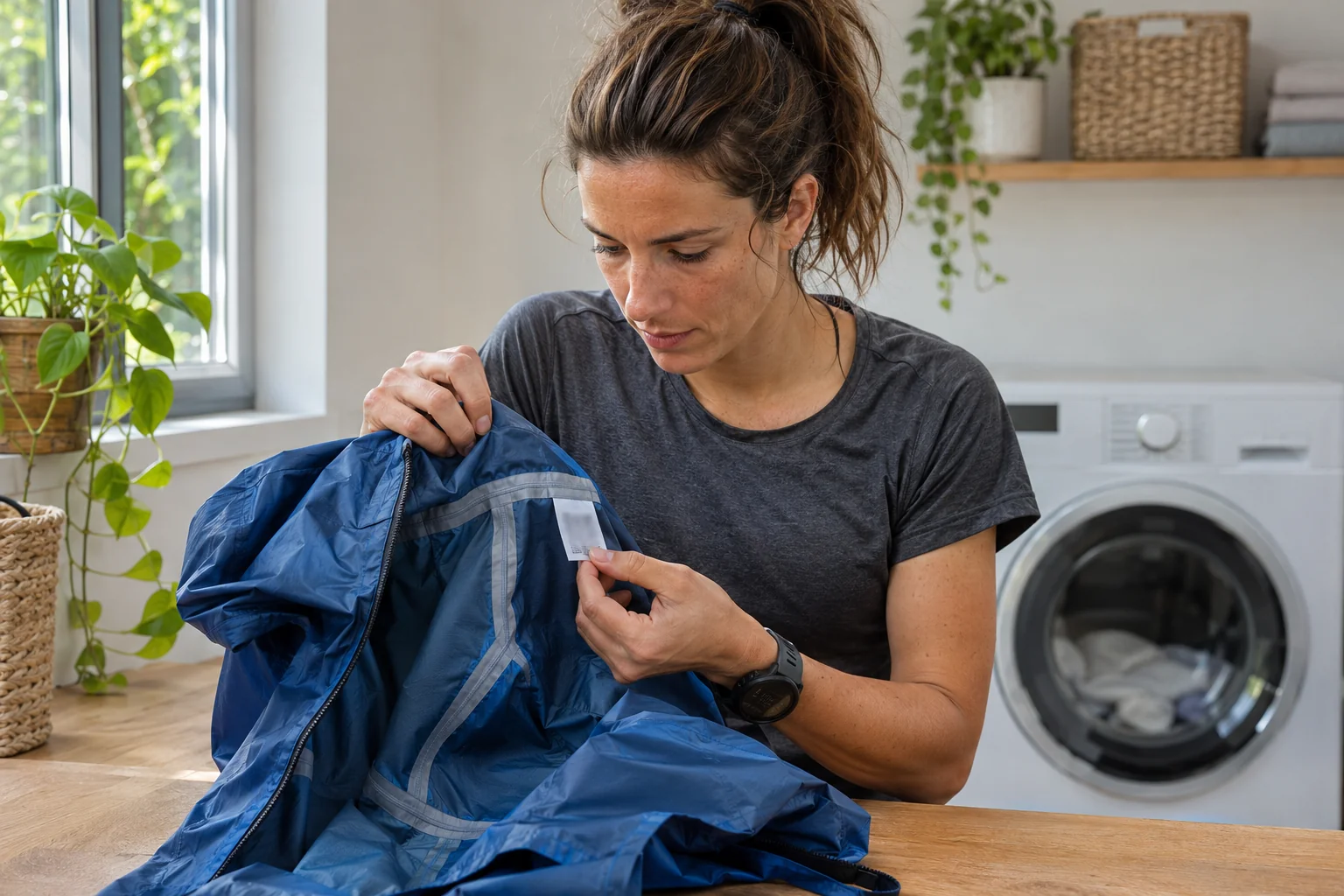
When buying, record the complete model name, available identifier and exact page where you found the information. For a used jacket, do not consult only the specification of its currently available successor. A similar name or identical colour alone does not establish the same generation. If history cannot be clarified, retain that uncertainty in your decision.
If a retailer’s specification and a manufacturer’s page differ, do not simply select the sentence you prefer. Ask whether they concern the same version and which information relates to the garment actually offered. That makes the comparison verifiable. A general impression of the brand cannot replace documentation appropriate to your product.
Do not infer oil and dirt repellency from water repellency
BfR’s outdoor-clothing explanation treats water, oil and dirt repellency as separate properties and also mentions water-repellent solutions without fluorinated compounds. A water droplet’s behaviour therefore does not describe every aspect of a surface’s performance. A result concerning water cannot support the same conclusion for every other liquid or contaminant.
In practice, care requirements may differ from the surface you previously knew, but you must still obtain the procedure from your own model’s instructions. Do not turn a striking promotional demonstration into a promise for every use. If garment care matters for everyday runs, ask about specific care instructions alongside the materials claim.
In an imagined situation, someone expects a top to release every stain equally easily because it is labelled water-repellent. This is already a second, unstated expectation. A more precise purchasing question asks which function the manufacturer substantiates and what care is required to maintain it. Seek the relevant documentation instead of experimenting with different liquids at home.
A materials statement is not the complete environmental balance
Information on PFAS use may be an important detail in understanding a product. It does not automatically encompass a complete assessment of manufacturing, transport, durability, repairability and every consequence of use. Turning one statement into an overall “environmentally friendly in every way” judgement asserts much more than the information provided.
Your comparison can have separate fields for the materials claim’s scope, repair options and likely usability for your task. You need not give these an invented common score. Where comparable data are absent, leave that question separate rather than invisibly filling the gap with another property’s advantage.
The boundary of individual health conclusions matters just as much. BfR’s general explanation of a substance group and a specific product page answer different questions. A clothing label alone cannot calculate your exposure or the health consequences of a particular occasion of wear. We therefore do not assign a personalised danger or safety rating from the label.
 Enlarge image
How to record the claim’s precise scope
A short information sheet can preserve a purchasing statement without allowing it to expand in memory later. The table is an editorial aid, not a certification system or substitute for chemical testing. It aims to show product identification, the claim’s subject, the manufacturer’s definition and the question still unanswered.
| Detail to record | What to look for |
|---|---|
| Exact product | Model, version and available identifier, not merely the brand. |
| The statement’s subject | DWR, membrane, main fabric, particular component or complete product. |
| The wording of “free” | For example, a commitment concerning intentional addition or a precisely defined test statement. |
| Source and date | The manufacturer page for that version and the date checked. |
| Open question | Which part, testing limit or version is not yet clarified? |
Alongside preserving the original statement, give your own interpretation a separate line: “I have information about the surface treatment, but not yet the membrane.” This is more traceable than an unbounded green adjective. If more precise data arrive later, the information added to your understanding will be clear.
When comparing, do not automatically penalise a manufacturer for thorough wording because it includes a footnote. A detailed definition may provide more interpretive guidance than a short, apparently unconditional label. Examine statements’ evidential strength by their content rather than ranking them solely by how confident they sound.
Five useful questions for a retailer or manufacturer
Begin with the exact model and the claim you read. Then request clarification about the relevant product part, rather than a general yes–no answer about the entire brand. Use whichever questions below match the information you actually lack; every purchase need not become lengthy correspondence.
- Does the PFAS-use statement concern only DWR, the membrane or the entire product offered?
- Which exact model version and production period does this information concern?
- How is the term “free” defined, and is there an important footnote?
- If testing is referenced, are its subject and the statement’s interpretive limits identified?
- Which specific care instructions apply to this surface treatment and garment?
Do not broaden the answer when passing it on. If only information about the external treatment was confirmed, say so; if several components were listed, preserve that list’s boundary. Equipment advice shared within a running community can then remain accurate, rather than a well-intentioned recommendation becoming a stronger but unsupported promise.
Interpreting a PFAS-free DWR label therefore means more than selecting the shortest advertising sentence. Product, named part and definition together provide the statement’s actual content. With those three clear, you can integrate material-use information more soundly alongside other criteria, without attributing a property to the jacket for which you received no data.
Sources and scope
For conceptual and textile-industry background, we used the BfR summary on the PFAS substance group and outdoor clothing; for an example of a specific definition, the footnote in Gore’s DWR information; and for an example of a time-specific manufacturer transition, Patagonia’s own H₂No description. The information sheet and questions are our own editorial aids. The article performs no product chemical analysis and attaches no health conclusion to a specific clothing label. Sources checked: 21 November 2026.
How Futószív articles are prepared: our editorial guidelines.