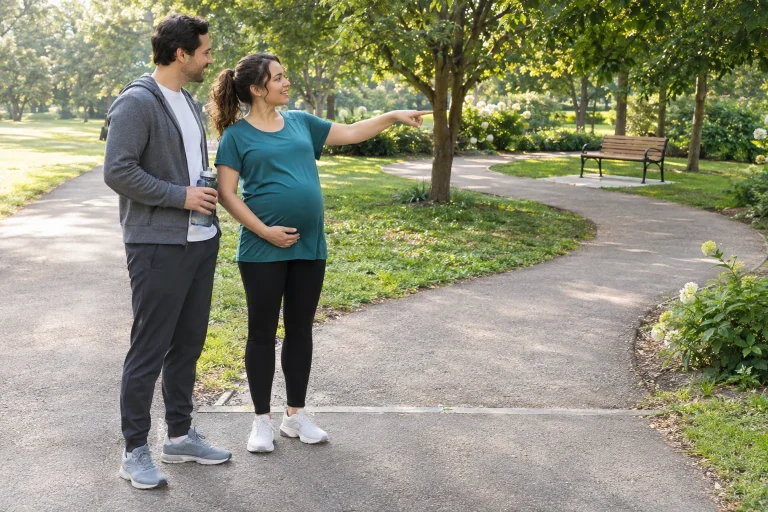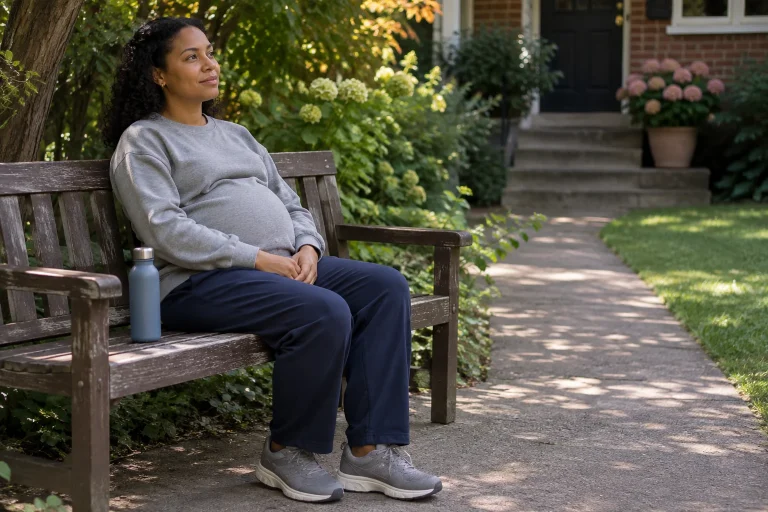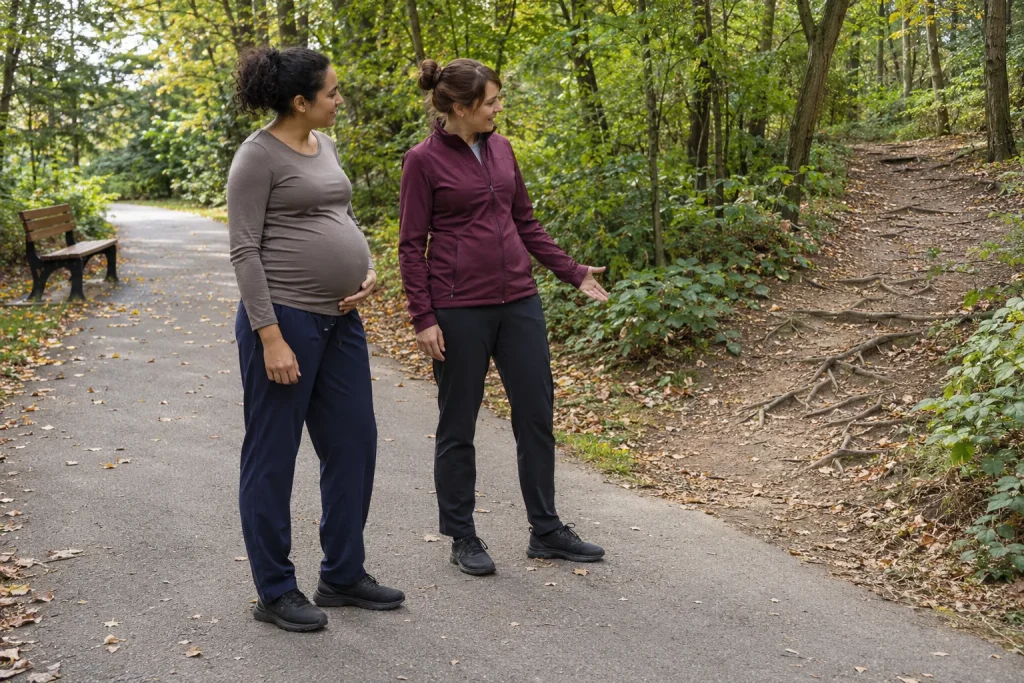
The trail where you once stepped over roots without thinking may demand more attention today. The place has not become worse, and your previous trail experience has not disappeared. What has changed is the conditions under which you want to move there. During pregnancy, simplifying a route can be a deliberate organisational decision, adapted to the activity guidance discussed within your own care.
This article does not classify terrain by trimester or offer a home fitness-for-activity test. It shows how to look afresh at familiar surroundings: where sudden adjustments might be needed, where two people cannot comfortably fit, what changes after rain, and what happens if you choose another activity at the entrance. A smoother path is not permission to run in every situation.
Changing balance need not become a judgement on performance
ACOG’s pregnancy exercise information explains that changing weight distribution at the front of the body also alters the centre of gravity, which matters for balance. The organisation also highlights avoiding activities involving a risk of falling. This is general physiological and safety information; it does not establish whether a particular park trail is suitable for you. ACOG’s summary also discusses the importance of an individual conversation.
The useful question is therefore not “How much worse has my balance become?” Be more specific: where on today’s route do you anticipate an unpredictable step, and do you want to take on that situation at all? You do not have to prove anything with a test on a wobbling stone. You can assess the location without testing its harder section while moving.
You can discuss the change matter-of-factly with your companion. “I do not want to use this narrow section today” is a complete sentence. It does not require a fall, obvious unsteadiness or a measurement against your previous outing. If you do not yet have individual guidance on the activity you want to do, choosing an apparently easier route cannot replace it.
A location’s technical demands involve more than elevation gain
Distance and elevation are two prominent numbers in a route app. A narrow, unevenly worn kerb, a raised root or a sideways-sloping dirt path rarely has its own data field. The same number of kilometres can involve very different situations. A riverside route that looks flat on screen may include steps, cobbles and narrow connecting sections.
Make three separate descriptions mentally or in a brief note: what the surface is like, what the space is like, and what you must do there. The surface may be even paving, ground of varying firmness or a junction between different materials. The space may be open and visible, or narrow, obscured or crowded. The task may be moving straight ahead, weaving around obstacles, using steps or crossing repeatedly. Do not combine these under one “easy” label.
| Detail at the location | A more precise question | A simpler option |
|---|---|---|
| Root-covered section | Must you step over raised obstacles? | A side route that does not require avoiding obstacles. |
| Narrow link with railings | What happens when someone approaches? | A wider, clearly visible connection between two sections. |
| Sideways-sloping verge | Is this the only place to move aside from cars? | A broad pedestrian path separated from traffic. |
| Cobbles at the end of the loop | Can they be omitted without forcing a detour? | Another finishing point or another loop. |
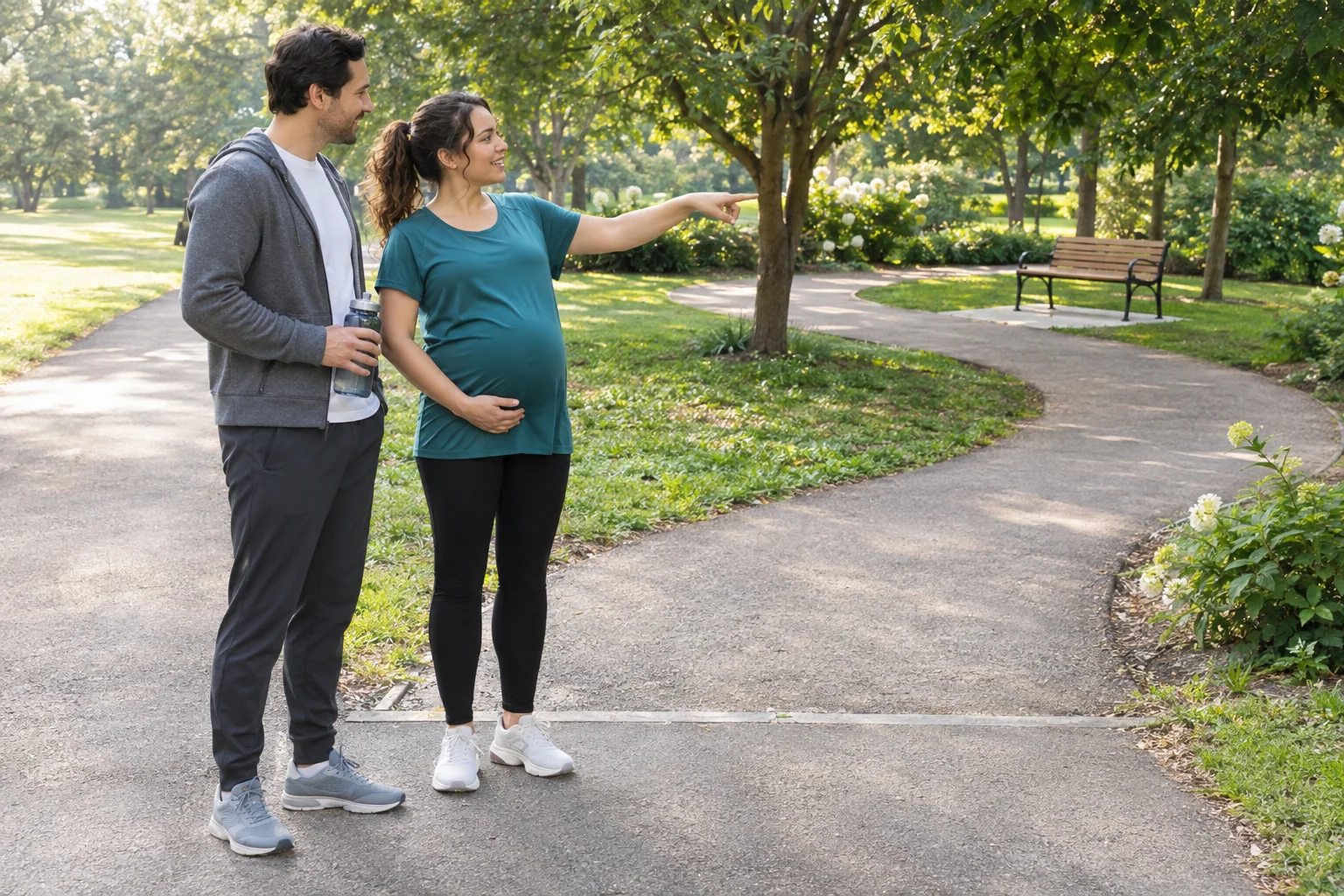 Enlarge image
Look at the surface in its current condition
“Asphalt” does not mean the entire route is even. Poorly reinstated utility works, roots pushing up the pavement or diversions around parked cars become apparent on site. “Soft forest ground” is not always more comfortable either: it may mean deep mud, loose gravel or a surface concealed by leaves. This does not produce a universal ranking of surfaces; describe the particular section.
If possible, a companion can inspect the section beforehand and send a few recent close-up photographs. A photograph helps when it shows more than scenery: include the entrance, the full width of the path and the problematic transition. This still cannot guarantee its later condition. A closure or construction vehicle may justify changing the outing that day.
Footwear alone does not solve a problem with the location. Do not infer from a product promise that a wet bridge or uneven path is now suitable for you. Choosing footwear and simplifying the location are separate tasks. If the outing appears possible only by expecting equipment to prevent every unexpected difficulty, reconsider the outing itself.
Sightlines and encounters are part of the route too
The practical advantage of a broad, straight section is seeing sooner whom and what you will encounter. A dog, bicycle or running group appearing after a blind bend may require sudden movement. This need not become a matter of blaming other path users. Plan instead to minimise unpredictable encounters within the chosen location.
The same route can be a very different environment on a weekday morning and during a weekend event. Check local notices for races, markets, fence removal or maintenance. A line drawn along the promenade does not guarantee free space. The traffic you encounter on arrival matters more than memories of a previous visit or an old panoramic photograph.
Even with a companion, you need not insist on walking or running side by side to talk on a narrow section. When choosing a location, look for somewhere that does not require constant stepping aside to spend time together. If conversation is the main value of the outing now, a wide promenade or even a pleasant seated meeting can provide it; the previous trail setting need not be preserved at all costs.
Let weather change more than your clothing
Rain since yesterday’s inspection is not merely a jacket question. Access to your chosen route may also change: a connecting section may be flooded, the entrance muddy, or a branch may block the easier detour. The same applies to frost and fading light. A previously manageable detail may disappear from view, or an apparently comfortable route may require a different approach.
The NHS advises avoiding sports involving a risk of falling or a blow to the abdomen during pregnancy, and stopping exercise if you feel unwell. Its pregnancy exercise information does not classify individual forest routes. Planning the location therefore supports an individual decision rather than producing an official “safe terrain” stamp.
Have an agreed alternative that is not an even less familiar detour from the original route. If the flat park path is waterlogged, a small hillside trail is not an automatic substitute. The alternative could be another familiar location already discussed, another form of movement or a different activity that day. You need not rescue an outdoor outing under every condition.
Plan the ability to stop through to the journey home
A loop is easy to shorten only if its shortcut is genuinely accessible. An exit appearing nearby on a map may involve a locked gate, a stepped underpass or a busy crossing. “We can just walk out” is specific only when you know where and how. Look at the nature of the section leading to the exit as well as its distance.
Choose the starting point for the whole day. A smooth park path’s advantage can easily disappear if reaching it requires a long route with steps and the same route is your only way home. For public transport, clarify access to the stop; for driving, establish whether the car park is actually accessible. “Someone will pick me up” requires an available person and a meeting point you both know.
- Entry: does the approach to the entrance also fit today’s intentions?
- Decision en route: where can you leave without another difficult section?
- Finish: are you still making uncertain assumptions about seating, toilets or getting home?
- Contact: does your companion know which exit you mean if you want to shorten the outing?
 Enlarge image
Three situations in which choosing the simpler option makes sense
The familiar forest loop. A fictional runner wants to meet friends on her old route, but the middle section has roots and no nearby exit. The group’s aim is spending time together, not completing a particular course. They move the meeting to a nearby promenade with clear sightlines; the others arrange their own runs separately. Nobody then needs to persuade someone through an uncertain section along the way.
The short urban loop. In another example, steps in the underpass leading to the park are the difficulty, while the park path itself appears suitable. The solution is not to shorten the park loop further, but to find another approach or choose another location. Reducing the activity’s duration does not remove the problem of getting there.
The suddenly closed entrance. In the third situation, the wide gate is under repair and only a narrow, muddy detour is offered on site. The participant chooses the alternative already agreed. She need not first head towards the detour to prove that changing plans was justified. These are organisational examples, not individual exercise programmes.
Which changes should you take back to your maternity-care professional?
The CDC emphasises discussing activity during pregnancy individually and adapting it as necessary. The general activity framework cannot replace that conversation. If you experience new unsteadiness, feel unwell or develop symptoms, do not try to sustain the same run with increasingly elaborate route adjustments; your question also concerns your condition.
Keep your note short and descriptive. In what situation did the change occur? Was it associated with uneven ground, or did it also occur on a smooth path? Were there other symptoms? What did you do afterwards? Separate your interpretation from events: “It must just have been the gravel” is already an explanation, not an observation. This article does not determine the urgency of symptoms; in a concerning situation, do not wait until the next planned run.
An appropriately simplified location is not a spectacular achievement, yet it removes many unnecessary decisions from an outing. You need not choose an obstacle at every step, resolve an unexpected detour or match everyone else’s rhythm. The activity serves you when it can adapt to today’s circumstances and still has an acceptable outcome if it ultimately involves no running.
Sources
- ACOG: exercise and physical changes during pregnancy
- NHS: exercise in pregnancy
- CDC: activity during pregnancy and after childbirth
How Futószív articles are prepared: our editorial guidelines.