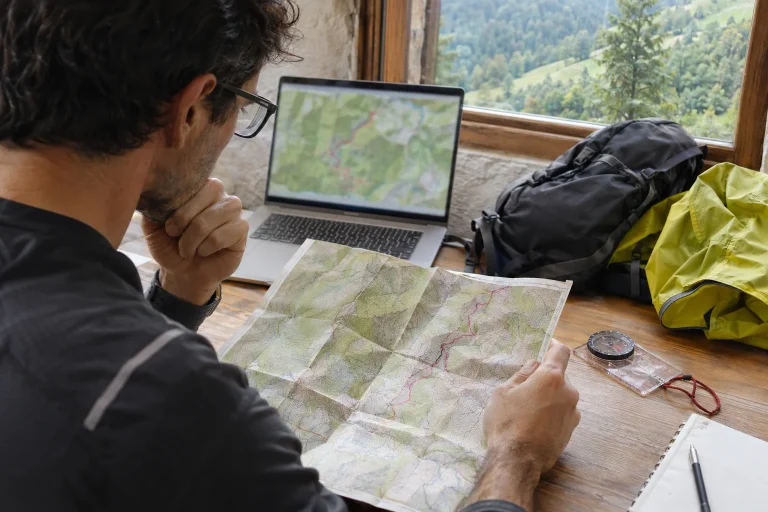
A route briefing for the next group leader works when they do not need to search the writer’s memory to understand it. A map file can show the line without necessarily explaining the best approach to the meeting point, where misunderstandings occur, which details change or which group-movement arrangements the plan assumes. Pass these on in a short, followable form without forwarding every earlier conversation.
A briefing does not automatically transfer local knowledge or fitness to lead. The next leader needs to adapt the activity to their own experience, the actual group and current conditions. The document is a starting point and transferable background knowledge. It works when it states precisely what the writer knows, where information comes from and which parts need rechecking.
Make the plan identifiable on the first page
Include the route name, version, date the description was written and date of the last actual visit. The dates can differ: someone may edit a briefing today from an older observation. State that clearly. ‘Updated’ alone is insufficient if it does not show which information was actually checked again.
Give precise start and finish names and say whether it is a loop, out-and-back or section with different endpoints. Add map identification alongside a personal name. A club nickname may mean nothing to a new leader. Tie the map file and briefing to the same version so two different routes do not remain current in parallel.
Briefly describe the activity’s purpose at the beginning too. Was it designed for a run staying together or several group options agreed beforehand? That is an organisational difference, not merely a stylistic one. Alongside route details, the new leader needs the basis of shared arrangements to interpret the plan appropriately.
Add brief section descriptions to the map file
Divide the course into sections recognisable on the ground. Describing one junction to the next is more usable than pages of continuous prose in which every sentence concerns another turn. Include each section’s beginning, end, main direction and important feature. You do not need to list every tree, but do not omit significant changes.
The Mountaineering Scotland page on route cards explains the role of a plan recorded in advance. A group-leader briefing can add more local background, but the underlying idea is similar: other people must be able to understand the plan too. A card or file does not solve navigation by itself; its user needs to understand the information and terrain.
Avoid instructions clear only in the writer’s mind. Instead of ‘the usual little path’, identify the junction and marked or otherwise identified path along which the plan continues. If a section is uncertain or needs rechecking, do not hide that behind generally confident language.
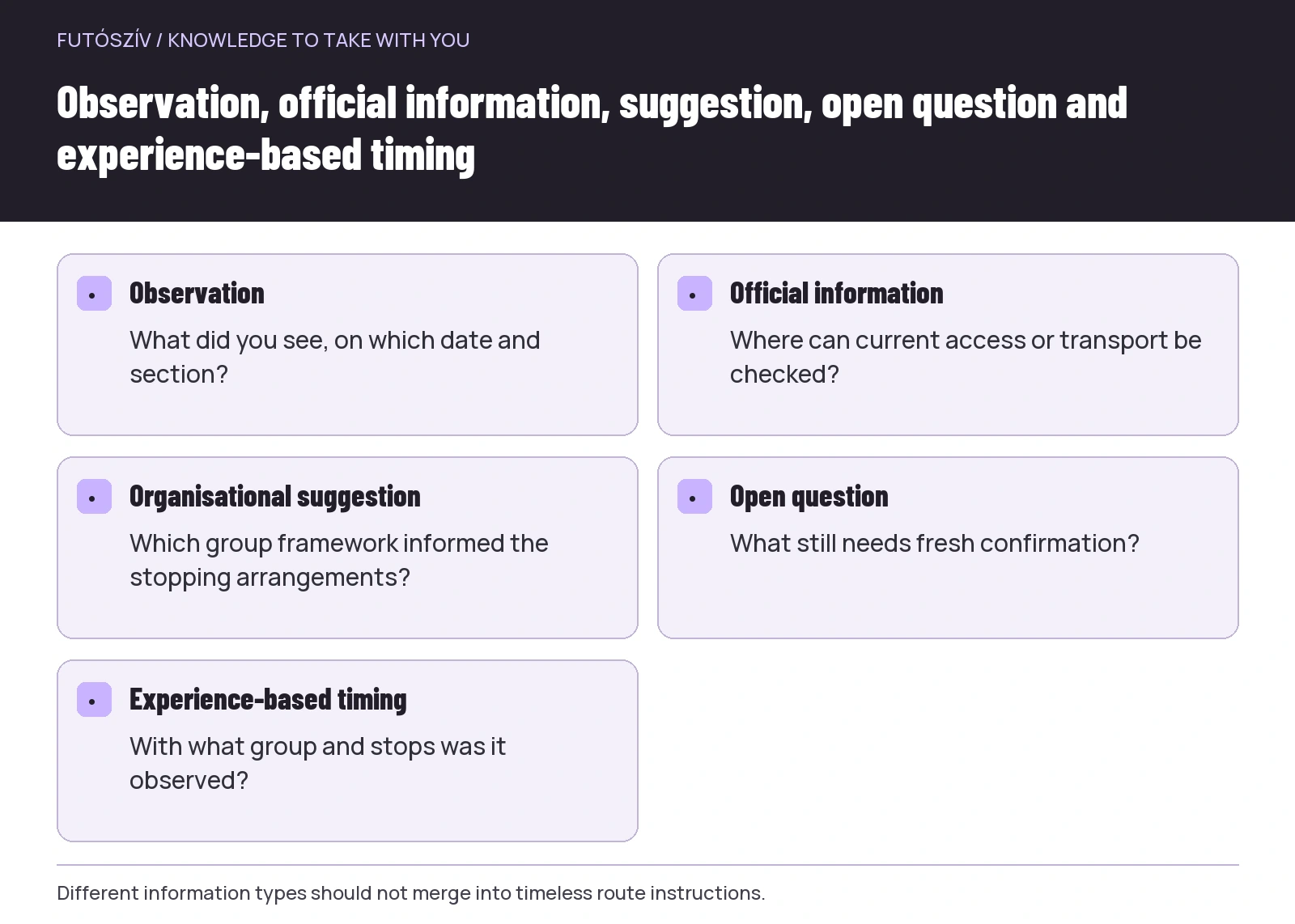 Enlarge diagram
Text version of the diagram
- Observation
- What did you see, on which date and section?
- Official information
- Where can current access or transport be checked?
- Organisational suggestion
- Which group framework informed the stopping arrangements?
- Open question
- What still needs fresh confirmation?
- Experience-based timing
- With what group and stops was it observed?
Put observation and suggested organisation in separate columns
A path being narrow on a particular day differs from wanting the group to proceed there in single file. The first is a field observation; the second is a suggestion for running the activity. Both help, but the new leader should know which they are receiving. They can reconsider the organisational decision in current circumstances.
The Ramblers leader handbook updated in December 2025 connects sharing earlier route work and local knowledge with planning adapted to the group and daily conditions. The British organisation’s internal ratios, rules and access arrangements are not automatically Hungarian requirements. What matters in a handover is that earlier work helps without replacing the next leader’s own checks.
| Information type | Example wording | What should the new leader do with it? |
|---|---|---|
| Field observation | On the visit date, this section was a narrow, rooted path | Interpret current conditions and the actual group |
| Organiser or land-manager information | Access information is available at this link | Open current information before their own day |
| Organisational suggestion | Consider arranging a regroup at this junction | Decide according to the actual group |
| Open question | Opening hours for the next period are not checked yet | Confirm before relying on them |
| Earlier experience | Getting out took longer than the map suggested | Recalculate the whole day’s time allowance |
Describe junctions from the approach direction
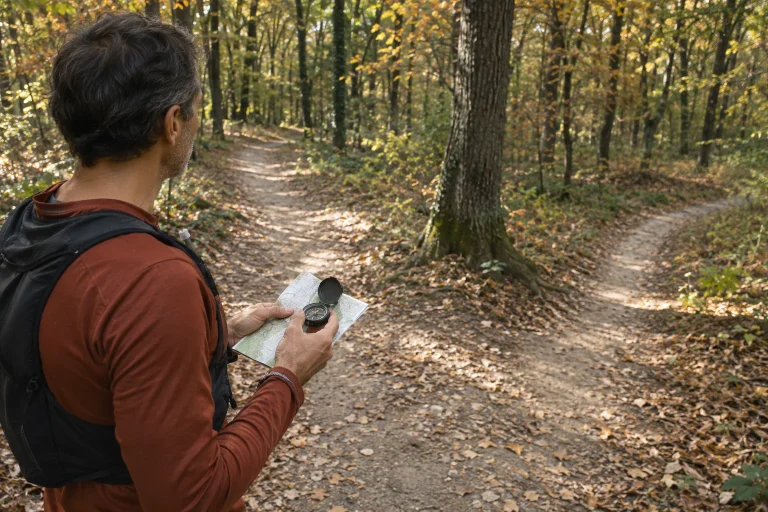
At a junction, what matters is where the group will approach from and which continuation it seeks. Label photographs from the opposite direction separately. A picture is a good supplement but should not be the sole navigation information. A precise place name, map identification and next section together create a usable description.
Use lasting, recognisable references and identify changing details. A movable object, seasonal vegetation or occasional vehicle is not a secure basis. Observations tied to a tree or sign can change too. In the document, a date and specific observation therefore matter more than ‘always here’.
Do not add your own ground markings to make handover easier. The briefing and appropriate map material can be used within the group; altering the physical surroundings is another matter. Report marking problems through the appropriate channel with a precise location. Tell the next leader the question remains unresolved.
Pass on group arrangements too
A route may involve stopping arrangements, waiting for one another, several versions or options to leave earlier. Describe the framework the plan was designed for without treating it as an unchanged personal commitment. Next time’s participants may differ, so agree specific roles again. Last year’s back marker is not automatically committed this year.
For important meeting points, state their function. A discussion before changing route, different groups meeting again or the final conclusion? Function helps when current circumstances lead the new leader to choose another, more suitable place. The point is not sacred; it serves an organisational task.
Briefly note shared equipment and communication questions without copying personal data without limit. The document need not become a medical or complete contact register. People concerned can agree what the new occasion needs afresh within an appropriate circle. The route briefing primarily supports understanding the programme.
Make the shorter version genuinely usable
If suggesting an alternative, give it a precise beginning, end and access too. A downhill path on a map is not automatically a workable exit. Check where it leads, how to continue from there and when you last saw it. Mark the alternative uncertain if any detail is uncertain.
Describe the alternative’s role rather than supplying a ready decision for every situation. It might be a shorter programme or another known path, but the choice depends on the current group and circumstances. The new leader should know which assumptions informed the suggestion to judge whether it is usable now.
An alternative may also become unavailable when surroundings or access change. Do not request updates only to the original route. Travel there and home, the meeting point and shorter version also belong to the full day. Several outdated background details could otherwise remain beside one updated main track.
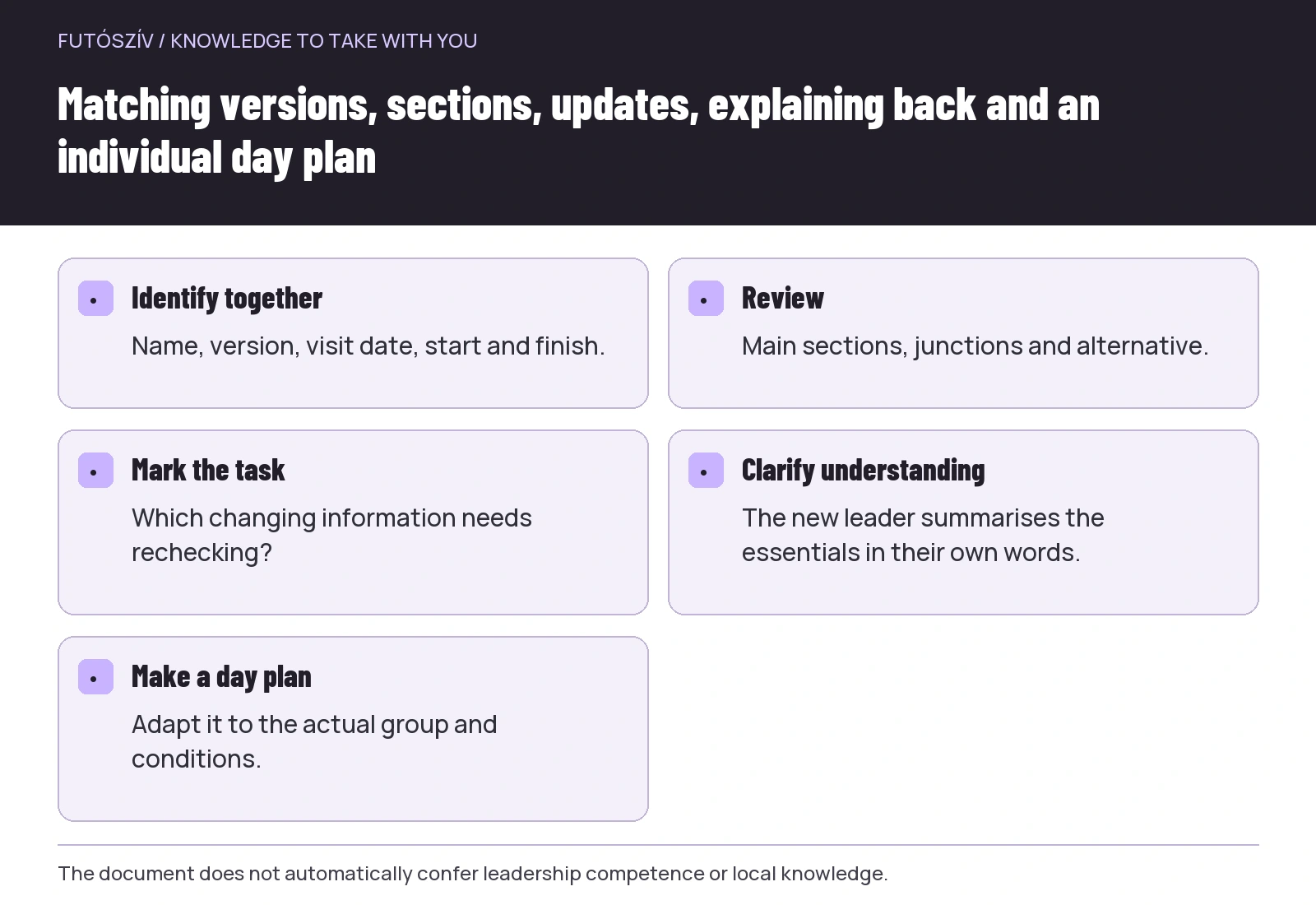 Enlarge diagram
Text version of the diagram
- Identify together
- Name, version, visit date, start and finish.
- Review
- Main sections, junctions and alternative.
- Mark the task
- Which changing information needs rechecking?
- Clarify understanding
- The new leader summarises the essentials in their own words.
- Make a day plan
- Adapt it to the actual group and conditions.
Give changing details a source and a checking task
Opening hours, timetables, area restrictions and services can change over time. Include not only information seen long ago but the official place to check again. If retaining information for a specific date, identify it with that date. The new leader can then see what needs updating.
Pass on experience-based route timing with its circumstances too. What group size, stops and section produced the observation? An earlier time is not an automatic commitment for a new group. The next leader should plan travel and the day according to their own situation.
Make connections clear rather than counting sources. Which link is the map, which the land manager and which transport? One long link list is less usable than a few named references beside the relevant question. If something cannot be checked, do not fill the gap with an authoritative-looking but irrelevant source.
Handover should involve more than sending files
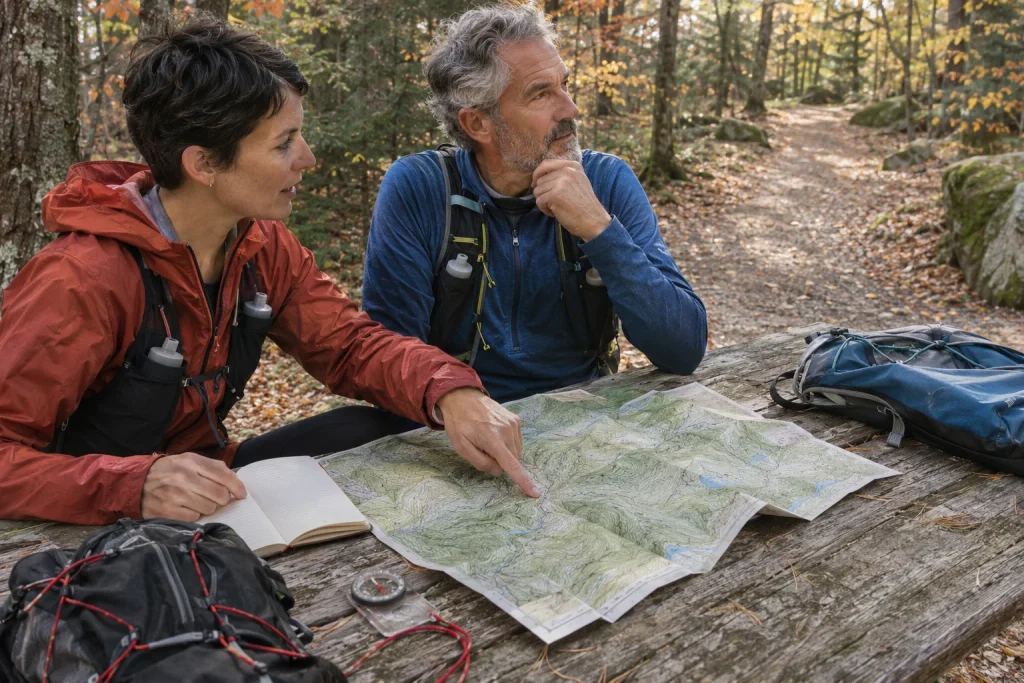
Briefly review the essentials with the next leader. Ask them to explain the main route, uncertain points and next checking task in their own words. This is not an exam but a check that you share an understanding. Misunderstandings are easier to spot then than on site.
If the other person does not yet know the terrain or lacks necessary skills, a good document cannot resolve that alone. A shared familiarisation visit, appropriate training, more experienced support or a simpler route can be the next step. Handover quality is not measured by whether the next activity goes ahead at any cost.
Keep the new leader’s changes as a separate version. It then remains clear which observations and decisions shaped which route. Every small amendment does not require a complex version-control system, but make the date, version and current copy’s name clear. Use traceable updates rather than a series of ‘latest final’ filenames.
A fictional example of a transferable package
Someone else will lead a club’s next woodland outing. The previous leader sends more than the GPX. They add a short summary of the precise meeting point, three main sections, a frequently misunderstood junction and a shorter version used previously. They state the visit date and attach an official checking link to the timetable.
The new leader sees that an earlier time estimate came from a smaller group and one service’s opening hours are not current. They do not treat those as settled. They change the meeting framework for the present group, check necessary conditions and confirm the final day plan themselves. Earlier work helps without deciding for them.
Afterwards, they report two specific improvements: the junction description needed clarification and getting out from the finish took longer. These enter the new version with observation dates. The club builds usable local knowledge rather than merely collecting routes, with uncertainty and updating visible too.
A good briefing briefly shows its own limits too
Before handover, check that map file and text refer to the same version, important points are recognisable and changing details have sources. Handle personal information only as necessary. An open question should not hide in a subordinate clause: make it a concrete next task.
The description fulfils its role when the new leader understands the course structure, basis of group arrangements and parts they still need to check themselves. Local knowledge becomes more transferable while remaining live knowledge: a traceable background assembled from sources, observations and current decisions, rather than certainty stored in one file.
How Futószív articles are prepared: our editorial guidelines.