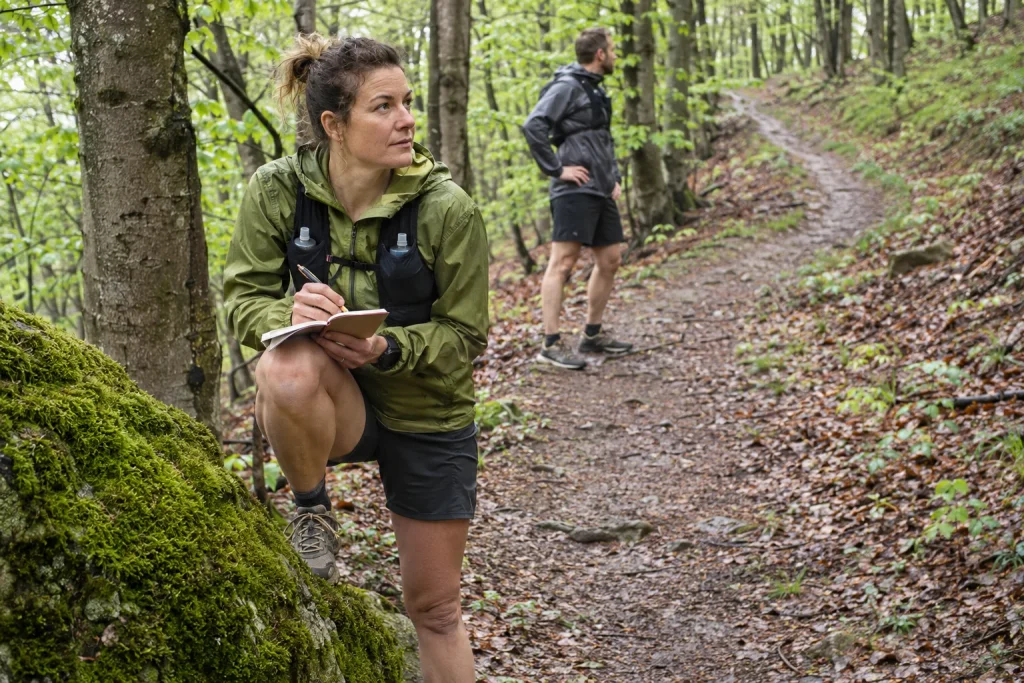
Reconnoitring a trail-race course does not necessarily mean running the race in advance. It can be a focused introduction to a few uncertain sections, understanding navigation points or checking how terrain imagined from a description compares with your own experience. It provides usable knowledge when you state beforehand what you want to learn and afterwards distinguish observed facts from assumptions about the later race.
Organising a reconnaissance is a separate activity. Race aid stations, markings, traffic arrangements or land-use conditions may not exist on another day. Plan access, weather, transport and supplies for your own route separately. This guide does not prescribe workout length or load; it organises the information a visit can provide and the logistical framework.
Start with three concrete questions
Choose a few uncertainties the location can answer. What is a longer descent like, for example; is a junction difficult to interpret on a map recognisable; and how can a later meeting point be reached? A broad aim of knowing the whole course can hide what you actually noticed. One day may not provide a complete picture of every section and condition.
Connect questions to your own experience. If a terrain type is new to you, calmly observing it may matter more than covering as much route as possible. If transport is uncertain, inspect the departure and exit points too. Useful course knowledge does not all come from the length you run.
Beside each question, note what would count as an answer. ‘It was difficult’ is imprecise. A more useful observation is that several rocky, narrow stretches follow one another on the descent, or the second sign at the junction indicates the intended direction. Your own sense of difficulty can belong in the notes, but do not confuse it with a factual route description.
Check which course version you are inspecting
The year matters alongside the event name and selected race. An earlier GPX, old screenshot or another distance’s route can easily look similar. Start from the organiser’s current page and look for any indication that a route is planned or still changing. If final information is expected later, keep that uncertainty visible in your notes too.
The official Salomon UTH race page, for example, indicates availability of the detailed 2027 handbook from 10 May. An earlier visit therefore does not replace checking current route and organisational information issued later. This is one organiser’s example, not a rule for every trail race. Follow information for your own chosen event.
Your file’s name can include the source and download date. Do not call something final merely because you have saved it. When a change arrives, inspect which sections it affects and keep the old file separate from the current one. A reconnaissance’s value lies in what you actually learned about that version.
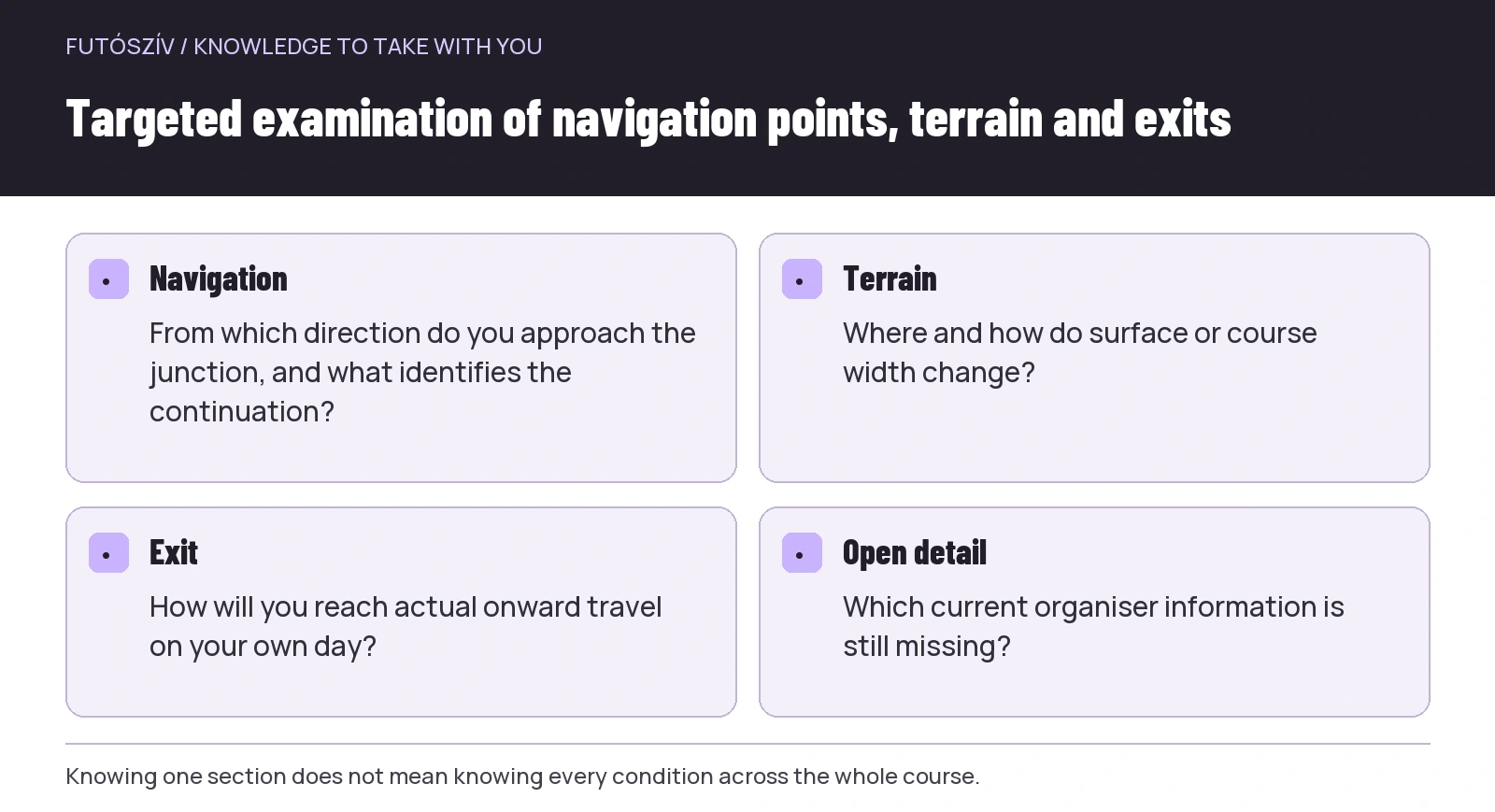 Enlarge diagram
Text version of the diagram
- Navigation
- From which direction do you approach the junction, and what identifies the continuation?
- Terrain
- Where and how do surface or course width change?
- Exit
- How will you reach actual onward travel on your own day?
- Open detail
- Which current organiser information is still missing?
Read participation conditions for a group reconnaissance too
An organised course visit is not necessarily a beginner session. It may be a shared activity for runners with specified experience, its own distance, climbing and pace framework. Do not automatically treat a group as a personal guiding service. Check the requirements, whether registration is needed and what you must arrange yourself.
The UTH announcement for its 51st course reconnaissance, published on 10 November 2026, for example, expressly asks participants for similar distance and elevation experience. It is linked here as an earlier announcement illustrating the need to read participation conditions, not as a new promise of joining. The word reconnaissance alone therefore does not establish how easy an activity is or what assistance is available.
If the description does not explain how the group operates, ask the official organiser. Will everyone stay together, where will they wait and which independent navigation skills are expected? Use the answer to decide whether the activity fits you now. An independent introduction or a smaller section may suit better; being less social does not make it a weaker choice.
The reconnaissance day needs its own route plan
Plan getting there, your own section and the journey home. If the race is point-to-point, a partial visit may finish somewhere without simple transport. Do not assume a shuttle operating on race day will exist at another time. Verify the exit specifically for your own day.
Current area restrictions and weather also belong to the reconnaissance date. Publishing a race route does not give blanket permission to use every part on any day. Follow local land-manager signs and actual access. If a section cannot be used, do not insist on following the same line at any cost.
Choose your own supplies and equipment for this separate activity. There may currently be nothing at a future aid-station location. Organiser tape, helpers and other race-day elements can be absent. These differences are not faults in the visit but circumstances to consider from the outset.
Do not give every section the same kind of attention
Assign observation points to your focused questions. At an uncertain junction, approach direction, a recognisable landmark and the next confirming sign may matter. On a longer climb, inspect where the surface changes and how it connects to the next section. At an exit, the actual path and access matter.
| Section examined | What should you record? | What does it not establish by itself? |
|---|---|---|
| Junction | Approach direction, recognisable sign and next section | That race-day markings will already be identical |
| Technical section | Surface, narrowness and course changes | Identical progress in every weather condition |
| Longer climb | Location and intermediate terrain changes | A time estimate valid for the whole later race |
| Meeting point | Precise place and actual access | An automatic organiser-provided service |
| End of a partial section | How to exit and travel onwards | That the rest of the course is now known too |
Keep notes brief and retrievable. Trying to record every tiny detail can turn a visit into constant documentation. Questions chosen beforehand help you decide where to stop and what only needs a reminder note.
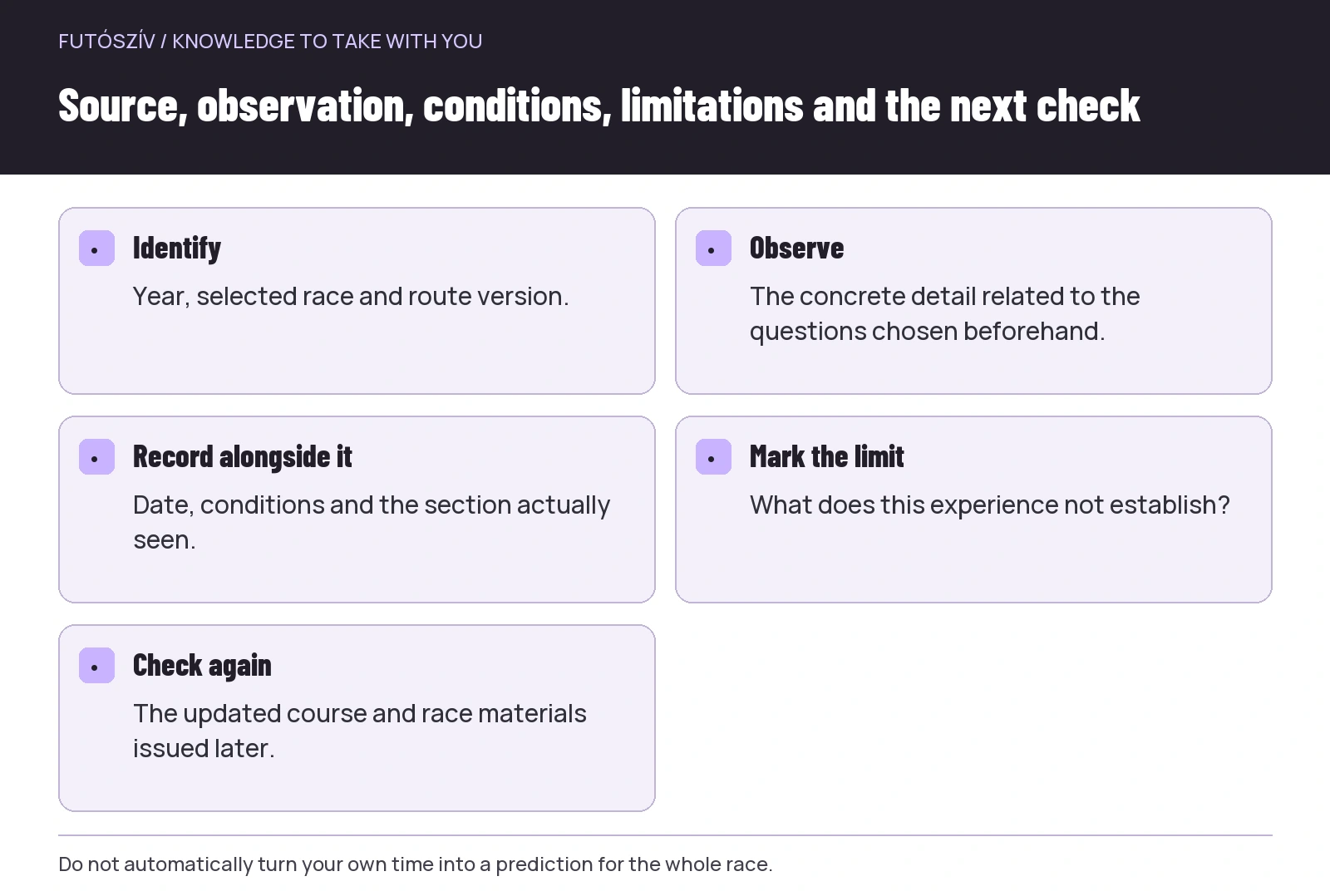 Enlarge diagram
Text version of the diagram
- Identify
- Year, selected race and route version.
- Observe
- The concrete detail related to the questions chosen beforehand.
- Record alongside it
- Date, conditions and the section actually seen.
- Mark the limit
- What does this experience not establish?
- Check again
- The updated course and race materials issued later.
Do not copy your time into a race prediction
A reconnaissance is a different situation: it may be in daylight, with fewer people, more stops or over less than the full distance. Race conditions and the ground already covered beforehand can also matter. A split time alone is therefore not a reliable forecast. If recording time, note the conditions and do not turn it into a general performance guarantee.
Separating stopped and moving time can help organisational estimates but does not remove differences. Total time on site matters for travel, while your own movement data can address another question. Neither replaces the later race’s published conditions and time limits. Even a precise figure can have limited applicability.
A more useful conclusion may be that recognising a particular point requires extra attention, or approaching the finish takes longer than the map suggests. These can be incorporated directly into later organisation. A visit’s value does not need compressing into one expected finish time.
Photographs should support finding the way
When photographing an important point, make what it shows understandable from the approach direction too. A picture taken looking backwards from the middle of a junction can mislead later unless its view is labelled. A short caption can help: we approach from here, look for this sign and continue this way. The photograph supplements the map rather than replacing it.
Do not change markings or rearrange anything for better documentation. Existing signs, markings and natural features are not your props. Report an apparently faulty or dangerous situation through the appropriate land-manager channel, but a personal reconnaissance aim does not authorise improvised course alterations.
For a sequence shared with others, state the year, visit date and route version. Instead of ‘always turn here’, explain more precisely that you inspected this version on this date. Surroundings and the official course can change, so your reminder should not become a timeless route instruction.
A fictional partial reconnaissance built around three questions
Márk is preparing for a later trail race but does not want to cover the entire course beforehand. He has three questions: where a more technical section starts, what an uncertain junction looks like and how to reach transport from the section’s end. He identifies the route version from the current organiser source and makes a separate route and exit plan for his own day.
On site, he observes the junction from both relevant viewpoints without trying to photograph the whole wood. He records where the surface changes and checks the actual exit path. He keeps his split time with stops and conditions. He does not automatically scale it to the entire race as though every kilometre presented the same situation.
At home, he writes three short answers beside the original questions. One remains uncertain because final race materials are expected later. He leaves it open and sets a reminder to check the new information. The visit does not create a feeling of complete certainty; it specifically reduces a few unknown details.
Make a usable summary after the visit
Include the date, route version, section actually seen and main observations. Distinguish personal experience from organiser information. Give open questions a next step: checking an updated map, handbook or official answer. You do not need to pour every old photograph and raw datum into the shared group.
As the race approaches, check again for changes to the course or organisation. A successful reconnaissance does not make current pre-start information unnecessary. At the same time, what you learned about terrain and your own questions can remain valuable even if a small section changes.
A good course visit does not necessarily end with saying you now know everything. It is more useful to identify which part you know, the conditions in which you saw it and what remains to check. Local knowledge then becomes concrete information supporting later decisions rather than a confident impression.
How Futószív articles are prepared: our editorial guidelines.