Running may need your hands too
We often regard running solely as a task for the legs. Yet we tie shoes, pull zips, turn keys, open bottles, use phones and switch on lights. With hand pain, a weaker grip, stiffness or changing dexterity, these small actions can determine how independently and comfortably someone can set out.
The solution is not necessarily buying a ‘special’ product. First understand which task is difficult: pinching, twisting, sustained holding, pressing a small button or reaching the device. The same bottle may be easier for one person and harder for another to handle. Trying your own use matters more than a general promise on the packaging.
Changing equipment is not a diagnosis
Hand pain can have different causes. The NHS page on pain in the palm explains several possible causes and situations for seeking help. Recurring or worsening symptoms, or symptoms interfering with everyday tasks, may need assessment. An easier-opening bottle is a useful practical aid, but it neither identifies nor treats the cause.
Severe pain after an injury, significant swelling, inability to use the hand, new loss of sensation or a hot, red hand together with feeling generally unwell may require urgent medical assessment. For sudden significant weakness or another serious symptom, do not experiment with equipment adjustments. In immediate danger, call 112.
Personal care may include advice suited to a particular activity. The Leeds Teaching Hospitals occupational-therapy information also describes assessing everyday tasks, adaptation and the role of equipment. If running matters to you, show the professional your equipment and the specific action that is difficult.
Map tasks from an actual departure
At a calm time, go through getting ready. What needs putting on, opening, holding, putting away and closing? Which actions are slow, which painful and which need another person? You do not have to change everything at once. Start with the two or three points causing the greatest obstacles.
Include tasks during and after running too. A cap that opens in a dry, warm room may not work with wet hands or gloves. At the finish, you need to remove clothes, retrieve a key and perhaps pay or make a call. Usability does not end at departure.
Describing the particular movement can help: ‘the small zip pull is hard to grip with two fingers’ or ‘holding the full bottle for a long time is uncomfortable’. These lead towards specific solutions. ‘My hand is bad’ is too broad by comparison and can steer you towards products that do not address the actual problem.
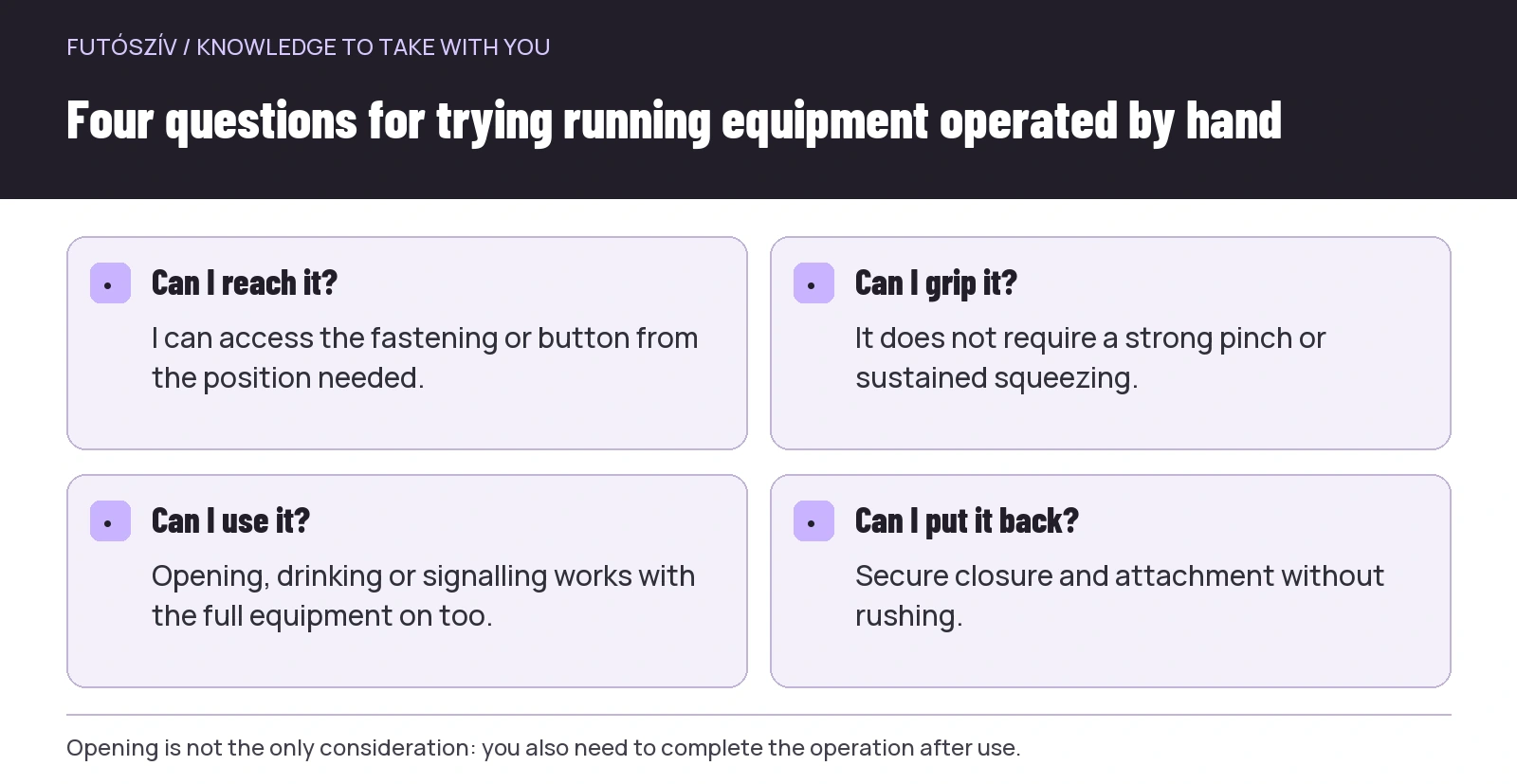 Enlarge diagram
Text version of the diagram
- Can I reach it?
- I can access the fastening or button from the position needed.
- Can I grip it?
- It does not require a strong pinch or sustained squeezing.
- Can I use it?
- Opening, drinking or signalling works with the full equipment on too.
- Can I put it back?
- Secure closure and attachment without rushing.
Shoes: easy handling and a secure fit together
Using shoelaces involves several separate actions: opening the shoe enough, putting it on, adjusting it and fastening it. Another closure can be chosen, but easier entry alone is insufficient. The shoe needs to fit the runner appropriately and remain securely in place during movement.
Elastic laces, a larger gripping element or another closure can be tried if they suit the shoe’s construction and personal needs. Do not overtighten to avoid readjusting, or leave it insecurely loose merely to make putting it on easier. Pay attention to removal during the trial too.
If using the solution requires pulling a small component hard every time, it may not actually be easier. Try it fully dressed, in your usual seat and with the real movement involved. Handling a product in your hands in a shop may not reveal how usable it is.
Zips, pockets and attachments
A larger, easier-to-grip pull can help, but any modification must remain safe. It should not have sharp edges, catch easily or interfere with the fastening. If the change is questionable, consult the manufacturer or a professional supporting personal equipment use.
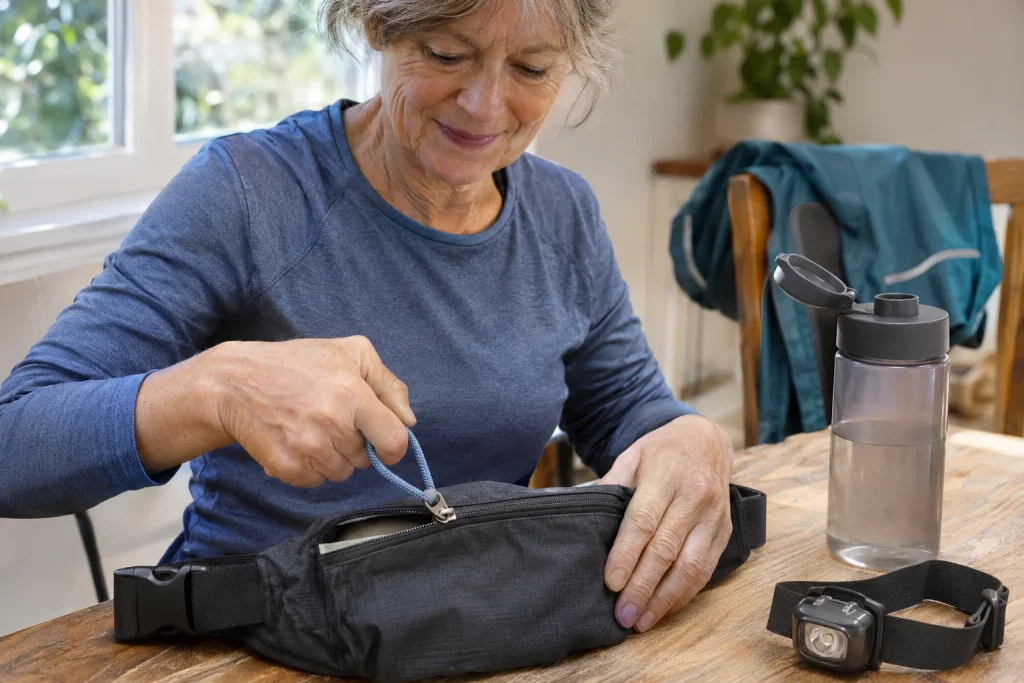
Pocket position matters at least as much as the zip. Can your hand reach it comfortably? Can you retrieve the key without everything falling out? Storage in the middle of the back is not independently usable for everyone, even if its size is theoretically suitable.
Do not skip a glove trial if you intend to run in winter. A small fastening usable with bare hands is a different task with gloves. A system requiring prolonged exposure of the hands every time in cold weather is not a good solution either. Choose clothing and handling methods together.
Bottles: opening is only the first step
For carrying drinks, consider the whole process: filling, closing, carrying, drinking, putting away and cleaning. An easy-opening valve is no advantage if the bottle needs hard squeezing or cleaning requires taking apart unmanageably small components.
Try it with the actual amount of liquid too. An empty bottle’s weight and stiffness can differ from those in use. A properly adjusted belt or vest may be more comfortable than holding it, but its pockets, buckles and putting it on also need handling. Shifting the load helps when the new system does not create a greater barrier.
The Cambridge University Hospitals information on hand osteoarthritis discusses joint protection and use adapted to tasks. This advice is for that particular condition, not a treatment rule for every kind of hand pain. Individual assessment can help determine appropriate grips or ways of carrying a load.
Aid stations need a workable solution too
At a race, understand conditions on site alongside your own equipment. Are drinks served in cups, are bottles refilled or are bottles handed out? Do you need your own cup? The particular event’s rules and actual service matter, rather than experience at another race.
If you want help with filling or opening, discuss it beforehand. Do not rely only on a volunteer identifying your need on the day. Make the request specific: help filling a bottle, for example, rather than taking over the whole refuelling process. That lets the organiser give a useful answer too.
The backup should not be deliberately going without fluid merely because packaging is difficult. Refuelling needs depend on circumstances and the individual plan; resolve the access barrier separately. Forcing a bottle or package open with your mouth is not a generally safe substitute either.
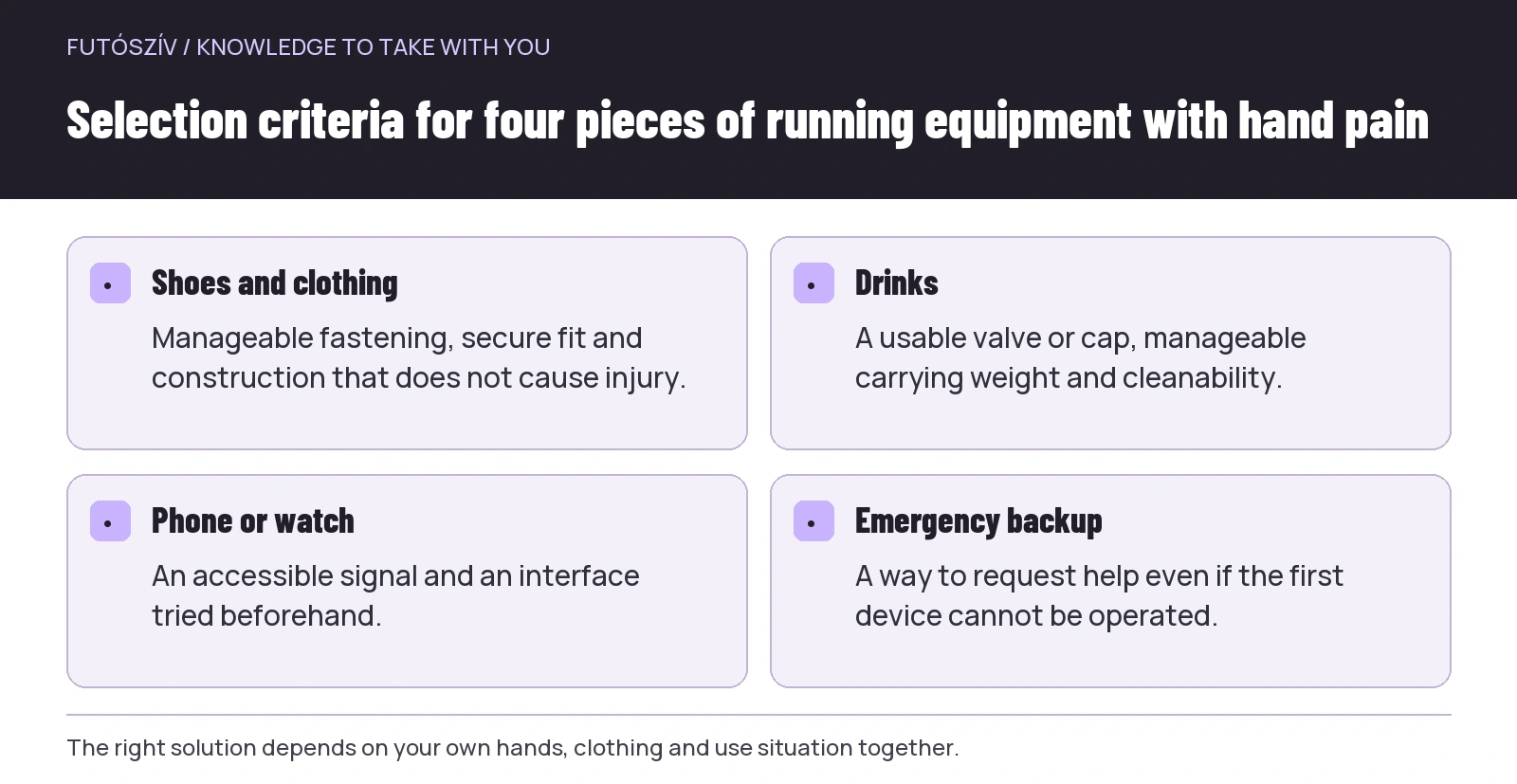 Enlarge diagram
Text version of the diagram
- Shoes and clothing
- Manageable fastening, secure fit and construction that does not cause injury.
- Drinks
- A usable valve or cap, manageable carrying weight and cleanability.
- Phone or watch
- An accessible signal and an interface tried beforehand.
- Emergency backup
- A way to request help even if the first device cannot be operated.
Phones, watches and requesting help
A small touch control or stiff side button can be a barrier even when the device offers many features. Identify which functions genuinely matter: tracking time, a route, communication or requesting help. Look for an appropriately accessible way to operate those functions on the device and test it under calm conditions.
Accessibility settings, larger controls or a preset contact may help, but verify how the particular device works separately. Voice control can behave differently in noise, wind or without reception. Do not regard one technical feature as a reliable answer in every situation.
Think through a backup: how will you request help if you cannot use the first device? This might be a signal agreed with a running partner or another method suited to your circumstances. Operate devices while stopped somewhere safe; prolonged searching on a screen while running can create a new risk.
Poles, straps and splints: not from general online advice
Running poles and different hand or wrist supports are not simple comfort accessories in every situation. Gripping a pole, loading the strap, releasing it and dealing with a fall can each present separate tasks. The appropriate wrist-splint type and use depend on the condition and activity.
The description of Cambridge’s hand-therapy service explains treatment linked to individual assessment and appropriate splint provision where needed. Do not choose a tight support merely to make pain tolerable while running. Numbness or increasing symptoms are not feedback to suppress through equipment.
Coaches should also ask about grips used during strength work. An exercise supporting running may not be usable unchanged if it requires holding a weight, resistance band or supporting position. Personal modifications can be developed with an appropriate professional.
How should you try things before buying?
Bring the gloves, jacket or vest you actually use if possible. Ask which trials and returns are available, and do not assume conditions for a shop or online retailer that you have not checked. A product video is useful but does not replace trying it with your own hands.
Review the entire sequence rather than one action. Can you reach it? Grip it? Open it? Use it? Close it securely again? You do not need to repeat this forcefully many times. If even a short trial causes pain or uncertainty, marketing it as sporty does not make the product better.
An ‘easy to open’ label alone is insufficient. Record your own specific experience: usable with gloves, too heavy when full, uncomfortable to close the buckle even with both hands. This can also make your next choice better informed.
Help does not take away independence
You may sometimes request help with an action and perform it independently at other times. That is not a contradiction. A helper should ask exactly where and how to assist, then leave the tasks the runner wants to do with them. Hand pain does not entitle others to handle someone’s equipment or body without permission.
A good solution is not necessarily striking: a better-positioned key, easier fastening or appropriately prepared bottle can make a substantial difference. Independence can also mean deciding for yourself when to request support.
If symptoms change, a previously successful system can be reconsidered. Equipment should adapt to the person, rather than the runner trying to tolerate using a product at any cost. Access to sport often becomes real through these everyday details.
Sources
- Cambridge University Hospitals: hand osteoarthritis and joint protection.
- Leeds Teaching Hospitals: assessment of activities and equipment use.
- NHS: palm pain and medical help.
- Cambridge University Hospitals: hand therapy and personal care.
How Futószív articles are prepared: our editorial guidelines.