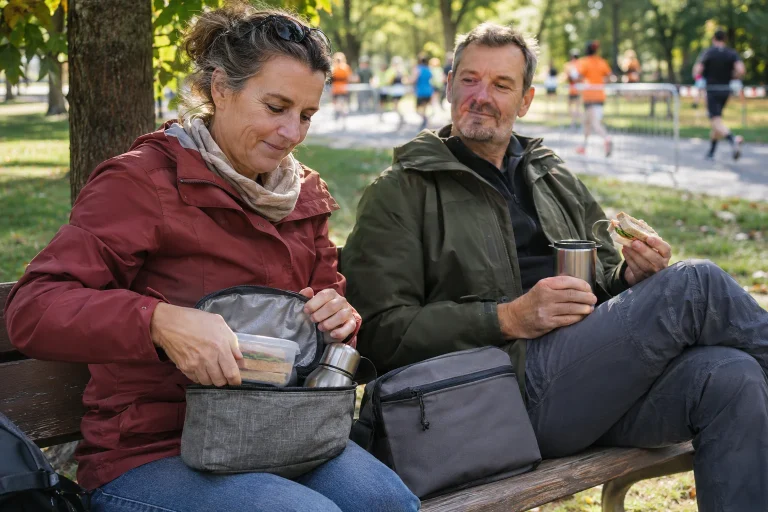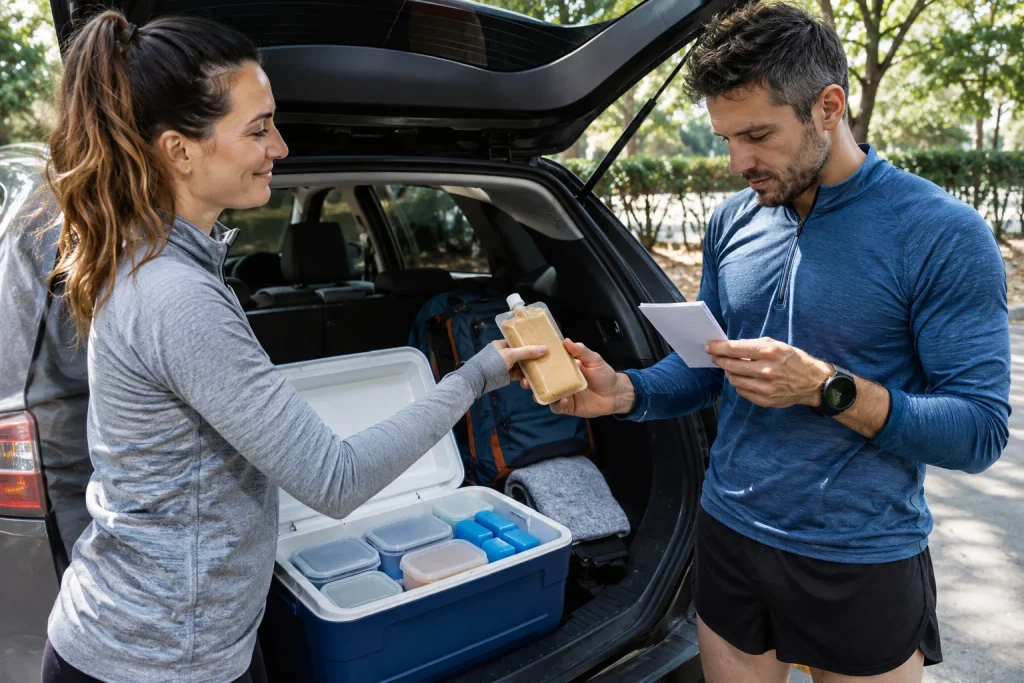
Several eating situations coexist in a relay race. One person is running, another is preparing for their next stage, a third has finished their current task, while the driver has been following the team for some time. Shared supplies therefore do not replace individual plans. Logistics ensures that participants can access their own suitable food and drink during the actual programme, rather than finding their bag is travelling in another car.
This article describes a team organisation system, not a uniform relay-race diet. It does not prescribe identical portions, recovery intervals or fluid intake for every participant. Personal needs, health conditions and sports-nutrition plans need separate determination. Follow the particular event’s current published rules for handovers, support and aid-station use. The following examples are original illustrative situations, not data from a real race team.
An access schedule belongs alongside the stage schedule
Start from the runners’ spreadsheet, but add a second view: who can access their own food pack at which location? The two tables may not show the same time. Before a stage starts, the person may be at another assembly point; after finishing, the car carrying their pack may not yet be waiting there. Identify these differences beforehand, because a mileage allocation alone does not reveal them.
The official NN Ultrabalaton team page separately explains team-race services and refreshments and describes using a personal cup or bottle at stations. This is a particular event example, not an identical arrangement for every relay. For your own event, check the team category’s services and necessary equipment. A relay exchange, aid station and opportunity to hand over a personal bag may not be the same at every point.
Keep the personal food plan short and actionable
The team does not need to know every participant’s full medical or dietary history. The logistics sheet needs to identify whose pack it is, when they require access, what handling it needs and what a helper may or may not change. The person concerned determines individual conditions under the appropriate plan. The captain organises access; they do not automatically become a personal sports dietitian.
The British Dietetic Association’s sports-nutrition overview emphasises eating suited to individual activity demands and specifically mentions rapid recovery when repeated efforts are close together. In a relay, the whole day’s schedule and the next personal stage may therefore matter, not just the distance just completed. However, this organisational article is not where appropriate food composition and quantities should be calculated.
Use two kinds of timing information
The first is the planned clock time, such as when the next exchange is expected. The second is a status linked to an event: the runner has arrived, the pack has been handed over, access for the next meal is arranged. A clock estimate can change with pace and traffic; the status shows what has actually happened. Together, they are more useful than a minute-by-minute schedule calculated beforehand and treated as immovable.
If the team becomes faster or slower than expected, update more than the running timeline. Review pack locations and food access too. The next person may already be waiting elsewhere, or delivering a pack from suitable storage may require longer. Changes should not remain on one phone. Helpers need to understand the same current version, particularly if you divide tasks between two vehicles or several locations.
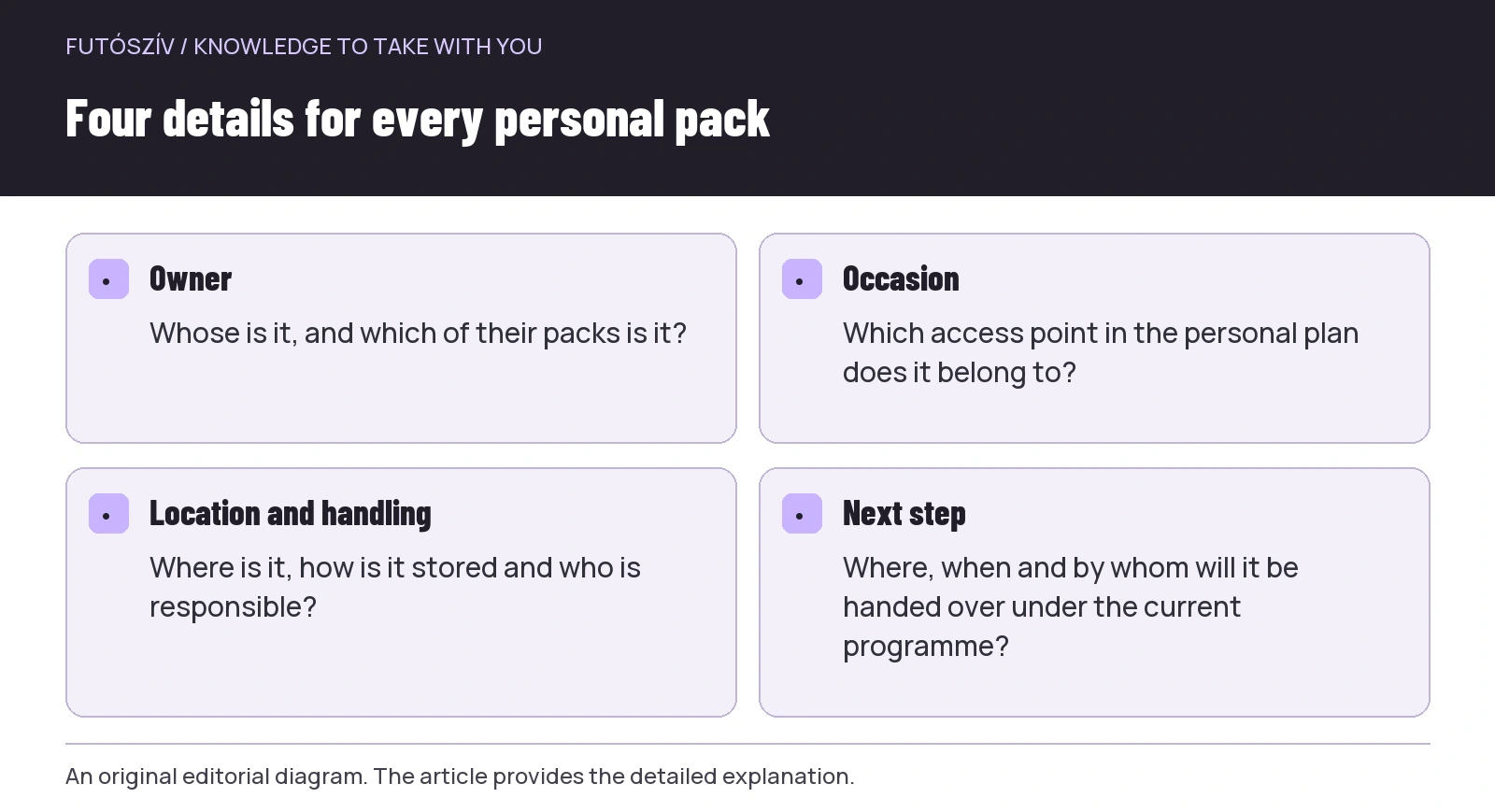 Enlarge diagram
Text version of the diagram
- Owner
- Whose is it, and which of their packs is it?
- Occasion
- Which access point in the personal plan does it belong to?
- Location and handling
- Where is it, how is it stored and who is responsible?
- Next step
- Where, when and by whom will it be handed over under the current programme?
Give each pack an owner, occasion and handling method
Beside the name, record the intended use, such as ‘before their next stage’ or ‘hand over after finishing’. This is a label based on the personal plan, not advice on meal timing. Mark storage requirements separately and whether further preparation is necessary. ‘Anna’s container’ is insufficient if the same person has three different packs for different times and conditions.
Make labels readable as text too. Coloured tape can supplement identification but should not be the only identifier. Distinguish bottles’ contents and owners, and do not swap personal mouthpieces. Keep ingredient information and instructions after opening traceable. If someone hands over just an outer package, it should not contain an unnamed mixture or an unknown order of use. A helper needs to identify the pack accurately, not guess its contents.
Shared supplies supplement rather than define everyone’s diet
There can be shared drinking water or a few agreed, appropriately handled backups. State their purpose clearly. Know the shared product’s ingredients and label, and do not arbitrarily add leftovers from another pack. For someone who needs their own food, access should not mean picking from a communal container whatever they think they can eat. A separate requirement may also need a separate handling system.
If a shared product runs out, do not look only for similar packaging when replacing it. The recipe or storage conditions may differ. Identify new purchases clearly to the team and let the person concerned decide how they fit their own plan. The logistics lead should explain what was obtained and where it is. They should not call something equivalent for personal use when they cannot judge its suitability.
Trace the cooling journey for each pack
The prevention guide from Nébih emphasises appropriate cold storage during transport for chilled food and protection of prepared food from contamination. Long waits in a team race do not change a particular food’s instructions. For each pack, know where it moves from and to under suitable conditions. A cool bag merely being present in a car does not establish appropriate handling throughout the day.
A changed handover point can affect storage too. If another helper receives the pack at an earlier point, transfer the subsequent handling instructions with it. Preparation or opening time must not disappear when changing containers, and moving to another car does not reset the cooling history. If appropriate condition is uncertain, use the backup plan. Race logistics is not a food-preservation method.
Do not make everyone responsible for everything at once
Assign preparation, transport, handover and communicating changes. These need not be four separate people, but the roles should be clear. If the same person is about to run, hand over their responsibility beforehand. The captain does not need to authorise every small bag movement centrally. The local responsible person should know what they can hand over and which changes to communicate onwards.
Use short status labels if helpful: prepared, stored in the right place, on the way to handover, handed over, further action. Agree what each means. An ‘okay’ message is not always clear: is the pack there, has the runner arrived or have they already eaten? Precise status updates prevent duplicate handovers or everyone assuming someone else completed a task. Status logic concerns facts, not pressure to monitor consumption.
| Fictional pack | Intended occasion | Where is it? | Next task |
|---|---|---|---|
| Runner A, first pack | Access before a stage under the personal plan | With the identified transporter providing appropriate handling | Hand over at the designated meeting point. |
| Runner B, second pack | After finishing the current stage | In another car, separately labelled | Agree a location using the new expected arrival. |
| Shared backup | For a predetermined loss of access | With the designated person responsible | When used, identify the exact product and its subsequent status. |
| Used utensils | Awaiting cleaning | In a separate bag | Do not return them to ready-to-use supplies. |
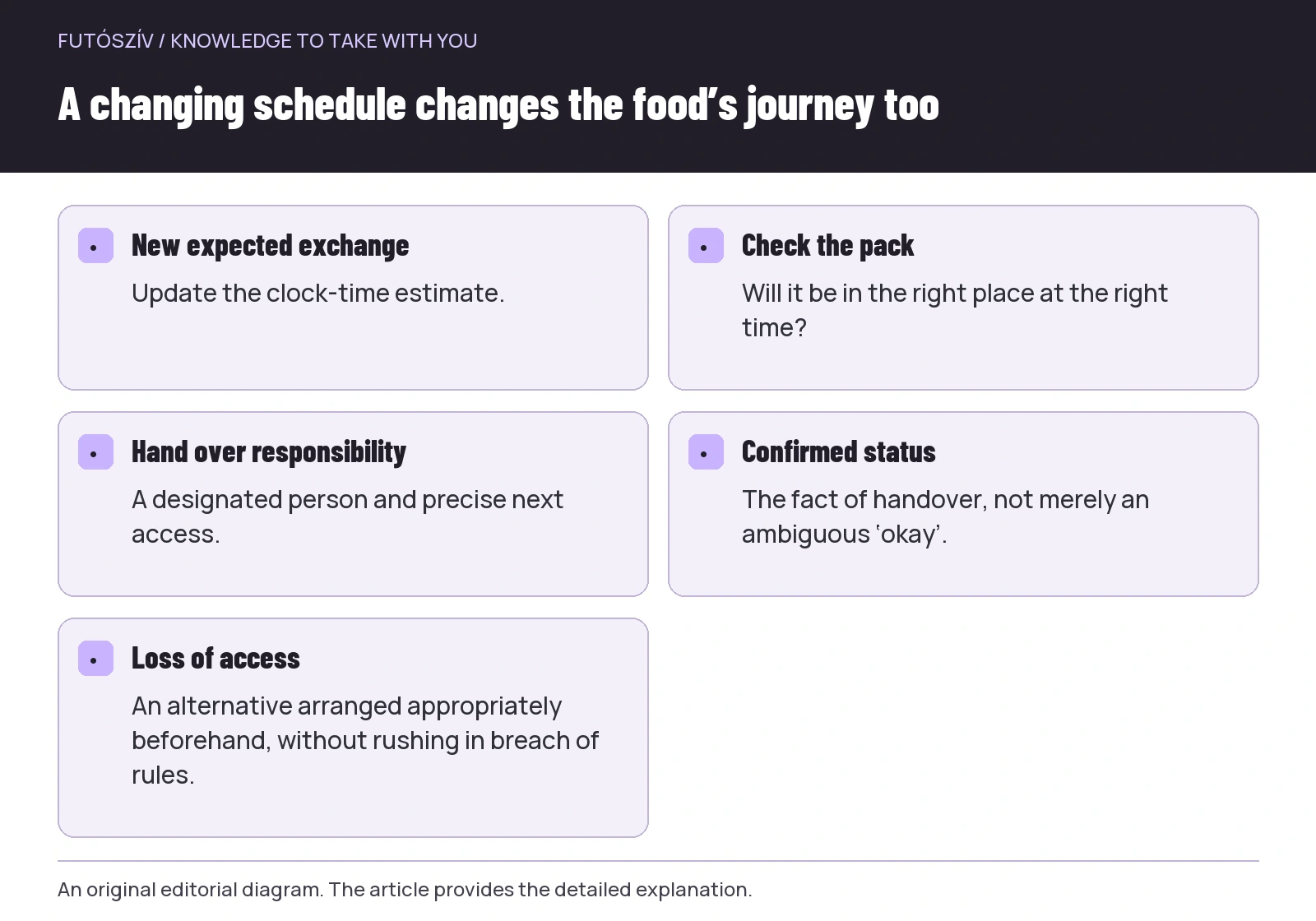 Enlarge diagram
Text version of the diagram
- New expected exchange
- Update the clock-time estimate.
- Check the pack
- Will it be in the right place at the right time?
- Hand over responsibility
- A designated person and precise next access.
- Confirmed status
- The fact of handover, not merely an ambiguous ‘okay’.
- Loss of access
- An alternative arranged appropriately beforehand, without rushing in breach of rules.
The spreadsheet should not ask for unnecessary personal information
A team member’s name, pack identifier and logistical requirements are usually different information from their full medical history. Share only what is needed to perform the task properly and what the person agrees to disclose. A short agreement describing a personal need can be precise without putting everyone’s health details on a shared screen. Helpers need to know the action required and when to consult the person concerned.
Make the document accessible to those who need it and readable at the venue. An overly detailed spreadsheet requiring horizontal scrolling on a phone is difficult to use at handover. You can create a short view for each point: the arriving runner, pack to hand over, responsible person and current expected time. Assign ownership of updating the underlying data so three differing versions, all called ‘final’, do not remain in use together.
A traffic change can also change eating arrangements
If the car is late, the runner has already arrived or the designated meeting is impossible, do more than send new coordinates. Check how the person’s access will remain appropriate. It is not the runner’s task to abandon a necessary meal to fit the team’s traffic mistake. A pre-arranged backup or another responsible person can help. Lawful, safe travel and event rules still set limits; handing over a pack does not justify an exception.
Keep a change message short: what changed, which pack is affected, what is the next arranged access and who will confirm? These details are usable, unlike lengthy explanations. If the new solution is not yet ready, say so too. ‘Almost there’ is insufficient when nobody knows which car and which point form the actual next step. Clearly stated uncertainty can trigger a suitable alternative in time.
Plan meals for helpers and drivers too
A team consists of more than runners. The person transporting supplies, organising packs or waiting at a point may also need suitable meals and rest. Their access should not depend on whatever remains after the last runner. Separate their personal pack and the time for handing over duties so they are not constantly on duty. Food logistics works when it considers the needs of the people carrying it out too.
Helping should not mean someone searching for food while driving or performing another task requiring attention. Organise stops and handovers properly. If the helper is unavailable, identify another person or next step. Abundant team supplies cannot solve a lack of access. Everyone’s access to their own suitable food should connect to a specific place and occasion.
The final handover matters after the race too
At the end, sort unused, opened and uncertain supplies according to their known handling history. Return personal containers and bottles to their owners and identify who will clean shared equipment. Nobody should take home a pack with an unknown history merely because it remained in the car. Closing the process begins with retaining information, not collecting anonymous containers together.
For the next relay, record where access broke down: did a pack remain in the wrong car, did responsibility fail to transfer or was the timing estimate too rigid? Target that specific problem. Good relay food logistics does not give everyone one shared menu; it guides different individual plans through a changing team programme. The pack, place, time and responsible person together make that possible.
Sources and further reading
- NN Ultrabalaton: Official team information and refreshments
- British Dietetic Association: Sport and exercise
- Nébih: Preventing foodborne illness
How Futószív articles are prepared: our editorial guidelines.