A compact food pack for a race trip by train is an advantage only if it is usable too. You need to retrieve the right food in a narrow seat, close it again and take everything with you in an organised state when changing trains. Onboard catering can help, but the actual service on your train and your personal dietary requirements determine what you can rely on. A train’s name is not a ready-made meal plan.
This guide offers organisational help, not a personal sports diet or a complete account of the railway operator’s current travel conditions. Check baggage and onboard-use rules with your own provider. We do not give a universal food quantity or storage duration for every journey. The particular food’s storage instructions, appropriate hygiene and individual medical or dietary requirements still apply while travelling. The examples here are fictional travel situations.
Map the entire journey from door to door
Alongside the scheduled train journey, count travel to the station, waiting, connections and the local journey after the destination station. Even a seemingly short rail section can become a longer food-handling period if you travel extensively before and afterwards. Food needs appropriate handling for more than just the hours on the train. The useful planning unit is the full window until the next reliable eating or storage opportunity.
Mark where you can eat calmly, where appropriate handwashing is available and which stages require ongoing packing or attention to connections. Do not automatically assign a six-minute connection the role of a meal break. You need an occasion that actually allows time to retrieve food, eat it and pack away. The time eating requires does not disappear because the timetable places a blank line between two services.
Bring the function of a familiar meal with you
The NSW Institute of Sport’s travel guide emphasises advance planning and choices similar to familiar daily eating when competition involves a change of environment. For a train food pack, that does not mean replicating your whole home menu. Instead, consider which eating need your own appropriate plan must meet on the journey and which familiar food can be handled in the available space.
A food is tried and familiar when you already know it in your own circumstances, but its packaging may need a separate test. A dish easily eaten with a spoon at home can become harder on a small, wobbling table with many separate parts. Do not choose solely by ingredient names: does it need cutting, mixing or a separate dressing, and can leftovers be closed securely? Personal nutritional suitability and practical handling while travelling both need to be in place.
Three packaging questions for the particular food
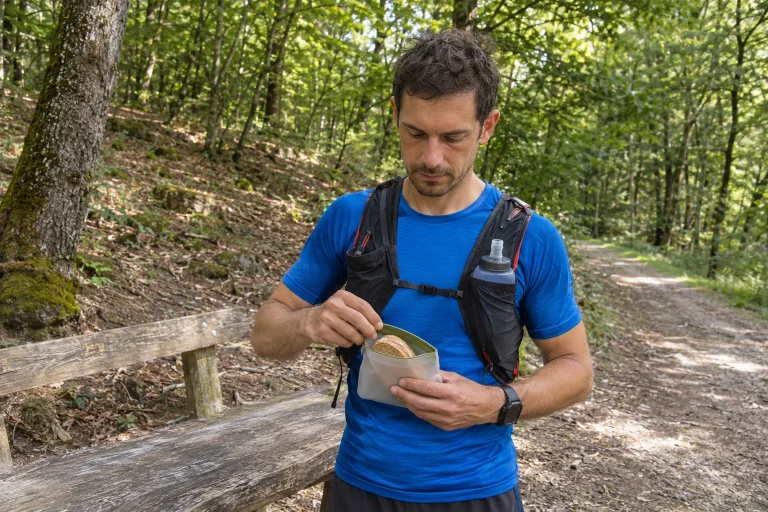
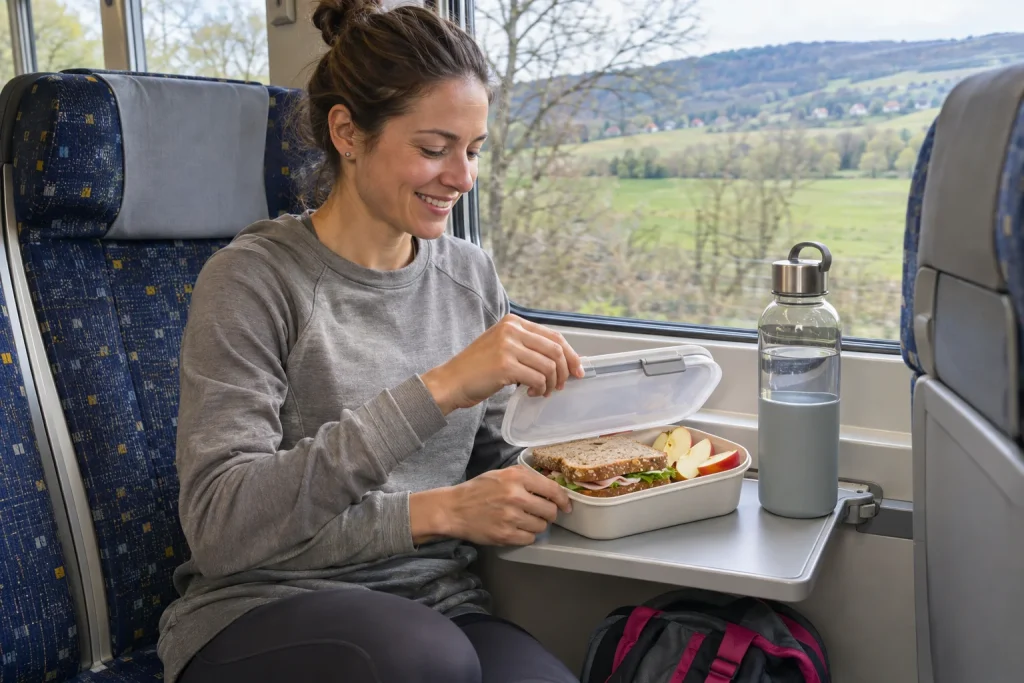
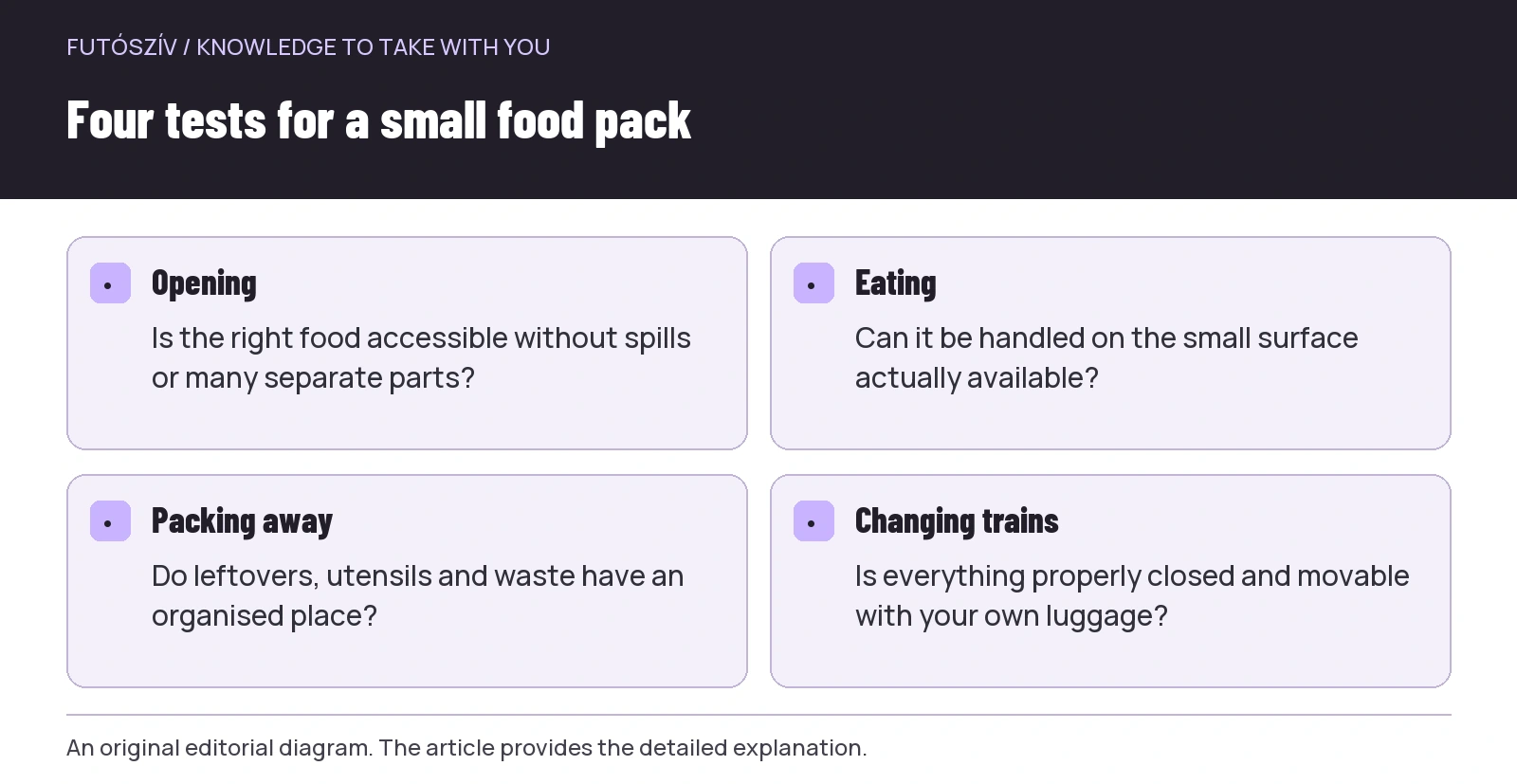
The first is opening. Can you remove the lid without spilling liquid or crumbs around you? The second is eating. Does it need two hands, a large surface or a separate bowl? The third is packing away. What happens to the spoon, leftovers and packaging after use? A clean trial at home can reveal these issues well. You are testing how the pack works, not the food’s digestive effects.
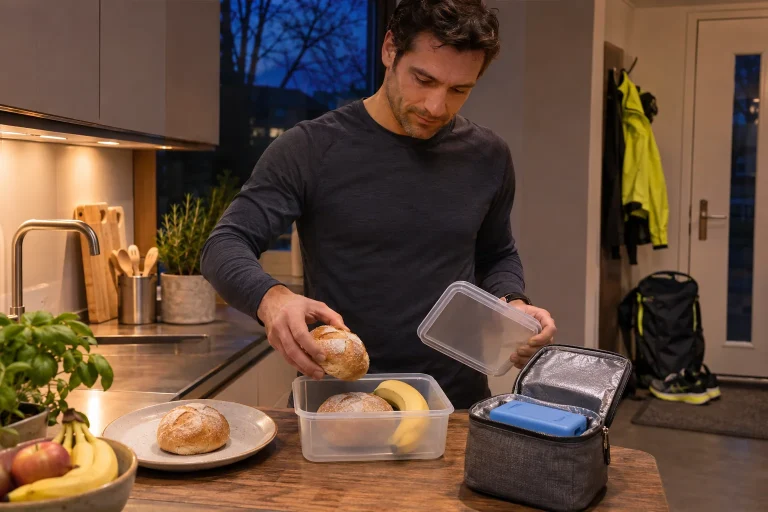
Choose a food-safe container suitable for the particular food that closes properly. Match the portion packaging to the intended occasion, provided this also meets your own needs. A very large shared container may require sharing and repeated opening among passengers, while numerous little packets create handling and waste tasks. There is no right number for every trip. The aim is to make your own meal happen with fewer unnecessary movements and a clear process.
 Enlarge diagram
Text version of the diagram
- Opening
- Is the right food accessible without spills or many separate parts?
- Eating
- Can it be handled on the small surface actually available?
- Packing away
- Do leftovers, utensils and waste have an organised place?
- Changing trains
- Is everything properly closed and movable with your own luggage?
Avoid unloading everything to reach the food compartment
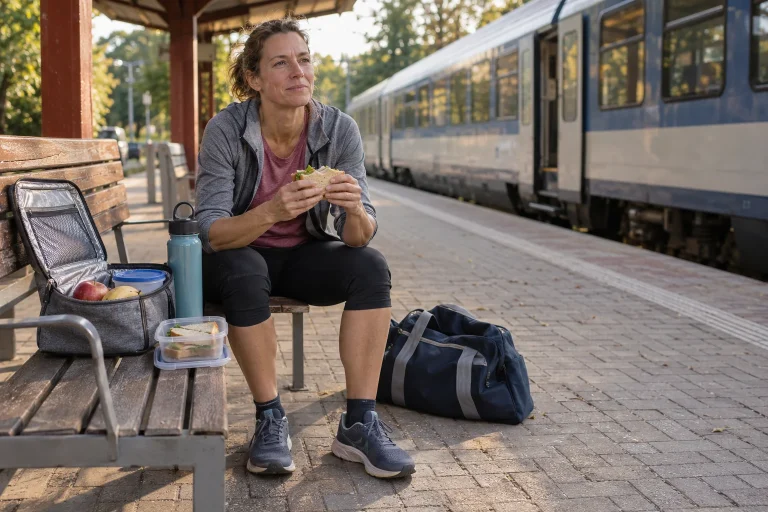
Give the pack for the next eating occasion a known place in your bag. You should not have to empty all your race equipment into the aisle for one sandwich or bottle. Keep food separate from used clothing, shoes and other potentially contaminated objects. If storage requires refrigeration, access arrangements must not disrupt the necessary cooling conditions either. Easy access does not justify putting food in an unsuitable storage location for convenience.
When changing trains, a separate hand-carried container or open drink can easily become another task. Make the pack closable and stowable so you can move your own luggage safely under the operator’s rules. Every small item does not need its own external handle. An organised internal compartment can help if you know its contents and do not need to grab the bag with a meal still half unpacked.
Check onboard catering for the specific train
The MÁV Group Utasellátó dining-car page lists trains operating with the service and available menus. It is a useful starting point, but does not mean the same food is available on any train or departure date. Check your particular train, section and current information. Another train’s menu does not provide a service at your seat.
Clarify personal requirements for onboard food separately. What does the dish contain, when can you access it and which payment options are available? The page itself notes that payment information is not comprehensive, so consult onboard staff if necessary. Stock, services or the train formation can change; a suitable backup addresses that uncertainty. Do not abandon every option of your own because you assume a dining car will exist.
Make the backup useful for a different kind of failure too
If one part of the plan is onboard catering, the backup should not consist solely of another equally unknown dish from the same service. It should address loss of access or a selection unsuitable for your diet. You need familiar food or another verified option that is genuinely accessible and can be handled appropriately on that journey. Larger supplies do not become a good backup without storage for them.
Reassess the time window when delayed too. Something suitable for the planned quick trip may face different conditions during a longer wait. A delay does not change the product’s storage requirements, and the old timetable cannot stand in for the time you will actually reach the next fridge. If the food’s condition is uncertain, do not try to rescue the plan by tasting it. Find the next suitable eating solution rather than persuading yourself to use uncertain supplies.
Food requiring refrigeration needs a solution throughout
The food-safety information from Nébih recommends appropriate ways to keep chilled food cold during transport and emphasises following label conditions. An air-conditioned train carriage is not automatically a food refrigerator. Your own food requiring refrigeration needs appropriate handling during station waiting, connections and the train journey too. Clarify this in advance for your particular pack and storage equipment.
Plan use of a passive cool bag according to its own instructions, with appropriate preparation and a way to check performance. Do not rely on uncertain, unknown performance or an ice pack feeling cold. If the food’s necessary conditions cannot be met for the whole journey, choose another appropriate solution. A compact food pack does not necessarily mean the smallest bag: the equipment for required storage is part of what you actually need to carry.
 Enlarge diagram
Text version of the diagram
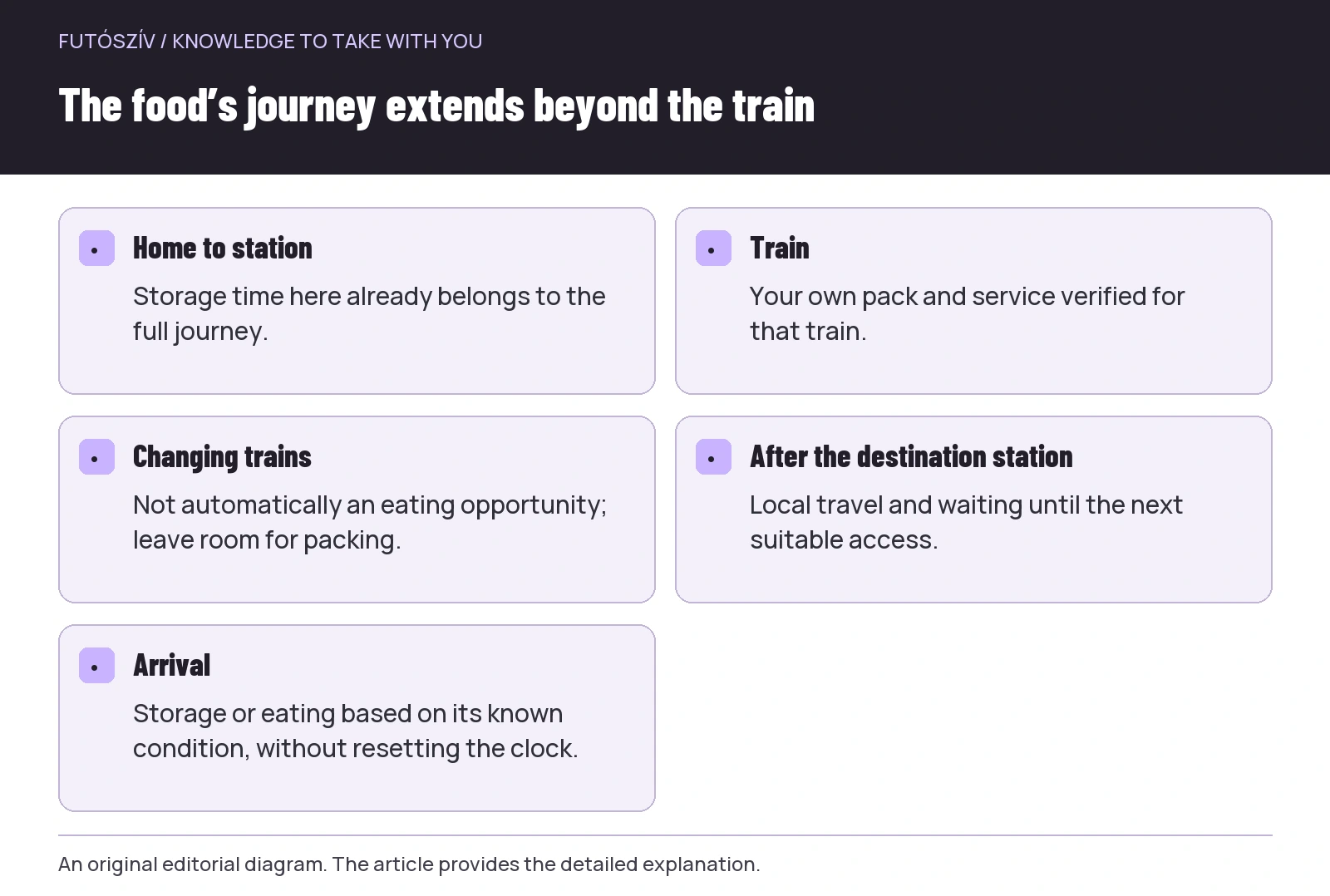
- Home to station
- Storage time here already belongs to the full journey.
- Train
- Your own pack and service verified for that train.
- Changing trains
- Not automatically an eating opportunity; leave room for packing.
- After the destination station
- Local travel and waiting until the next suitable access.
- Arrival
- Storage or eating based on its known condition, without resetting the clock.
Access to drinking water needs planning too
Drinks for the journey should be clearly identifiable, properly closed and accessible according to your own plan. Check refill opportunities beforehand, and do not automatically treat every station or onboard tap as a drinking-water source. Follow local markings and restrictions. A water point of unknown purpose does not become appropriate because it is near your bottle. If access is uncertain, reorganise supplies and stopping options appropriately.
Clearly label your own drink when several people travel. Identical bottles should not get swapped in a shared bag, and do not share mouthpieces either. If you carry drinks with different contents, labels should help identify their composition too. Do not mix powder from your personal plan into an unknown prepared drink merely because water is unavailable. A missing condition for the specified preparation needs a different solution.
| Train situation | The pack’s job | Condition to clarify in advance |
|---|---|---|
| Short connection | Supplies that close properly and can be moved together | Eating should not take time away from making the connection. |
| Small seat table | Food usable with few separate movements | Opening, cutlery and packing away leftovers |
| Planned onboard meal | Known backup of your own for service uncertainty | Specific train, current selection and personal suitability |
| Longer delay | A solution still suitable in the changed time window | Storage instructions do not reset or extend. |
| Travel after the destination station | Accessible food and drink until the actual next opportunity | Consider the full door-to-door time. |
Your own trial can model the table size too
At home, take out the intended container, bottle and cutlery on a small, clean surface. Open them, arrange them, close them and put them away again. This can reveal too many lids, parts that roll away easily or a separate mixing step. The aim is not to build an entire train interior but to understand the actions involved in your particular food pack. Use food already known to suit your own eating plan for the trial too.
If the food’s travel format does not work, change the container or choose another suitable food. You do not need to compress a whole meal into one elaborate package. Handling ingredients separately can help if storage requirements and the entire eating occasion remain workable. Choose an option that lets you carry out your own appropriate meal calmly in the real setting, rather than one that only looks clever on a kitchen counter.
Leave space for people around you too
Use food in a way compatible with the operator’s travel rules and other passengers’ comfort. Packing should not require taking over the neighbouring seat or passageway. Deal appropriately with your own spills, and give waste a separate place until it reaches a designated bin. Do not handle clean supplies with the same used cloth or bag that held leftovers and cutlery. Closing everything neatly also makes the next connection easier.
In a larger group, distinguish personal supplies from shared ones. Do not put all the food with one person if others in different carriages then cannot access it. Everyone should understand the personal conditions for their own pack, and shared backup food should have identifiable ingredient information. Group travel can help with organisation, but it does not make differing needs identical. Ask precise questions at handover rather than guessing.
The pack’s journey continues after arrival
Getting off the train does not end food-handling responsibilities. Local travel, race-pack collection or waiting for accommodation may still follow. Arrange the next appropriate storage or meal around that whole stage. Do not lose track of opened leftovers’ condition or instructions for use at the new location. Do not put an unnamed container into the accommodation’s fridge as if its contents had just been prepared.
For your next race trip by train, note which specific task was difficult: the container did not fit, the desired service was unavailable or too many steps fell during a connection. You can choose targeted changes for those problems. A compact, tried food pack works because it carries the meal you need through the journey in appropriate condition and with actual access. The smallest pack does not win; a traceable, workable solution does.
Sources and further reading
- NSW Institute of Sport: Trips and travel
- MÁV Group: Utasellátó dining cars
- Nébih: Preventing foodborne illness
How Futószív articles are prepared: our editorial guidelines.