
The cost of running is more than what you pay for the next race entry or pair of shoes. Small subscriptions, transport, shared activities and equipment needed less often can add to it. That does not mean turning your hobby into a complicated financial project. A simple budget helps you understand what you can afford and avoid automatically treating a new offer as a new need.
The aim is not to spend as little as possible at any cost. What makes sense for someone who runs locally in clothes they already own may differ from what makes sense for someone who values the shared experience of a few events involving travel. A system suited to your circumstances considers the money available alongside essential expenses and existing commitments. It does not recommend borrowing, investments or a universal saving percentage; it makes everyday planning around running clearer.
Start with the full household budget
Your running budget should not begin with how many interesting things you have found. Look at the amount you can use for this purpose in your own circumstances while keeping essential expenses and existing commitments visible. If you spend shared money, make sure everyone concerned understands the budget. A new race day should not become a shared discussion only after the entry fee has been paid.
The Hungarian National Bank’s information on household budgeting emphasises reviewing income and expenditure in advance. You can apply that principle to your running budget too: establish the available amount and expected spending first, then make your choices. Older statistical examples in the information are not current cost figures for your household; use your own numbers.
You can set an annual budget, but check when payments fall due as well. A cost may look manageable when divided over twelve months, yet several larger fees in the same month may still be difficult to pay comfortably. The plan needs to show actual cash movements, not just an average monthly figure.
First review what you already use
Make a short inventory of the equipment and services you actually use. You do not need a brand catalogue: the question is which tasks you already have a suitable solution for. You might have a separate top for rain, a simple light, a phone holder or an app whose basic features are sufficient. Without that overview, it is easy to buy another item for the same job.
Three statuses may be enough for the inventory: usable, needs checking and needs replacing. A new colour or model does not, by itself, make a usable item obsolete. ‘Needs checking’ can mean a specific question, such as whether a fastening works, a zip is intact or charging works properly. For safety-relevant items, consider manufacturer instructions and actual condition, rather than lower spending alone.
Do not turn the inventory into an obsessive usage diary. If an item of clothing works, you do not need to assign it a monetary value after every run. It is enough for the list to remind you before a purchase whether you already have an adequate solution to that need. The review is meant to simplify decisions, not continuously rate every possession.
 Enlarge diagram
Text version of the diagram
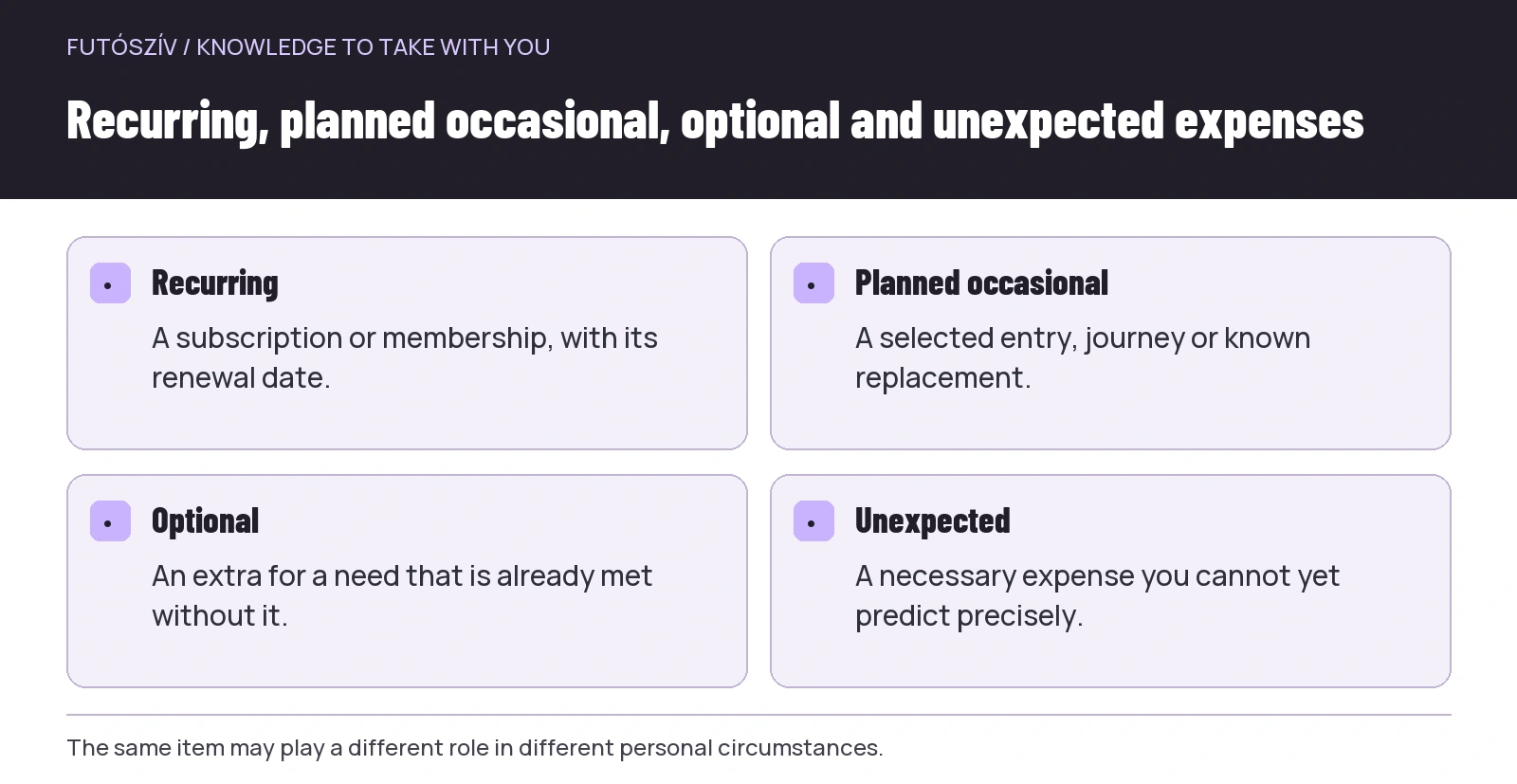
- Recurring
- A subscription or membership, with its renewal date.
- Planned occasional
- A selected entry, journey or known replacement.
- Optional
- An extra for a need that is already met without it.
- Unexpected
- A necessary expense you cannot yet predict precisely.
Separate four groups of expenses
A recurring expense repeats, such as a service subscription. A planned occasional expense might be an entry, journey or known equipment replacement. An optional expense is an extra you would like to buy but can run without. An unexpected item is a need you cannot currently predict precisely. Do not merge them into a single ‘sport’ figure.
| Group | Possible personal example | Planning question |
|---|---|---|
| Recurring | A subscription you use or a membership fee | When does it renew, and do you actually use it? |
| Planned occasional | A selected entry or a journey known in advance | When must you pay the full cost of taking part? |
| Optional | A top in a new colour, a souvenir or an additional app | What does it genuinely add to what you already have? |
| Unexpected | A broken accessory you genuinely need | What still fits within the existing budget? |
The groups are personal. Something one person sees as a convenience may be an important condition of participation for someone else. Do not simply copy a friend’s budget. Identify your own needs, and feel free to acknowledge choices made for convenience too. You do not need to invent an indispensable technical justification after the fact for every item you want.
Turn the one-off price into the full commitment
Alongside an event’s entry fee, include the associated travel and unavoidable expenses at the venue. For a device, check whether it requires another accessory or a recurring service. Not every purchase brings further costs, but where it does, those belong in the overall picture. Do not confuse a discounted introductory price with the full cost of use.
If several people share a cost, treat only the agreed contribution as certain. For shared travel, clarify who is committed to going, what the shared amount includes and what happens if someone drops out. A vague agreement can easily produce an unexpected expense that did not really need to be unexpected.
Mark how certain each cost estimate is. A current price, an amount estimated from past experience and a fee you do not yet know are different things. Do not fill a missing figure with zero. If you can only give a range, that is more honest than an apparently precise total that leaves out accommodation or the journey home.
Judge a discount against your own plan
A discount reduces spending when it lets you pay less for something you really want and will use. If another top or a third app enters your basket only because of the offer, your total spending still increases. Ask two questions: would I have looked for this solution without the offer, and does it fit the budget I chose in advance?
An urgent deadline does not automatically make an item better or an event more suitable. You can set your own thinking rule for purchases that are not needed immediately. For example, first list the task the purchase would solve and decide only at a later review. There is no mandatory waiting period for everyone; the point is to avoid making the pace of advertising your only rhythm for decisions.
Do not confuse postponing a planned replacement with having to keep using equipment regardless of its condition. A necessary replacement and a desire for something new are different questions. If there is significant uncertainty about how an item functions, resolving that takes priority over aesthetic extras. A budget helps you put things in a sensible order, not ignore genuine needs.
For subscriptions, the renewal date matters too
List the services you pay for, the channel through which you subscribed and when each renewal is due. Deleting an app and cancelling its subscription are not the same action. Check your provider’s current help information for the cancellation procedure and deadline. Do not rely on experience with a different app.
For example, Strava’s official cancellation guide distinguishes between management through the web, iOS and Android according to the purchase channel, and draws attention to the deadline before renewal. This is information for a particular service, not a general rule for every sports app. Check the fee and status in your own account rather than just looking at your phone’s home screen.
Assess use simply: which paid feature have you actually needed recently, and does it overlap with another service? You do not need to cancel every subscription to spend thoughtfully. The point is for a service you keep to be a deliberate choice, rather than the continuation of a forgotten trial.
 Enlarge diagram
Text version of the diagram
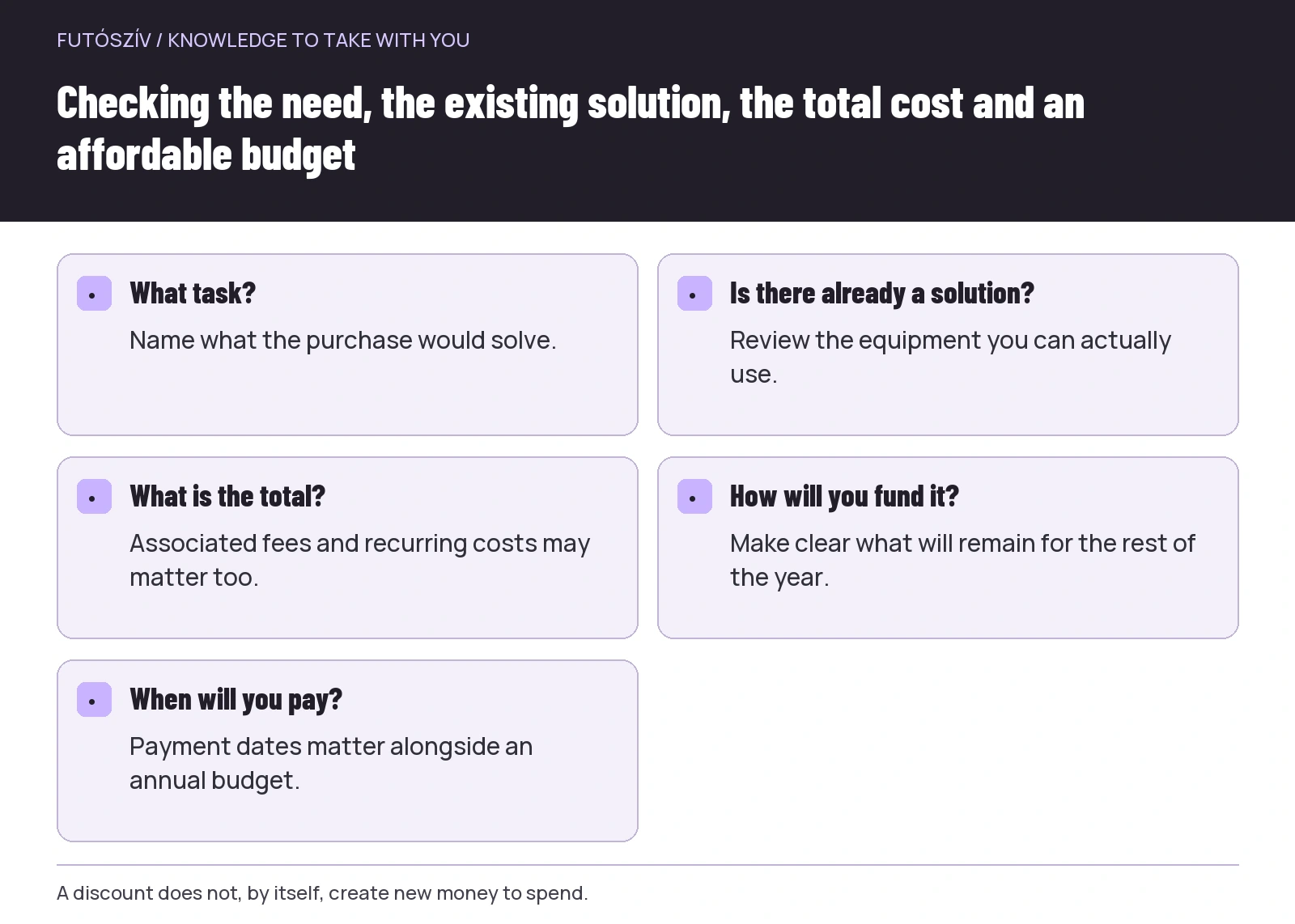
- What task?
- Name what the purchase would solve.
- Is there already a solution?
- Review the equipment you can actually use.
- What is the total?
- Associated fees and recurring costs may matter too.
- How will you fund it?
- Make clear what will remain for the rest of the year.
- When will you pay?
- Payment dates matter alongside an annual budget.
Use fictional figures to check the logic of your own system
The following example is purely illustrative, not a recommended annual budget or a current price list. Suppose someone allocates HUF 180,000 to running-related expenses for a year. They plan HUF 24,000 for recurring services, HUF 54,000 for entries, HUF 42,000 for travel, HUF 30,000 for expected replacements and HUF 30,000 not yet allocated. The five items total HUF 180,000.
If an optional expense of HUF 20,000 arises later, the question is which part will cover it. Liking an offer has not created new money. They can choose to use the unallocated amount, give up another choice or not buy now. The decision makes its consequence visible: how much remains for the rest of the year.
The example’s annual budget is equivalent to an average of HUF 15,000 a month, but actual payments may not be evenly spread. In one month, an entry payment and a travel booking may fall together. A simple monthly schedule may therefore be needed alongside the annual total. A different amount, a different rhythm and fewer paid activities can form an entirely coherent plan for your own circumstances.
Keep records you will actually update
A few columns are enough: date, item, group, planned amount, actual amount and the next related task. For an entry, travel might appear on a separate line; for a subscription, the task might include its renewal date. There is no need to put bank-card numbers, passwords or full payment identifiers in a shared running spreadsheet.
For small expenses, choose a level of detail that does not become a burden in itself. If the budget is meant to plan annual events and larger replacements, you may not need to divide every small shared household purchase into running-related portions. Where numerous small subscriptions or regular journeys conceal the total, however, more precise grouping can be useful.
Do not mark the difference between actual and planned spending with a red number alone. A short reason helps: travel cost more, an activity was cancelled, you entered a different distance, or an accessory you had not anticipated was also necessary. That leads to a better next plan. An overrun on its own says less than the decision visible behind it.
Handle social pressure separately from cost calculations
In a group of friends, the latest watch, matching team tops or a multi-day race trip can easily seem normal. Other people choosing to pay does not automatically change your budget. You can simply say that a local activity is what you can afford now, or that you are using your existing equipment. You do not have to share your whole financial situation for that to be a valid decision.
When deciding on a shared purchase or activity, make opting out a real possibility. Team-building should not depend on who pays for the same accessory. State costs in advance and distinguish what is necessary for that particular participation from optional extras. A mandatory cost disclosed later is not the same as an amount agreed beforehand.
The cheaper solution is not always better in every respect either. A different journey, complicated collection arrangements or used equipment in uncertain condition may require more work. Alongside the budget, consider your time and actual usability. Price is important, but it is not the only property that informs a good decision.
You can change the budget, and it helps to explain why
If your circumstances change during the year, you can replan running expenses too. That does not make the earlier plan meaningless: it was based on the information available then. Check which committed costs are fixed, which can be changed under their specific terms and which future ideas you will let go. Make the revision a new, deliberate decision rather than a quietly growing series of exceptions.
At the end of the period, examine which expenses actually served your own aims. A simple local activity may have brought more enjoyment than an expensive extra, although the reverse can also happen. Do not create a retrospective justification for every item. What helps with the next budget is knowing what you used, what went unused and where the original estimate was incomplete.
A working running budget is not a shopping blacklist. It shows what you are saying yes to, how you will pay for it and which other possibilities remain or disappear as a result. You can then place a new offer within your own plan. The value of running is still not determined by the total spent on the possessions and subscriptions attached to it.
How Futószív articles are prepared: our editorial guidelines.