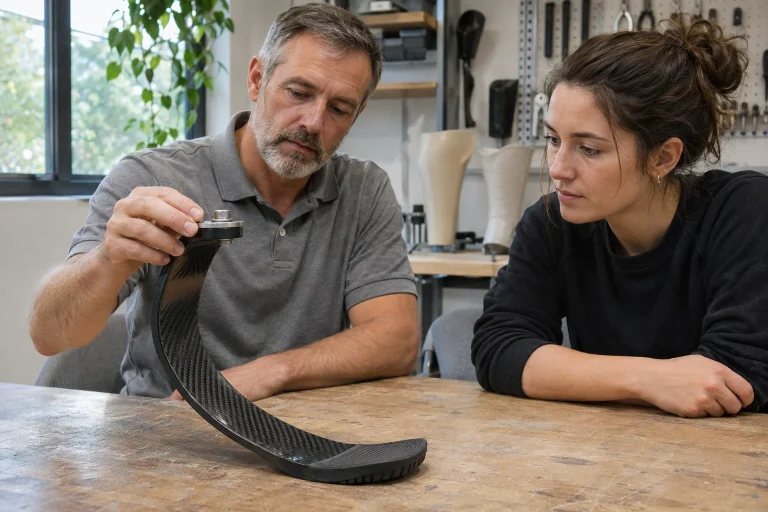
When a runner with cerebral palsy, or CP, joins a group, the diagnosis name does not tell you what movement they want or which support they request. They may run independently, participate in another way, use equipment or be meeting a sporting community for the first time. A good beginning is the same: direct conversation, a personal goal and assessment of actual conditions.
Inclusion does not mean everyone performs the same task in the same way. Build a framework that makes the participant’s decisions, current function and necessary professional support visible. This article primarily concerns adult participation and community organisation; it gives no personal running programme or medical clearance.
CP can involve many different movement situations
The CDC describes CP as a group of conditions affecting movement, balance and posture, with substantial individual differences. Body areas affected, muscle tone and coordination may differ. A diagnosis cannot reliably predict pace, endurance or assistance needs.
The underlying brain change in CP is nonprogressive, but symptoms and daily function may change during life. Do not simplify this into assuming every new concern belongs to the usual condition or every difficulty represents inevitable deterioration. Changes need individual assessment.
Do not automatically infer intellectual ability from unusual speech or movement. Ask about the time and communication method needed. The runner’s own answer and decision remain the basis, even when they arrive with a helper.
Start the conversation with activities they enjoy
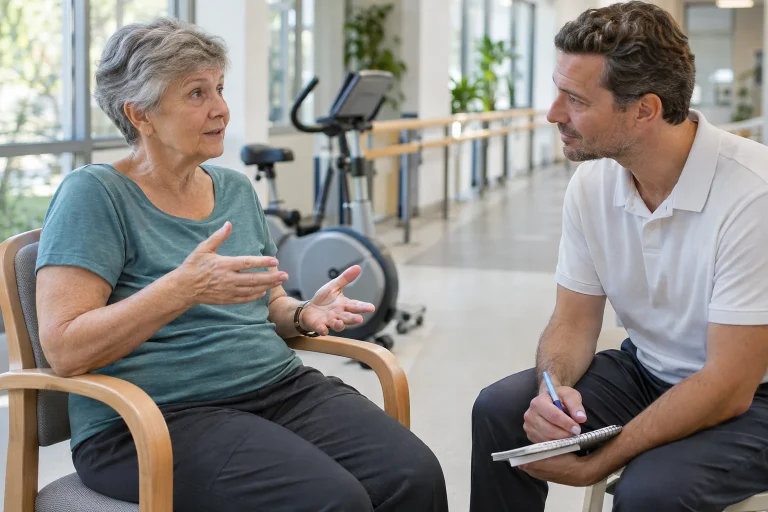
The NICE guideline on CP in adults recommends asking in care what the person enjoys doing and what prevents their chosen activity. Sporting communities can use this approach too. Do not decide beforehand that rehabilitation must be the sole purpose of participation.
Describe the outing you organise and ask what appeals to the runner. It may be shared movement, personal time, learning or competition. If their goal does not fit the usual programme exactly, explore possible modifications.
The first question should not demand a performance promise or self-imposed limitation. ‘How can we help you participate?’ is more specific than asking whether they can definitely keep up. Stating a personal limit should not prevent belonging to the group.
Individual assessment should seek movement opportunities
The NICE guidance emphasises supporting physical activity and assessing barriers to participation. Pain, joint problems or changed function may warrant appropriate professional help. Assessment is not only about prohibition, but clarifying accessible, manageable possibilities.
At consultation, describe current daily movement, previous sport, equipment use and the planned task. If running is the goal, include terrain, distance and desired frequency. The particular task needs assessment alongside the diagnosis.
A running group leader should not independently change treatment or assistive-equipment settings. Clarify healthcare questions with the appropriate provider. An organiser can help make the agreed movement framework workable in practice.
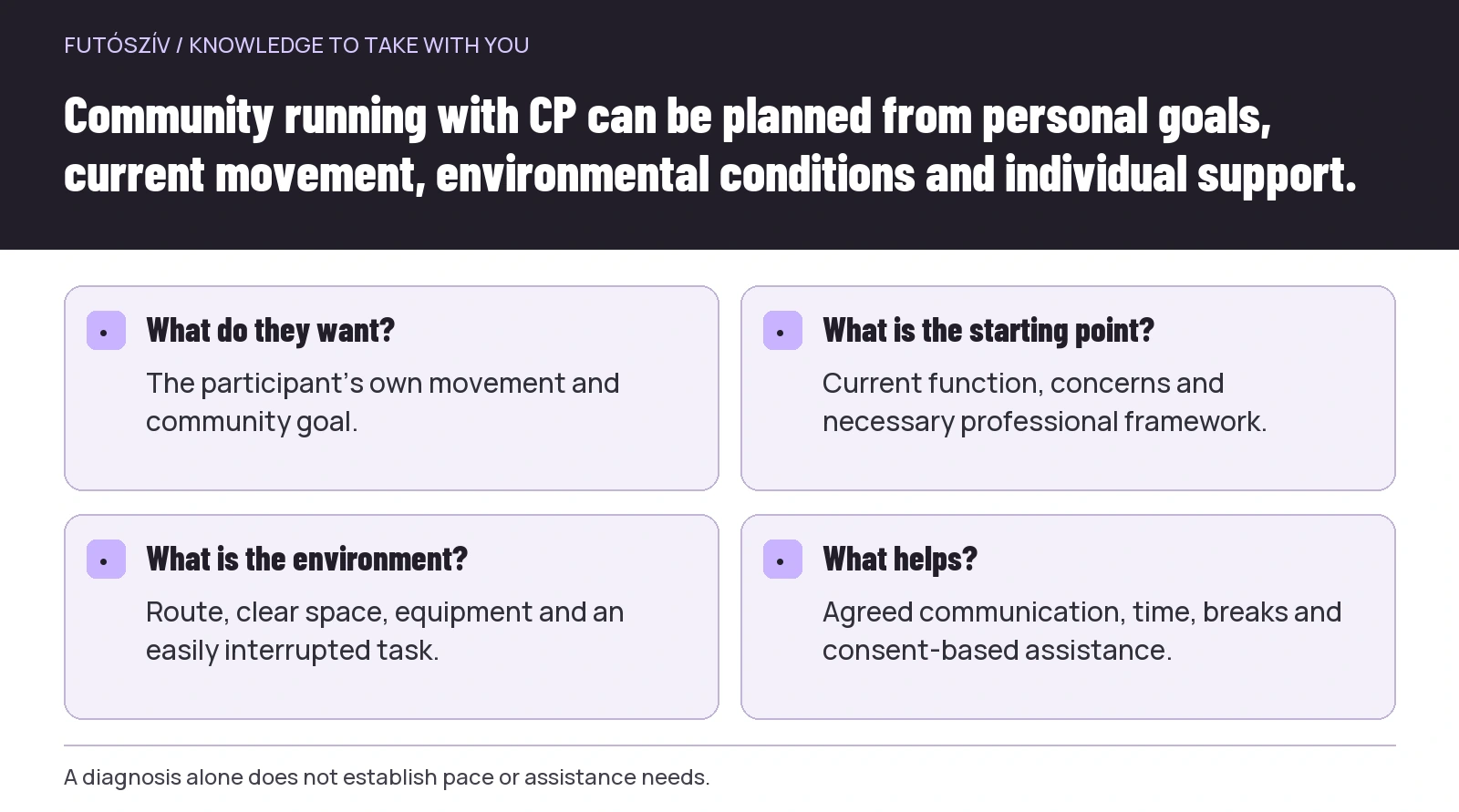 Enlarge diagram
Text version of the illustration
- What do they want?
- The participant’s own movement and community goal.
- What is the starting point?
- Current function, concerns and necessary professional framework.
- What is the environment?
- Route, clear space, equipment and an easily interrupted task.
- What helps?
- Agreed communication, time, breaks and consent-based assistance.
An outing can have several workable versions
Not every participant needs the same distance or speed to move within a community. A shorter loop, separate stopping point or different task can fit within the same meeting framework. Choose the modification’s purpose with the runner, rather than assigning an easier version unilaterally.
Make the task clear: what happens, where, for how long and how to request a change. If one part is more complex, show it beforehand. The participant then has time to ask questions and decide.
Slowing or taking a break can be options agreed in advance. The participant should not have to defend their right to adapt the programme every time. A group is more inclusive when different forms of participation already have space in its arrangements.
Frame Running may be another option
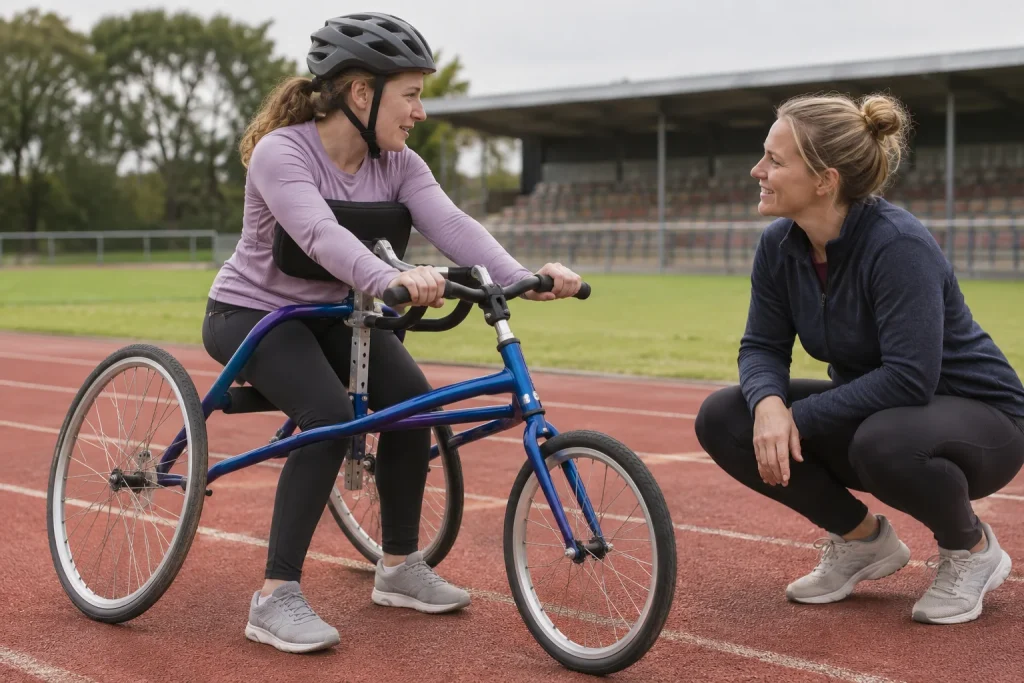
The Cerebral Palsy Alliance presents Frame Running as an equipment-supported sport that can offer running movement to people with movement and balance difficulties. It is not automatically suitable or necessary for everyone with CP. Individual suitability and instruction are separate questions.
If equipment use is considered, request knowledgeable assessment and an opportunity to try it. Fit, handling and an appropriate practice setting matter. A product video alone does not teach use or establish manageable activity demands.
Check event participation conditions separately too. Group activity, community events and official competition categories may differ. A diagnosis does not automatically grant permission to use equipment or establish competition classification.
Review the route in actual movement conditions
Surface, narrow sections, sudden turns, steep stretches and meeting points can all affect participation. Ask which information matters to the runner. A brief uneven section on an otherwise smooth route or a difficult entrance can matter too.
With equipment, be specific about clear space and turning opportunities. Do not leave passing through a gate or barrier to improvisation at the start. A route check aims to identify and address obstacles, not test whether someone can somehow manage them anyway.
For a new group or task, choose an initial environment that is easy to leave or interrupt. The participant’s experience supports the decision, but they need not organise accessibility for the entire outing alone. This can be a shared, actually assigned task.
Make daily demands and the need for breaks visible
Before sport, travel, work or other physical tasks may already have occurred. Let the runner explain today’s starting point and allow the programme to account for it. The weekly plan should look beyond minutes spent in sport.
If someone needs more time to start, handle equipment or move between tasks, include it in the schedule. Do not try to preserve the original timetable by cutting breaks. Time needed for access is not unnecessary delay.
Match monitoring of demands to the individual professional plan. Environmental arrangements can remain flexible without a new medical examination for every outing. With new or worsening symptoms, however, a running group should not attempt diagnosis.
Shape communication individually too
The NHS symptoms information also discusses possible communication difficulties, but these differ between people. Ask how the participant prefers to communicate: whether more time, writing, a communication device or another format helps.
Do not automatically finish their sentence or speak only to their companion. Ask about help rather than taking over the conversation. With important training instructions, allow time for questions and understanding the task.
Community messages should be usable too. Provide the precise time, route and changes in an understandable form. Participants should not have to infer which information remains valid from a rapid group conversation.
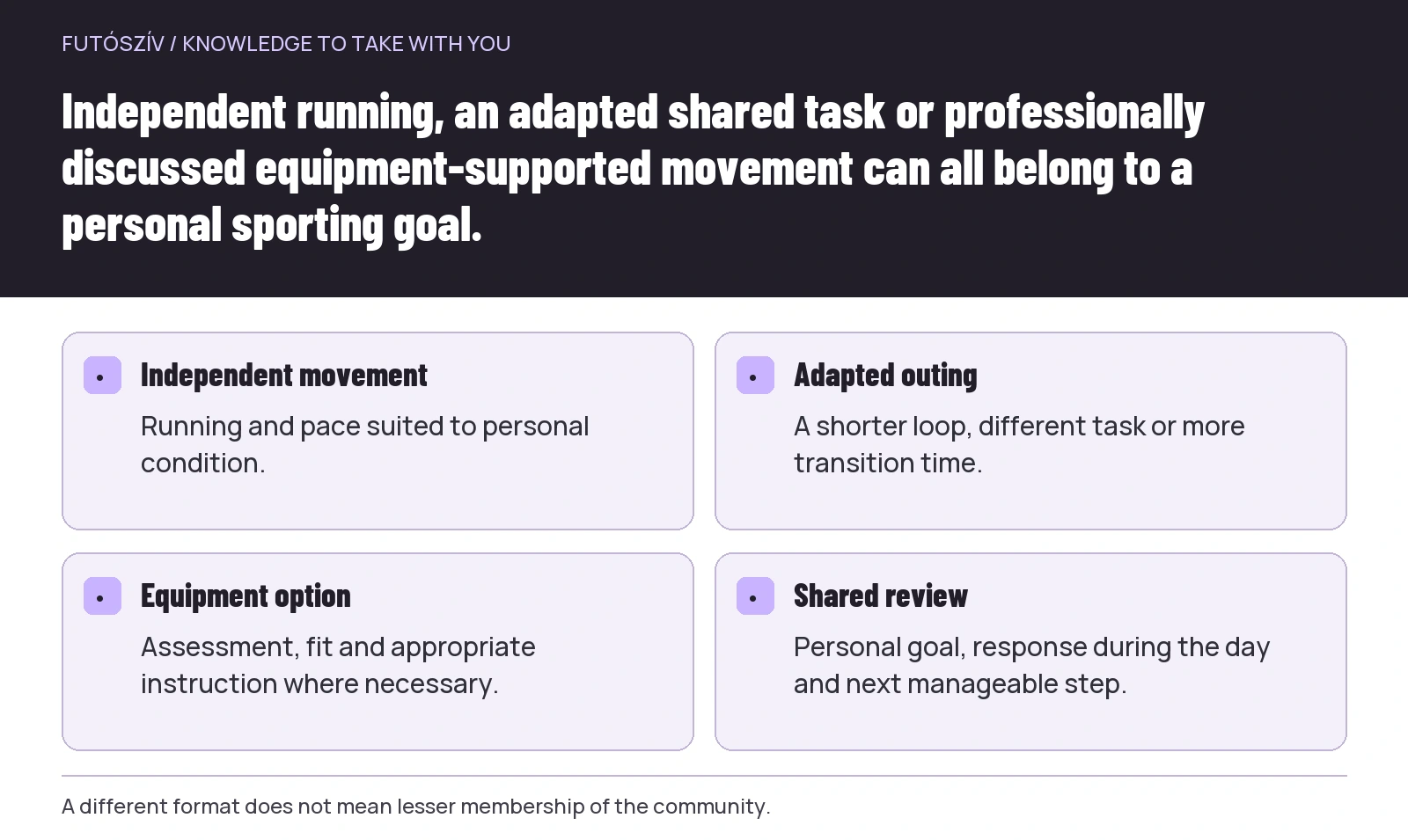 Enlarge diagram
Text version of the illustration
- Independent movement
- Running and pace suited to personal condition.
- Adapted outing
- A shorter loop, different task or more transition time.
- Equipment option
- Assessment, fit and appropriate instruction where necessary.
- Shared review
- Personal goal, response during the day and next manageable step.
Get consent before helping
Do not touch a runner’s body or equipment without prior agreement. When offering help, explain what you mean and ask whether it is wanted. The person concerned and appropriate professional guidance where needed shape the method of support.
Make a helper’s role clear. Are they accompanying, giving route information, performing a previously learned equipment task or providing other organisational help? General supervision is not the same as a specific accepted task. Participants retain independent decisions even when assisted.
Do not improvise complex lifting, securing or movement techniques in an unexpected situation. If surroundings are unsuitable, another route or stopping the task may be possible. Group pressure is no reason to accept an uncertain solution.
Do not automatically explain new pain through CP
The NICE guideline treats appropriate assessment of pain and movement difficulties as part of adult care. Changed usual condition, worsening daily function or recurring symptoms deserve professional discussion. A diagnosis does not make every new symptom self-explanatory.
Explain symptom location, onset, relationship to activity and later response. If communication is difficult, an appropriately supported description is valuable too. Symptoms need not be provoked through harder training before assessment.
Connect the healthcare plan and group arrangements to the necessary extent. A coach or leader may need only the activity and stopping framework; every personal report need not be shared with the community.
Let the athlete have more than an inspirational role
A participant with CP can be a beginner, experienced, ambitious or simply a runner seeking company. Their presence need not become a heroic story every time. Ask about and respect their own sporting goal as with any other member.
Discuss sharing photos, videos and personal stories separately. Displaying disability is not an automatic admission price to a community. Even a positively intended post can feel uncomfortable when someone wants to tell their story differently.
Make assessment of progress personal. Regular attendance, a new movement experience, a race goal or a successful shared outing may matter. Every improvement need not be measured against other runners’ pace.
Questions for checking a first shared outing
- Have we asked about the participant’s own goal and preferred movement?
- Does the task suit individual condition and necessary professional guidance?
- Are the route, equipment and transitions actually usable?
- Have communication, breaks and assistance methods been agreed together?
- Are there options to shorten, give feedback and obtain appropriate care for new symptoms?
In running-community participation with cerebral palsy, personal questions and specific adaptations help more than assumptions from a diagnosis. The goal is shared movement that gives the athlete information, choices and a real place in the community.
Sources
- NICE NG119: Cerebral palsy in adults – recommendations
- CDC: About Cerebral Palsy, 2026
- Cerebral Palsy Alliance: Frame Running Group
- NHS: Cerebral palsy – symptoms
How Futószív articles are prepared: our editorial guidelines.