After an event, plenty of praise may arrive mixed with a few irritated messages. This does not always reveal what to organise differently next time. Useful feedback is more than a satisfaction score. It is a specific experience that can be connected to a part of the programme, a decision and a possible improvement. Consider how to collect it before designing the questionnaire.
This article offers our own examples for practical evaluation of small running events. It is not a representative opinion-survey methodology or a data-protection compliance document. Establish specific personal-data handling arrangements within an appropriate professional framework. The response counts, questions and event situations shown are fictional examples.
Name the decision first, not the number of questions
What do you want to know before the next event? You may need to improve the clarity of collection information, finding the meeting point or volunteer shifts. These are separate questions. ‘Let us measure everything’ can produce a long form while leaving use of the results unclear. Choose a few actual organisational decisions.
Our own example: a team wants to know why many people looked for baggage storage in the wrong place. A general atmosphere rating out of ten is not the first question needed. Find out which information they used, which sign they saw on site and where they became uncertain. The information can then connect directly to a change in the next guide or sign.
Sport England’s evaluation framework treats aligning the information to collect with the chosen method beforehand as a separate step. We use that planning principle here: the available form should not decide what you want to learn. The questions below are our own event-management examples, not copies of the organisation’s standard questionnaire. Sport England: Select data collection methods and tools
Separate experience, fact and suggestion
‘There was a long wait’ is an important experience, but difficult to use without clarification. At which point, approximately when and for what request? ‘Have more people’ is already a suggestion, but not necessarily the only or best solution. Queue labelling or the document to prepare may have been unclear. The respondent’s experience and the organiser’s search for solutions are separate stages.
A question can collect a more specific experience without arguing with the respondent. ‘At which part of pack collection did you get stuck, if any?’ This does not assume everyone got stuck or suggest nobody could have had a problem. If a participant can give only a general impression, record it as such. Do not retrospectively turn it into precise measured information.
| Part of the feedback | Our fictional example | What can it be used for? |
|---|---|---|
| Experience | ‘I could not find the collection counter.’ | Shows that this participant had difficulty. |
| Circumstance | ‘I arrived through the south entrance.’ | Connects the problem with an approach route. |
| Suggestion | ‘Put a sign there too.’ | A possible improvement to examine. |
| Organiser’s decision | ‘We will check the information for arrivals from the south.’ | Starts a task and further checks. |
Do not merge the table’s roles. Organisers should not rewrite a participant’s experience because they choose another solution. Nor must they automatically accept a suggestion as a promise. Good evaluation preserves the experience, then separately examines a workable change.
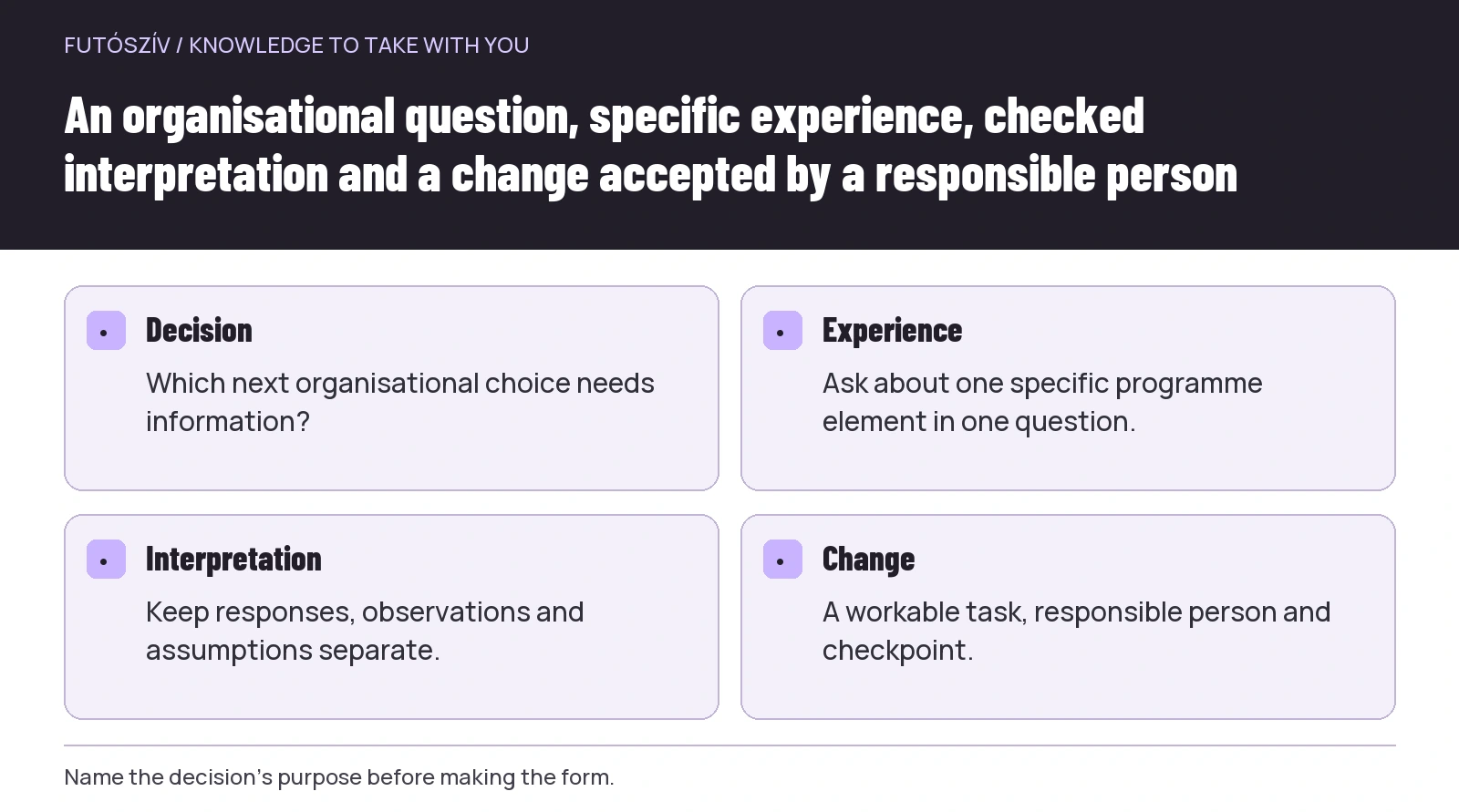 Enlarge diagram
Text version of the illustration
- Decision
- Which next organisational choice needs information?
- Experience
- Ask about one specific programme element in one question.
- Interpretation
- Keep responses, observations and assumptions separate.
- Change
- A workable task, responsible person and checkpoint.
Ask one thing in each question
‘How good were race-pack collection and refreshments?’ compresses two experiences into one answer. A participant may have liked one while having a problem with the other. A combined score is difficult to interpret later. Separate questions or a single well-chosen area may work better.
The British Government Analysis Function’s 2023 questionnaire-design guidance also addresses clear, non-leading questions and advance testing. The page says it is under review; here we use a brief methodological principle about question wording, not a current legal or regulatory rule. Government Analysis Function: Questionnaire design guidance
Our own revision example: replace ‘How fantastic was the new starting area?’ with ‘How clear was it where you should wait for your chosen race?’ The latter concerns a specific programme element and an interpretable experience. Options such as ‘I did not use it’ or ‘I cannot assess it’ may also be appropriate. Do not force opinions on details a participant did not experience.
Test even a short questionnaire
Before sending it, ask a few appropriate people to review what they understand by the questions. Do not ask only whether they like the text. Have them explain in their own words what they would answer and which information is missing. A term obvious to organisers may be unfamiliar to participants.
If a question concerns the ‘race headquarters experience’, not everyone necessarily means the same space. Naming the particular service and period may be more precise. Estimate completion time from actual testing too, rather than question count. One open question may require lengthy thought, while several simple choices can be completed quickly.
Fix problems found during testing before opening. Substantially changing a question’s meaning during collection can make comparisons between earlier and later answers uncertain. Record the update’s timing and content in your evaluation. A later report should not pretend everyone answered the same question.
Participants and volunteers see different details
A runner experiences time in the collection queue, while a volunteer may also see why the process stopped. Together, the two can provide a useful picture. Ask each role separately about what they could actually observe. Do not expect volunteers to report the entire field’s opinion or participants to professionally assess background logistics.
Sport England’s volunteering questions and answers present volunteer feedback as one source for improving future organisation. Here we highlight including experiences from different roles. Your organisation needs to establish specific collection and confidential-handling arrangements under real conditions. Sport England: Planning and organising
Your own volunteer question could be: ‘Which information arrived too late for your task?’ or ‘Was there a situation where you did not know whom to contact?’ These relate directly to a role. Answers can improve the next briefing and contact arrangements. Every volunteer’s satisfaction need not be described by one aggregate figure.
An immediate problem should not wait for a questionnaire
A feedback form is not necessarily an appropriate channel for urgent, safety-related reports or matters requiring separate administration. Participants should know where to turn in such cases. Do not promise immediate help in the questionnaire introduction if responses will only be read later. Provide a separate contact suited to the organiser’s process.
Some incoming responses may also need handling beyond a general comment on atmosphere. A designated person should pass the matter appropriately under the organisation’s procedure. Popularity or the number of similar answers does not determine whether it needs attention. A single specific, serious report can require separate consideration.
Whoever processes questionnaires should not take on a professional role they are unprepared for. The aim is finding the appropriate channel and responsible person. Do not copy detailed personal or health information into the general summary for the whole organising team. Clarify necessary handling arrangements beforehand.
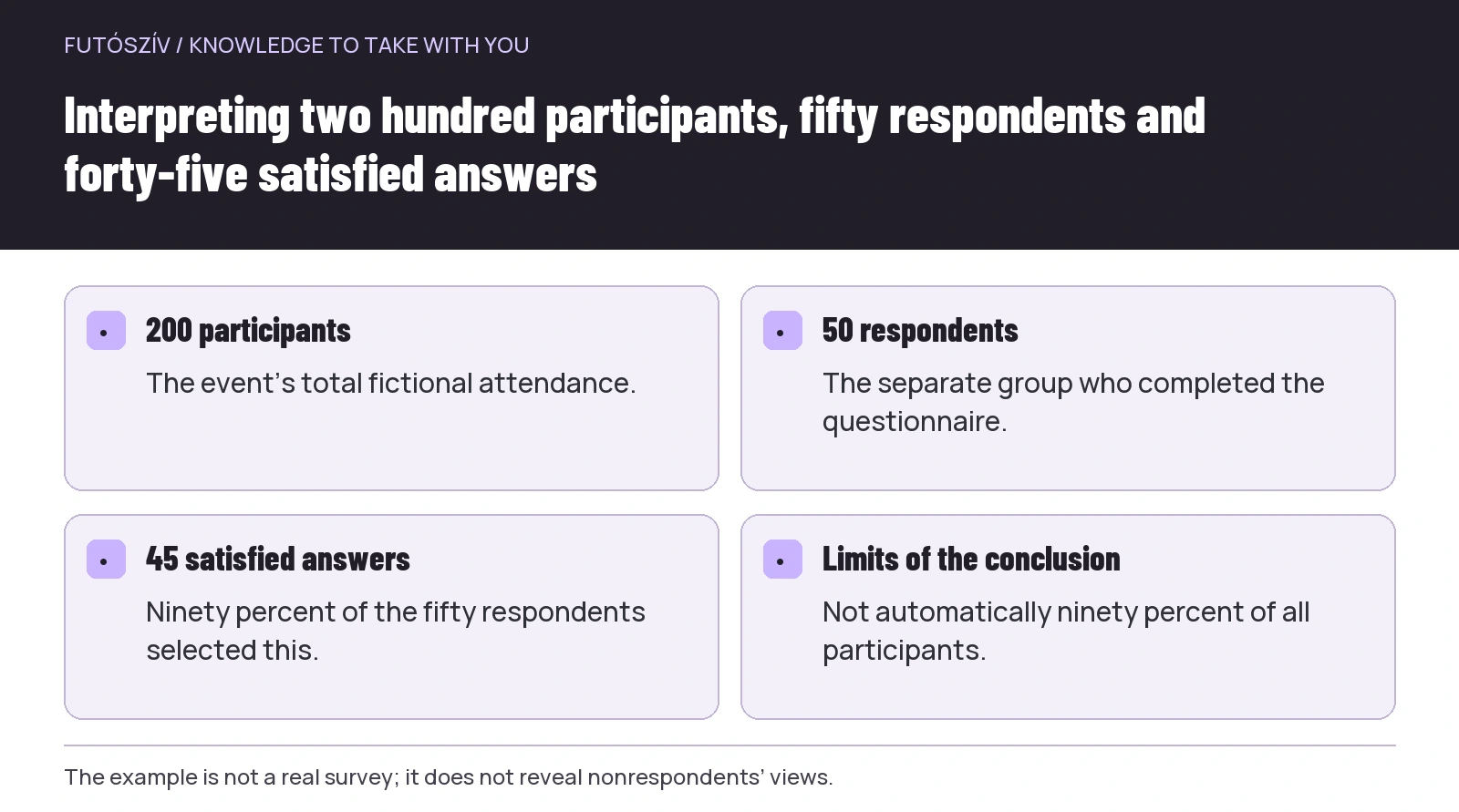 Enlarge diagram
Text version of the illustration
- 200 participants
- The event’s total fictional attendance.
- 50 respondents
- The separate group who completed the questionnaire.
- 45 satisfied answers
- Ninety percent of the fifty respondents selected this.
- Limits of the conclusion
- Not automatically ninety percent of all participants.
State the response count in the report too
A fictional arithmetic example: after an event with two hundred participants, fifty people respond and forty-five are satisfied with collection. That is ninety percent of the fifty respondents. It does not automatically establish that ninety percent of all participants feel the same way. The questionnaire does not reveal the views of the hundred and fifty who did not respond.
An accurate statement therefore names the respondent group and question. ‘Forty-five of the fifty respondents selected this answer.’ Do not hide a small response count behind a percentage or count missing answers as implied satisfaction. These figures illustrate only differences in interpretation, not results from a real event.
Respondents may include especially satisfied or dissatisfied people while others did not complete the form. Feedback remains useful, provided the conclusion’s limits are maintained. Your organisational decision does not always need a population-wide claim. Identifying and fixing a specific, verifiable problem may suffice.
Do not treat open answers merely as a source of quotations
Praise looks good in a report, but processing has a broader purpose. First group experiences by theme: arrival, collection, route information, shared space, volunteer tasks or other categories suited to the programme. Themes should not erase different circumstances. The same word can conceal two separate problems.
Examine infrequent but specific details too. Difficulty finding a counter from one entrance may be mentioned less often than a general impression of atmosphere. It can still be an organisational point that is easy to improve. Frequency and importance are separate considerations. Every decision need not depend on the largest number of similar messages.
Arrange use of public quotations separately with appropriate information and procedures. Submitting a response is not a reason to turn someone’s personal story into unlimited communication material. General lessons can often be shown without identifying details. Specific legal and data-protection arrangements belong to your organisation.
Observation and participant answers can be stronger together
Where the on-site team has appropriately collected, purpose-specific organisational observations, interpret these alongside the questionnaire. For example, when did the queue direction change, or which sign needed pointing out repeatedly? These do not replace participant opinions, but can help explain circumstances. Do not automatically infer internal feelings from observations.
In a fictional situation, some participants complain about late information. The organiser’s timeline shows that an update was ready, but a screenshot of an earlier version kept circulating. The solution may be one current information source and clear change notifications, not simply another warning sentence. Connections between several types of information help the decision.
In evaluation, indicate the basis for each statement. Participant accounts, volunteer experience, system data and organiser assumptions should not merge. An uncertain explanation should remain a question to check. This makes the lesson more precisely useful, not weaker.
Turn feedback into an accepted next step
Processing should produce more than an attractive summary. Choose a workable change with a named person responsible and a checkpoint. Instead of ‘we need better communication’, say: ‘The next invitation will have a separate approach map for the south entrance, checked alongside the on-site sign.’ Adapt the detail to your event; specificity matters.
You can also tell participants how their answers were used. You need not promise to implement every suggestion. Explain what changes, what still needs a decision and which questions remain open. The feedback loop closes meaningfully when collection leads to visible organisational learning.
Useful event evaluation does not maximise praise. It connects a precise question, an appropriate respondent group, interpreted information and an achievable improvement. Maintaining that chain means a few well-worded questions may offer more than a long form whose findings never reach the next programme’s plan.
How Futószív articles are prepared: our editorial guidelines.