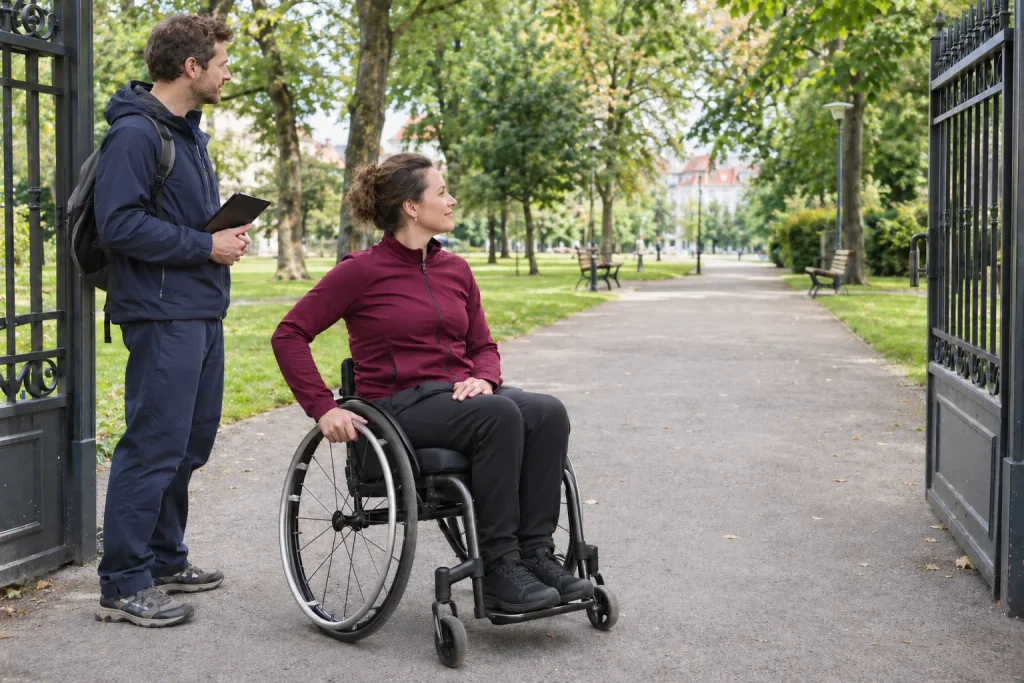
Asphalt and low elevation gain alone do not establish whether a running route is usable with a wheelchair. A narrow gate, crossfall, gravel connection or a queue directed onto grass at the finish can interrupt an otherwise usable route. The athlete’s equipment, experience and the event’s actual layout matter together.
Provide specific information and describe the whole process rather than simply labelling a route accessible. This article offers points for organisers, running groups and participants to consider during a route check. It is not a building-compliance assessment or personal equipment-handling lesson; the athlete’s own decision and appropriate professional help where needed belong to planning.
Wheelchair participation can take different forms
An everyday wheelchair, sports device, racing chair and independent or assisted movement create different circumstances. Do not assume the same speed, turning space or assistance needs. Ask the participant which equipment and mode of participation they prefer, and what route information they need to decide.
Event rules are a separate question. The London Marathon elite wheelchair race information, for example, describes a specified racing chair and separate participation requirements. This does not imply the same rule at every community run. Handcycles and other devices do not automatically have the same participation conditions as wheelchairs either.
Check the particular event’s current rules. If something is unclear, the organiser should answer precisely about equipment, helpers, the start and results classification. Do not leave the whole participation plan to a general ‘para’ category name.
Include the athlete in checking the route
The parkrun 2026 policy emphasises discussing local course details because usability also depends on the participant’s skills and experience. This does not remove the organiser’s information role: accurate information is what makes an individual decision possible.
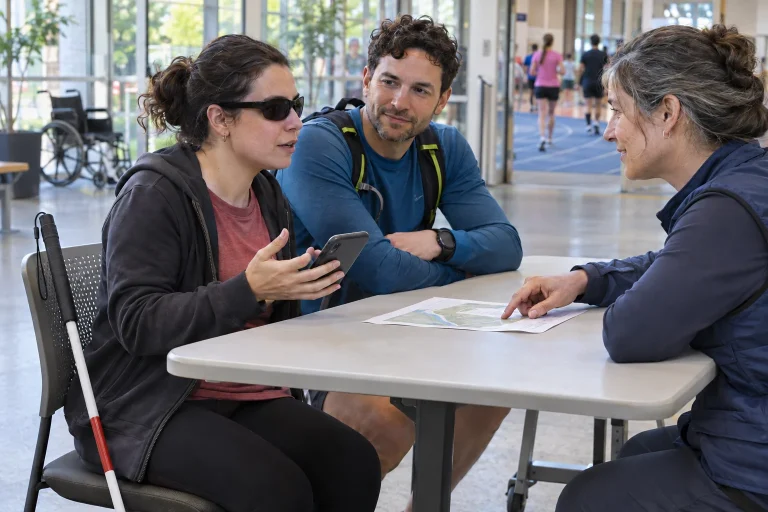
Where possible, involve an athlete using the particular equipment or a knowledgeable partner in planning. A section that seems easy on foot can differ with a wheelchair. The purpose of the check should not be to make someone prove they can overcome an obstacle, but to make the conditions accurately visible.
Participants do not have to work free as every event’s accessibility expert. Organisers can seek feedback, but gathering information and making improvements remain organisational tasks. Lived experience is valuable, not an automatic assignment of work.
Check continuity of the surface
The England Athletics organiser guide treats surface changes, uneven ground and other course obstacles as separate route-review questions. A short grass or gravel connection can matter even if most of the distance is smooth. Do not let a short difficult section disappear behind an average description.
Record cracks, loose stones, grates, temporary cable covers and raised mats. Different devices do not behave identically on them. Describing location, length and actual condition is more useful than saying there is slight unevenness.
Weather can change the surface too. Rain may bring mud, standing water or wet leaves; dry conditions may bring other difficulties. An earlier visit does not remove the need for a fresh check before the event.
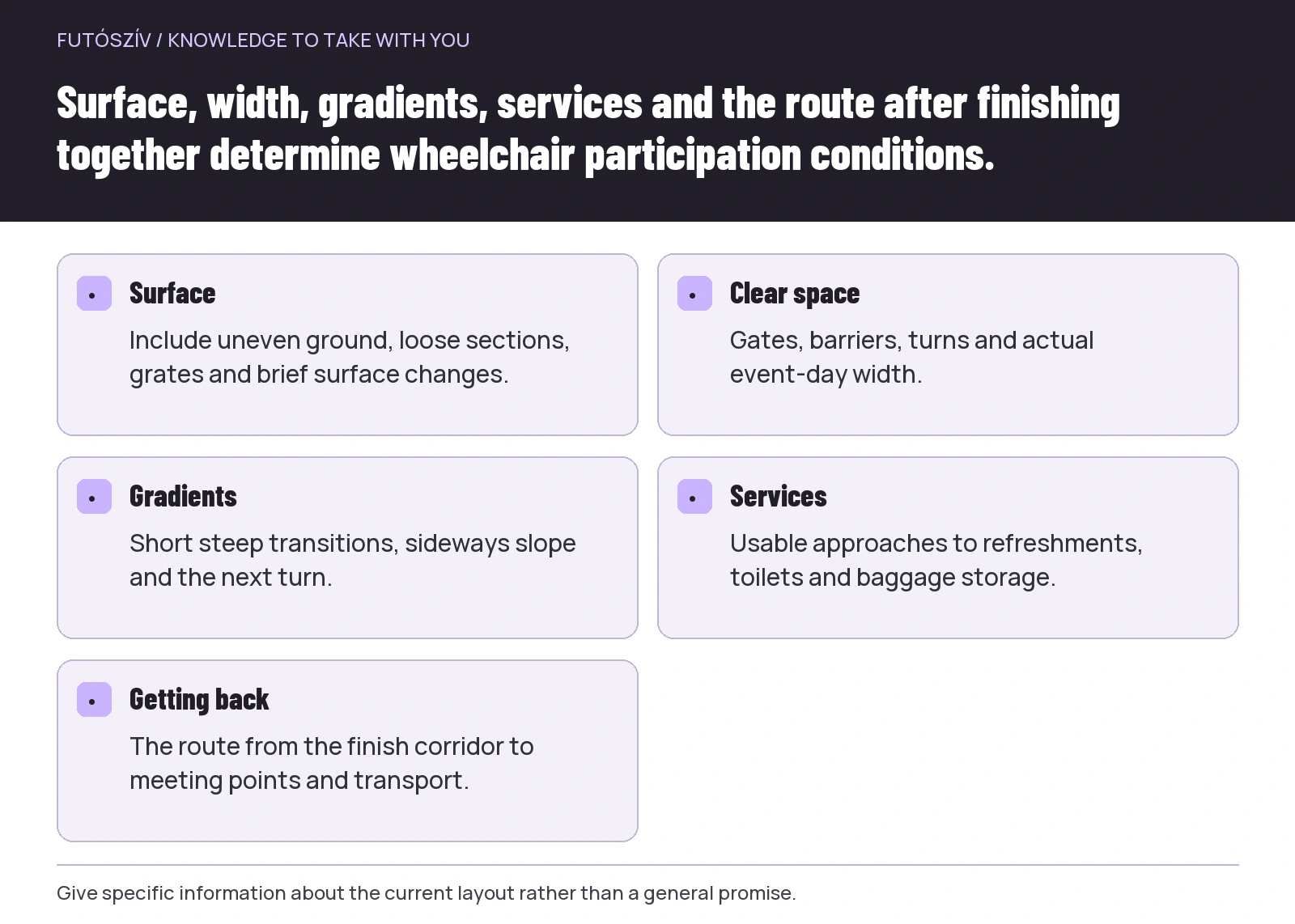 Enlarge diagram
Text version of the illustration
- Surface
- Include uneven ground, loose sections, grates and brief surface changes.
- Clear space
- Gates, barriers, turns and actual event-day width.
- Gradients
- Short steep transitions, sideways slope and the next turn.
- Services
- Usable approaches to refreshments, toilets and baggage storage.
- Getting back
- The route from the finish corridor to meeting points and transport.
Describe gradients beyond a summary figure
An elevation profile generally shows ascent and descent along distance, but not necessarily crossfall or a short steep transition. These may be separate information needed for a wheelchair athlete’s decision. If providing measurements, make clear what they concern and where.
A turn or narrowing at the bottom of a slope creates different circumstances from a long straight section with clear visibility. During the check, consider successive features together rather than only as isolated points. Route usability is not always a simple count of obstacles.
Do not give universal safety thresholds without knowing the participant or claim building compliance from a phone measurement alone. A specific description, necessary professional assessment and the athlete’s choice can together provide an appropriate basis.
Measure clear width with the event layout in place
A path may be wide when empty and narrow on race day with barriers, tables and spectators. Check actual clear space at gates, turns, starting areas and finish corridors. Space needed for two participants side by side or overtaking matters too.
Temporary equipment should not create an obstacle absent from the normal route. The location of a flag base, advertising sign or bin may be adjustable. Give such items an owner on the route-check sheet so improvement does not remain merely a suggestion voiced aloud.
Equipment dimensions may matter, but request the information discreetly for an appropriate purpose. The athlete should not first have to prove at the start that they can fit through a gate. Prior discussion makes the day easier for both parties.
Starting arrangements and speed differences need organising
An independent wheelchair athlete, an assisted participant and a runner may accelerate, slow and turn differently. The organiser should plan the start and shared course use from their own event’s conditions. Another event’s practice need not be copied unchanged.
Make clear beforehand where the participant waits, whom they contact and how they reach the appropriate position. Support-person access, baggage handling and number checks should not make the process uncertain either. The London Marathon Events accessibility information also addresses individual support needs separately; clarify your own event’s specific commitment directly.
A running group has a simpler framework, but discussion remains necessary. Companions should not stop unexpectedly immediately in front of the equipment, and the group should not block the movement space agreed beforehand. Shared signals should be known, not improvised shouts.
Make the approach to refreshment stations usable too
Table height, queue direction and stopping location matter together. Ask what help the particular participant needs and what they handle independently. An accessible cup or properly agreed handover is more practical than a well-meant but unexpected approach.
Leave appropriate space before and after the station for moving and slowing. Discarded cups, wrappers and other waste can also reduce surface usability. Keeping the area clear should be an actual assigned task, particularly during crowded periods.
Food and fluid needs are individual; a route planner does not need to provide a universal prescription. The organisational task is usable access and accurate information. If participants bring their own solution, agree its conditions beforehand too.
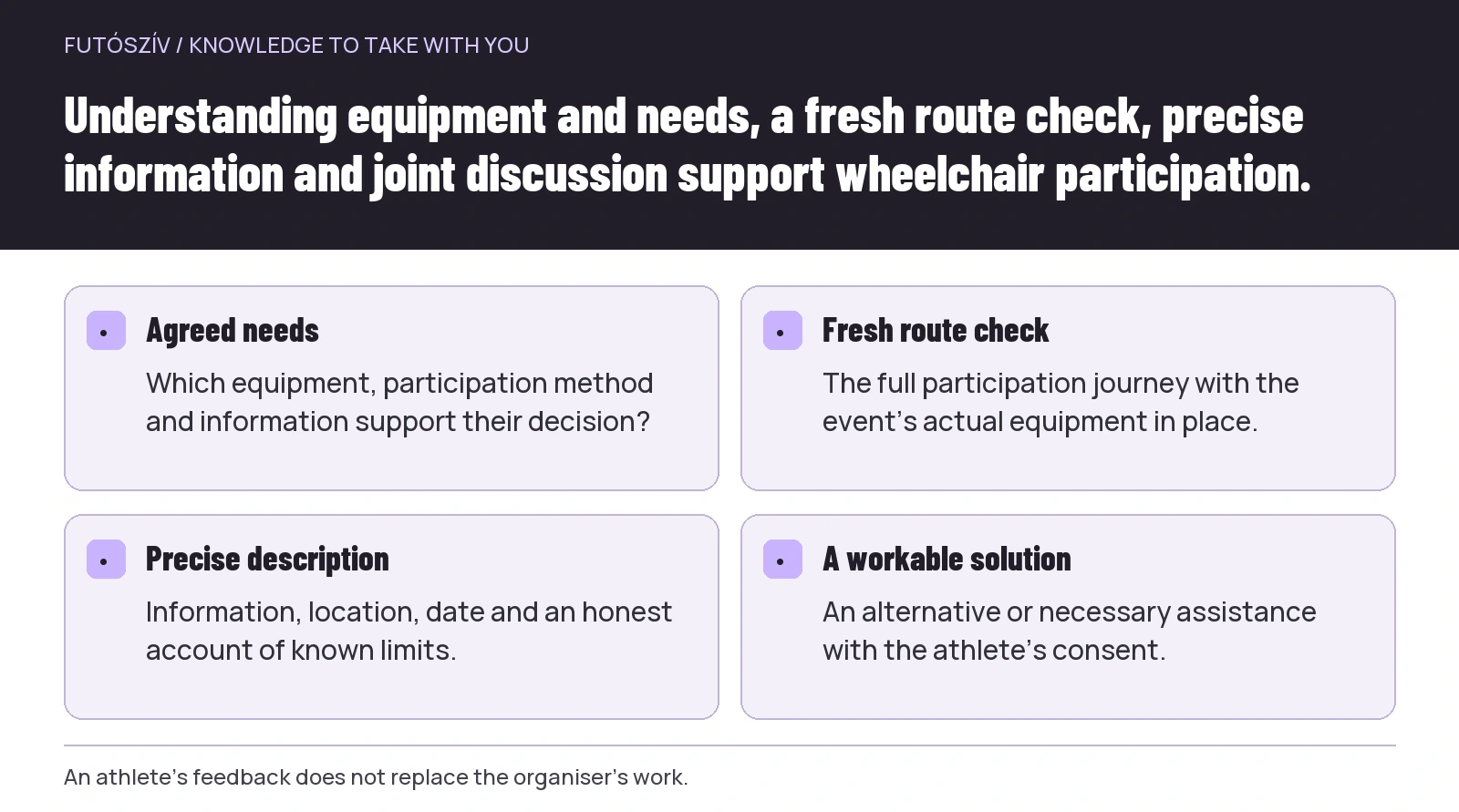 Enlarge diagram
Text version of the illustration
- Agreed needs
- Which equipment, participation method and information support their decision?
- Fresh route check
- The full participation journey with the event’s actual equipment in place.
- Precise description
- Information, location, date and an honest account of known limits.
- A workable solution
- An alternative or necessary assistance with the athlete’s consent.
Ask about assistance rather than moving the equipment
Do not touch a wheelchair or start pushing without its user’s consent. Let the athlete explain whether help is needed and, if so, how. The equipment is part of their movement and personal space; good intentions do not replace agreement.
For assisted participation, roles and equipment handling need appropriate instruction. Do not improvise lifting, securing or downhill techniques from an article. Manufacturer guidance and knowledgeable teaching where needed may matter for the particular device.
If an obstacle could be crossed only by lifting, do not automatically describe it as accessible passage. Seek a suitable alternative route and discuss the situation instead. A solution acceptable to the participant is not always the organiser’s first idea.
Toilets and baggage are not incidental services
Participation may also require a usable toilet, accessible entrance and appropriate space. Do not ask only whether an accessibility sign exists. The actual approach, door, internal use and opening during the event matter together.
Include baggage storage and changing facilities in the route check too. A usable course does not resolve the whole day if steps lead to the cloakroom. Participants need to know the limitation and real alternative beforehand to make their own decisions.
A helper’s presence is no reason to conceal an inaccessible service either. The aim is not to rely on someone sorting it out on site, but to make expectations clear in the plan. Personal help can supplement arrangements without making a route obstacle vanish.
The route continues beyond the finish mat
Check where participants are directed after finishing. Is there loose ground, a tight turn, queuing or tape that interrupts onward movement? A usable exit matters alongside an impressive finish arch.
Make the meeting point precise and baggage and toilets genuinely accessible. Explain any long expected wait too. Organiser communication should not end with recording the finishing time.
The return to parking or transport belongs to the plan as well. A gate closed later or repositioned barrier may not have been there during the earlier visit. Check the full day’s layout afresh.
What should a usable route sheet contain?
- Main surface types and precise locations of every significant surface change.
- Actual clear space at narrow sections, gates, turns and temporary equipment.
- Descriptions of short steep sections, turns after descents and sideways slopes.
- The start, refreshments, finish corridor and opportunities to leave the course.
- Usable routes to toilets, baggage storage, arrival and getting back.
- A contact person, update date and known limits not yet resolved.
Where possible, provide photographs and usable written descriptions. Participants can then ask questions based on their equipment and experience. Honestly naming a gap provides a better foundation than an overly general accessibility promise.
A wheelchair athlete’s route becomes more predictable when the details connect throughout the day. Specific information, appropriate discussion and organisational improvements actually carried out can together offer greater independence and opportunities for sport.
Sources
- England Athletics: Inclusion Guidance for Race and Event Providers, 2015
- parkrun Support: Wheels, updated October 2026
- London Marathon Events: Elite wheelchair entry
- London Marathon Events: Participants with disabilities
How Futószív articles are prepared: our editorial guidelines.