When choosing a running race with a visual impairment, distance, elevation gain and entry fee often are not enough. An accessible entry process, the guide’s registration, finding your way before the start and getting from the finish to your belongings may also matter. Accessibility depends on the entire participation journey, not a single service described as accessible.
Discussing arrangements with the organiser beforehand aims to clarify specific conditions. Not every visually impaired runner needs the same help, and no event should be assumed to offer the same solution. Choose from the questions below according to your own needs. Learn techniques for running with a guide separately through appropriate practical preparation.
Map the participation journey before registering
Consider the whole day: finding information, entering, travelling, arriving, collecting your pack, the start, course, finish and journey home. Different questions can arise at each point. Even a well-marked course does not solve an unusable entry form or an uncertain meeting after the finish.
The England Athletics inclusive guidance for event organisers also aims to improve participation practices. An overseas organisational recommendation is not automatically a Hungarian event rule, but can help you ask more precise questions. General openness becomes something you can assess when specific arrangements accompany it.
Write down which parts you handle independently, where you need information beforehand and where personal assistance may be required. Having a guide does not mean they must take over every organisational task. Your own choices and access to information should remain visible.
The organiser should answer the runner too
The RNIB guiding information emphasises asking how someone would like help. This is also the starting point for event communication: let the person explain what they need. An organiser should not send essential participation information only to the guide if the runner wants to discuss it directly.
Choose an appropriate contact channel and request a usable format. It may matter that a response arrives as text, rather than information written only on an image. Even after a phone discussion, a short written summary of deadlines and commitments can help.
You do not need to send a long health history to the general organising address. Begin with the question relevant to participation. If documentation is genuinely required by the event rules, ask exactly what is requested, for which purpose and through which appropriate channel.
The entry form’s usability is a first decision point
If you use a screen reader or another assistive technology, try the main registration steps before the deadline. Can you access fields and error messages, follow payment and receive understandable confirmation? Working around every technical fault alone is not your responsibility.
If there is a problem, describe the specific barrier: at which stage and which task cannot be completed? Request an equivalent, safely usable solution and confirmation of registration. A helper should not register you using their own address so that all later information goes to them.
Your competition category and support needs may be different information. Do not randomly choose another classification because the form lacks a clear way to request help. Ask the organiser how your participation can be recorded accurately.
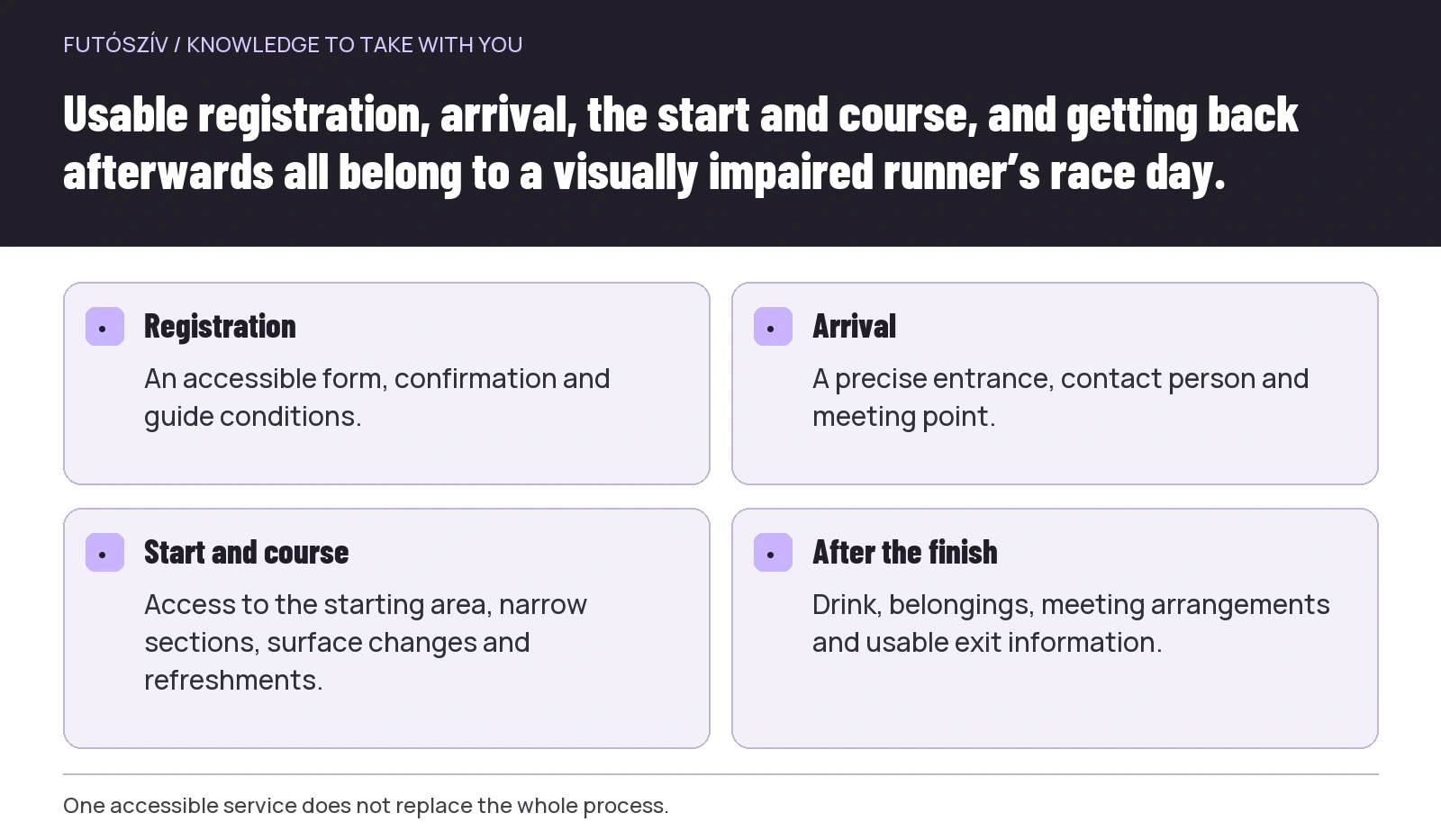 Enlarge diagram
Text version of the illustration
- Registration
- An accessible form, confirmation and guide conditions.
- Arrival
- A precise entrance, contact person and meeting point.
- Start and course
- Access to the starting area, narrow sections, surface changes and refreshments.
- After the finish
- Drink, belongings, meeting arrangements and usable exit information.
Clarify the guide’s registration separately
Ask whether a guide needs a separate entry, identifier or race number, and by which deadline. Who handles the information, is there a separate fee and what happens if the partner changes? Do not assume an ordinary entry automatically gives a guide access to the same areas.
The current London Marathon Events information describes, for example, a support-runner place that can be requested separately in certain participation circumstances. This is that organiser’s system, not a rule granting free participation at every Hungarian or overseas race. Check your own event’s conditions directly.
Also agree the guide’s role at the particular event and which competition rules apply. The presence of a helper, an official guide-runner category and results classification may differ. Current event rules provide a more precise basis than memories of another race.
Do not confuse a welcome with an available guide
An event may welcome visually impaired runners while being unable to provide its own guide. Another event may have connections with trained volunteers. Establish what is actually available and what you need to arrange beforehand.
The parkrun volunteer role description discusses supporting a visually impaired participant as the separate VI Guide role. This does not mean every location automatically has a suitable partner for every occasion. Local availability and preparation together require separate discussion.
With a new guide, the start line should not be the first meeting. Learning shared signals, rhythm and preferences takes time. An organiser’s response is usable when it clarifies not only the person’s presence but also opportunities for appropriate preparation.
On arrival, precise location descriptions matter
Ask for an address, approach information and an easily identifiable meeting point. ‘Beside the main gate’ or ‘at the stage’ may be insufficient when there are several entrances and the site has been rearranged for the event. A specific entrance and contact person are more helpful.
The route from a transport stop or car park to race headquarters should be open to discussion too. Does it cross a busy road, temporary fencing or a site closure? Do not first try to agree assistance on arrival during the few minutes before the start.
If arriving with a guide, clarify where you can meet if travelling separately. Choose a place and communication method usable by both. Reducing lost minutes and uncertainty forms part of the race experience.
Ask through the process before the start
Where do pack collection, baggage storage, toilets and entry to the starting area take place? Can the guide stay with you where needed? Starting areas, barriers and crowd movement create different circumstances from a familiar training route.
Request advance information that also reflects changes during the day. A changed start or location should not be discoverable only through announcements or a distant screen. A contact agreed with the organiser may help, but main information should be accessible to every participant.
Allow enough flexibility in your schedule to find your way, but do not accept that arriving earlier must resolve every organisational gap. Accurate information and a well-planned process are also the organiser’s responsibility.
You need more than an elevation profile for the course
Ask about surfaces, narrow sections, sharp turns, kerbs, surface changes and traffic appearing on the course. Space available for two people moving side by side may matter too. A map and GPX file are useful additions, but do not fully describe on-site conditions.
Plan course communication according to your needs and the arrangements developed with the guide. The organiser can provide an advance description and organisational help, but cannot replace cooperation while running. Ask what changes to expect near the start and finish.
Refreshment stations deserve separate questions. Where does one begin, on which side, how long is it, and how can you safely approach or bypass it? Crowds, discarded cups and unexpected sideways movement are circumstances worth discussing beforehand with the guide.
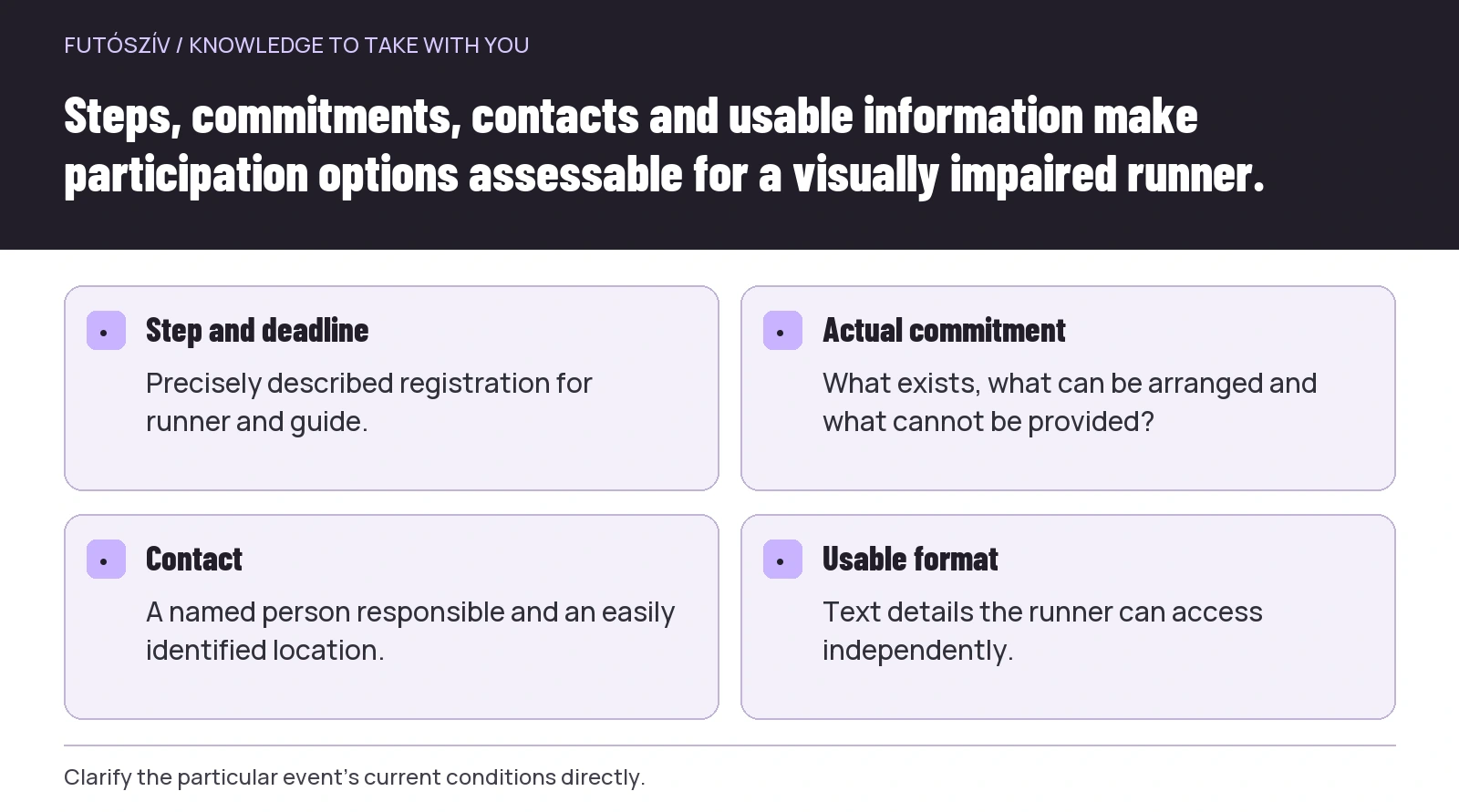 Enlarge diagram
Text version of the illustration
- Step and deadline
- Precisely described registration for runner and guide.
- Actual commitment
- What exists, what can be arranged and what cannot be provided?
- Contact
- A named person responsible and an easily identified location.
- Usable format
- Text details the runner can access independently.
Have a plan for shortening or withdrawing
The participation plan also includes what happens if you finish the outing early. Where can you ask for help, how can a particular course point be identified and how will you get back? A route difficult to leave may require a different decision from a short loop course.
Keep contact details available in a form you can both use, rather than only on a tiny printed card. Learn the event’s emergency information too; a general running-group message is not an appropriate route to help in every situation.
Agree beforehand with the guide that slowing or stopping are accepted options. Organisational difficulties should not force you to endure an uncomfortable or uncertain situation until the finish. Your own decision still matters after the start.
Keep information accessible after the finish too
Beyond the finish arch, many events have busy movement and several directions to follow. Ask where to find drinks, belongings, toilets, meeting points and exits. If you may separate from your guide, agree how to reunite beforehand too.
Usability of results and later information also forms part of participation. If necessary information arrives only as an image, you can request text. In feedback to the organiser, name the specific step that helped or created a barrier.
Discuss publication of pictures and stories separately. Presenting an event’s inclusive intentions does not override the runner’s own communication choices. Your sporting experience is not automatically material for a community campaign.
A short message template for the first discussion
‘I would like to take part as a visually impaired runner; my chosen distance is … . I would like to clarify the following participation details: how to register a guide and the fee; access to an appropriate starting area for us; important narrow sections and surface changes on the course; and the meeting and baggage-collection points after the finish. Please send your reply in a usable text format. If another contact is responsible, please provide their details.’
Adapt the template to your needs without sending unnecessary personal details. You may have only two questions or request different help. The organiser’s reply should show what actually works and what needs further discussion.
What makes an answer useful?
- It specifically describes the runner and guide registration steps, deadlines and information needed.
- It explains what exists, what can be arranged and what cannot be provided.
- It names a contact person and precise meeting point.
- It provides usable details about the course and starting process.
- It leaves room for the runner’s own needs and further clarification.
Entering with a visual impairment becomes more predictable when goodwill becomes a specific participation plan. You do not have to solve every question alone or choose the same support as another runner. Usable information allows you to decide about an event according to your own sporting goal.
Sources
- England Athletics: Inclusive guidance for event organisers
- London Marathon Events: Participants with Disabilities
- parkrun Support: Volunteer Roles – VI Guide
- RNIB: Guiding a blind or partially sighted person
How Futószív articles are prepared: our editorial guidelines.