A drinking-water plan for a long urban run involves more than marking a few fountains on a map. A marker can tell you where to look, but you must separately establish whether the facility provides drinking water, can be reached and operates at the planned time. A usable plan also says what you will change if one point is unavailable. The running route and access to water then become connected rather than separate ideas.
This article concerns organising drinking-water access for adult recreational runners. It does not establish personal fluid needs, give a universal litres-per-hour amount or verify a particular fountain’s condition today. Adapt the drinking plan to individual circumstances; where fluid or electrolyte management is prescribed for health reasons, individual professional instructions take priority. The examples below are constructed route situations, not verified Budapest running routes.
Access to water and how much to drink are separate questions
The British Dietetic Association sports nutrition information emphasises appropriate hydration before, during and after training, linking planning to individual sporting demands. This does not establish one bottle size sufficient for every runner. Equipment and refill points should enable your own appropriate plan. A fountain’s availability does not by itself determine how much you need to drink.
If a route includes only one uncertain point, for example, do not try to solve this by drinking unusually large amounts beforehand or postponing access to needed fluids until the run ends. An access problem calls for changing the route, timing or equipment. Do not force a personal drinking plan to fit a service failure on a map. If they do not match, first rearrange the run’s practical framework.
Make usable point cards rather than a list of locations
The municipal Cooling Budapest page offers a drinking-fountain map and refers to fountain display in BudapestGO. This provides a useful starting point for gathering locations. In your own notes, however, include access and the checking date alongside the place name. Do not automatically call mapped facility information a live operating update unless the service actually provides that information.
A point card needs only a few well-chosen fields: precise location or clear landmark, the designated function of the water source, approach, known restrictions, checking source and date. Add the detour from your own route and the direction of the backup. You do not need a detailed database for the whole city. Three points understood properly may serve your run better than twenty markers for which you know only coordinates.
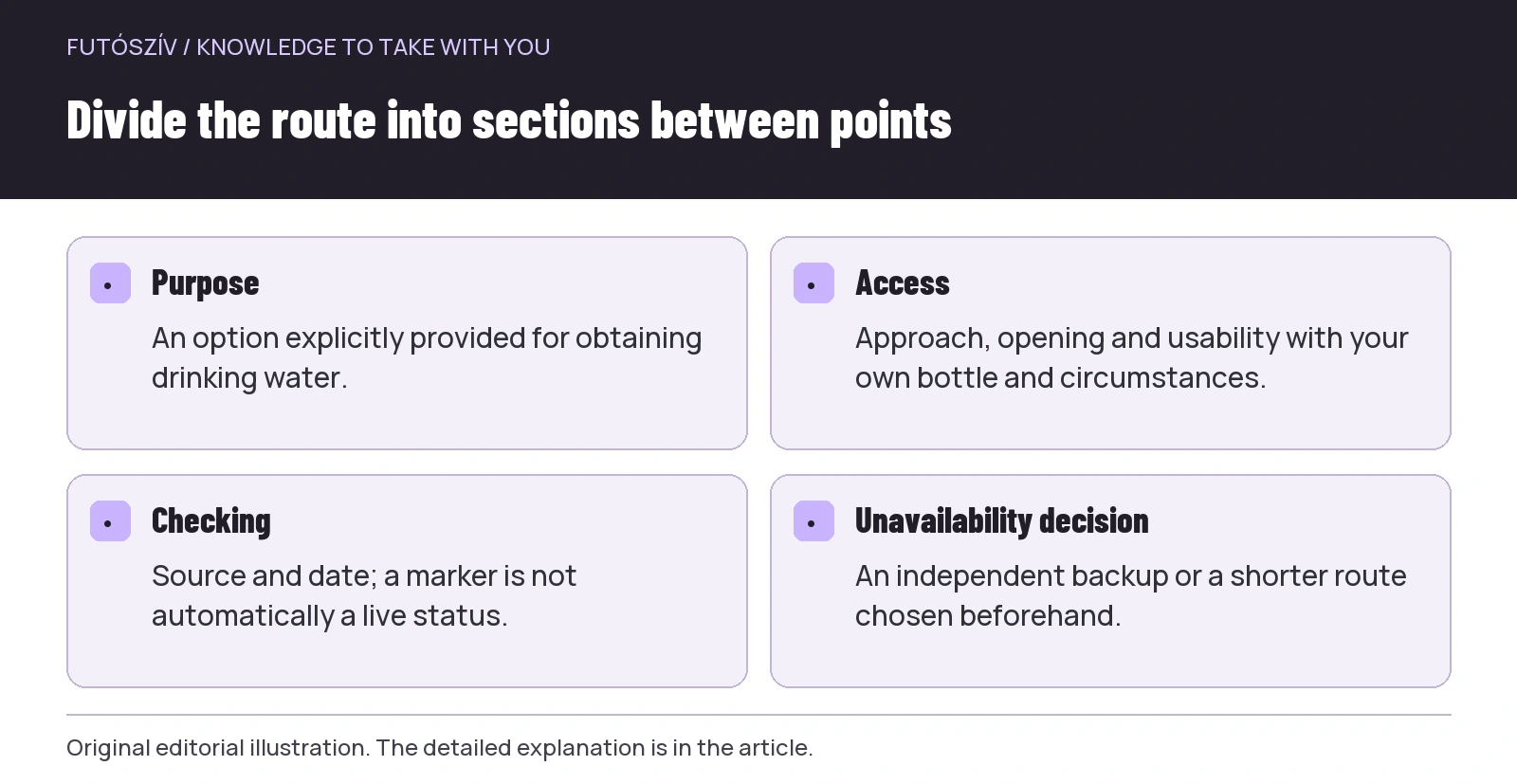
Divide the route into sections between points
For each planned section, consider how you reach the next suitable option and where you can turn back earlier. Look beyond kilometres. Traffic lights, access to a bridge, a fenced park or waiting along the way can add time and detours. Two fountains at the same map distance may differ in actual accessibility. Plan using a permitted approach you can use, rather than a straight line between points.
Give the route decision points where several good choices remain. Before entering a longer riverside section, for example, check that necessary conditions are met. If not, you can still switch to a shorter loop there. Do not put the decision beyond the uncertain point, where continuing would mean heading towards another unchecked option. Dividing the route this way preserves choice.
 Enlarge diagram
Text version of the illustration
- Purpose
- An option explicitly provided for obtaining drinking water.
- Access
- Approach, opening and usability with your own bottle and circumstances.
- Checking
- Source and date; a marker is not automatically a live status.
- Unavailability decision
- An independent backup or a shorter route chosen beforehand.
The backup should not depend on the same condition
Two adjacent fountains do not necessarily provide independent backups. If both are inside the same closed park, a locked gate may make both inaccessible. If you rely on the same unknown seasonal operation, the second marker does not resolve the first uncertainty. A backup has value because it genuinely provides a different, verifiable way to obtain water or change the run.
A backup might be a shorter loop matched to your own appropriately planned supplies, returning to a starting point with reliable access. It could also be an agreed refill option if genuinely usable at the planned time. For a shop, check opening hours and purchase conditions; do not assume someone somewhere will surely give you water. Asking politely may bring occasional help, but is not a guaranteed service at every location.
Assess the approach for your own use
A fountain visible from the pavement is not equally easy for everyone to reach. Steps, a narrow gate, surfacing, button position, the bottle opening and water-jet direction may matter. If running with a pushchair, guide or another device, consider these in your own situation. Even an accessibility marker means only what its source defines; do not automatically extend it to the feasibility of every refilling movement.
In a calm location, try fitting your bottle to a similarly designed water source. Is the opening wide enough? Can you hold the bottle while operating the control? Can you involve a helper if needed? The solution need not become a dexterity challenge. If a point is uncertain or awkward to use, choose different access. The refill plan concerns your actual use, not the fountain’s nominal proximity.
Do not confuse different water features
A drinking fountain, ornamental fountain, misting arch and pond have different purposes. For drinking water, seek a properly identified facility specifically intended for it. Do not infer from clear water or a pleasant cooling effect that it is suitable for your bottle. Observe local prohibitions, closures and warnings. If its purpose is unclear, do not decide by an improvised taste test; use the backup or change the run.
The same applies to an unknown private tap or irrigation connection. Permission to access water and suitability for drinking are separate matters. Use what the responsible operator explicitly provides for that purpose. Ensure your own bottle is clean and suitable before leaving too; a public refill point does not replace thorough cleaning of the whole bottle and drinking tube. Refilling is a brief stop, not an on-site overhaul of unfamiliar equipment.
A fictional comparison of two routes
Option A is one large loop: its first half includes a fountain inside a park, while the second has only an uncertain shop. Option B consists of two smaller loops meeting at the starting point, where appropriate water access is actually arranged. Neither route is better for everyone in every situation. The example examines how many conditions the plan depends on and where it can be changed without adverse consequences. Total running time and your own appropriate supplies need matching separately to each.
| Planning question | One large loop | Repeated loop returning to the start |
|---|---|---|
| Where does the first point’s failure become apparent? | Possibly already far from the starting point. | You can return to the checked location sooner. |
| What does the backup depend on? | The shop’s actual opening and access too. | Access arranged beforehand at the starting point. |
| How can it be shortened? | Identify a usable return route beforehand. | Skip the next loop if necessary. |
| What remains a separate task? | The individual drinking plan and suitability for the weather. | The same; running loops does not automatically make everything safe. |
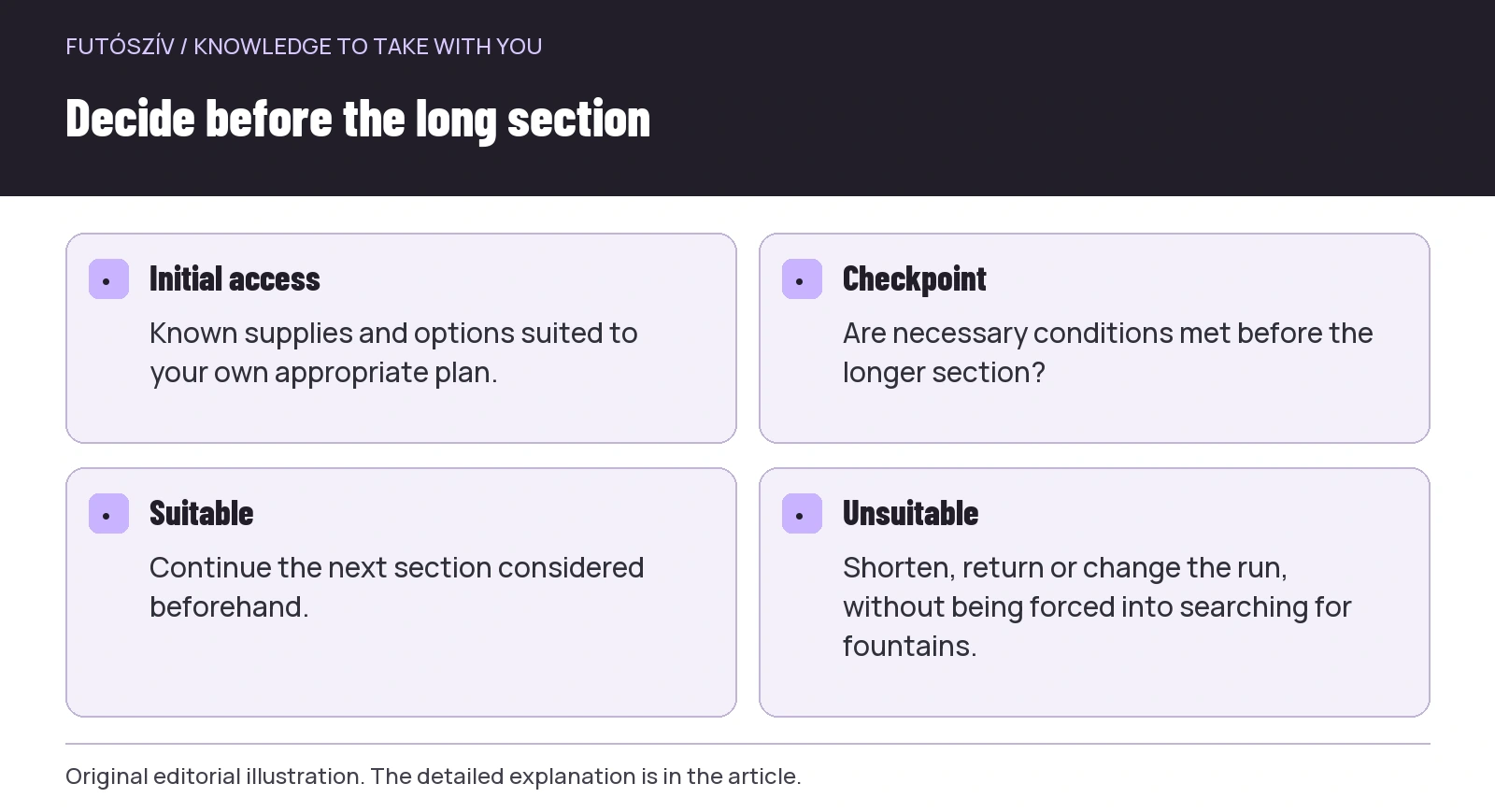 Enlarge diagram
Text version of the illustration
- Initial access
- Known supplies and options suited to your own appropriate plan.
- Checkpoint
- Are necessary conditions met before the longer section?
- Suitable
- Continue the next section considered beforehand.
- Unsuitable
- Shorten, return or change the run, without being forced into searching for fountains.
The plan should remain understandable without a phone too
Allow real stopping time for refilling within your route plan. Someone else may be waiting, you need to take out and close the bottle, and a detour takes time both ways. Counting only uninterrupted running can produce an overly optimistic return estimate. Make water collection a planned part of the run rather than an interruption to eliminate at any cost. Agree with companions beforehand where to wait for one another so that you do not have to search for the group individually after stopping.
Do not keep important points and the return route only in one online view. Save the necessary map section or write a short route card, and check whether the app actually makes the required information available offline. A screenshot may not navigate, but can preserve a point’s precise name and the direction of a decision. Phone battery status should not be the sole condition for understanding an otherwise complicated water plan.
Do not copy entire websites onto the card. Include, for example, the first checked option, the detour to it, the return route to choose if it fails and your own contact information for necessary help. Fill in specific locations for current conditions before leaving. Even a card that worked previously can become outdated through construction, locked gates or another change. Saving information preserves access to it, not a guarantee that it stays current.
If something fails, do not tamper with the fittings
The Budapest Waterworks fault-reporting page distinguishes responsibility for blue lever-operated public standpipes from networks in parks and playgrounds. This also reminds us that not every urban fountain belongs to the same operator. If you see a fault, record the precise location and observable problem, then report it according to the responsible operator’s public information. Do not try to alter closed or faulty equipment.
During your own run, the first consequence of a fault should be activating the backup plan. You can make a detailed report from a safe place, but spending a long time experimenting beside the equipment is unhelpful. If telling others, make your statement a dated observation: you could not obtain water on that day. Do not promise a repair time unless the operator has given one. Precise, limited information remains more useful later too.
A working plan remains adaptable
Before setting off, ask three final questions: have you identified the actual drinking-water point, does access enable your individual needs to be met, and what happens next if it is unavailable? If one has no answer, change the plan while still at home. This does not make water planning for a long urban run more complicated. It replaces uncertain searching with a few clear decisions you can follow on the ground.
Sources and further reading
- Municipality of Budapest: Cooling Budapest
- Budapest Waterworks: Fault reporting – drinking fountains and responsibility
- British Dietetic Association: Sport and exercise
How Futószív articles are prepared: our editorial guidelines.