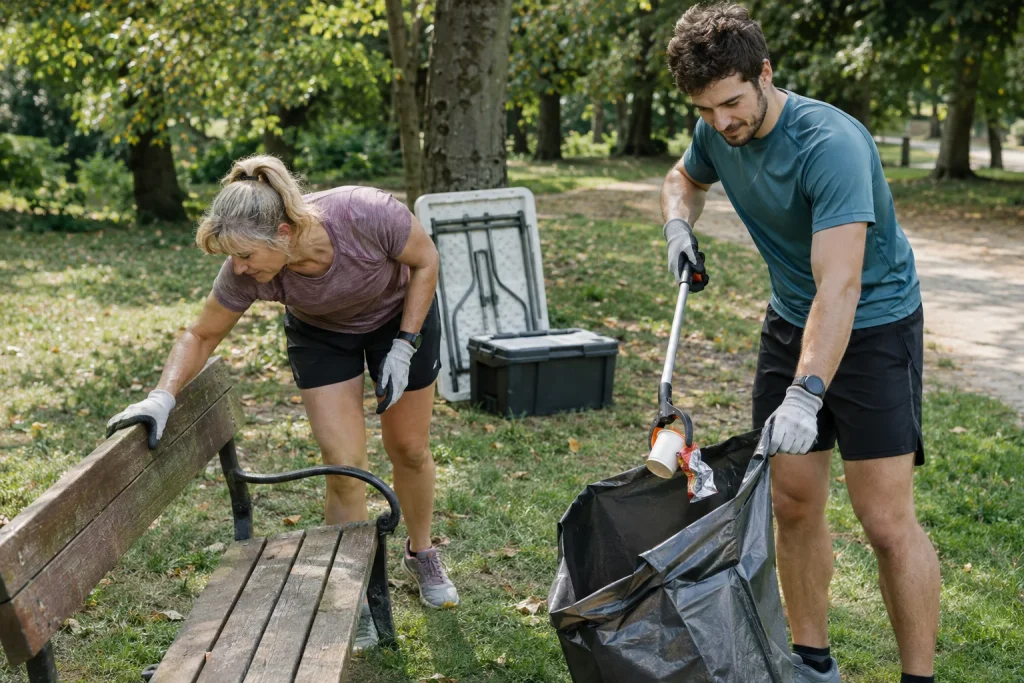
After a community run, tidying up can easily fall to those who have not yet gone home. Yet handing the site back in order is a task to agree beforehand, just like advertising the meet-up. It involves more than visible packaging: your equipment, abandoned clothing, temporary signs and remaining products may also be on site. Good completion has an owner, a time window and a waste-management route that actually works.
This article helps organise tidying after small community outings. It does not instruct people in handling hazardous waste, working on roads or clearing unfamiliar land. Follow conditions agreed with the site manager, organiser and appropriate service provider. The examples are fictional and illustrate the logic of roles and handovers.
First define what you are completing
Tidying your own picnic area, dismantling a designated running event and organising a separate litter-picking campaign are different tasks. Do not let them merge unnoticed. A participant who agreed to gather their own rubbish after a short run has not necessarily volunteered to handle unknown discarded items throughout the neighbourhood. Explain the task’s area and boundaries beforehand.
List which parts of the site you use, which items of your own equipment go out and where waste arises. The meeting point, chosen refreshment location and temporary information may need separate checks. Walking the whole route afterwards should be part of the plan only if an actual, agreed and properly organised task and person exist for it. Do not invent the conditions at the end of the day.
If waste or another problem is already present when you arrive, distinguish it from completing your own outing in the way agreed with the site manager. There is no need to guess an owner or who littered. The observed condition, location and necessary report matter. Community goodwill does not automatically authorise removal of every object.
Arrange the final destination before collecting waste
Buying bags is easy, but a full bag has not solved waste management. Know who accepts the collected material, under which system, where handover happens and what conditions the provider requires. A nearby street bin or recycling collection point is not automatically a receiving point for organised-event waste. Agree an appropriate solution beforehand.
The University of Kansas Community Tool Box guide to community clean-ups also highlights checking local service and handling conditions. We do not copy specific American institutional procedures to Hungary here. The organisational principle is useful: collection, transport and handover belong to one process. Community Tool Box: Conducting Neighborhood Cleanup Programs
The provider should also know the materials expected. A few wrappers, many drinks containers and a larger catering operation produce different mixes. Do not discover after the event that the selected bags, separation or collection time are unsuitable. Give the on-site person responsible a clear summary of the agreement too, rather than keeping it only in the organiser’s emails.
 Enlarge diagram
Text version of the illustration
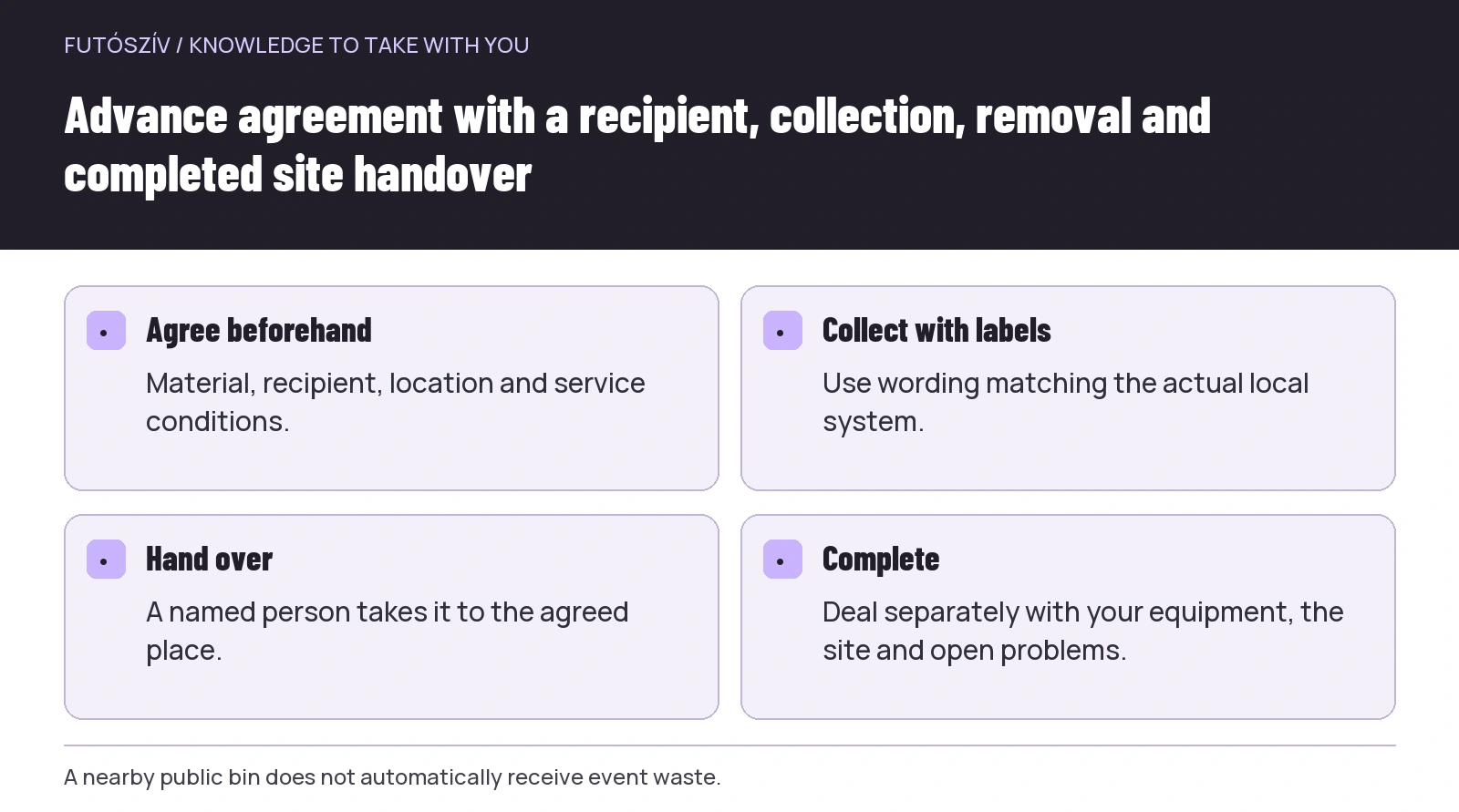
- Agree beforehand
- Material, recipient, location and service conditions.
- Collect with labels
- Use wording matching the actual local system.
- Hand over
- A named person takes it to the agreed place.
- Complete
- Deal separately with your equipment, the site and open problems.
Include the recipient among the roles
Who prepares collection containers, monitors them, performs the designated tidying and checks final site handover? Each need not be a different person, but check timing conflicts. Someone leading the participant meet-up may not be able to transport bags at the same moment. A role should be an accepted commitment, not a surprise left to whoever stays longest.
| Stage | Person responsible to name beforehand | A verifiable result |
|---|---|---|
| Preparation | Person preparing the collection point | The container stands at the approved location with clear labels. |
| Operation | Contact monitoring its condition | Filling and discrepancies are reported promptly. |
| Tidying | Designated team or committed person | The agreed area is checked under the procedure provided. |
| Removal | Agreed recipient or service provider | Waste is not left in unowned bags. |
| Completion | Person responsible for site handover | Equipment, waste and open problems are dealt with separately. |
The table sketches your own division of work, not legal responsibility. Necessary professional and service conditions need providing separately. Even a friendly handover works only when someone understands their commitment and has appropriate conditions. Entering a name does not replace that discussion.
Label containers for the actual system
Separate collection means more than placing differently coloured bags side by side. A label should explain what belongs in a container under the site’s system. Participants should not have to guess from colour, and the later recipient should be able to identify the materials collected too. Use the list agreed between organiser and provider.
MOHU Budapest’s information about recycling collection points, for example, separately lists accepted and unsuitable materials, including distinctions between contaminated papers. We use this only to illustrate why a local materials list matters, not as permission to take event waste to public collection points. Conditions can differ by municipality, service and collection format. MOHU Budapest: Recycling collection points
Do not classify material by appearance alone. A paper-like cup, composite packaging or unusual product may require different handling from what its name suggests. If the precise classification is unknown, ask the appropriate provider before purchasing or collecting on site. A bag called recyclable on the basis of a guess may cause problems at handover later.
Give reusable equipment a return route too
A personal cup, borrowed jug or reusable sign may reduce the need for one-off purchases, but works well only if collection and later handling are also arranged. Participants’ belongings and shared supplies should not merge in an unlabelled box. Know who owns each item and how it returns.
Return borrowed items in the condition and at the time agreed with the owner. Cleaning depends on the particular equipment and use; do not improvise it in the park. Have someone accept responsibility for returning it too. ‘Someone will take it’ can easily become weeks of storage work in a volunteer’s home.
Handle returnable drinks packaging under the actual system and provider’s current conditions too. Do not confuse general recycling advice with the deposit-return process. The organiser should clarify beforehand who collects it, who returns it and what happens to any refunded money. This article does not give one handling rule for every package.
Food scraps are not a gift for local wildlife
Fruit peel and other food remains are part of the outing’s waste too. Do not put them under bushes, at the base of trees or beside the path because they are natural material. Leave No Trace’s educational material points out that human food waste can attract wildlife to places used by people. The practical consequence is to include leftovers in appropriate waste collection too. Leave No Trace: Out Here, It’s Trash
There is no need to put uncertain decomposition times on participant signs. A sound organising decision needs only the principle that managing remains of food brought in is part of the programme. List composting or separate collection as an option only when a suitable local system and recipient actually exist. A compostable label is not an organised handling route by itself.
Remaining edible products are not automatically waste either, but passing them on must follow the organiser’s food-handling procedure. Volunteers should not independently decide what can be given to others without knowing its condition. The aim is responsible completion, not an impressive ‘nothing went to waste’ report at any cost. Report uncertainty to the appropriate person responsible.
 Enlarge diagram
Text version of the illustration
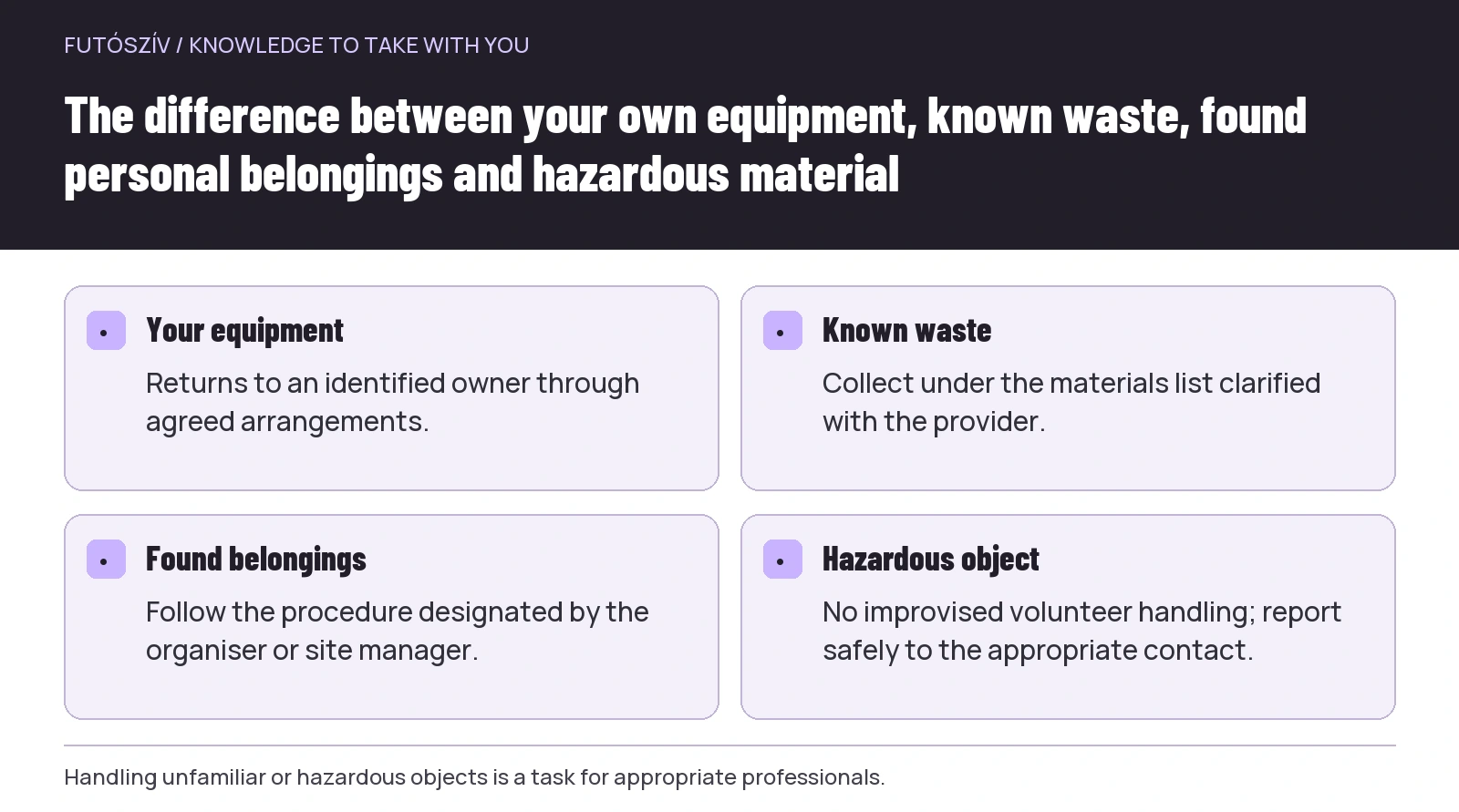
- Your equipment
- Returns to an identified owner through agreed arrangements.
- Known waste
- Collect under the materials list clarified with the provider.
- Found belongings
- Follow the procedure designated by the organiser or site manager.
- Hazardous object
- No improvised volunteer handling; report safely to the appropriate contact.
Tidying should not cause further environmental damage
While checking the designated area, stay within permitted access and use. Seeing distant packaging is not a reason to leave the route, trample vegetation or enter a closed section. Follow the site’s conservation and management conditions during tidying too. A good purpose does not make every method appropriate.
Remove temporary organiser signs only under the procedure agreed for the assigned task. Do not remove unfamiliar tape, signs or markers merely because you think they belong to your event. Another activity or site manager may be working nearby. Identify items confidently from your own equipment list and the responsible person’s information.
Weather and light can limit tidying too. Consider these when scheduling the whole programme, rather than improvising a lengthy, uncertain task at day’s end. If something cannot be completed within the designated framework, agree the further solution with the appropriate person responsible. A discrepancy does not disappear because everyone goes home tired.
An unfamiliar or hazardous object is a separate matter
Needles, chemical packaging, unknown liquids, sharp objects and large unstable waste are not ordinary hand-tidying tasks after a run. Do not handle them without appropriate preparation, equipment and authority. Report the location safely to the appropriate contact under local procedures. A community outing does not make you a hazardous-materials handler.
The Community Tool Box guide links work involving hazardous materials, traffic and other substantial risks to trained staff or responsible organisations. We draw on that role boundary here, not American administrative channels. Clarify the appropriate Hungarian local reporting route separately. Making a problem visible is a valuable contribution too.
Do not involve children in handling unknown waste simply as a playful competition either. If families join, the organiser needs to design tasks appropriate to age and necessary safety conditions. Competing for the most items collected can easily direct attention the wrong way. The aim is appropriate completion of the designated task, not filling the largest bag.
Include small details in site handover
After larger objects are packed away, carry out a separate final check of the agreed area. Your markers, fastenings, pieces of packaging, clothing or equipment may remain. Check the places used during the outing under the agreed procedure. Completion should not consist only of one photograph from a favourable angle.
Lost personal belongings may have their own handling procedure. Do not automatically pass them on or discard them, and do not publish unnecessary personal information about them. Use the channel designated by the organiser or site manager. Distinguishing your equipment from found belongings matters at handover too.
The final person responsible should be able to say what was completed, what was removed and whether a problem remains that has been reported to the appropriate contact. If there is a site-manager handover, follow its conditions. Record tasks actually checked rather than simply saying ‘it is clean’. This makes it possible to trace which part of the event was completed later too.
A fictional completion after a run
Twenty adults at an imagined community outing meet at a familiar location. Beforehand, they agree which equipment they will use, how they will handle waste and who commits to the final twenty minutes. These numbers are examples only, not safety or service-sizing standards. They arrange specific conditions separately for the site.
At the end, they handle their packaging through the agreed collection process, put borrowed equipment in a separate box and have the responsible person check the used areas. An unfamiliar object found beneath a bush does not go in the shared bag; they report it according to local procedure. Whoever accepted transport learns the task beforehand, not at the end, and knows what they are taking where.
They note one change for next time: make the collection-container label more visible from the meeting point. They do not compete over bag counts or claim to have solved every environmental question. They completed their own programme and gave the remaining problem a clear reporting route. Shared use of a place can then become a responsible occasion worth returning to.
How Futószív articles are prepared: our editorial guidelines.