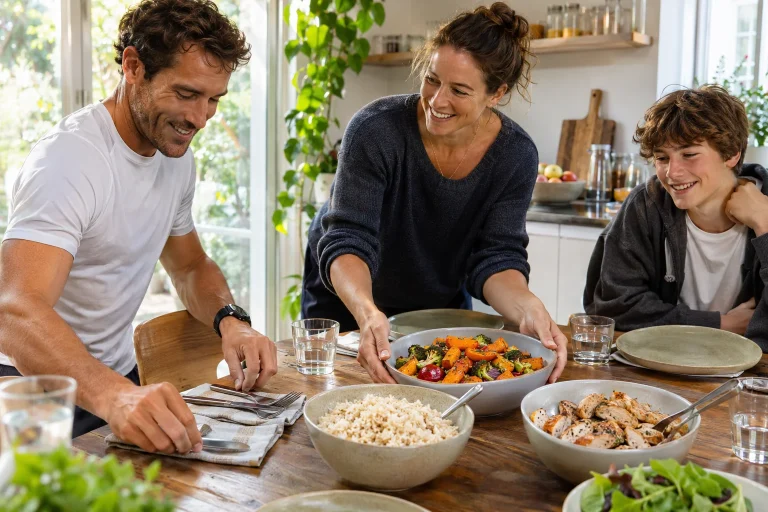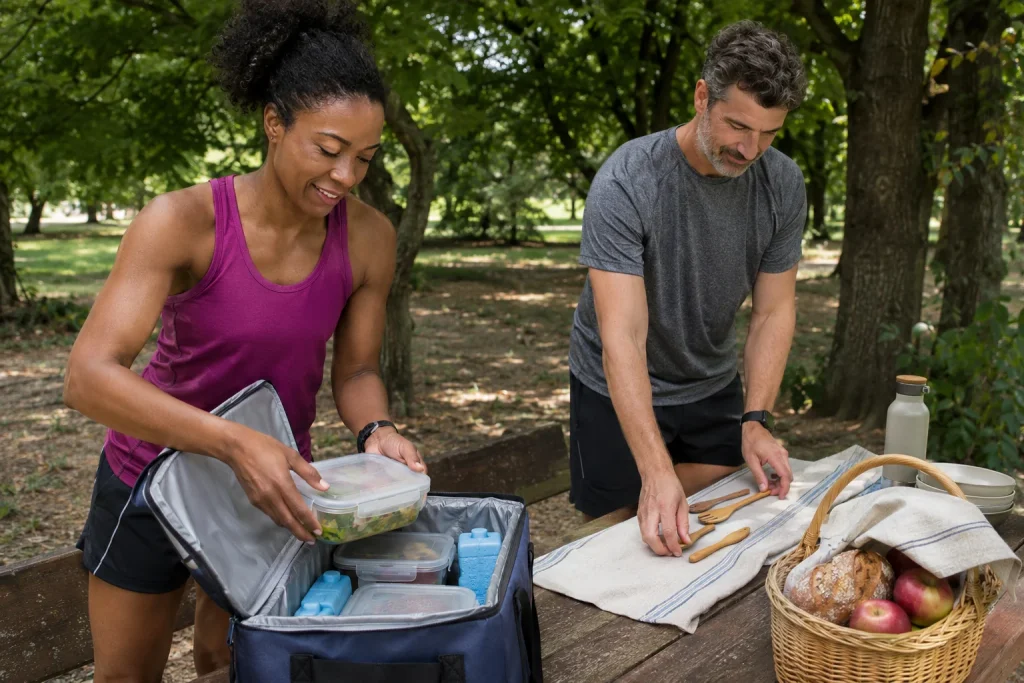
At a picnic after a group run, food often arrives before the runners. Someone prepares a dish in the morning, another brings sandwiches by car, and those taking the longer route return much later. Food safety therefore needs considering before the moment of serving. Know the food’s journey from preparation through transport and waiting to eating, and who will watch over it while everyone else runs.
This guide offers food safety and practical ideas for a private gathering of friends. It does not replace checking professional and legal requirements for a public event, catering or a food business. It does not claim a cool bag is sufficient in every circumstance or give personal safety guarantees for special diets. If appropriate conditions are unavailable, simplify or change the meal rather than omit necessary precautions.
Set the meal time separately from the start
The meet-up description should state when you will eat and whether groups return at different times. Whoever transports food needs more than the gathering time. If salad arrives before the group run, a person and appropriate location must manage the entire waiting period. A dish left in a car does not become supervised refrigerated storage because others are still on their loop.
A simple organiser sheet can have four columns: dish name, who brings it, storage required and when and how it will be eaten. If a dish has no sensible answer to the last two questions, change it before leaving. Every participant need not bring a large bowl. Appropriate quantities of manageable food can be easier than many anonymous containers whose contents and history nobody knows for certain.
A dish’s name does not determine whether it needs chilling
The Food Standards Agency guidance for hot weather says that food you would refrigerate at home should also be kept cold at a picnic. This can include more than meat dishes: prepared salads, sandwiches and other ready-made foods requiring refrigeration may count too. Link storage needs to the particular dish and product instructions. Plant-based, homemade or sporty descriptions do not establish storage life without refrigeration.
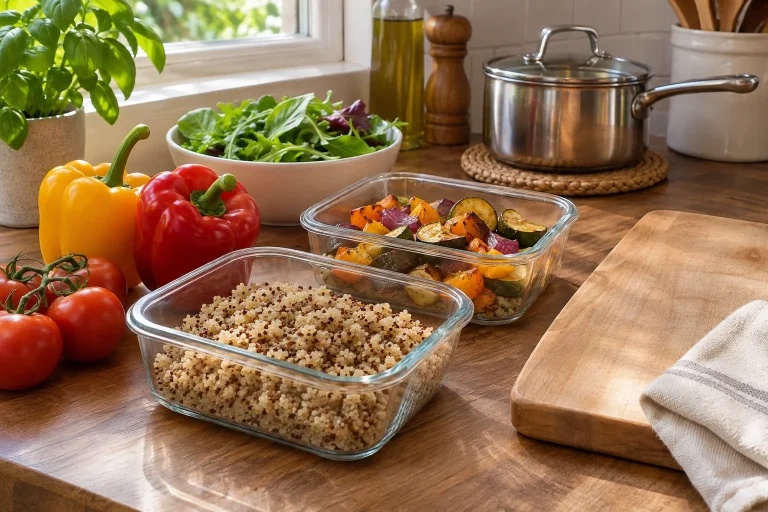
Cold food should start in an appropriate condition. A cool bag is not intended to somehow chill a freshly prepared large, hot dish once it reaches the site. Preparing and cooling a homemade dish is a separate task requiring enough time and space at home. If the intended food is too large a quantity or too complex for this, choose another solution. Transport can be assessed only when the starting condition is known too.
A clean handover begins at home
The Nébih prevention advice emphasises clean hands, drinking water, suitable ingredients and separation of raw and ready-to-eat food. Check refrigerator temperature with a thermometer; the information specifies 0–5 degrees Celsius. Do not prepare food for others if you have symptoms suggesting an infectious illness. The fact that people expect your dish at the meet-up is not a reason to override this.
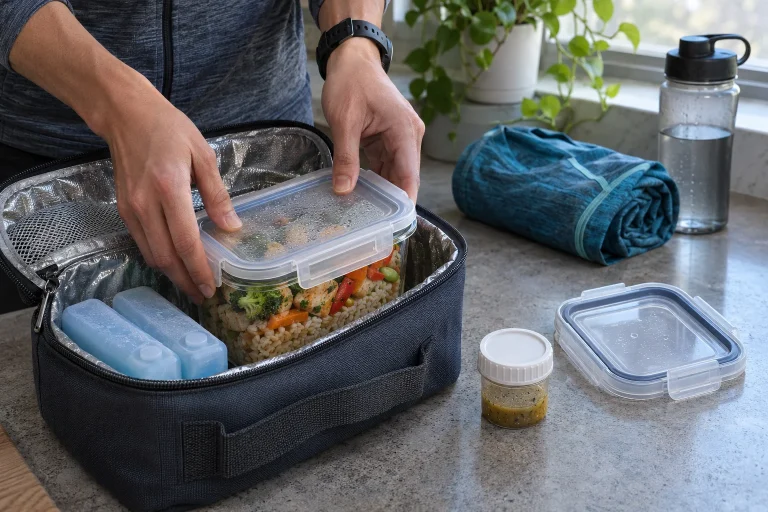
Pack food in clean, food-safe containers that close well. Pack serving utensils separately and cleanly alongside them. During travel, ready-to-eat food should not touch soil-covered equipment, shoes or potentially contaminated bags. Keep its compartment clearly separate from used clothing put back after the run. A car boot is a storage surface, not automatically a clean food-preparation environment.
 Enlarge diagram
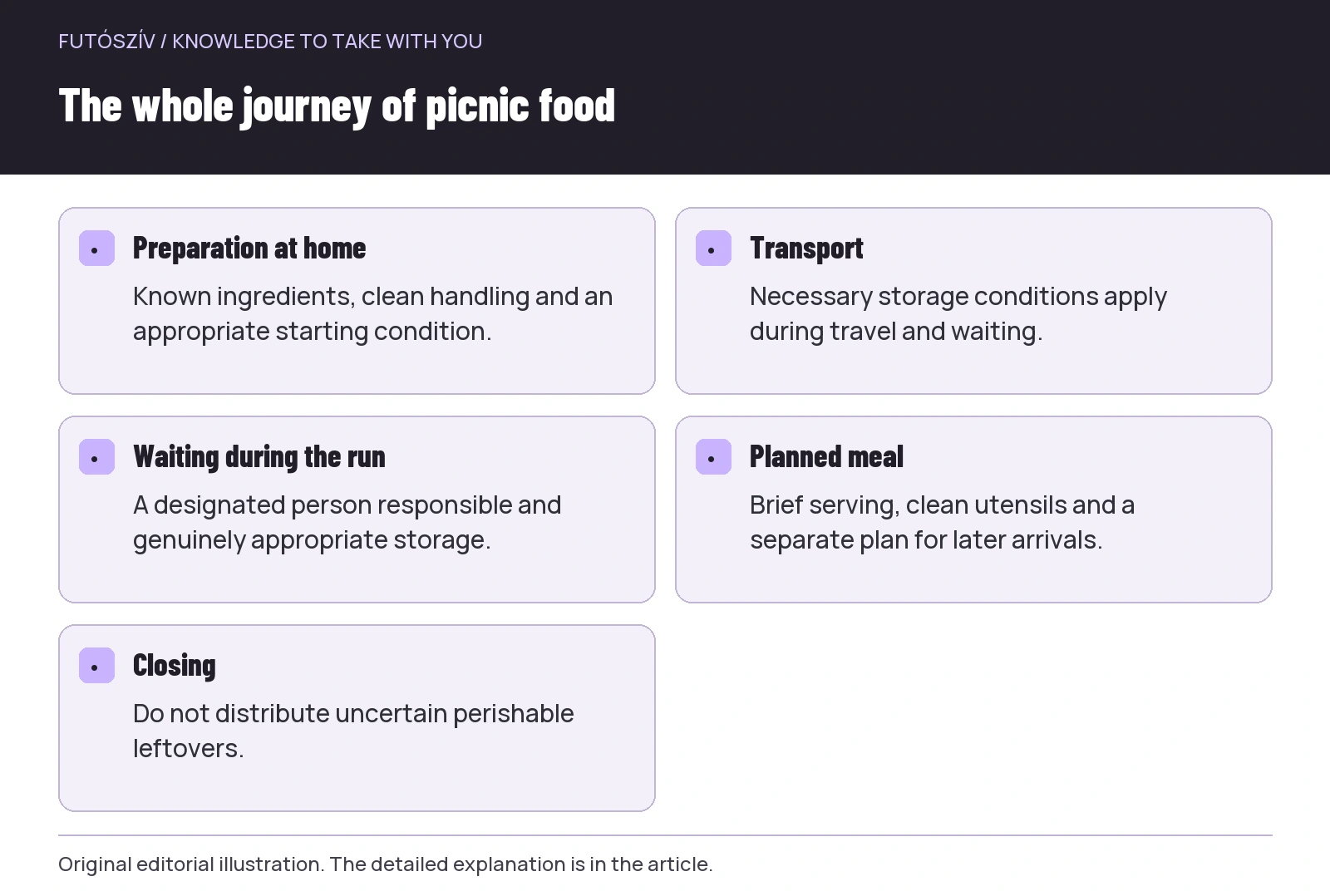
Text version of the illustration
- Preparation at home
- Known ingredients, clean handling and an appropriate starting condition.
- Transport
- Necessary storage conditions apply during travel and waiting.
- Waiting during the run
- A designated person responsible and genuinely appropriate storage.
- Planned meal
- Brief serving, clean utensils and a separate plan for later arrivals.
- Closing
- Do not distribute uncertain perishable leftovers.
Include the whole journey in the transport plan
Do not count only travel time between home and the park. Packing, waiting, any stop, unloading and the run itself count too. A dish requiring refrigeration needs appropriate conditions throughout the necessary period. Use the bag according to its manufacturer’s instructions with suitable cooling packs, and maintain the food’s required storage temperature in a way you can verify. A plastic wall that feels cold is not a detailed measurement on its own.
Designate an appropriately protected place for the closed food container on site. The FSA recommends shade and reducing the number of openings; a separate food cool bag can help too. This offers an organisational advantage when participants open a drinks container frequently. Shade alone is not active cooling, however. Naming somewhere the ‘cold corner’ does not replace actual storage requirements for the dishes.
The two-hour limit is not a target serving time
Nébih says not to keep refrigerated perishable food outside refrigeration for more than two hours. The FSA also specifically warns about handling within no more than two hours in hotter-than-usual weather and recommends discarding perishable food left out beyond that. Do not interpret this as a guarantee that every food lasts two hours in the sun under every condition. The particular food’s instructions and handling so far matter too.
Aim for appropriate chilling and a short, planned serving period. Preparation, travel and waiting do not reset to zero when food moves to a prettier bowl or back into a bag. If you do not know how long a perishable dish was without refrigeration and under which conditions, do not offer it. A cheerful gathering and a pleasant smell cannot verify missing information.
Make recipe information readable and available for questions
Give each dish its precise name and ingredients, and retain relevant labels from packaged ingredients used. ‘Home-baked’, ‘free from everything’ or ‘vegan treat’ does not give enough information to a participant with a food allergy. Preparation conditions and possible cross-contamination matter alongside ingredients. If these are uncertain, do not promise a dish is suitable for a particular restriction.
The Food Standards Agency guidance on allergen information for non-prepacked foods describes written information supported by conversation. This is best practice developed for British businesses; we do not cite it here as Hungarian event law. It also offers a useful organisational idea for a picnic with friends: have the information present and someone available who can actually answer questions about the dish.
Do not let a shared buffet alter an individual meal
Anyone needing their own food should agree storage beforehand, keeping it in an identifiable, separate pack. Nobody should helpfully transfer it into a communal bowl, and its utensils should not be shared. The organiser may provide information and space, but cannot establish definite suitability for an unknown personal risk. The communal selection does not override a participant’s own health and eating plan.
If a version using different ingredients arrives instead of the agreed dish, flag this before serving. A substituted sauce or garnish can change composition too. Update the written information rather than relying on remembering that someone already heard about it. Identify uncertainty precisely: what is unknown? Do not use general reassurance to resolve something that cannot be verified.
 Enlarge diagram
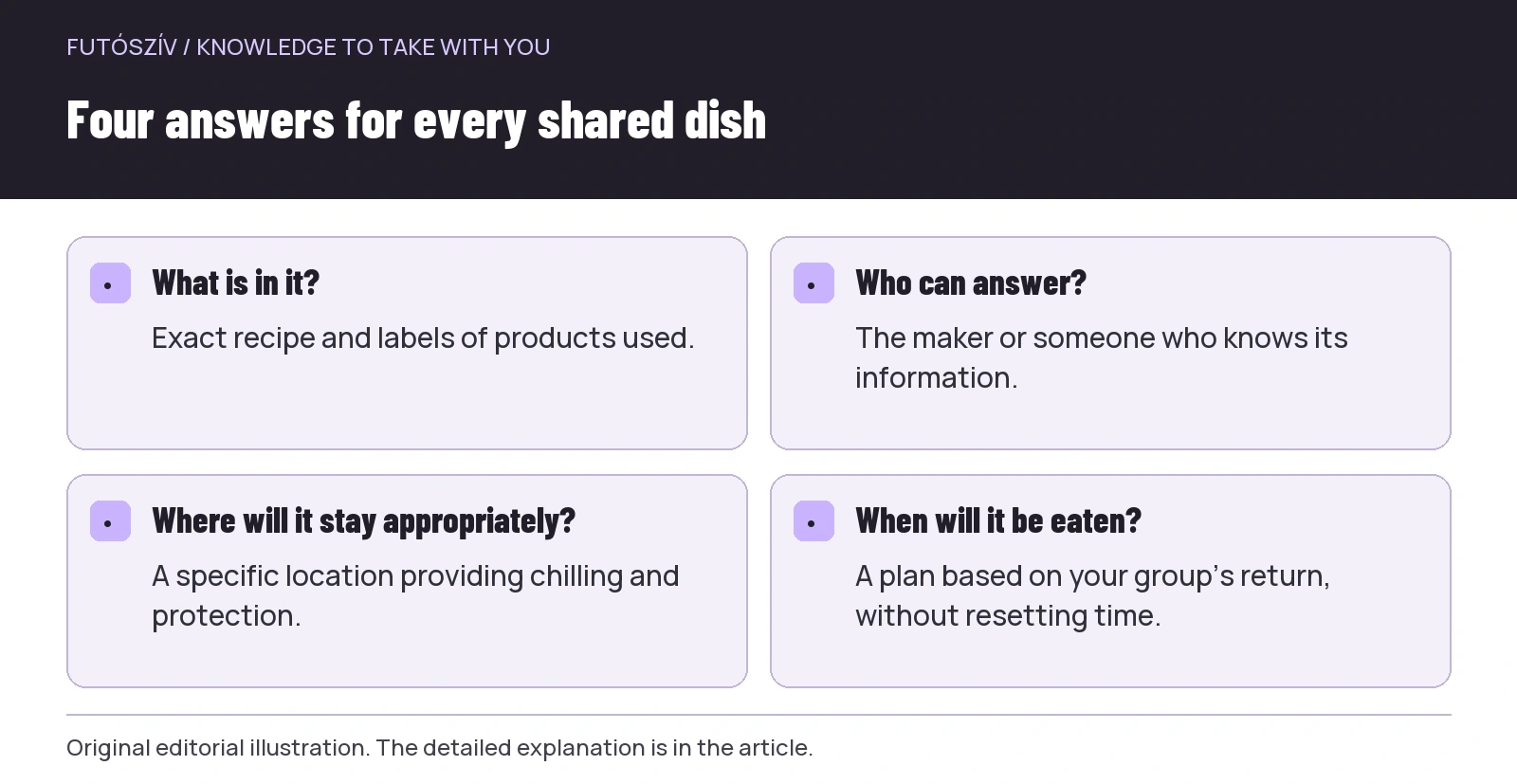
Text version of the illustration
- What is in it?
- Exact recipe and labels of products used.
- Who can answer?
- The maker or someone who knows its information.
- Where will it stay appropriately?
- A specific location providing chilling and protection.
- When will it be eaten?
- A plan based on your group’s return, without resetting time.
Keep serving small and manageable
Do not place open bowls on the ground. Choose a clean, suitable surface, protect food from contamination and provide each dish with its own clean serving utensil. A used spoon should not move into another dish. Ensure real handwashing facilities before eating; check this when choosing the location. A bag of paper napkins serves a different purpose from providing conditions for handwashing.
Bring out only a quantity from closed reserves that can be handled appropriately, and make clear who oversees serving. If everyone leaves to run at once, nobody supervises food already laid out. Matching the meal to people’s return is easier than maintaining an unattended buffet for a long time. Scale the selection to the site’s facilities rather than inferring storage capacity from participants’ enthusiasm.
| Situation | Responsibility clarified in advance | When should you change the plan? |
|---|---|---|
| Food arrives before the runners | Who manages necessary storage, and where? | If the dish would simply wait unattended in the car. |
| The longer-route group returns later | How will they receive separate, appropriately handled food? | If only the bowl left out earlier would remain for them. |
| A dish’s composition is unknown | Who can answer from the recipe and labels? | If suitability would be promised despite uncertainty. |
| The shaded spot is unavailable | Who checks the actual storage conditions? | If the original meal plan’s conditions cannot be maintained. |
Later arrivals need a separate plan
The interval between the short and long loops is more than a difference in activities. The second group’s food needs storage until its own eating time. Covering the first group’s leftovers again and pretending they have just been opened is not a good solution. A separate, identifiable supply kept under appropriate conditions or another manageable meal is needed. If that cannot be provided, reorganise the food element of the outing.
The same applies to someone who wants to shop after the run or pack a portion before a longer journey home. Taking away a dish planned for on-site eating introduces another storage and transport stage. Distributing leftovers does not automatically reduce waste appropriately if safe-handling conditions are lost. An unopened, properly handled pack is a different case from leftovers in a shared bowl left out for a long time.
Decide from information when closing
At the picnic’s end, review which foods have a known handling history and where appropriate storage was interrupted. Do not offer uncertain perishable dishes to take away. Pack dishes and utensils needing cleaning separately, and keep waste away from food still suitable for use. Briefly note for next time what was excessive, what was difficult to handle and which eating time actually worked.
The most important feature of a well-organised running picnic is not the size of its selection. For each dish, people know its contents, who brought it, how it reached the point of eating and who is watching it. When that information and necessary conditions are missing, a simpler, achievable meal is a better organising decision. Attention can then genuinely stay on running together and spending time with one another.
Sources and further reading
- Nébih: Preventing foodborne illnesses
- Food Standards Agency: Food safety in a heatwave – advice for consumers
- Food Standards Agency: Allergen Information for Non-Prepacked Foods Best Practice
How Futószív articles are prepared: our editorial guidelines.