
At race-number collection, a runner reaches an important moment: an earlier online entry becomes a race pack they can hold. Meanwhile, the helper at the counter must distinguish many different requests. Good communication is not a long explanation, but a clear sequence: why the participant has come, which confirmation the organiser requires and what happens next. When this is understandable, there is less uncertainty in the queue too.
This article looks at communication by participants and volunteers, using our own constructed examples. It does not replace the event’s race-pack collection rules or staff training. Not every race uses the same code, identity document, authorisation or collection system. The organiser must determine specific entitlements and exceptions.
One clarifying question can prevent many mistaken searches
The first question at the counter should not assume everyone has come for the same reason. ‘Are you collecting your own pack, handling a team’s collection or asking for help with an entry problem?’ Adapt the exact wording to the organiser’s system, but the aim stays the same: establish the type of request before a long search begins. Missing confirmation and a question about T-shirt size may lead to different tasks.
As a participant, you can help by stating the essential request first. ‘I would like to collect the pack for my own ten-kilometre entry; here is the confirmation requested.’ Or: ‘I cannot find the code in the email, so I am asking for help.’ You do not need to fit the entire registration story into the opening sentence. Targeted questions make it easier to add further details.
If you are at the wrong counter, redirection should be specific. ‘Not here’ is insufficient when a participant does not know the site. Give the name and recognisable location of the designated information or problem-resolution point. Do not invent another administrative channel on the spot; use the one the organiser provides.
The exact type of code matters
An entry system may contain several identifiers: payment confirmation, order number, runner ID, race number or a separate race-pack collection QR code. They are not necessarily interchangeable. Participants need not be IT experts, but they should be told clearly which screen or document the person at the counter is looking for.
The official page for the Debrecen Marathon’s 2027 short-distance event links pack and race-number collection to the QR code received in the confirmation email. This is a specific organiser requirement. It does not mean every Hungarian race works the same way, but illustrates why naming the correct confirmation matters. Debrecen Marathon 2027: Short distance
By contrast, the Maratonman race series’ 2027 rules specify the individual QR code available in StafétApp’s race-pack collection function. The shared term ‘QR code’ can therefore conceal different ways of accessing it. Follow your own event’s current description rather than habitually opening another organiser’s app. Maratonman: 2027 Race Rules
Ask for one step at a time
In a noisy place, it is difficult to follow an instruction that simultaneously requests an email, identity document and entry information, and sends someone to another counter. Break the task into short messages following the system’s actual sequence. First request the necessary document, then move to the next step once it has been checked. The participant can then tell when a task is complete.
A sample sentence: ‘Please first open the code sent for pack collection. I will wait while you find it.’ If the event uses a different document, that is naturally what you should request. The sentence’s advantage is not the QR code, but naming a clear, achievable step. Making a queue move faster does not necessarily mean speaking faster.
As a participant, you can check: ‘Have I understood correctly: I should open this now, and then we check the team?’ Brief feedback helps prevent two separate processes running in parallel. If you did not hear the request, asking for repetition is better than showing other documents at random. Accuracy is a shared task.
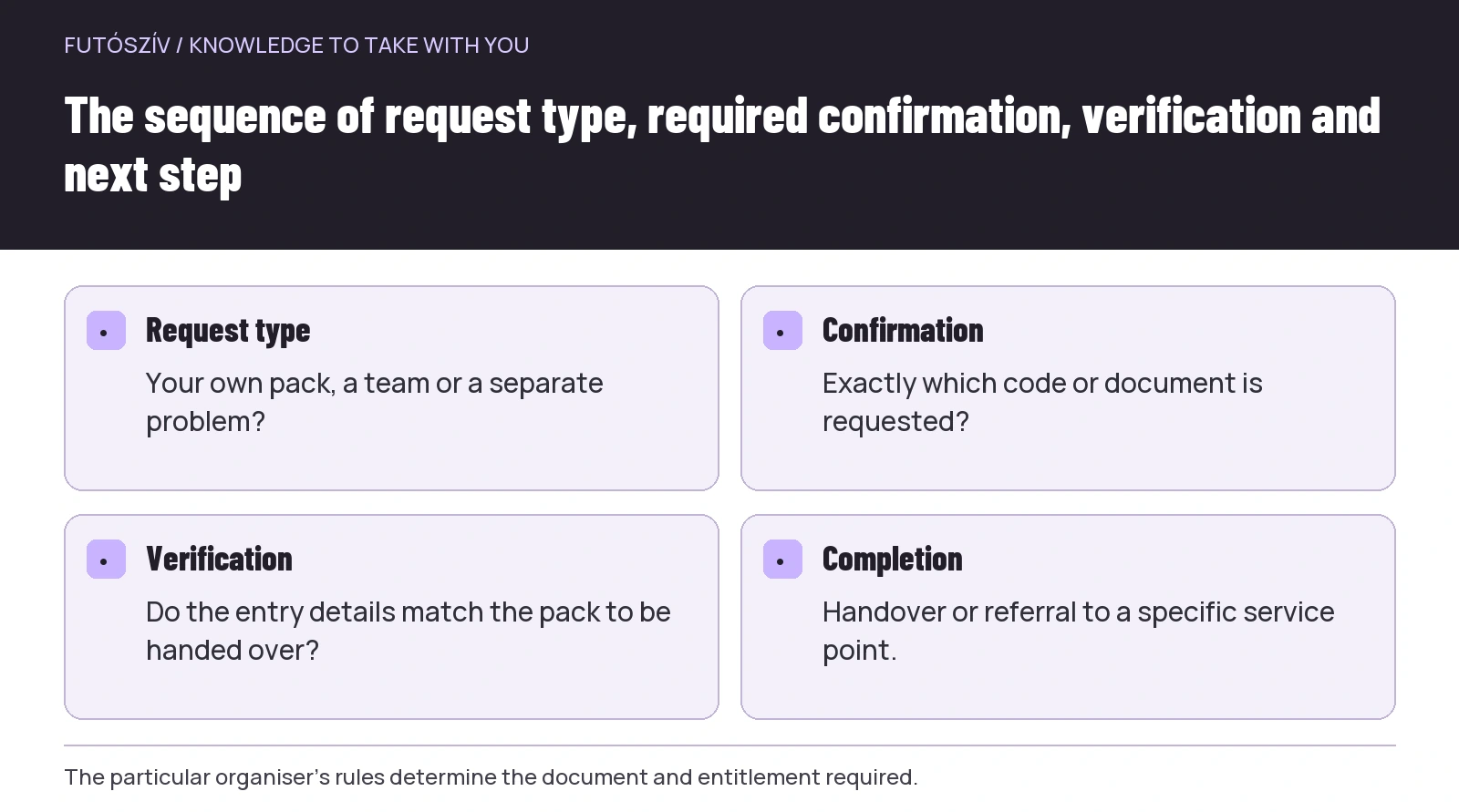 Enlarge diagram
Text version of the illustration
- Request type
- Your own pack, a team or a separate problem?
- Confirmation
- Exactly which code or document is requested?
- Verification
- Do the entry details match the pack to be handed over?
- Completion
- Handover or referral to a specific service point.
Keep personal data relevant to the task
At the counter, request and handle only data needed within the organiser’s procedure. A name or identifier used for searching is not a reason to read the whole entry form aloud. People waiting in the queue are not parties to the request. The organiser must establish and teach the specific data-handling procedure.
If the necessary confirmation is on a participant’s phone, adapt how it is shown to the organiser’s equipment. Do not request a login password or make a copy of the document for personal use. Other messages and personal details may be visible on the phone; the task is the necessary check, not reviewing the device’s entire contents. The organiser provides the appropriate tools and procedure.
For a more sensitive matter, know where a quieter discussion is possible. Details of a payment problem or data discrepancy are not always best discussed in front of the whole queue. Redirection should not sound like rejection: ‘The designated colleague can check this; I will show you where to find them.’ Also explain which information the participant should take.
Team collection and acting for someone else may differ
A relay team representative and someone collecting a friend’s individual pack do not necessarily follow the same procedure. An organiser may set separate requirements, and arrangements differ between events. A counter volunteer should not grant an exception from their own experience last year. Equally, a participant should not assume a name or forwarded message is always enough.
Make the question specific: ‘Which entry does this collection relate to, and what authorisation do the current rules require?’ If a condition is unmet or unclear, refer to the designated administrator. Sympathy from people in the queue does not decide entitlement. Good communication preserves the participant’s dignity here too.
| Request type | Information to clarify |
|---|---|
| Your own individual pack | The identifier and document required by the event. |
| A team’s pack | The collection procedure for the team and its authorised representative. |
| Another person’s pack | The organiser’s conditions for collection by a representative. |
| Missing confirmation | The official search or problem-resolution channel. |
| A change of details or distance | The person authorised to make changes and the current options. |
Distinguishing request types does not make things unnecessarily complicated. It prevents reaching the end of a supposedly quick but incorrect process and having to start again. A precise question respects both the organiser’s time and the participant’s patience.
Do not treat missing confirmation as a personal failing
An email address may have been mistyped, another inbox used, a message filtered or the process left incomplete. At the counter, you do not have to decide immediately which happened, and an accusatory tone is unnecessary. First establish which checking options the organiser’s system provides. ‘You must not have read it’ does not help solve the problem.
The Debrecen Marathon short-distance information asks people missing their QR-code confirmation to contact the organiser’s back-office team. We use this as an example of advance administration for that specific event. Do not arrive assuming an on-site volunteer can certainly override a missing-document requirement. Start the necessary checks before the last-minute rush before the start whenever possible.
As a volunteer, know the on-site referral process and which information the colleague resolving problems needs. Do not start your own unauthorised search on a private device or in personal email. What matters to participants is a next step they can follow. It is also an honest answer that only the appropriate person can establish something.
Information at the start of the queue can prevent a counter dispute
If the organiser assigns a separate role for this, someone can explain at the beginning of the wait which queue handles which request and which document to prepare. The information must match the procedure used at the counter. If people are told one thing at the queue entrance and another at collection, they understandably become uncertain.
Information on signs should be grouped by task and easy to recognise. Instead of a long text containing every event detail, a brief message relevant to the local function can help. The organiser approves the exact content. Volunteers should not write their own exception or new deadline on paper merely to reduce questions.
If someone prepares while queuing, allow room for this under the site arrangements. Do not expect them to open several documents while running or in a narrow passage. The space for waiting and handling requests is part of communication too. A clear next step sometimes helps more than repeatedly saying ‘let us move faster’.
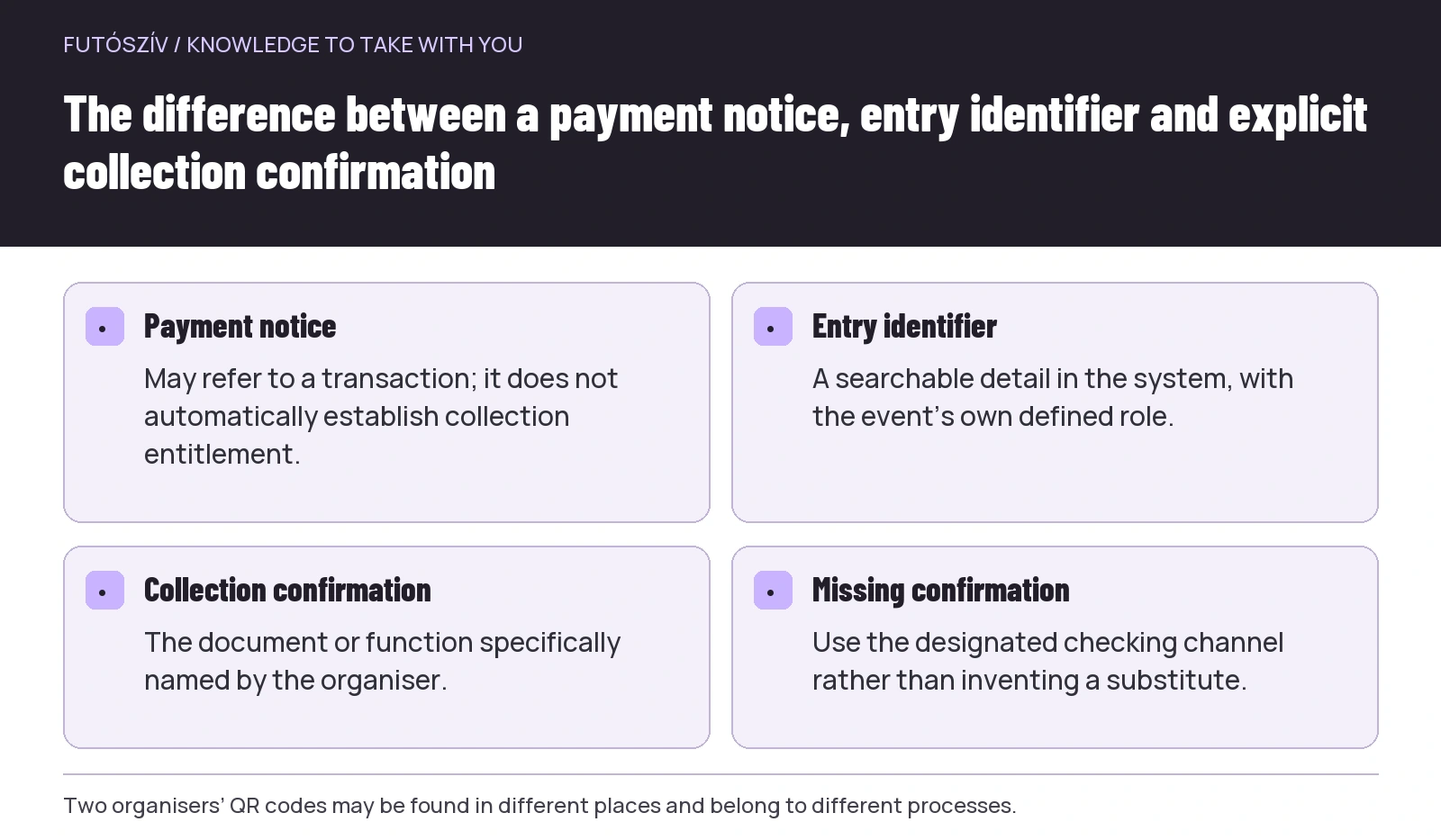 Enlarge diagram
Text version of the illustration
- Payment notice
- May refer to a transaction; it does not automatically establish collection entitlement.
- Entry identifier
- A searchable detail in the system, with the event’s own defined role.
- Collection confirmation
- The document or function specifically named by the organiser.
- Missing confirmation
- Use the designated checking channel rather than inventing a substitute.
Do not resolve a data discrepancy with someone else’s pack
If displayed entry details and the pack to be issued do not match, follow the organiser’s verification procedure. Finishing at any cost using the nearest similar name or another race number should not be the goal. Linking identification with handover matters more than an apparently quick solution. Reporting the discrepancy requires precise facts.
As a participant, check the details the organiser requests or displays and the pack received while still at the counter. If something seems unexpected, ask immediately before moving on. Do not independently open or alter an item that may have a timing function. Learn how to handle it from the organiser’s information.
A volunteer need not establish the cause of every discrepancy. Their task may be to pause the process at the appropriate verification stage and involve the person responsible. ‘We need to check this’ is a factual statement. It does not mean you have judged the participant wrong or suspicious; you are simply maintaining necessary accuracy.
Discuss pack contents and optional extras separately
An item included in the entry and an optionally ordered product involve different information. If a participant asks about a T-shirt, first check the relevant order and collection arrangements. A general ‘everyone gets one’ or ‘nobody gets one’ may mislead when an event offers several packages. Clarify individual entitlement within the organiser’s system.
At the end of collection, give only the important information within your role: what was handed over, whether any part still needs separate attention and where official instructions can be found. Do not restate detailed rules for wearing a race number or chip timing from memory when the organiser provides different information. Good communication does not mean repeating the whole race prospectus aloud.
If an item is missing or different, name the next step and the person responsible. Do not independently promise later postage, a refund or an exchange. Such commitments belong to the organiser’s authorised person. Pass on a verified answer, rather than turning your own well-meant assumption into a promise.
The structure of a fictional counter conversation
The participant begins: ‘I would like to collect the pack, but I have several confirmations on my phone.’ The helper first clarifies the event and request type, then names the document actually needed. They do not ask for every email or rush the person with more instructions while they are still searching for the first.
It turns out the participant can find only the payment notice. Following the on-site procedure taught, the helper shows the appropriate problem-resolution point and briefly explains which information to prepare there. They do not promise the matter will definitely be resolved within a minute. At least the participant knows where they are going next and why.
When they return later, the process continues using verified details. By the end of handover, both parties know whether collection is complete or another task remains. In this example, speed came from a clear branching point: they did not try to force the wrong process through with increasingly rapid speech.
Pass on current information when shifts change
Counter assignments, stock or administrative contacts that change during the day should also be known to the next helper. Hand over open requests according to the organiser’s procedure, without more personal data than necessary. Saying ‘they already know everything’ does not ensure the next person works from the same information. To the participant, however, the whole row of counters appears to be one event.
Report recurring questions to the person responsible. If many people prepare the wrong code or misunderstand the same sign, information placement may also need improvement. Do not treat the pattern solely as participant inattention. Good communication provides lessons for the next event too.
Clear race-number collection depends on a few simple distinctions: request type, required confirmation, verified details and a specific next step. Participants can prepare, while volunteers can help within their roles. Not everyone at the counter needs to know everything; the path information follows needs to remain clear.
How Futószív articles are prepared: our editorial guidelines.