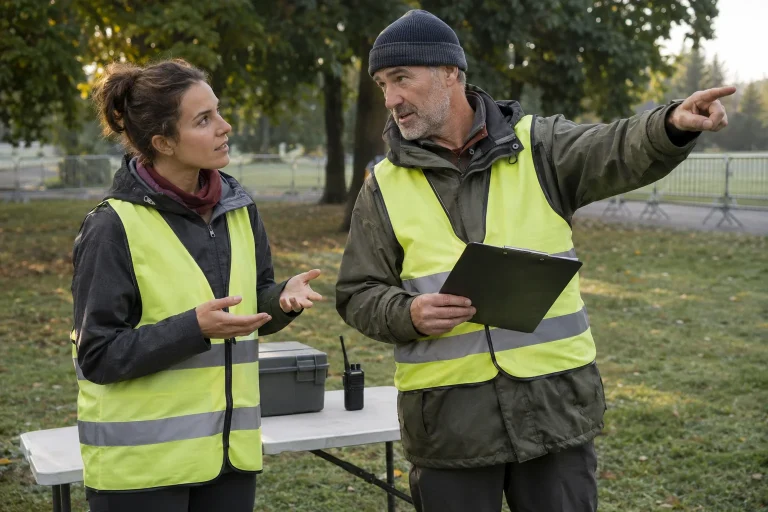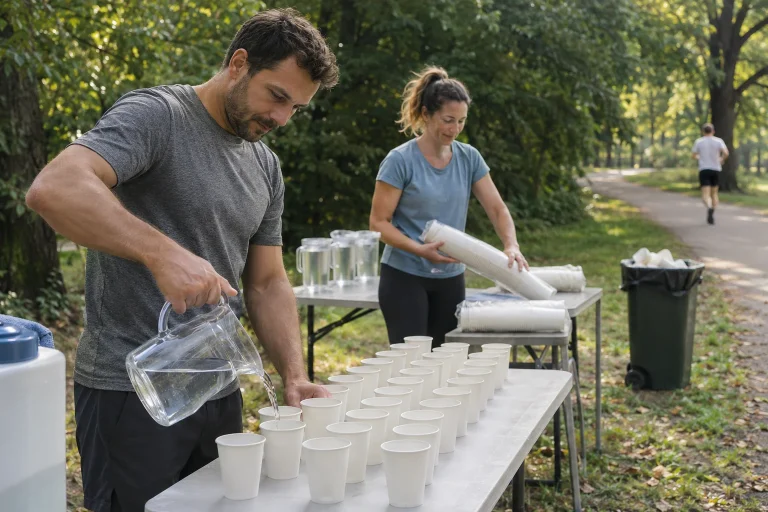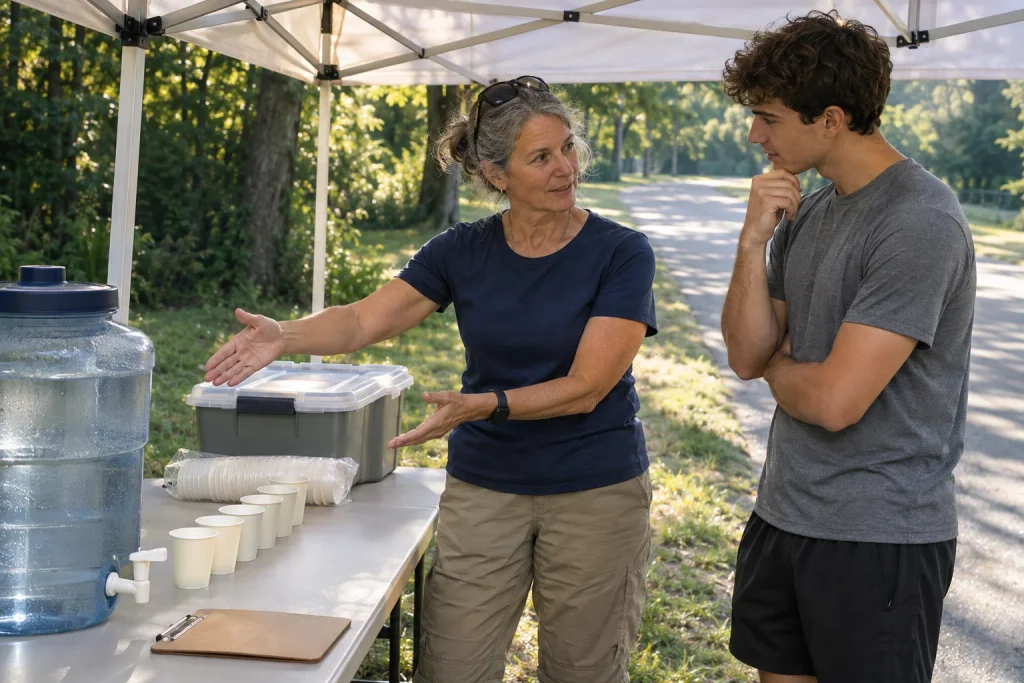
A runner experiences a refreshment station for a few seconds or minutes, while a volunteer forms part of a long workflow with a changing rhythm. Preparation, distribution, replenishment, questions and tidying may follow one another. The task is more than cheerfully handing something to a participant. You need to know what you handle, which procedures you follow and whom to notify if conditions change.
This article helps you prepare for your own volunteer role. It does not replace the event’s food safety procedures, on-site training or arrangements for medical assistance. It gives no mixing recipe, fluid intake quantity or treatment advice. The examples are our own editorial constructions; the station’s responsible leader must provide the specific arrangements to use.
Understand the station’s function and your own task separately
A large refreshment station may bring together several products and separate working areas. You may help distribute only a particular product while someone else replenishes the table and another person handles participants’ questions. It is worth understanding the station as a whole sufficiently to direct questions correctly. But do not automatically take on something you have not been assigned or trained to do.
At the start, ask: which table will I work at, what may I hand out, where do supplies come from and who decides if something changes? If several races arrive, clarify whether the same products and procedures apply to everyone. Do not copy the neighbouring table’s work solely from observation; it may handle a different product or group of participants.
London Marathon Events’ account of Bath Half volunteers describes a leader’s briefing before starting the role as a separate step. We use this as an organisational example: a person working at a station needs information for their specific role. Shifts or products in the overseas account are not requirements for your event in Hungary. London Marathon Events: A day in the life of a Bath Half volunteer
Learn the exact names of the products offered
What is in the cup or on the tray matters to the runner. Do not infer it from colour, a neighbouring volunteer’s habits or last year’s event. Know your own table’s current, approved products and labels. If you are unsure, ask the person responsible before answering.
Using ‘sports drink’, ‘water’ or a specific product name exactly as the organiser instructs helps prevent misunderstandings. You do not need to give the participant nutritional advice. Your task may be reliable product information and the assigned handover, not deciding what the runner should consume. Do not treat your own training experience as the station’s official guidance.
If the products change, signs and spoken information must follow according to the organiser’s procedure. Do not leave the same label above a new product because the change happened quickly. Notify the person responsible and wait for clear instructions. A volunteer’s improvised explanation does not replace an understandable station procedure.
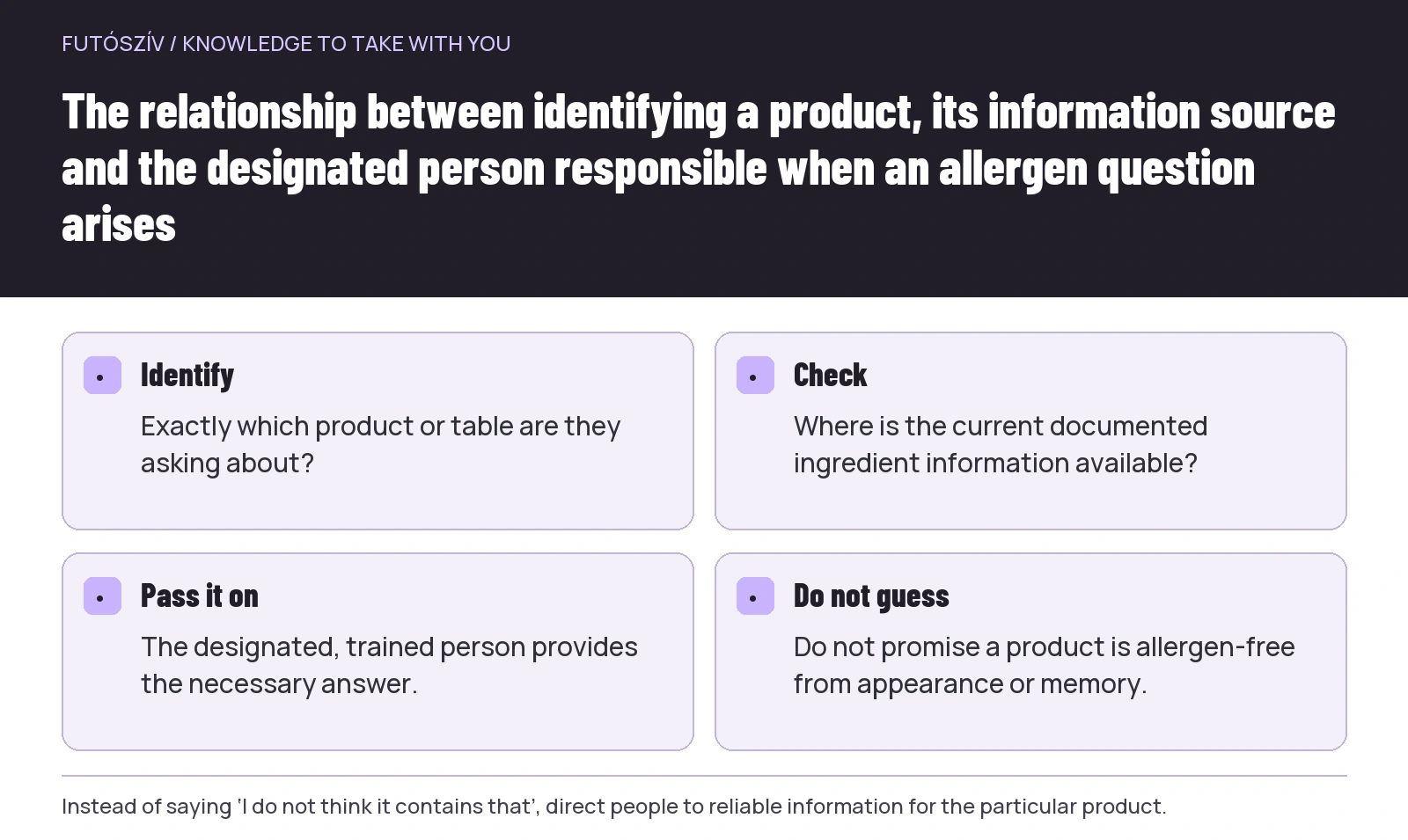 Enlarge diagram
Text version of the illustration
- Identify
- Exactly which product or table are they asking about?
- Check
- Where is the current documented ingredient information available?
- Pass it on
- The designated, trained person provides the necessary answer.
- Do not guess
- Do not promise a product is allergen-free from appearance or memory.
Do not answer an allergen question with a guess
‘I do not think it contains that’ is not an appropriate answer to a question about an ingredient. You need to know where reliable information for the particular products is available and who is authorised to provide it at the station. Do not promise freedom from an allergen because you cannot see the ingredient on the surface or in the product name. Participants need accurate information for their own decisions.
EFSA’s Hungarian-language information about allergens highlights the importance of ingredient labelling for consumers with allergies. We are not discussing recognition or treatment of allergies here. The station volunteer’s practical task is to connect the question to verified information, rather than reassure the participant from personal impressions. EFSA: Food allergens
Nébih’s 2018 good hygiene guide for catering connects spoken allergen information with documented knowledge and a designated, trained staff member. We use this as a source for the principle of handling information, not to establish the complete legal or operational classification of a particular race. The person responsible for the event must ensure the actual, current conditions. Nébih: Guide to good hygiene practice in catering and food service
A useful sentence of your own is: ‘I do not want to guess about that; I will show you who can give you accurate ingredient information.’ Do not send the person asking off in an unknown direction. If the process is unclear, clarify it with the station leader. Well-meant but unfounded certainty can cause more harm than a brief check.
Find the arrangements for clean working before starting
Know where and how to perform the hand cleaning required for your role, which tools you may use and how to handle the working area. These need teaching according to the station’s procedure. A general list remembered from an online article does not replace on-site arrangements. If a necessary item is missing, notify the person responsible before choosing an improvised solution.
Keep your own phone, bag and eating separate from the distribution surface according to the arrangements provided. When changing tasks, ask whether different preparation is needed: handling waste and handing out food are not the same operation. Do not assume cleaning completed earlier is indefinitely sufficient for every later task.
As someone working at the station, you also need to know how to report when your own condition makes continuing a particular task inappropriate. You do not need to disclose personal details in front of participants; discuss it with the designated leader. Determining the appropriate role and conditions forms part of the on-site arrangements. This article does not establish fitness for work.
Know how replenishment works
Distribution is predictable only when replenishment from behind the scenes follows a known procedure too. Know which supplies you may use, which tools to work with and whom to notify as supplies run low. Do not open or mix in a new product on your own initiative. Quantities, dilution, storage and other handling must follow the instructions for that product and event.
Report diminishing supplies specifically. Instead of ‘there is not much left’, use the method agreed with the person responsible to explain which stock changed at which table and when you noticed. You need not invent your own stock threshold if the station has a system. If it has not been clarified, ask before the first major wave of participants.
| Situation | The organisational side of your task |
|---|---|
| Supplies running low | Report the exact product and location to the named person responsible. |
| An unfamiliar box arrives | Do not automatically treat it as a continuation of the previous product. |
| The products offered change | Arrange updates to information and labelling with the person responsible. |
| The handling method is unclear | Ask for instructions before use. |
| You notice damaged or contaminated equipment | Report and handle it under the local procedure rather than hiding the problem. |
The table is not a complete food safety protocol. It shows the information you can contribute to managing the station. The responsible leader must provide the actual response procedure. Speed should not mean overlooking uncertain details.
Do not improvise changes to participant flow
The station’s position and the runners’ route form part of the event arrangements. Do not independently move a table, change the distribution side or stand somewhere new because it briefly seems more practical. A change may affect other volunteers, signs and participants’ movement. Report the problem you notice to the designated person responsible.
For your own movement, know where you can walk within the working area and how to leave your post. Fetching supplies or handling waste should not require stepping unexpectedly among runners. The local arrangements should provide a solution. Something obstructing the assigned work is not necessarily a minor issue you must quietly solve alone.
The organiser should demonstrate the specific handover technique suited to their own equipment and location. The same cups, bottles, tables or stopping arrangements do not work at every event. A video from another race is not reliable training. Even at a participant’s request, provide only help that falls within your role and the guidance received.
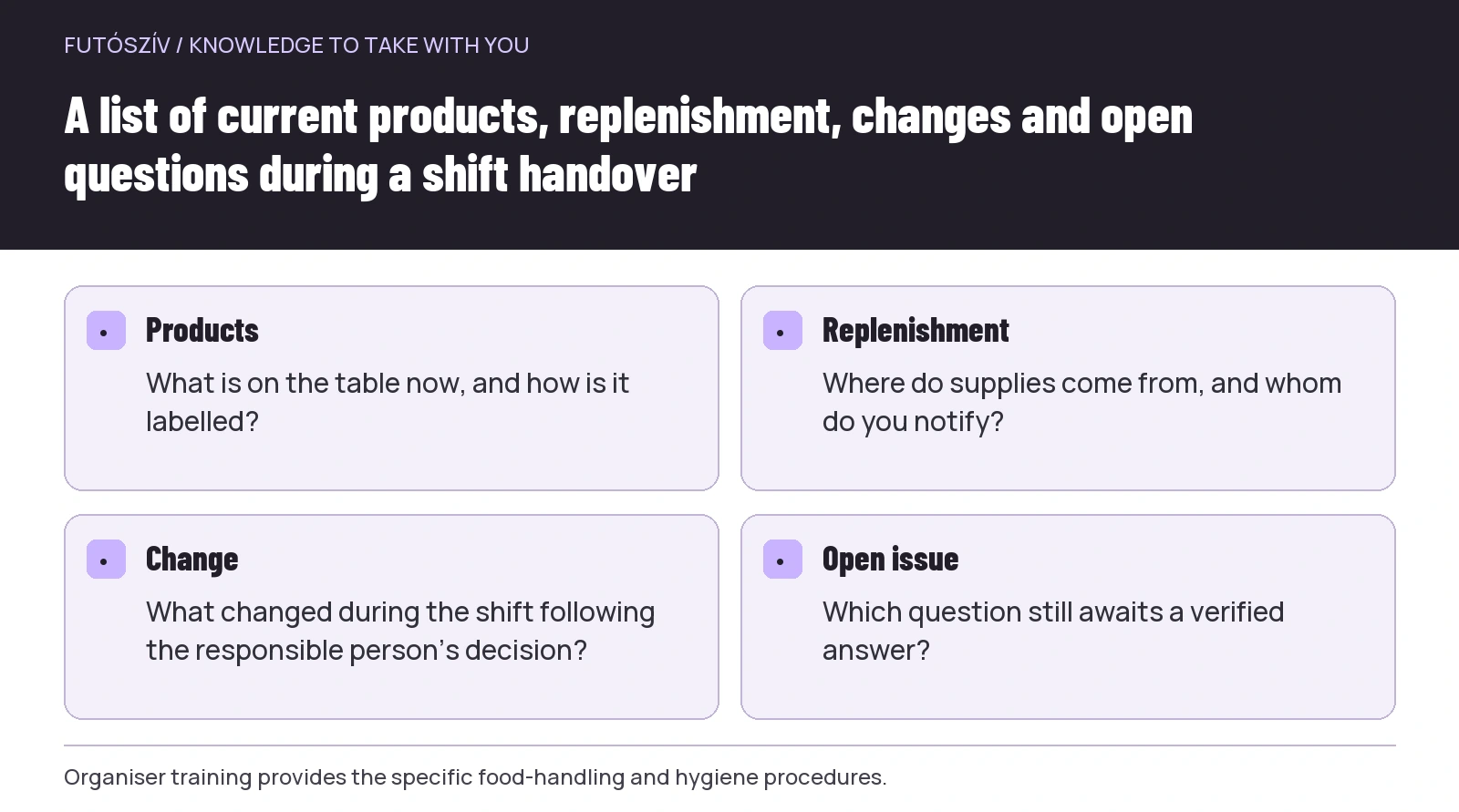 Enlarge diagram
Text version of the illustration
- Products
- What is on the table now, and how is it labelled?
- Replenishment
- Where do supplies come from, and whom do you notify?
- Change
- What changed during the shift following the responsible person’s decision?
- Open issue
- Which question still awaits a verified answer?
Short, precise sentences help amid noise
Runners often hear information while moving and with background noise. State the product name or designated next location briefly and clearly. Do not mix long encouragement or personal advice into important information. Alongside a good atmosphere, the essential point is that participants know exactly what you offer and whom to ask about which matters.
If someone asks something for which you have no verified answer, say so. ‘We will check the distance to the next station with the person responsible’ is better than a kilometre figure from memory. Use approved route information if the station has it. Your own watch or an earlier route visit may not match the current race route.
A participant’s short answer or silence does not necessarily mean rudeness. Do not expect a compulsory conversation at every handover. Considerate help can be a precise word and a movement agreed beforehand. Encouragement should not distract from an actual request or signal.
Waste management is a separate organisational task
Know where different materials go, who replaces a full collection container and which equipment is used for cleaning. Do not independently add another task to your own food or drink distribution role while leaving your working area unattended. The station team needs to manage handovers and tidiness together.
A collection container’s label and actual purpose should match. If you do not know where a particular packaging material belongs in the on-site system, ask the person responsible. Do not decide from its colour or a general idea about recycling. Event waste management needs understanding in relation to the local service and organiser’s system.
Do not automatically treat handling a hazardous or unfamiliar object as simple tidying. Report it according to the on-site procedure and carry out only the task entrusted to you. The station’s cleanliness matters, but is not a reason to accept an unknown risk without appropriate equipment or guidance. Making the problem visible is useful work too.
The lesson from a fictional product change
A volunteer has been handing out water at their table. A new container arrives behind the scenes and someone says that another drink will now be served there. A quick but mistaken solution would be to continue distribution under the old sign while trying to explain the change separately to everyone. Meanwhile, another volunteer at the station still uses the old information.
In an orderly version, the volunteer tells the station leader that the products and labels do not match. The person responsible clarifies the product, distribution arrangements and necessary information, and the team receives the same new information. The event’s procedure determines the particular transition. The volunteer does not substitute a personal recipe or spreadsheet for the missing decision.
The organisational point of the story is information that can be followed. A runner cannot know that a change has just happened behind the table. The team must ensure that participants are not choosing between contradictory signals. A brief clarification is therefore part of efficient operation, not an obstacle to it.
Hand over your shift so the next person can continue
At handover, do not simply say ‘everything is fine’. Explain the current products, where replenishment comes from, what changed and which question remains open. Pass on essential information for your role according to the station’s arrangements. Do not share personal details about participants more widely than necessary.
Follow the responsible person’s decision about closing; do not start dismantling simply because runners are arriving less often. Participants may still be coming, and dismantling may have an assigned sequence too. Know what happens to remaining products, equipment and waste; do not handle these according to your own ideas for using them. Report completion of your task and your departure too.
A refreshment-station volunteer’s greatest contribution is a precisely understood role. They know the products, follow the procedures taught, avoid guessing about ingredients and pass on changes promptly. This keeps the station predictable even during the runner’s brief encounter with it. A good atmosphere can build on that reliable operation.
How Futószív articles are prepared: our editorial guidelines.