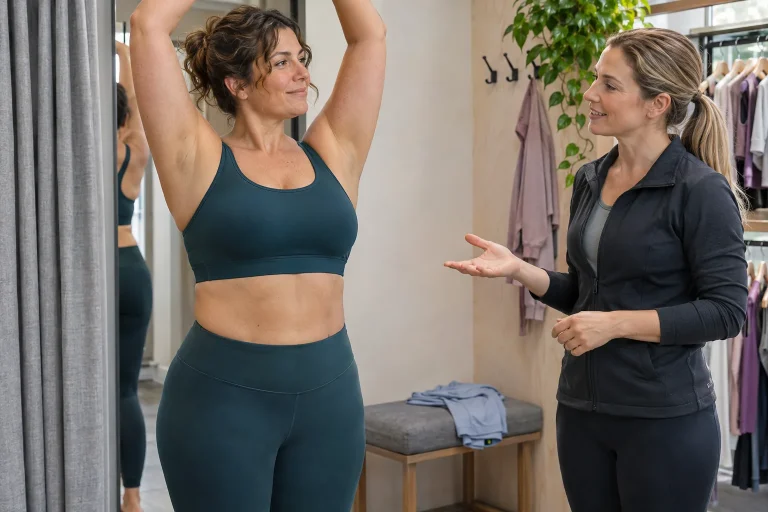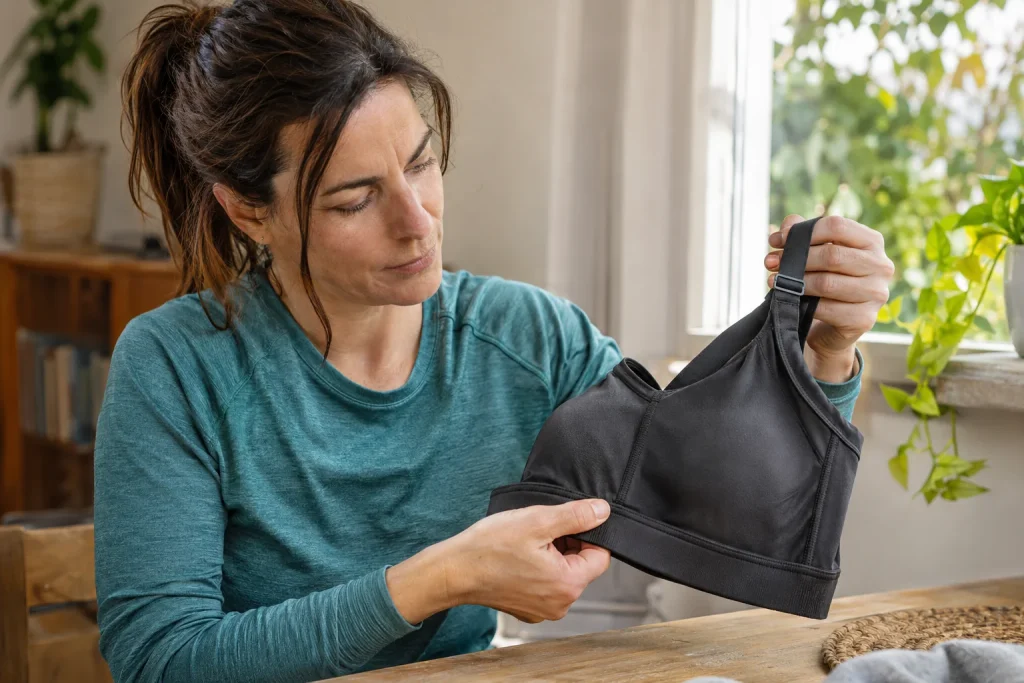
A sports bra works for running when it supports comfortably while allowing breathing, arm movement and easy dressing and removal. Its size label is only a starting point. Two styles with identical labels can fit differently, and a previously suitable bra may change after physical or training changes.
Selection need not become a brand competition or one perfect rule. Specific trials are more useful, distinguishing support from painful compression. The checks below help assess practical running use. They provide neither a universal sizing formula nor an automatic clothing explanation for new breast symptoms.
First identify what bothers you now
Is breast movement uncomfortable, a strap digging in, the underband riding up or a cup edge pressing? These are different fit questions. Writing only ‘more support needed’ may lead to another tighter bra with the same problem. Describe the location and movement context more precisely.
Consider the running you want it for. A short easy loop, longer session and race mean different time against skin. Tops, vests, bags or heart-rate straps can affect comfort together. Try to consider the kit you will actually use.
The University of Portsmouth Research Group in Breast Health emphasises appropriate fit and support suited to activity. Comfortable support is not a question only for larger breasts. Your experience matters more than assuming a particular body size needs no attention to equipment.
Three main fitting points
The underband should stay stable and ideally distribute pressure evenly without pain or breathing difficulty. Cups or the front should contain breasts appropriately without uncomfortable spilling at sides or top. Shoulder straps should adjust to provide support without the entire garment relying only on pressure hanging from your shoulders.
The UK Sports Institute educational material discusses underband, cups, straps and, where present, underwire as separate fit considerations. Underwire should not press on breast tissue. Without wire, still examine pressure distribution, gaps and folds.
One finger test or tape measurement does not tell everything. Measurements can help select trial sizes, but movement checks should remain part of the decision. When trying several sizes, compare the same functional points rather than only labels.
Support can use several designs
Some styles compress breasts towards the chest, others support each breast in a separate cup, and designs can combine these approaches. One style cannot be selected for every runner. Comfort, breast shape and the particular garment’s construction matter together.
Thicker padding, crossed straps or a high front alone do not prove better running use. Check how you move in it. Less striking details, such as a wider adjustment range or comfortable seam, may help more during an actual session.
If a style fails, do not conclude your body is at fault. Another cut, band-to-cup relationship or fastening may be needed. Knowledgeable fitting support helps when it considers your experience and purpose during running.
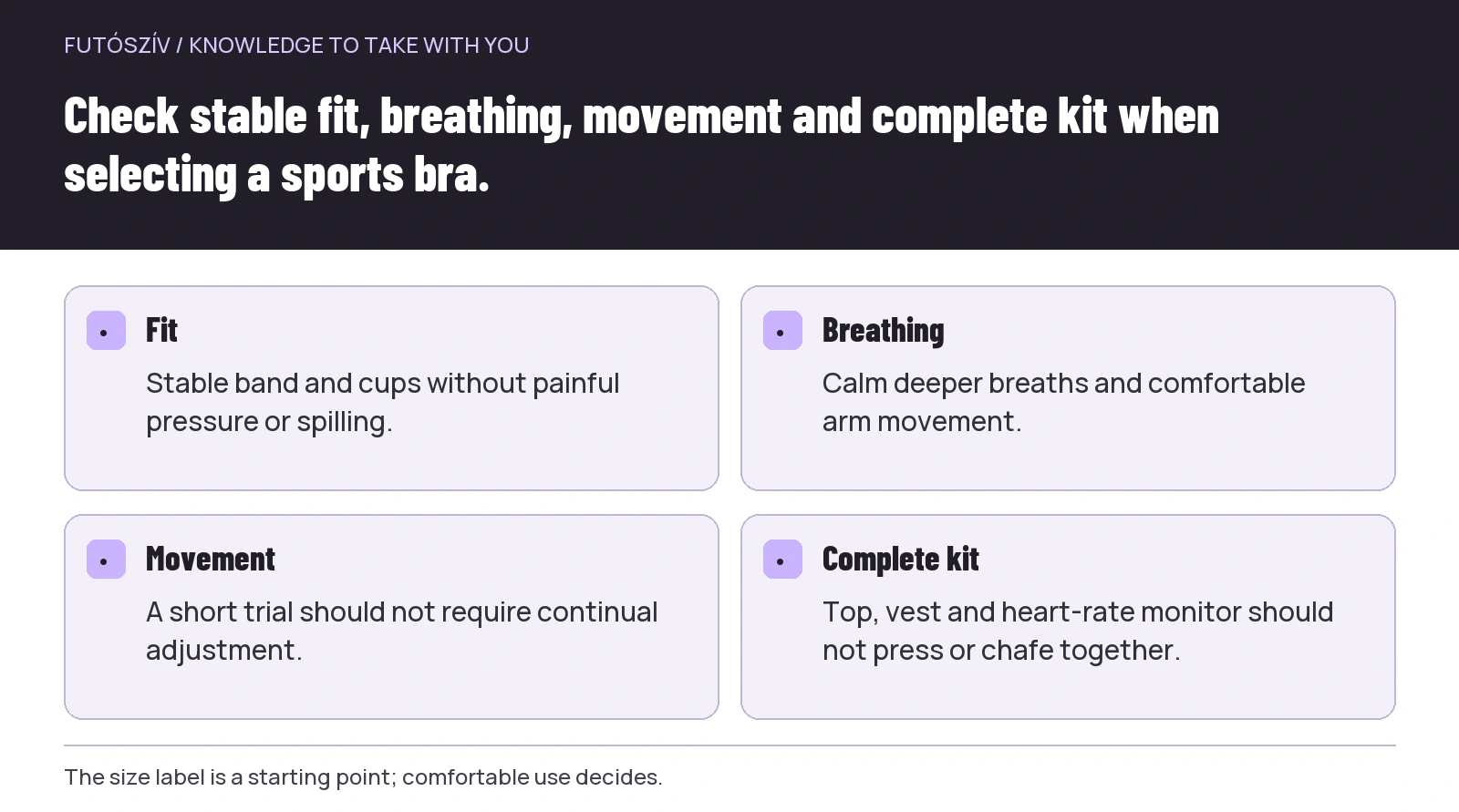 Enlarge diagram
Text version of the illustration
- Fit
- Stable band and cups without painful pressure or spilling.
- Breathing
- Calm deeper breaths and comfortable arm movement.
- Movement
- A short trial should not require continual adjustment.
- Complete kit
- Top, vest and heart-rate monitor should not press or chafe together.
Do not omit the breathing check
A 2024 study compared different underband tightness in nine well-trained runners. The tighter band affected breathing mechanics and effort; under the studied conditions, the looser setting produced more favourable breathing and energy-use responses. This small, specialised sample does not instruct everyone to loosen their bra.
For fitting, the lesson is to check breathing comfort alongside support. Take a few calm deeper breaths, raise your arms and move your torso. Tightness or pain should not be accepted as the necessary price of support.
Breathlessness or chest pain, however, cannot automatically be attributed to clothing. New, severe or concerning symptoms need appropriate healthcare. A clothing trial assesses comfort rather than ruling out another condition.
What can research performance benefits mean?
A 2022 treadmill study found lower oxygen consumption and better running economy with greater breast support in the situation studied. This is an interesting biomechanical finding, but does not prove a particular retail product causes faster racing for everyone.
The laboratory task, participants and garments compared determine possible conclusions. Appropriate support and comfort remain important without expecting a percentage performance promise. Do not tolerate pressure or chafing for a number highlighted in marketing.
Consider the whole outing: do you move more comfortably, adjust equipment less and feel appropriate afterwards? These are interpretable outcomes in your own use. A bra does not replace training, food or recovery.
A short movement trial
First check strap and cup positions standing. Then swing and raise your arms and turn within a comfortable range. If possible and appropriate to your condition, briefly jog on the spot or take a few running steps. Dramatic jumping is unnecessary to prove the garment’s strength.
Notice whether the underband rises, straps dig in, fastenings move or continual adjustment is needed. After stopping, check whether the garment stayed in place. Ask the same questions for every bra to identify real differences more easily.
Test putting it on and taking it off too. A supportive bra difficult to remove alone may be problematic after a long run. Limited shoulder movement, recent surgery or another circumstance can make accessible fastening particularly important.
Longer running can reveal other problems
A short trial can leave questions about moisture, seams and repeated movement. First use a new bra for a shorter appropriate session. Do not discover at the target race that a clasp presses under a vest or a seam chafes after longer wear.
Test the complete kit together. Backpack straps, top seams and a heart-rate device can move relative to one another. Changing one component makes the source easier to identify. Testing every new garment at once is difficult to interpret.
Painful chafing is not a natural part of breaking in a bra. Stop or adapt use and address the cause before another longer session. Seek appropriate advice for persistent skin problems or signs of infection; masking pain does not improve fit.
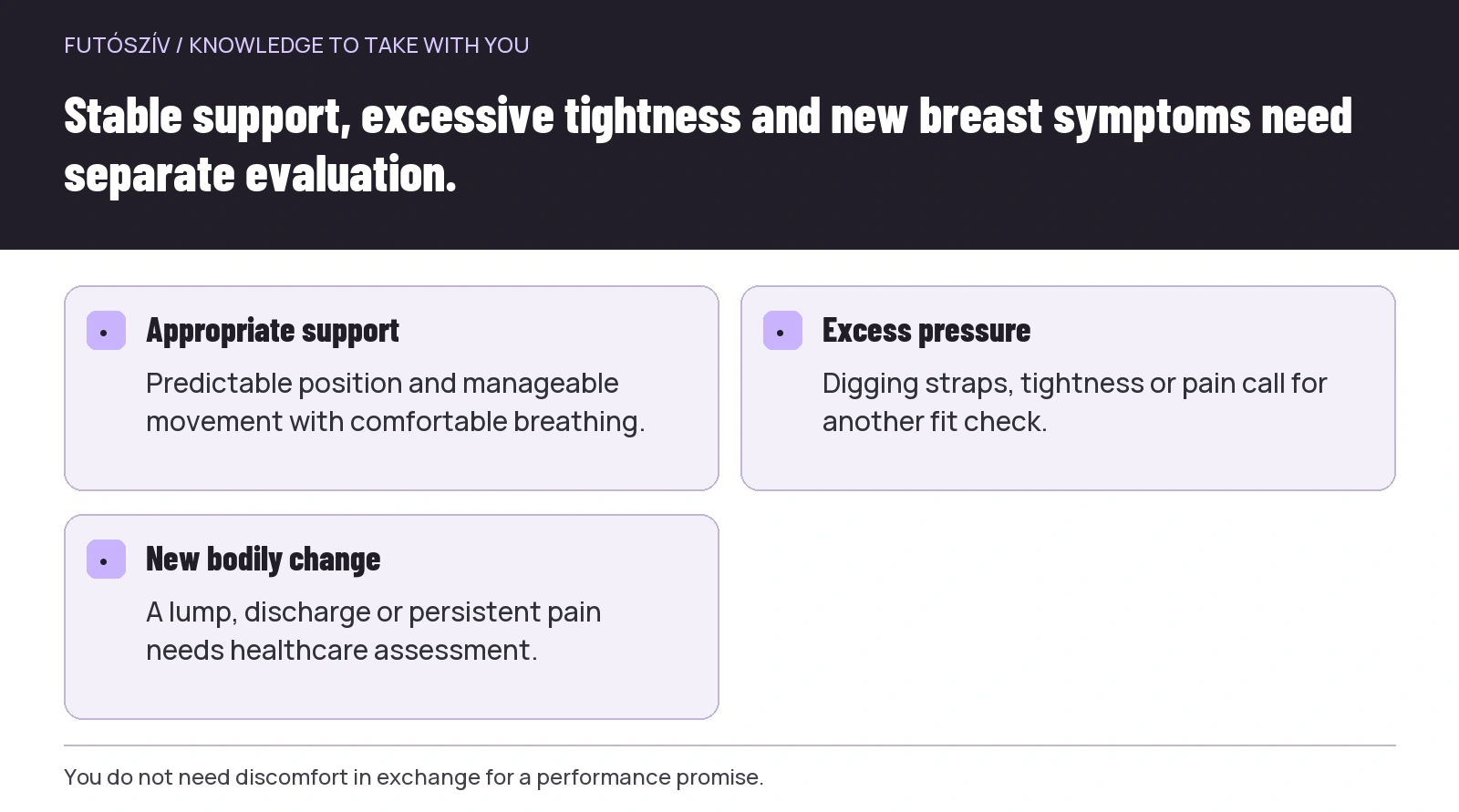 Enlarge diagram
Text version of the illustration
- Appropriate support
- Predictable position and manageable movement with comfortable breathing.
- Excess pressure
- Digging straps, tightness or pain call for another fit check.
- New bodily change
- A lump, discharge or persistent pain needs healthcare assessment.
Physical changes may require another fitting
Pregnancy, breastfeeding, weight changes, hormonal changes or a procedure can alter a previous fit. You need not buy a whole new wardrobe beforehand, but should not expect an old garment to work identically in every situation. Fit for your present condition.
During breastfeeding, fullness and access matter practically; painful compression is not the goal. After surgery, follow the clinician’s clothing and activity instructions. A general sports-bra label does not replace condition-specific guidance.
Your boundaries matter during fitting too. When requesting sizing help, say which touching or checks you consent to. Appropriate service should be respectful and understandable; you do not need to accept discomfort in the hope of accurate sizing.
When is a bra worn out?
There is no replacement kilometre count for every bra and wearer. Check whether the underband retains shape, adjustments work and seams and fastenings are intact. If the same setting repeatedly rides up, presses or needs more adjustment, reassess fit.
Washing and drying according to the care label help preserve usability. Do not judge only by age: frequency of wear and actual condition matter too. A long-unused bra taken out before a race also deserves a trial earlier than the evening before.
If an adjustment helps, observe it during a short session too. If discomfort remains, do not keep the product solely because of price or past success. The aim is current usability rather than justifying the purchase afterwards.
Do not let clothing explanations hide breast symptoms
The NHS recommends healthcare advice for a new lump, swelling, skin or nipple changes, unusual discharge or persistent breast or armpit pain. Improving bra comfort does not replace assessing these symptoms.
Not every breast pain means serious illness, but do not automatically blame a new change on training. Describe onset, circumstances and changes. Do not use painful runs to prove clothing is the sole cause.
If symptoms have been appropriately assessed and you are improving comfort, fitting can contribute usefully. Both healthcare assessment and more comfortable movement can be relevant together. Neither makes the other unnecessary.
A short fitting checklist
- Does the underband remain stable without painful pressure?
- Do breasts fit appropriately within cups or the front section?
- Are breathing, arm movement and necessary activity comfortable?
- Do straps or fastenings need repeated adjustment?
- Can I put it on and remove it within my movement capabilities?
- Does it work on a short run with the complete kit?
Choosing a good sports bra is a functional trial. Add your own movement and comfort to size labels, research promises and product photographs. Equipment can then genuinely support running and demand less attention during the session.
Sources
- University of Portsmouth: Research Group in Breast Health
- UK Sports Institute: Supporting the developing female athlete – breast support education
- Sports Bra Restriction on Respiratory Mechanics during Exercise, 2024
- Greater Breast Support Is Associated With Reduced Oxygen Consumption and Greater Running Economy During a Treadmill Running Task, 2022
- NHS: How to check your breasts or chest
How Futószív articles are prepared: our editorial guidelines.