
‘Why race at that pace?’ ‘Should you still be doing this at your age?’ ‘Those shoes do everything for you.’ A running comment can be clumsy interest, unsolicited advice or a hurtful judgement. You do not need the same response to each, and winning every conversation as a technical debate is not your job. First decide whether you want to discuss it at all and consider the setting.
Male runners can also say when a comment does not fit the social activity. You need not accept repeated discomfort as teasing. This guide offers original example sentences for everyday communication. It does not classify legal cases or replace professional assistance in serious or threatening situations.
Separate the content from the situation
The same sentence can sound different from a close friend, new club member or unknown passer-by. Agreed humour, the opportunity to ask calmly and whether comments continue after your request all matter. Your response need not depend solely on a sentence’s claimed intention. Its practical consequences matter too.
‘I didn’t mean anything bad’ may explain intention, but you can still state your need now. For example: ‘I understand you wanted to help. I’m not looking for equipment advice right now.’ This does not declare the person generally malicious. It defines the boundary of one conversation.
You do not have to analyse your reaction at length in front of everyone either. Today you may simply want to continue, then discuss it later. A brief closure and later clarification are compatible. A running route does not always provide space and attention for a longer conversation.
Four possible aims, four different answers
Setting a boundary is not always the primary aim. You may want to clarify a misunderstanding, close the subject or request changed behaviour after repetition. Knowing which you want makes the answer shorter and clearer.
| Your aim | Original example sentence | What should you not automatically expect? |
|---|---|---|
| Clarification | ‘Are you asking about today’s run, or giving a general opinion?’ | The other person may not have expressed it clearly initially. |
| Brief information | ‘This is the shared activity I chose today.’ | One fact does not resolve every disagreement. |
| Closing the topic | ‘I don’t want to discuss this now.’ | A full personal justification is unnecessary. |
| Requesting change | ‘Please leave that comment out at future sessions.’ | After the request, observe actual behaviour. |
These are not compulsory scripts. Use words that fit you and the relationship. Finding the perfect expression is not the task. What matters is that the other person understands what you are answering and requesting.
You do not have to defend performance in an unsolicited ranking
If someone judges your pace, distance or chosen race, results can seem the obvious reply. But this may accept their conversational framework, as though your right to participate depends on a better number. If you do not want that comparison, return to your own activity.
‘This distance suits me now.’ ‘I came for today’s meeting, not a comparison.’ ‘This session has another purpose.’ These do not claim results are irrelevant. They indicate that you do not want a personal ranking in this conversation. Someone genuinely curious about your preparation can ask a clearer question later.
Among male friends, ‘show us you can handle it’ need not automatically become a shared task either. Say: ‘I didn’t agree to that challenge.’ If you want competition, choose it separately in advance. The original agreement does not need constant demonstrations of endurance to remain valid.
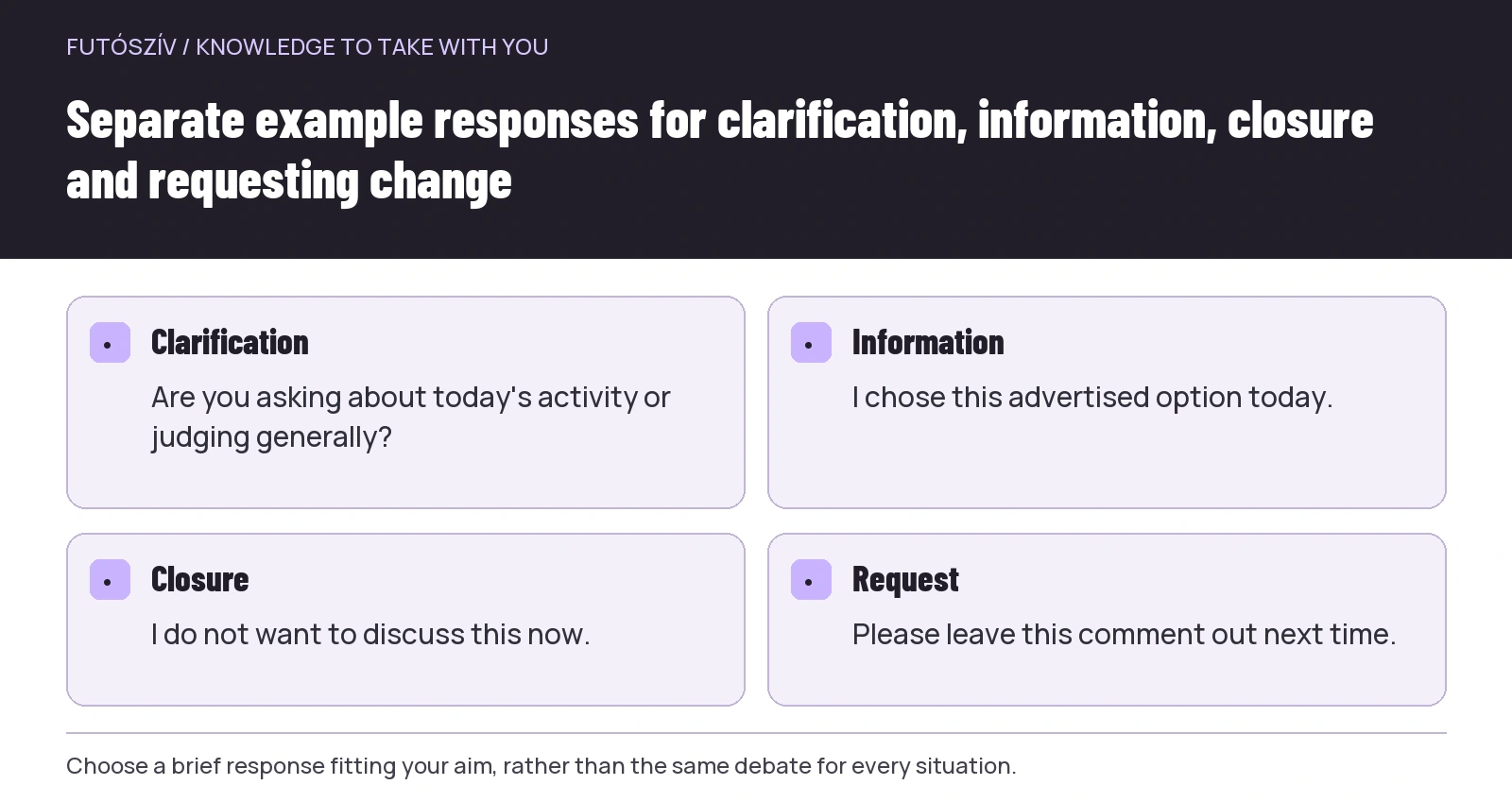 Enlarge diagram
Text version of the illustration
- Clarification
- Are you asking about today’s activity or judging generally?
- Information
- I chose this advertised option today.
- Closure
- I do not want to discuss this now.
- Request
- Please leave this comment out next time.
Ask what unsolicited advice is based on
A brief technical observation may help, but goodwill does not guarantee professional accuracy. If interested, ask which circumstances the advice concerns and its source. You do not need to try a new suggestion mid-run because it sounds confident. Check applicability separately.
For health questions, a companion’s impression should especially not determine your situation. ‘It worked for me’ can be personal experience rather than general authority. Say: ‘Thank you; I’ll discuss that with an appropriate professional.’ This is not insulting the adviser; it selects support appropriate to the task.
If you do not want advice, you need not first prove it wrong. ‘I don’t want to change that now’ may suffice. Hearing advice and following it are separate decisions. Closing the conversation does not reject every future professional comment.
A personal subject does not require the whole story
Unsolicited running comments can involve body shape, age, family circumstances or health history. Decide separately how much to share. Organising the route may need information, but not a public discussion of your entire background. A group chat is not automatically confidential either.
One sentence might be: ‘I don’t want to discuss that part in the group. For today, what matters is that I’m choosing the shorter option.’ This provides necessary practical information while retaining the rest. You do not need to apologise for an answer having limits.
You can acknowledge friendly interest too: ‘Thank you for asking, but I’d rather not talk about it now.’ If you want to share later in another setting, offer that separately. A no now is not a permanent verdict on the relationship, only a choice about this conversation.
One clarification and repeated behaviour are different situations
Simple feedback often works after a clumsy sentence. If comments regularly recur despite a clear request, however, the issue extends beyond original content. Consider how the person responds to your signal too. You do not need endless new explanations of the same request.
Refer to specific occasions: ‘This happened last time and today, although I asked us to leave it out.’ Name observable situations rather than analysing personality. The aim is to decide whether the shared activity can continue acceptably for you too.
If not, choose another group, end the conversation or contact the organiser. Belonging does not oblige you to tolerate every repeated discomfort. You need not start a public argument to choose another activity either. Further participation is your decision.
A club should have known behaviour expectations
In an organised community, handling every situation alone is not solely the affected participant’s responsibility. Clear expectations and a known contact help. England Athletics’ codes-of-conduct page, for example, highlights making acceptable behaviour and expected practice understandable. This is an overseas organisational example, rather than a rule automatically applying to Hungarian clubs. England Athletics: Codes of Conduct
Find your own club’s actual rules and contact. An informal group may lack a formal procedure, but its organiser can still know about recurring problems affecting the activity. Do not assume every Hungarian community has the same roles or complaints route. Clarify this locally.
In a message to the organiser, separate events from requested support. For example: ‘These comments were made at these sessions, I raised it, and it happened again. I’d like to know the shared framework you use to address this.’ Asking for targeted help does not require sending every detail to the entire group.
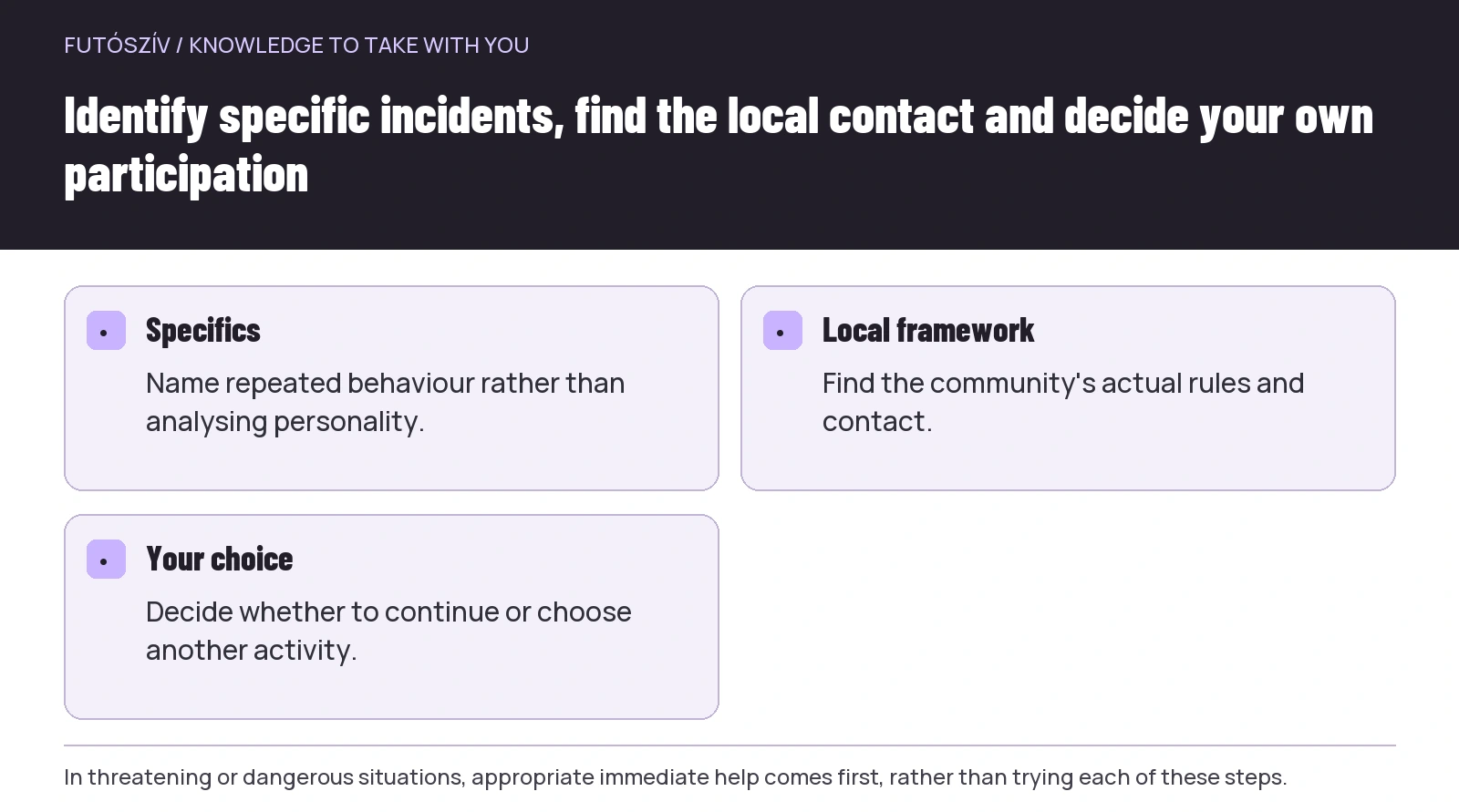 Enlarge diagram
Text version of the illustration
- Specifics
- Name repeated behaviour rather than analysing personality.
- Local framework
- Find the community’s actual rules and contact.
- Your choice
- Decide whether to continue or choose another activity.
Distinguish an uncomfortable argument from a threatening situation
Everyday communication phrases are not enough in every situation. With threats, violence or immediate danger, politely ending a debate is not the priority. Seek immediate help appropriate to the situation and prioritise on-site safety. You do not need to try the article’s polite replies first.
England Athletics’ reporting information distinguishes minor club conduct issues from more serious cases. We present that distinction as a principle, rather than recommending the English procedure for Hungarian cases. Check your own community’s responsible contact and appropriate Hungarian support separately. England Athletics: Reporting a concern
Do not expect yourself or another person affected to remain in a dangerous conversation to collect evidence. Necessary information that can safely be retained may be noted for later reporting. Legal or official questions need appropriate professional channels; the group’s opinion cannot classify a particular case.
A fictional club situation in three steps
A newcomer registers for a shorter route. Another runner says: ‘You’ll get used to it; our men don’t turn back so soon.’ The newcomer replies: ‘I came for the advertised shorter programme; that’s what I’m choosing.’ This is clear without debating anyone’s sporting ability.
If the comment stops, the session can continue as agreed. If it returns, the next sentence might be: ‘Please don’t judge my chosen distance that way.’ The participant need not recount their whole sporting history. The request concerns behaviour rather than the other person’s entire character.
If it continues, discuss with the organiser how the shorter session works and how advertised participation can be provided. The example promises no guaranteed solution: the group may remain unsuitable. The participant still controls future attendance even without persuading everyone.
If you witness an unsolicited judgement
You need not stage a public scene to avoid reinforcing the comment. Do not laugh along, repeat it or add more examples. A brief redirection can help: ‘Let’s discuss the advertised programme.’ If the affected person wants to talk later, listen without deciding their next step for them.
Describe your own observations precisely: what you heard, when and what you remember confidently. Do not add assumed motives or second-hand stories. If involving the organiser seems necessary, help find the channel in consultation with the person affected. Serious situations prioritise safety and appropriate help.
Do not make the target of the comment the constant topic afterwards either. Support does not mean revisiting the incident at every meeting. Ask what is needed now: conversation, company when approaching an organiser or simply another shared outing. Respect the answer.
A good response can be brief
Every unsolicited sentence does not need to become a teaching conversation. Clarification, closure or a specific request may suffice. A response’s value is not measured by immediate agreement, but by expressing your choice clearly and taking a next step appropriate to the situation.
You may enjoy talking about running without constantly defending your right to participate. Agreements, behaviour and mutual consideration matter in shared activities. When missing, requesting support or choosing another setting are valid decisions too. Your running life need not revolve around endless explanations in response to unsolicited comments.
How Futószív articles are prepared: our editorial guidelines.