The history of women’s participation in the marathon is not a story of one single door opening. Completing a race, receiving a race number, gaining official recognition for the women’s field and entering the Olympic programme are different milestones. Combining them can obscure individual pioneers’ contributions or turn a local turning point into a claim of being first worldwide.
This overview connects several documented international milestones. The examples from Boston, New York and the 1984 Olympics belong to separate events. They do not replace the full history of women’s running in every country, but show how participation, recognition and visibility changed. The information can be checked in the organisers’ and international sporting institutions’ own archives.
Finishing and having an official place could be different things
The historical section of the Boston Athletic Association’s 2023 media guide identifies Roberta ‘Bobbi’ Gibb’s 1966 run as the first female completion of the Boston Marathon. The document also makes clear that official recognition of women came later. A claim about the ‘first woman in Boston’ therefore needs to distinguish completion from status.
This is more than a minor administrative detail. Someone could physically run the course during a period when the system did not yet offer them the same participation framework. The gap between achievement and record-keeping is also part of the history of recognition. Understanding the later official list therefore requires learning about earlier participation under a different status.
Do not infer from this that Gibb was the first woman in the world to run a marathon. The source describes a first at one specific event. Naming the location precisely preserves its real significance without diminishing achievements by other athletes elsewhere, earlier or under another system. A good historical statement has a defined scope.
Kathrine Switzer represents another milestone
The same Boston historical material discusses Kathrine Switzer’s race number and her entry under the name K. V. Switzer at the 1967 event. Photographs of the attempt to remove her during the race also made the conflict over participation visible. This is an important story, but it is different from Gibb’s completion the year before. Precise wording distinguishes the two athletes’ roles.
Instead of asking only ‘Who was first?’, it can be more useful to ask: first in what respect, or representative of which change? One story concerns an earlier completion, the other participation with a race number and a visible conflict. Both belong to the event’s history. They do not need to compete for one title for the sake of a short social-media post.
When using a historical photograph, describe the scene and its associated status together. A dramatic image is not a complete biography of every female runner of the period, nor a substitute for checking results or rules. It provides powerful visual evidence of how participation became a conflict involving specific people in a specific situation.
 Enlarge diagram
Text version of the illustration
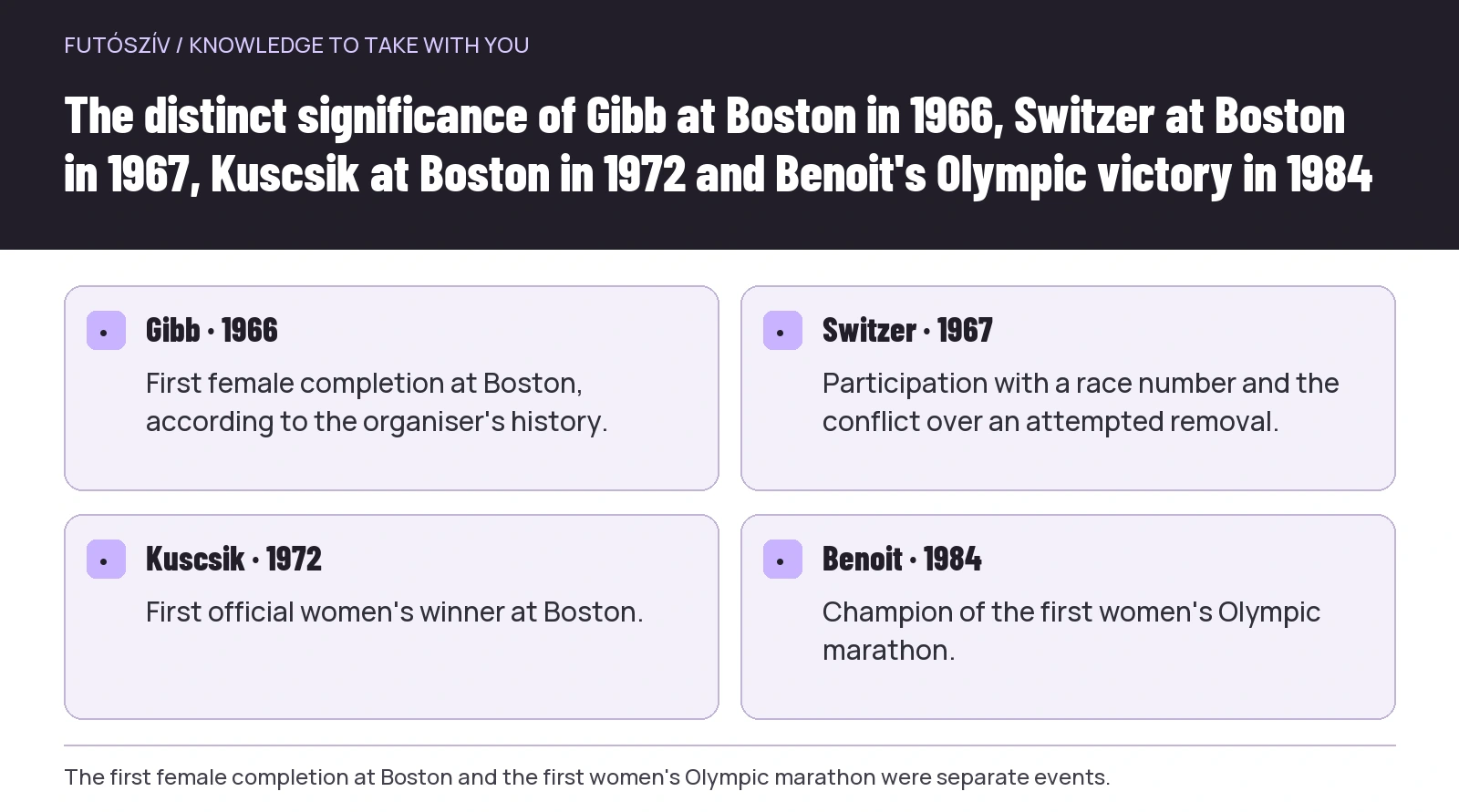
- Gibb · 1966
- First female completion at Boston, according to the organiser’s history.
- Switzer · 1967
- Participation with a race number and the conflict over an attempted removal.
- Kuscsik · 1972
- First official women’s winner at Boston.
- Benoit · 1984
- Champion of the first women’s Olympic marathon.
1972 was the year of official recognition in Boston
The BAA historical summary records official recognition of women’s participation in 1972 and Nina Kuscsik’s first official women’s victory. The listed results can be understood within this new framework. The date answers a different question from the 1966 completion or participation with a race number in 1967.
This distinction still helps when reading historical lists. If an archive treats a pioneering period and official results in separate sections, examine what that division means. Alongside the recorded time, the status assigned by the list’s compiler is important information. A change in the recording framework does not diminish the athletes’ actual efforts; it explains the nature of the change.
The process should not be turned into a single instant when everything changed everywhere. Boston’s own history describes that local event. Other races followed different timelines. Understanding international change requires placing several such specific histories alongside each other while preserving their differences.
New York contributed a different timeline and a different conflict
The New York Road Runners timeline of women’s running describes the first New York City Marathon in 1970 as already open to women. This alone shows why treating one city’s opening year as the history of the entire international field is inaccurate. Events operated in different regulatory and organisational settings.
For 1972, the timeline also records the female starters’ sit-down protest in New York against unequal treatment. This reminds us that the opportunity to participate and equality in the conditions of participation are separate questions. After a door opened, operating arrangements could still remain that athletes challenged.
There is no need to supplement the story with a sweeping explanation that reduces every detail to one cause. The verified claim is that specific runners protested at a specific event, and the organiser’s retrospective connects this with a rule change. The athletes’ active role is clear: they did not merely accept an opportunity handed to them, but also shaped the conditions of participation.
Entering the Olympic programme brought a new level of visibility
The International Olympic Committee overview of Los Angeles 1984 explicitly emphasises that women had already run marathons at international events. The turning point in 1984 was the first women’s Olympic marathon. Keep this precise wording: it was not the first women’s marathon in general, but the first included in the Games.
The World Athletics historical retrospective describes Joan Benoit’s victory on 5 August 1984 in 2:24:52. The result was both an individual sporting achievement and the first victory in the new Olympic event. Both meanings can be retained without one replacing the other.
The greater publicity of Olympic participation does not make the earlier city-race histories unnecessary. Instead, it adds a new institutional level to an already existing women’s marathon scene. Starting the timeline only in 1984 loses earlier completions, organisers’ decisions and athletes’ initiatives. Leaving out the Olympic programme change, however, omits an important milestone in international recognition.
 Enlarge diagram
Text version of the illustration
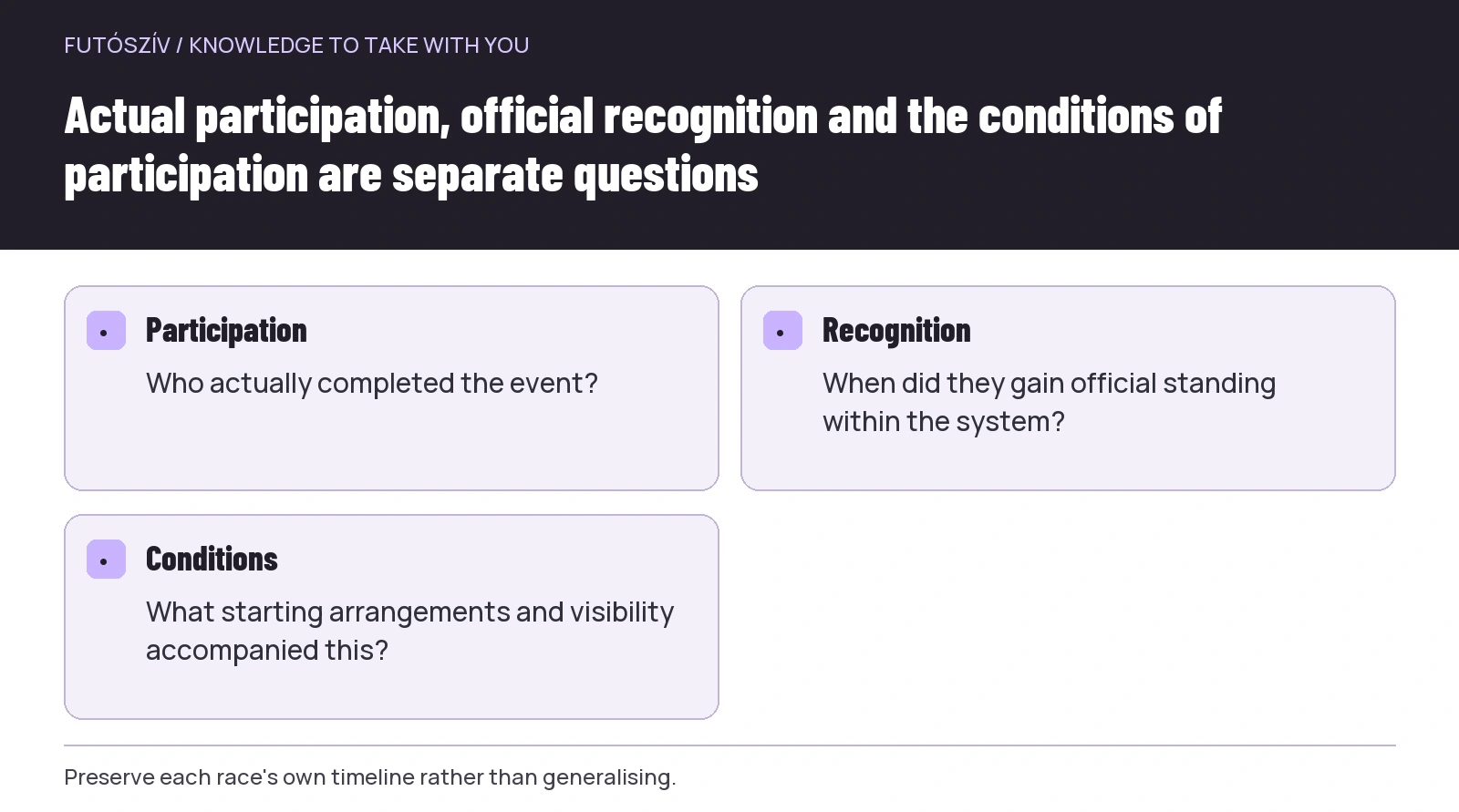
- Participation
- Who actually completed the event?
- Recognition
- When did they gain official standing within the system?
- Conditions
- What starting arrangements and visibility accompanied this?
Examine a separate start together with its purpose
The NYRR timeline also mentions a separate start for the elite women’s field in 2002, connecting it with visibility and the racing situation. This is a different historical question from earlier, contested discrimination. Physical separation alone does not explain a rule’s purpose or effect.
Read a decision like this through the event’s rules and historical context. Who did it apply to, what racing situation did it create, and what reason did the organiser give? A blanket statement that all separate starts mean the same thing would erase important differences. Equally, a stated intention should not be treated as proof of every effect.
As a participant today, find out your own starting arrangements from your event’s current rules. A historical article does not provide starting instructions for your next race. It can, however, help you recognise that sporting and social considerations may lie behind an event’s format, and that these should be named specifically.
Participation, recognition and conditions are separate layers
You can use three questions as your own interpretative framework. Could the person take part in the run? Did the system officially recognise their participation and result? Under what conditions did they feature in the race and in public coverage? This is not an official sporting classification, but a way of supporting historical reading.
A sentence saying that ‘women could enter by then’ often answers only the first question. Official lists, starting arrangements and public presentation may be documented elsewhere. The distinction is more than wording: it shows how an existing sporting achievement could gradually become a recognised part of the competition system.
| Historical question | What information can help? | What should you not automatically infer? |
|---|---|---|
| Who completed the event? | Reliable results recorded at the time or subsequently compiled. | That all conditions of participation were equal at the time. |
| Who received an official opportunity? | Entry and organiser documents. | That nobody had completed the distance before then. |
| When was the women’s field recognised? | The specific event’s official history and results list. | That the change happened simultaneously worldwide. |
| When did it become an Olympic event? | The Olympic programme and results archive. | That this was the first women’s marathon in general. |
Do not turn a pioneer’s story into a requirement for every woman
An athlete’s courage and initiative can inspire, but a historical achievement does not mean everyone today should choose the same distance. The marathon is one branch of running culture, and women’s running cannot be reduced to this single goal either. Shorter distances, community activity or another role can belong to the sport in their own right.
The story’s value may lie in showing the importance of being able to choose for yourself. Recognising earlier restrictions is not a reason to introduce a new performance expectation. A beginner today does not have to measure her participation against an Olympic milestone for her interest to be taken seriously.
This cultural article does not draw sex-specific conclusions about training or health. It discusses athletes’ histories and changes to the framework of participation. Individual preparation and suitability are different questions, which cannot be decided on the basis of a past victory or a popular story about a pioneer.
How can you accurately describe these four important roles?
For Gibb, name the Boston completion. For Switzer, the precise context is participation with a race number in 1967 and the associated conflict. For Kuscsik, highlight the official women’s victory in Boston. For Benoit, the defining claim is the first women’s Olympic marathon gold medal. These are separate points in a longer history, rather than mutually exclusive titles.
If you create a short timeline, write the event name beside every year. The year 1972 alone does not show whether you mean Boston, New York or another change. Retaining the place prevents a historical claim from quietly extending beyond its source. An accurate sentence is often only a few words longer than an inaccurate one.
The history of women’s participation thus emerges as the interconnected work of athletes, communities and institutions. Documented completion, official recognition and Olympic inclusion are distinct but related milestones. Presenting them together, each within its own scope, gives running history a richer and fairer picture of those who shaped it.
How Futószív articles are prepared: our editorial guidelines.