Running history is full of memorable stories: a famous helper at the finish, a marathon lasting decades or a record arising unexpectedly. Yet a good story may contain several separate claims, and the same source may not establish all of them. The first step towards reliable reading is to turn a colourful narrative into questions you can check.
You do not have to be a professional historian to do this. Simply distinguishing a contemporary document, a participant’s recollection, later research and a repeated internet summary already helps. The following method uses two specific cases from running history to show how a legend can become a more accurate story that remains interesting.
Break the story into claims
Consider a general, invented sentence: “The famous writer saved the runner, who was therefore deprived of Olympic gold.” This contains at least four separate claims. Who was present? Who provided assistance? What happened to the result? What was the stated reason for the official decision? A single striking photograph may not answer all these questions.
Beside each claim, note the kind of evidence it needs. Identifying a person may require a sound caption and other information supporting the identification. A race result needs an official results list. A decision needs a rule and documentation relating to the event. A participant’s own account may matter when examining their feelings, but does not automatically replace the official result.
Breaking the story down does not diminish its value. It reveals which parts are secure, which are disputed and which represent later interpretation. Instead of an overly general sentence, you gain a narrative whose important details each prompt an appropriate question. This precision also serves the athletes’ histories well.
First example: Conan Doyle and Dorando Pietri’s finish
Peter Lovesey’s study Conan Doyle and the Olympics specifically examines the story that Arthur Conan Doyle helped Dorando Pietri at the end of the 1908 Olympic marathon. It identifies the two helpers in the famous photograph as Jack Andrew and Dr Michael Bulger, and discusses Conan Doyle as a reporter seated in the stands.
The study’s strength is not simply attaching different names to the same photograph. It also identifies the contemporary newspaper account in which the writer described the scene from his own position. This connects different types of evidence: a photograph, personal identification and the eyewitness author’s own account. It provides a much stronger route to verification than an impression that someone “looks like him”.
The UK Parliamentary Archives’ description of a collection item also mentions Conan Doyle’s connection to Olympic fundraising and journalism. This gives him a real link to the sporting event, but does not prove that he physically assisted at the finish. Two true, related statements do not automatically establish a third.
This example is particularly instructive because a legend need not be entirely invented. A famous person may have been present, written about the event and later helped with a related cause. The error can arise when these roles are compressed into a single dramatic gesture. An accurate story retains the real connection without adding an unverified role.
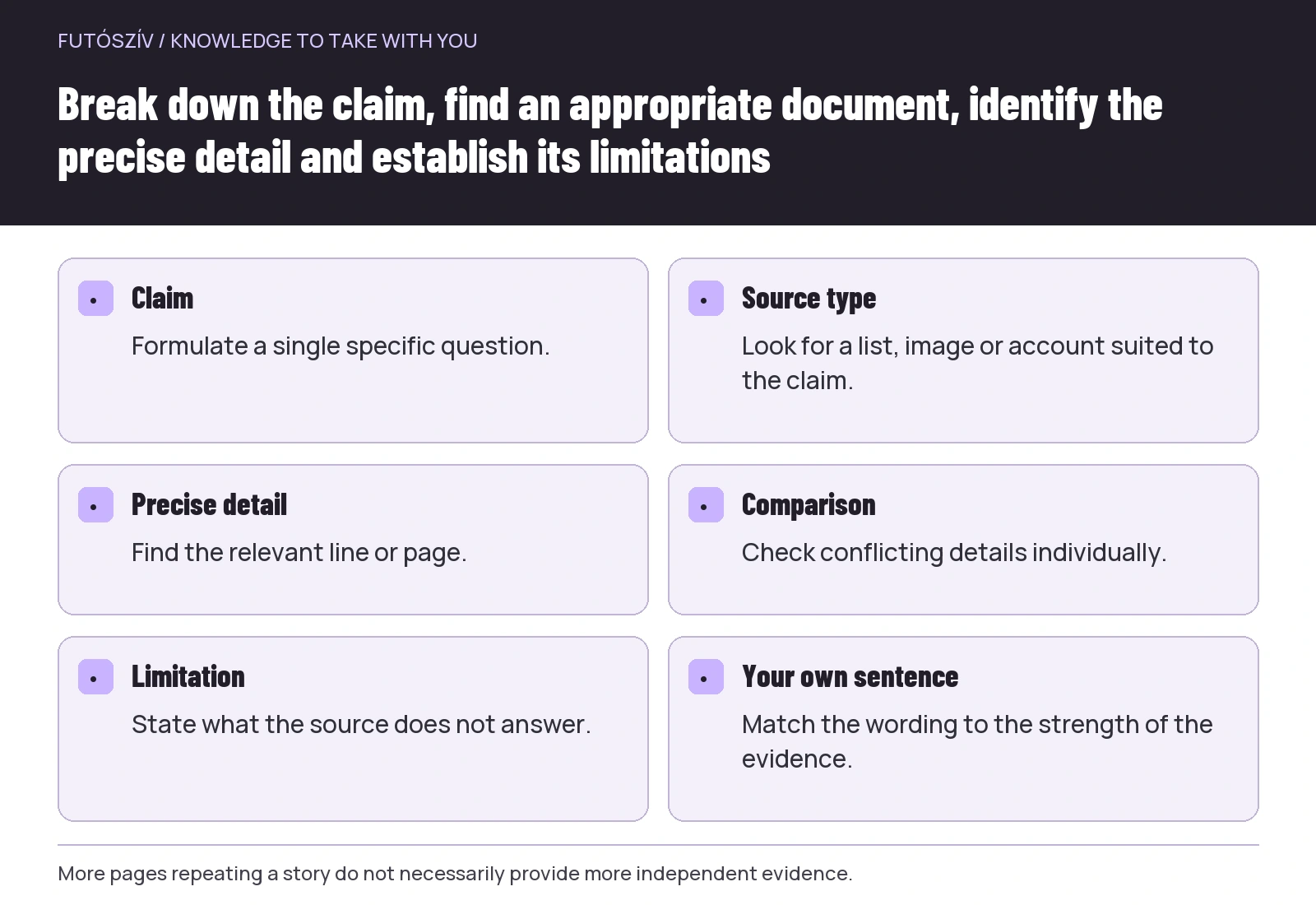 Enlarge diagram
Text version of the illustration
- Claim
- Formulate a single specific question.
- Source type
- Look for a list, image or account suited to the claim.
- Precise detail
- Find the relevant line or page.
- Comparison
- Check conflicting details individually.
- Limitation
- State what the source does not answer.
- Your own sentence
- Match the wording to the strength of the evidence.
The image and its caption need separate checks
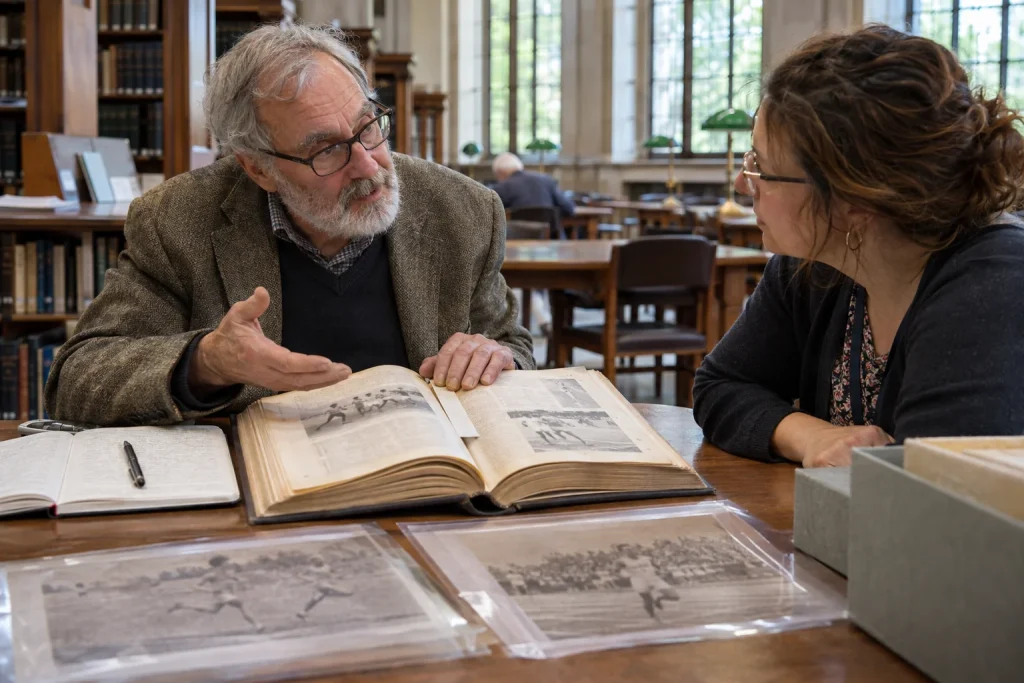
A photograph may preserve many details of clothing, location and posture. The names of the people, precise timing and reason for the scene often come instead from its accompanying description. If that caption was copied or altered later, the same image can appear to support different stories.
Find the image’s original or institutional description, collection and catalogue details. Check whether you are looking at the same photograph or another moment from the same event. Cropping can also alter the context you perceive. Identification repeated only in another post is different from traceable information in a collection.
Using a source and republishing an image are also separate questions. Being able to view a photograph for research does not give you unrestricted permission to use it. In your own explanation, linking to the collection page may be enough, while providing the explanation in your own words or an independently produced diagram. You do not need to copy historical evidence without authorisation to discuss it clearly.
Second example: Kanakuri and the decades-long marathon story
An official sporting press release presenting the Swedish sports museum’s 2024 exhibition specifically examines the legend of the “missing Japanese runner”. According to the account, Shiso Kanakuri dropped out of the Stockholm marathon in 1912 and returned to the Japanese delegation. The finish arranged during his 1967 visit to Sweden was a symbolic event staged before cameras.
The museum’s explanation therefore places the period of more than fifty-four years in a different context from a literal reading of the internet story. It does not describe continuous running or an athlete remaining in an unknown location for decades, but a scene of later commemoration and media participation. The unusual number alone is not an interpretation of an official results list.
The Japan Association of Athletics Federations’ publication summarising Olympic results records DNF in Kanakuri’s 1912 entry and lists participation in Antwerp and sixteenth place for 1920. This is a different type of source with which to check the status of a sporting result. The later symbolic scene and the official Olympic entry do not answer the same question.
Even an authoritative source can contain an incorrect detail
Checking the sources reveals an interesting discrepancy: the Swedish release names Amsterdam in connection with 1920, whereas the Japanese federation’s results table identifies Antwerp. To check the specific result, use the appropriate row in the table. This does not automatically make every other statement in the museum release false, but the incorrect place name should not be copied onward.
Together, these two sources demonstrate one of the method’s strongest lessons. The publishing institution helps you assess the background, but does not remove the need to check individual details. Equally, one correctable detail does not mean the entire research is worthless. Assess claims individually, using evidence suited to each one.
As a reader, retain this sense of proportion. You can explain that one page appears to contain a mistaken place name and provide the correct results source. You do not need to infer intent or general unreliability. A precise correction shows what you managed to verify and how far the correction extends.
What counts as a primary source for a particular question?
A contemporary results list can be primary evidence of the result that was published. A participant’s letter can be primary evidence of what they wrote about their experience. A photograph provides a direct trace of the captured scene. Modern research is particularly useful when it examines identifiable original documents and clearly explains how it reached its conclusion.
Being primary does not mean a document gives the final answer to every possible question. A contemporary newspaper may misidentify a person, while an official list may not explain a participant’s motivation. Always choose a source to match the subject of the claim. A document’s role matters more than whether it generally looks old or official.
You need not discard later summaries either. They can provide a useful map of where to find the original information. Problems arise when you treat the map as a substitute for all the evidence and stop following its references. Reliable research makes that checking possible.
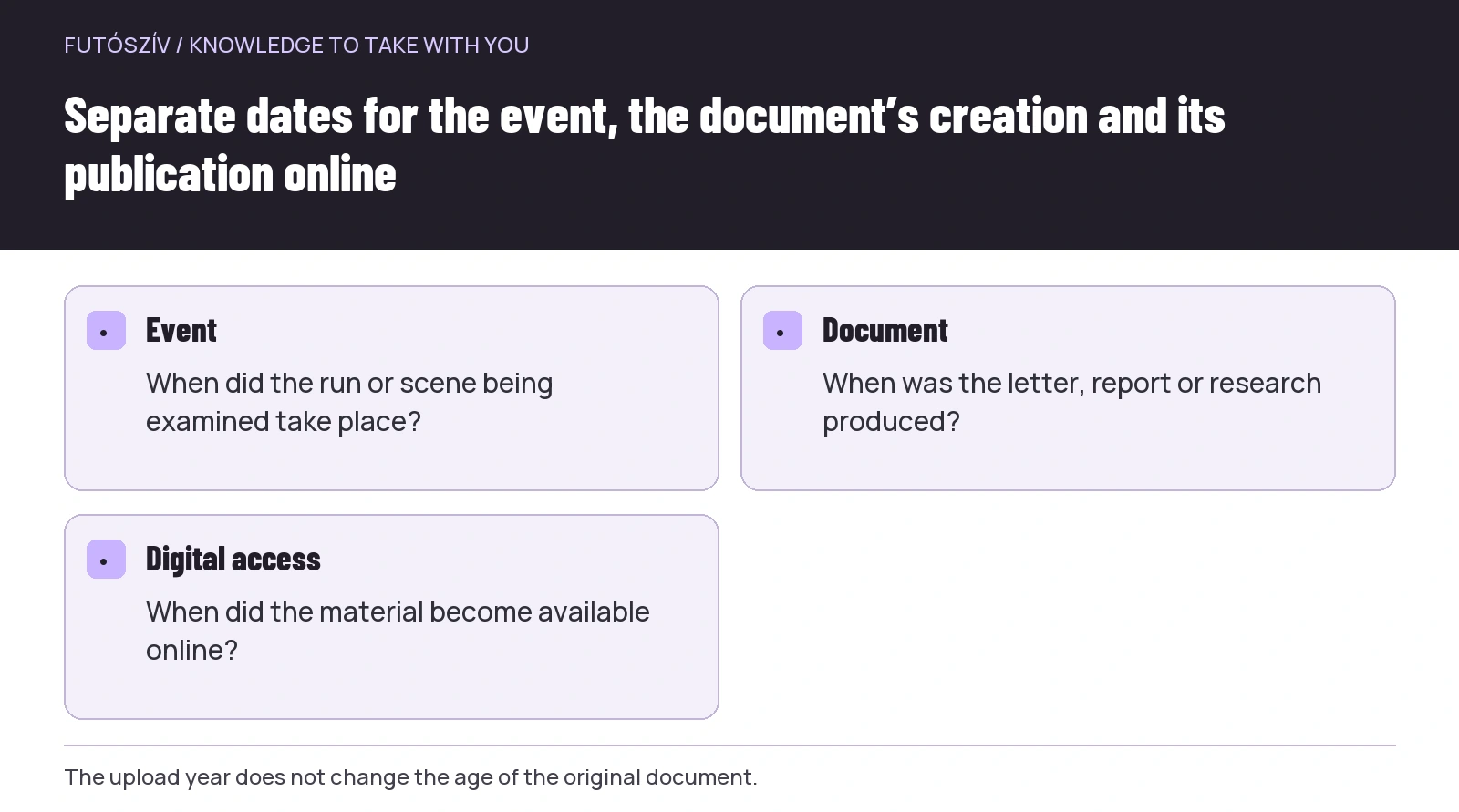 Enlarge diagram
Text version of the illustration
- Event
- When did the run or scene being examined take place?
- Document
- When was the letter, report or research produced?
- Digital access
- When did the material become available online?
Keep track of three separate dates
The event date, the document’s creation and its publication online may differ. A study about a 1908 event, published in 2001–2002, may later be placed in a web directory. The year visible in the file’s path does not change the study’s publication date or turn its historical claim into a recent event.
The same applies to a digitised letter or results list. The upload date belongs to the history of digital access, whereas the original document’s date belongs to its creation. When quoting or summarising, find that original date too. “I found this today” is different from “this happened today”.
Record these dates in separate fields in your notes. An anniversary republication or archive update will then be less likely to confuse the chronology. Handling dates precisely is especially important in sporting histories that try to present a later commemorative event as a continuation of the original race.
Look for the source chain rather than counting repetitions
If ten pages contain the same sentence with the same unusual mistake, they may derive from a shared text. Ten results do not then represent ten independent confirmations. Check whom they cite, where the quotation begins and whether an original source is actually accessible. The spread of information and the evidence for a claim are separate matters.
Look beyond a polished summary for the precise name, date and document type too. An athlete’s name may have several transliterations, so the absence of one spelling does not prove an event never happened. Identifying the person, date and event in a table provides a much stronger lead than an unsuccessful general search.
Handle the source language carefully as well. Words such as symbolic finish, disappearance or record can acquire different emphasis in a short summary. Read a complex claim within its full paragraph. If a translation is uncertain, do not promote the strongest-sounding version to certainty. Clearly identified uncertainty is more accurate than a smoothly polished mistake.
A simple verification worksheet
| Field | What should you record? | Example of the question type |
|---|---|---|
| Claim being checked | One specific statement that can be supported by evidence. | Who appears in the finish photograph? |
| Event | Name, location, date and discipline. | The particular Olympic marathon. |
| Source’s role | A list, image, letter, report or study. | Results list or photograph caption. |
| Evidence | A reference to the relevant line, page or detail. | A precise entry in a table. |
| Limitation | What does the document not answer? | The participant’s later feelings. |
| Wording | Your own sentence matched to the strength of the information. | According to the source; the table records this. |
The worksheet also helps when you are preparing only a short club post or a family quiz. You do not need to read every related biography. Find the evidence needed for your own claim and leave the rest of the story at the appropriate level of certainty.
A correction can become an interesting story too
The legend does not need to be replaced with another exaggerated headline. In Conan Doyle’s case, explain the different roles of the reporter and the helpers. With Kanakuri, the later symbolic finish and the story of commemoration remain interesting. The accurate version still contains people, decisions and cultural meanings; there is simply no need to connect them through unverified roles.
If a detail is disputed or cannot be verified, say so briefly. “I did not find suitable evidence for this” differs from “it definitely did not happen”. Likewise, “the source gives an incorrect place name” does not mean “none of it is true”. Measured wording precisely marks the boundary of your knowledge.
Reading running history reliably ultimately requires curiosity: what does the story claim, what trace did it leave and what does that trace answer? Keep those three questions in view and you can discover sport’s past beyond popular anecdotes. Well-documented details are often at least as interesting as the legend that later grew from them.
How Futószív articles are prepared: our editorial guidelines.