
A running-event website may display several logos and designations: international organisational membership, course-measurement status, an event label, series participation or a system assessing runners’ results. They answer different questions. They help when you understand their scope rather than expecting one symbol to reveal everything about an event.
This article maps the concepts using primary sources checked on 18 November 2026. Systems and entry conditions can change; separately check status and requirements for your selected race and year. Examples do not replace an international series’ complete rules or event regulations.
Ask whom or what the designation assesses
The first distinction is its subject. Membership may show an event or organiser’s connection to a network. A course-measurement document concerns a defined route. An event label may indicate fulfilment of requirements. A personal index may assess a runner’s results. Logos can occupy similar screen space while meaning different things.
Without separating these, it is easy to read too much into one. A personal performance index does not certify every service throughout an event. Organisational membership alone does not grant personal eligibility to start. The correct question is therefore not is this logo good, but what it claims and which source verifies it.
Write a brief meaning beside each in your own words: organisational connection, defined course, event requirement or personal result. If unable, first seek the issuing body’s explanation. This helps more than arranging coloured badges into an imagined common ranking.
AIMS membership connects to an international event network
The AIMS introduction page describes an international association of road races. Membership is a network connection involving information exchange and shared professional principles. Check an event’s current membership through the official register and its current information.
The membership application conditions also require courses over standard distances to be measured by appropriate professionals. This shows membership has substantive professional content. Membership and a specific route’s measurement document nevertheless remain separate information: seek details about your distance’s current course.
As a runner, assess the connection at its proper scale. International-network participation can be important background while your day’s practical questions remain. When is collection, where is the start, what time limit applies and how do you return home? Specific regulations answer these alongside a membership logo.
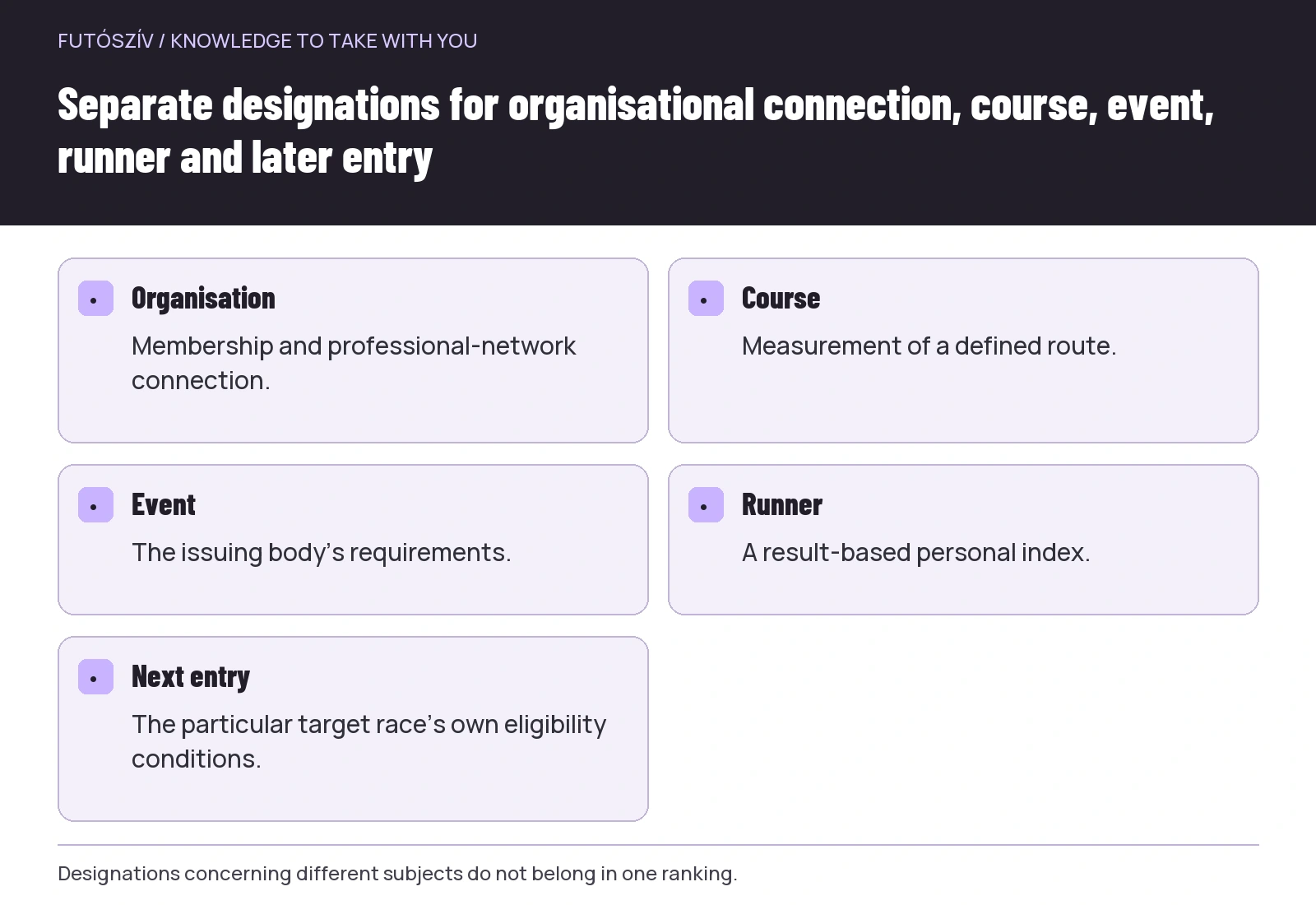 Enlarge diagram
Text version of the diagram
- Organisation
- Membership and professional-network connection.
- Course
- Measurement of a defined route.
- Event
- The issuing body’s requirements.
- Runner
- A result-based personal index.
- Next entry
- The particular target race’s own eligibility conditions.
World Athletics Labels are event-level requirements
The Label Road Races Regulations effective from 3 August 2026 address requirements for 2027 labels. They list four names: World Athletics Label, Elite Label, Gold Label and Platinum Label. The system combines requirements concerning organisation, safety, runner experience and anti-doping, among others; elite competition is also important at higher levels.
Such a label therefore means more than a self-selected marketing adjective. It belongs to the issuing organisation’s defined system. Checking still requires the specific event and year. Previously holding a label does not establish the next edition’s identical status.
Do not turn label content into a personal convenience promise. A higher level alone does not identify the best event for your travel, suitable accommodation prices or your companion’s preferred programme. Examine professional requirements and personal fit alongside one another. Logo knowledge helps choice without removing your own conditions.
One event, several distances: identify the designation’s scope too
A weekend may include a marathon, half marathon, shorter event and family activities. Do not automatically assume every designation beside the main event applies identically to all programmes. Check official claims by your race’s name, distance and edition.
This is particularly tangible for course measurement. A defined route is measured, not the event name generally. If a shorter distance turns elsewhere, seek its own measurement information. A footer logo may describe the organiser generally while technical status emerges separately by distance.
Personal aims also determine necessary checking. To use a result for another event’s entry condition, read the receiving organisation’s rules too. A current event seeming recognised is insufficient. Know the conditions under which the specific result is accepted for the intended purpose.
A trail-running index is another kind of information
The official UTMB World Series system description presents the UTMB Index as a system assessing runners’ performance level. This information connects to individuals and results. Categories and validity follow their own rules, so check your precise situation in the system and current conditions.
An index-providing race designation is therefore different from road-course certification and serves another purpose. Trail route, elevation gain and conditions still need independent understanding. An index symbol does not replace full mandatory-kit, time-limit or route descriptions.
A personal assessment is not general health or fitness clearance either. Sporting data formed from earlier results can help for the system’s purposes, while current condition and the selected terrain’s demands remain separate questions. Entry requires considering both organiser rules and genuine preparedness.
UTMB Index race and Running Stone: remember the distinction
The official UTMB Index races page states clearly that finishing an Index race may contribute to your index but does not itself give a Running Stone. This distinction matters practically. Someone choosing specifically for later entry cannot rely simply on seeing the UTMB name.
The system describes a Running Stone as a chance used in the Finals lottery, distinguishing the index, World Series events and entry requirements. Meeting lottery eligibility is not the same as a guaranteed start. Personal qualification, application and confirmed participation may be different steps.
Do not promise yourself guaranteed progression from general information. Check the specific next event edition’s rules, required category and validity. Meeting one system condition does not automatically meet every other condition. Precise relationships matter more than similar names.
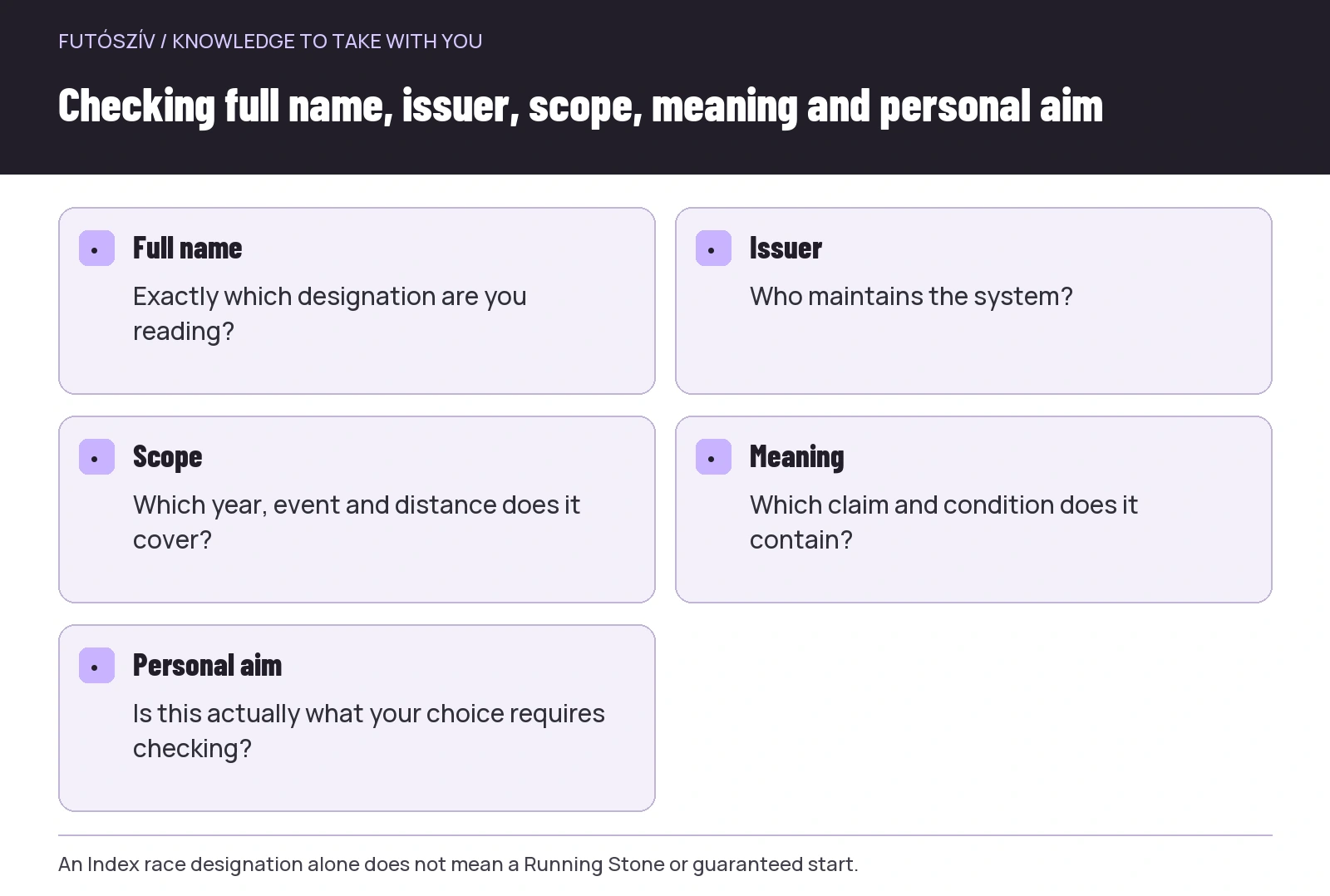 Enlarge diagram
Text version of the diagram
- Full name
- Exactly which designation are you reading?
- Issuer
- Who maintains the system?
- Scope
- Which year, event and distance does it cover?
- Meaning
- Which claim and condition does it contain?
- Personal aim
- Is this actually what your choice requires checking?
Make a concept map rather than a logo collection
| Designation type | What might it concern? | What needs separate checking? |
|---|---|---|
| Organisational membership | An event’s relationship to a professional network. | Current status and your race’s specific details. |
| Course-measurement document | Measurement of a defined route. | Validity and agreement with the present course. |
| Event Label | The issuing body’s requirements. | Year, event and actual scope. |
| Personal index | Assessment formed from the runner’s results. | The system’s calculation and validity rules. |
| Entry or lottery condition | A later participation process. | The target race’s complete current conditions. |
The table creates no shared ranking between these concepts. A good measurement document is not a lower- or higher-grade personal index. They describe different subjects. Meaningful comparison first identifies the same designation type and only then examines differences.
Read self-selected adjectives separately from issued designations
Premium, elite atmosphere, international or festival can mean many things in an event’s description. Not every phrase has an equally defined external system behind it. If expecting a service from the term, find its content in regulations. Personal interpretation does not automatically become a provider commitment.
An issued designation should have an identifiable organisation, name and source for current status. If visible only on an old poster, ask about the relevant edition. If listed by an aggregator, follow its link to the primary register or organiser announcement. Copying a logo in several places does not create several independent proofs.
This does not make an unlabelled local run necessarily a poor choice. It may have different aims, scale and arrangements. Clear locations, schedules and conditions still matter. Understanding designations lets you evaluate actual claims rather than an imaginary ranking of all running.
A fictional example: three runners seek three different answers
The first wants an officially usable road time for later entry. The second seeks a friendly trail day with a known route, while the third wants conditions for a named international lottery. This invented example concerns no particular Hungarian event.
For the first, measurement of their distance and receiving-event acceptance rules matter. For the second, distance, terrain, group programme and logistics may be the first filter. The third needs the exact result or eligibility supplied within the system. One attractive logo cannot answer all three simultaneously.
If searching together, say this beforehand. A shared choice is possible, but check conditions individually. An event serving one person’s longer sporting project does not automatically make the same entry appropriate for every companion. Starting from personal questions rather than logos eases agreement.
Five steps towards verified interpretation
First write the full designation name. Second identify the issuing body. Third check year, event and distance. Fourth read what it claims and what conditions it does not cover. Fifth compare with your aim: is this the information sought, or does another question still need answering?
Save a date and source alongside the finding. If regulations or designation systems later change, you can see the state informing your decision. Mark details still awaiting confirmation separately. Shared plans must not turn a condition seen only on an earlier edition’s page into certainty.
Race labels help when connected to the right question. Membership, measurement status, event requirements, personal indexes and entry eligibility are separate information. Preserve this map to find what your next race decision actually needs behind the logos.
How Futószív articles are prepared: our editorial guidelines.