Enjoyable running and anxiety care can meet
Many runners know the feeling of a calmer, more organised day after an easy loop. It is easy to infer that returning tension simply needs more kilometres. A positive personal experience does not establish what causes persistent anxiety or which support you need, however. Running can have a place in the week while other help is used too.
This article explores discussing movement without expecting it to solve every problem. It diagnoses no anxiety disorder, selects no medicine or therapy and prescribes no compulsory training quantity. The practical aim is a more livable system: manageable movement opportunities, clear support roles and professional questions asked in time.
Persistence and everyday impact matter
NIMH information distinguishes occasional worry from persistent anxiety appearing across life situations and disrupting everyday life. The NHS also recommends seeking help when feelings are hard to manage or self-help attempts do not work. This need not depend on running results: someone running well can still face substantial difficulty.
One bad day does not establish a diagnosis. Describe what became harder: leaving home, concentrating at work, sleeping, meeting people or making an everyday decision. Patterns over time and daily impact provide information a professional can use. Watch data is supplementary at most, not proof that symptoms are real.
Professional care can fit alongside movement
The NIMH publication on generalised anxiety discusses psychotherapy, medication or their combination according to individual circumstances. It mentions exercise and other healthy habits as complementary options. Develop treatment with an appropriate professional; a running programme is no basis for independently stopping or changing prescribed care.
The two kinds of support do not compete. Discuss symptoms and care with a clinical professional, and manageable movement within agreed boundaries with a coach. Ask for clarification if advice is unclear. A clear question may help more than trying to assemble every professional detail alone.
Do not make training your only backup
Imagine a week when construction closes the usual route, work finishes late and weather is unpleasant. If every way of handling tension depends on one running occasion, change can be particularly difficult. Gather other accessible supports beforehand too: an agreed phone conversation, quiet shared time or approaches learned in care.
The list is not another performance task. Include options that do not require going out or feeling well. The important question is whom you can contact and how when usual routines change. Running can retain enjoyment without being responsible for every difficult feeling. A support network may contain several kinds of relationship.
 Enlarge diagram
Text version of the diagram
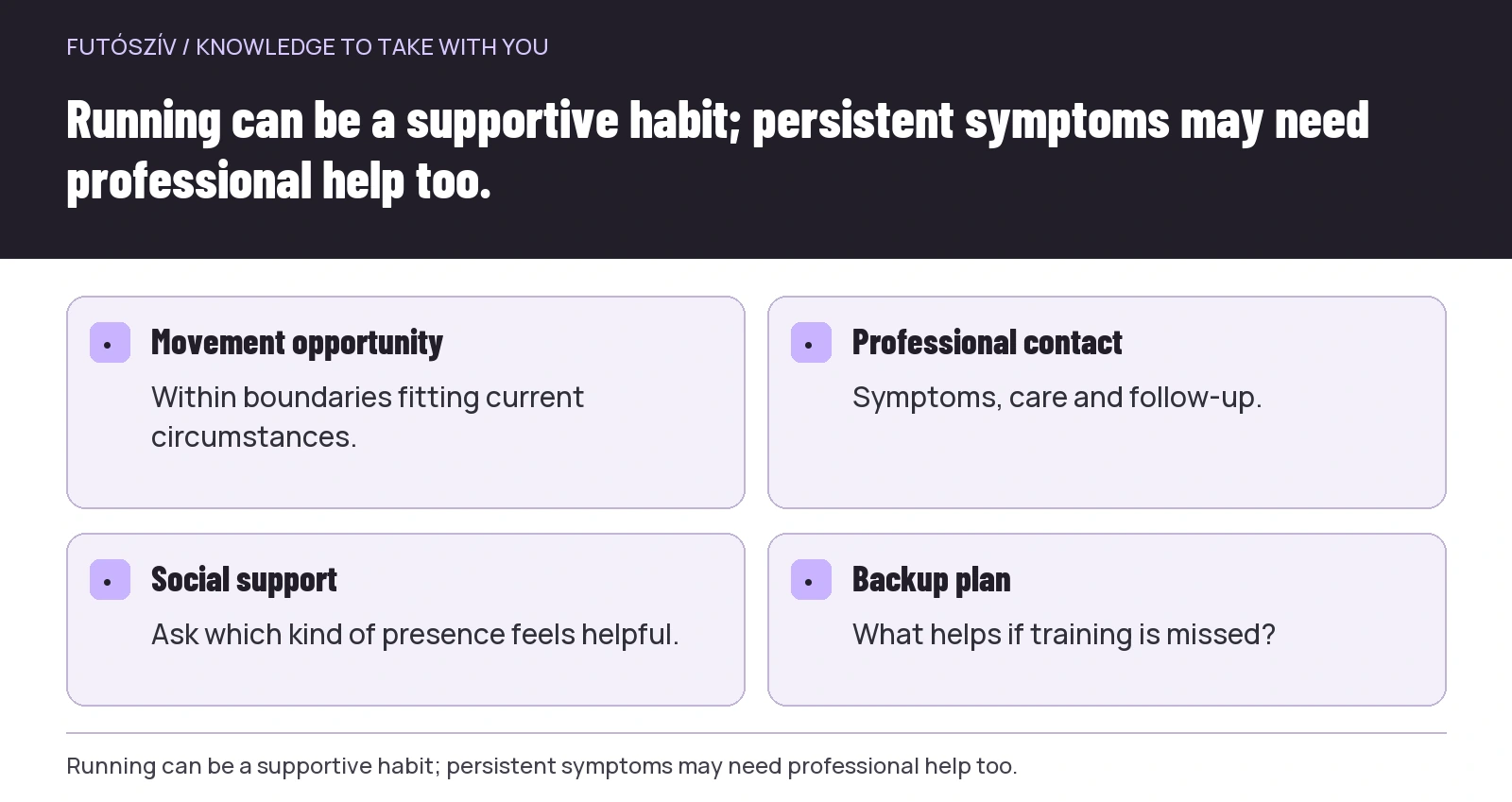
- Movement opportunity
- Within boundaries fitting current circumstances.
- Professional contact
- Symptoms, care and follow-up.
- Social support
- Ask which kind of presence feels helpful.
- Backup plan
- What helps if training is missed?
You can plan the circumstances of setting off too
If joining a group creates tension, request simple organisational information beforehand: exact meeting place, expected duration, group divisions and whom to ask questions. This may not remove every worry but reduces unnecessary uncertainty. Any participant can legitimately ask for these details.
Your decision includes whether that occasion is appropriate. With clinical anxiety, discuss avoidance or gradual confrontation within treatment; an editorial article cannot devise a personal exposure plan. A group leader can make the programme transparent, while therapeutic work belongs with the appropriate professional.
Do not automatically call physical symptoms anxiety
Tension may involve physical sensations, but new or unusual symptoms during running cannot safely be classified solely as anxiety. Stop and seek appropriate urgent help for chest pain, fainting, severe difficulty breathing or another alarming symptom. Previously known anxiety does not exclude another health problem.
For recurring symptoms, note onset, situation, duration and accompanying features for medical discussion. You need not prove sensations definitely physical or definitely psychological. Description matters more than a self-assigned label. The professional determines justified further investigation or support.
Give circumstances room in the diary
If recording experience, a few simple sentences suffice. What was the day like beforehand? What was the occasion’s purpose? What felt good and what made it difficult? Rather than it went badly, arriving in an unfamiliar group, not finding the meeting point and rushing before the start says more. This can produce an organisational question too.
Do not turn logging into constant symptom hunting. You need not check every kilometre whether you have calmed enough. If recording itself creates tension or continuous self-monitoring, discuss that with the treating professional too. Notes help when clarifying experience rather than setting another strict standard for how you should feel.
What can a coach do, and what can they not?
A coach can give clear tasks, adjust programme organisation and discuss usable feedback. You may also request that assessment temporarily avoids public comparison. These are sporting-environment decisions. They do not authorise a clinical diagnosis or replacing therapy.
Before sharing health information, clarify who may receive it and for what purpose. The entire group need not know your story. Saying you follow an agreed plan and request particular feedback in certain situations may suffice. Support does not require unnecessary disclosure or public explanation.
A running companion’s support should be help asked about
Friends can easily propose immediate solutions: run faster, go further or think about something else. A more useful start may be asking what is needed now: company, practical help or listening. Shared running may be a good choice; a calm conversation may suit that day better too.
Do not demand reports of how much running improved someone. Not feeling better is neither ingratitude nor failure of shared time. Presence need not be measured through immediate mood change. If concerned about a friend’s everyday functioning, express this without judgement and support seeking professional help.
 Enlarge diagram
Text version of the diagram
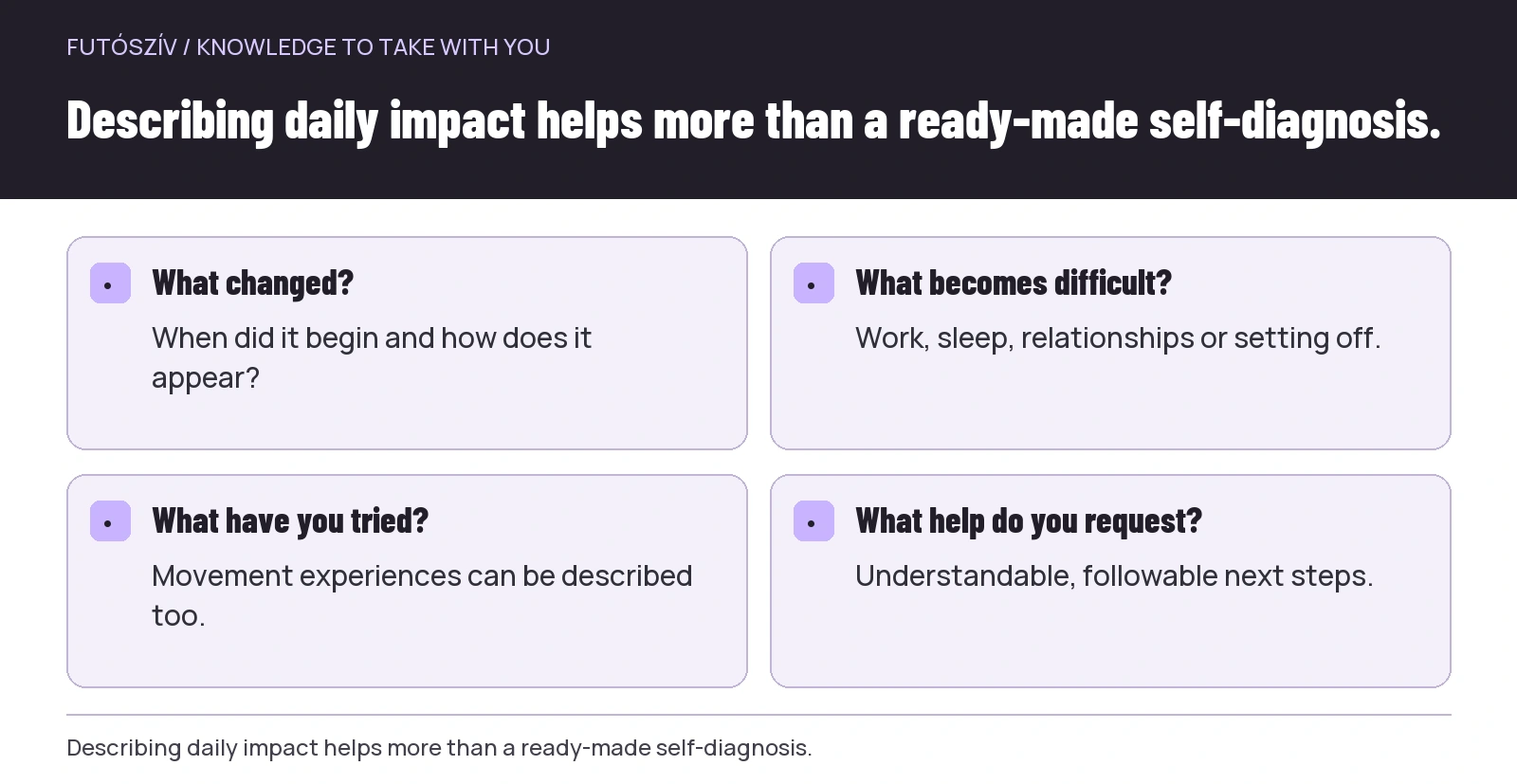
- What changed?
- When did it begin and how does it appear?
- What becomes difficult?
- Work, sleep, relationships or setting off.
- What have you tried?
- Movement experiences can be described too.
- What help do you request?
- Understandable, followable next steps.
A brief situation description for a consultation
You can begin: recently I worry a lot outside running too, sleep less easily and cancel more activities. Movement sometimes feels good but does not resolve the situation persistently. I would like to review appropriate help. This can already provide a sufficient start; professional terms or a ready self-diagnosis are unnecessary.
List current medicines, known health conditions, previous care and what you want to retain from movement. Ask what to watch for alongside activity and how follow-up works. Explain advice difficult to follow because of work or family tasks too. A plan is individual when it is feasible in real days.
Improvement is not a certificate from one run
You can have a good session in a difficult week and a harder run in a generally more settled period. Interpret experience within broader circumstances. What can you do in your days, how accessible is support, how is sleep and how do you assess exercise demands? Discuss these in care without turning everything into one number.
Do not require becoming entirely anxiety-free before enjoying a calm walk or meeting friends. Equally, do not demand activity where safety or health requires other help. Movement needs a role fitting current condition rather than fulfilling a predetermined expectation at any cost.
Make the route to help clear
If anxiety persistently disrupts everyday life or remains unmanageable despite independent attempts, consult a GP or appropriate mental healthcare professional. You can also request help beginning access to care. Immediate danger or a mental health emergency requires immediate urgent help; do not try resolving it with another running session.
Running can remain a chosen activity connected to enjoyment, company and personal goals. Professional care addresses what a running programme alone cannot assess. Coordinating the two is not weakness. It is a practical decision considering your whole daily life alongside kilometres.
Planning a week can be specific without a race
A weekly plan can include a brief freely adjustable movement opportunity, an agreed consultation and a social activity unrelated to sport. Add what happens if weather or schedules change. All three need not happen on the same day, and you need not award yourself points. Clear options make decisions easier.
At the next discussion, examine which element was accessible and where you became stuck. A group time clashing with work is an organisational question. Worry making ever more everyday situations inaccessible may need professional attention. Naming these difficulties separately helps seek support in the right place.
Sources and further reading
- NIMH: Anxiety Disorders
- NIMH: Generalized Anxiety Disorder, What You Need to Know
- NHS: Anxiety, fear and panic
How Futószív articles are prepared: our editorial guidelines.