
With two or more babies, running questions become more individual too
In multiple pregnancy, experiences of runners expecting one baby are insufficient to assemble a sporting programme. Pregnancy type, course, gestational week and current symptoms matter together. Previous endurance is important history but does not replace advice from a maternity team familiar with multiple pregnancy.
The RCOG information explains that most multiple pregnancies result in healthy babies, but certain complications and premature birth are more common. Additional checks and individualised maternity planning are therefore necessary. This also changes the starting point for sport-related decisions.
This article grants no general running clearance and prescribes no complete immobility for everyone expecting twins. It is organised around eight questions that can lead to specific, followable discussion. The aim is understanding movement, rest and help-seeking in your circumstances.
1. Exactly what kind of multiple pregnancy is this?
The number of babies is not the only important factor. RCOG separately discusses whether babies share a placenta and amniotic sac. This can influence care and monitoring. Ask what abbreviations in a report mean; you need not decode them online yourself.
Questions about movement can then have more precise background: how many babies, pregnancy type, gestational week and any findings at checks. You need not make your own risk score from this. The information aims to support understanding of personal advice.
A friend ran with twins provides little in this context. You do not know whether pregnancy type, health condition and stage were the same. An inspiring story can be an emotional anchor without being a clinical comparison.
2. Which movement are we actually discussing?
The ACOG information on multiple pregnancy explains that activity may be important, but avoiding strenuous exercise may become necessary. Describe your usual programme precisely. Easy walking, a running race, intense intervals and heavy strengthening are different questions.
A brief list helps: frequency, duration, effort and terrain. Work and the rest of daily activity matter too. A sporting occasion called gentle can add to considerable total demands if the day is physically difficult already.
Ask separately what can remain in daily life and what organised training needs changing. If running is not recommended, do not independently replace it with similarly intense sport. Appropriate alternatives must also be interpreted within current maternity boundaries.
 Enlarge diagram
Text version of the diagram
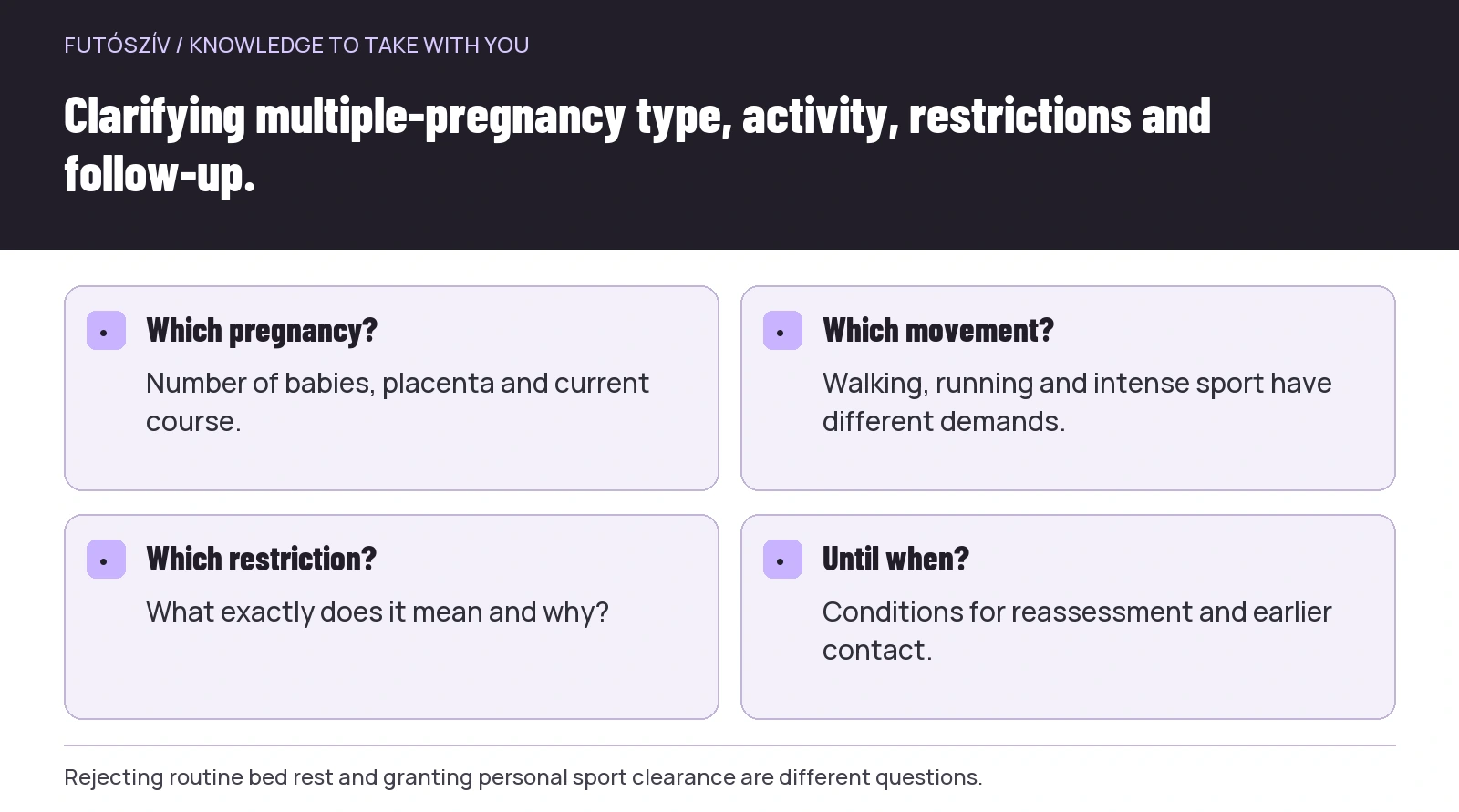
- Which pregnancy?
- Number of babies, placenta and current course.
- Which movement?
- Walking, running and intense sport have different demands.
- Which restriction?
- What exactly does it mean and why?
- Until when?
- Conditions for reassessment and earlier contact.
3. What exactly does rest or restriction mean?
The everyday instruction rest more can mean more sleep, less work, reduced sporting demands or omitting certain tasks. Ask what is recommended, for how long, why and when it will be reassessed. Vague instructions can easily create constant uncertainty.
The Society for Maternal-Fetal Medicine document reaffirmed in 2025 does not recommend routine hospital admission and activity restriction in multiple pregnancy solely to prevent premature birth. This statement concerns routine general practice. It does not mean an individual complication or particular sporting demand can never require personal adjustment.
Rejecting routine bed rest does not automatically grant running clearance. Equally, a training restriction does not necessarily mean lying still all day. Clarify the distinction with your maternity professional and follow individual guidance.
4. What would change the current plan?
The NICE guideline on twin and triplet pregnancy describes personalised care and repeated opportunities for information. The movement plan need not be a one-off decision either. A new symptom, finding or advancing pregnancy may warrant reassessment.
Ask which boundaries apply until the next appointment and which changes require earlier contact. You then need not search general forum advice daily for a new rule. Follow-up should have an understandable time and reason.
If advice from several professionals seems different, bring the exact statements back for discussion. They may concern another treatment stage, symptom or activity. The task is not selecting the most permissive answer but retaining a mutually understandable individual plan.
5. Which symptoms require immediate contact?
In multiple pregnancy, recognising premature-labour signs is particularly important. The NHS information describes regular contractions before the thirty-seventh week, period-like pain, unusual backache and vaginal trickling or gushing fluid as signs requiring immediate maternity contact.
RCOG’s multiple-pregnancy material also recommends prompt contact for sudden abdominal pain or swelling, unexpected breathlessness and changed baby movements. Do not automatically call these natural consequences of a larger abdomen or active day. Appropriate assessment is needed alongside stopping movement.
Severe breathlessness, chest pain, fainting, heavy bleeding or another severe illness requires emergency help. Know which care unit and number to contact within your own maternity system. UK information’s service names do not replace the local Hungarian pathway.
6. How does movement fit the day’s other tasks?
Movement involves more than sports shoes. Prolonged standing, travel, work, stairs and caring for other children belong to the day too. Describe these when a professional asks about demands. Weekly running kilometres alone are insufficient to understand the whole situation.
If adjustment is needed, request help for specific tasks: shopping, carrying, travel or part of the housework. Simply removing an enjoyable short outing while all other physical tasks remain yours is not always most useful. Adjust priorities to the health plan and your opportunities.
The NHS page on antenatal care with twins also discusses additional monitoring. This needs time and travel. Leave room for maternity appointments in the training programme rather than making the week fuller through catching up missed sessions.
 Enlarge diagram
Text version of the diagram
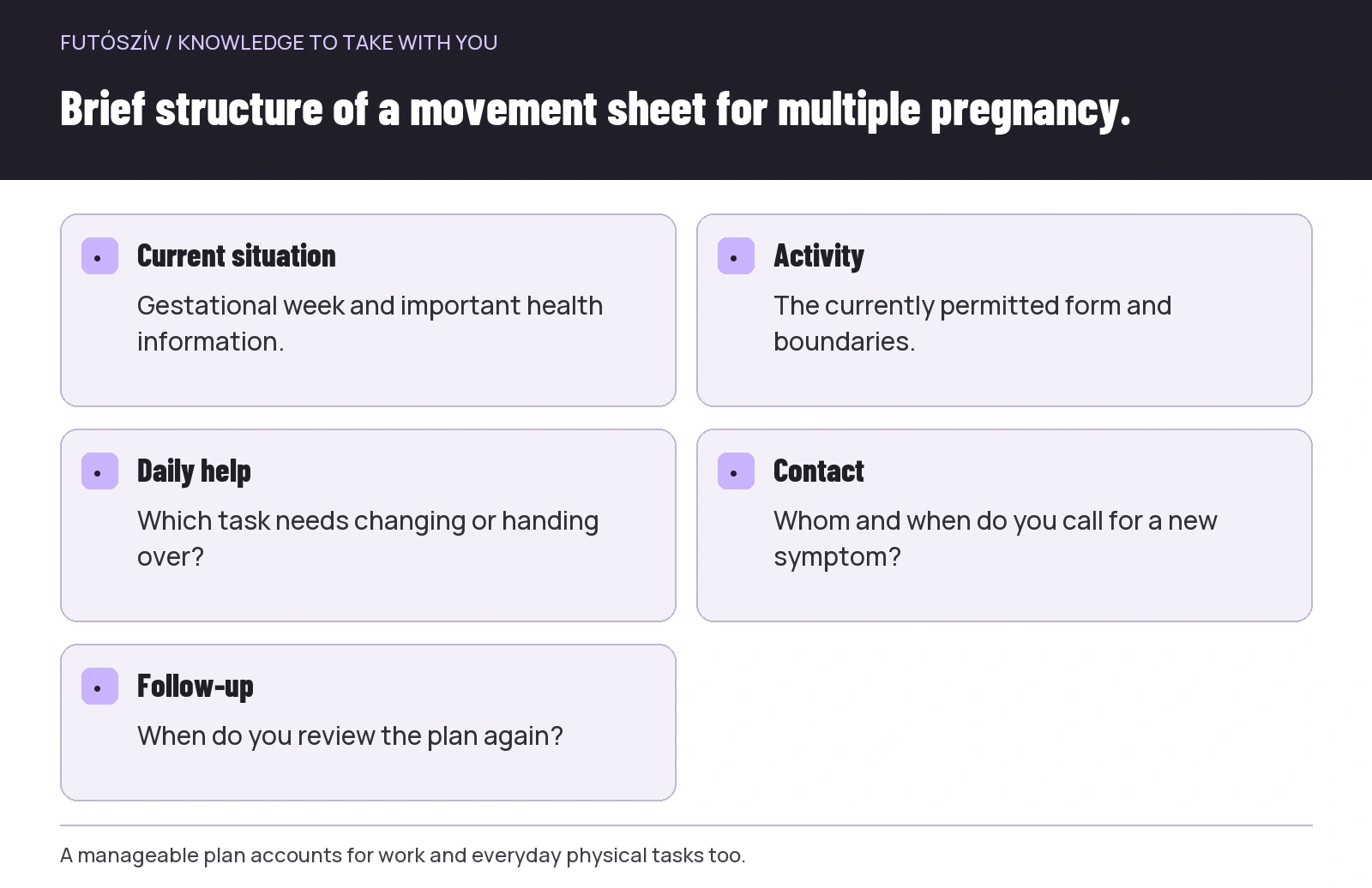
- Current situation
- Gestational week and important health information.
- Activity
- The currently permitted form and boundaries.
- Daily help
- Which task needs changing or handing over?
- Contact
- Whom and when do you call for a new symptom?
- Follow-up
- When do you review the plan again?
7. What practical setting suits permitted activity?
If movement agreed with maternity care fits, make it simple to stop. A nearby route, accessible toilet, phone and easy journey home are practical choices. A distant loop difficult to shorten may increase organisational difficulty if wellbeing changes unexpectedly.
Do not set duration from previous race preparation. Permitted easy activity need not produce the same energy expenditure or sporting experience. If only a shorter outing feels comfortable today, that can still fit the personal plan.
A companion should know adaptability matters more than distance now. Agree where to meet if they continue separately and who helps if you finish earlier. Community participation need not depend on identical speed and completion.
8. What support do you need beyond sport?
Multiple pregnancy can be both joyful and uncertain. Ask maternity care about dietetic, physiotherapy or mental healthcare support if needed. A movement plan is only part of what needs arranging for manageable daily life.
Tell family and running companions which help you would appreciate and which stories or advice you do not want. Every comment need not receive a detailed medical explanation. I am following my own maternity plan now can be a sufficient boundary.
If reduced activity leaves you feeling lost, discuss that with a professional too. Sport forms part of independence and emotional balance for many people. Its temporary change is a real emotional task you need not resolve alone or with constant positivity.
A personal movement sheet may help more than a general prohibited list
- Current situation: gestational week, type and important current health information.
- Permitted activity: which form and within which boundaries is manageable?
- Demands to change: sport, work and everyday tasks specifically.
- Help-seeking sign: which symptom means calling whom and how quickly?
- Reassessment: when and based on which information can the plan change?
You need not show the sheet to the whole running group. Share relevant parts with someone directing the programme or providing daily help. Detailed obstetric information can remain personal health information.
If something is unmanageable, report it. Advice requiring unavailable help at home, a suitable route or flexibility at work may need further discussion. Individualisation means feasible daily life as well as medical findings.
You need not decide permanently about later return now
In multiple pregnancy, birth circumstances and subsequent recovery are individual too. Later running plans cannot be derived merely from the pregnancy week until which you moved. After birth, plan again from current health, symptoms, rest opportunities and care.
For now, choose a goal supporting present circumstances: understandable movement boundaries, less organisational burden, appropriate support and clear help-seeking routes. These are concrete results even when a watch records less activity.
Movement during multiple pregnancy is not an online yes or no. It is an individual plan open to repeated review, bringing together professional evidence, maternity circumstances and personal experience. Your connection with running can retain a place in this transitional period in the currently appropriate form.
Sources and further reading
- RCOG: Multiple pregnancy, having more than one baby
- NICE NG137: Twin and triplet pregnancy, recommendations
- SMFM Consult Series 50: The role of activity restriction in obstetric management, reaffirmed 2025
- ACOG: Multiple Pregnancy
- NHS: Antenatal care with twins
- NHS: Premature labour and birth
How Futószív articles are prepared: our editorial guidelines.