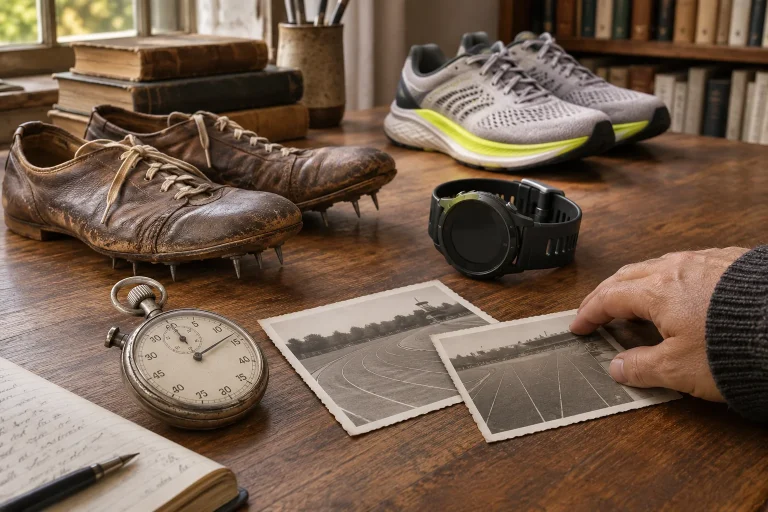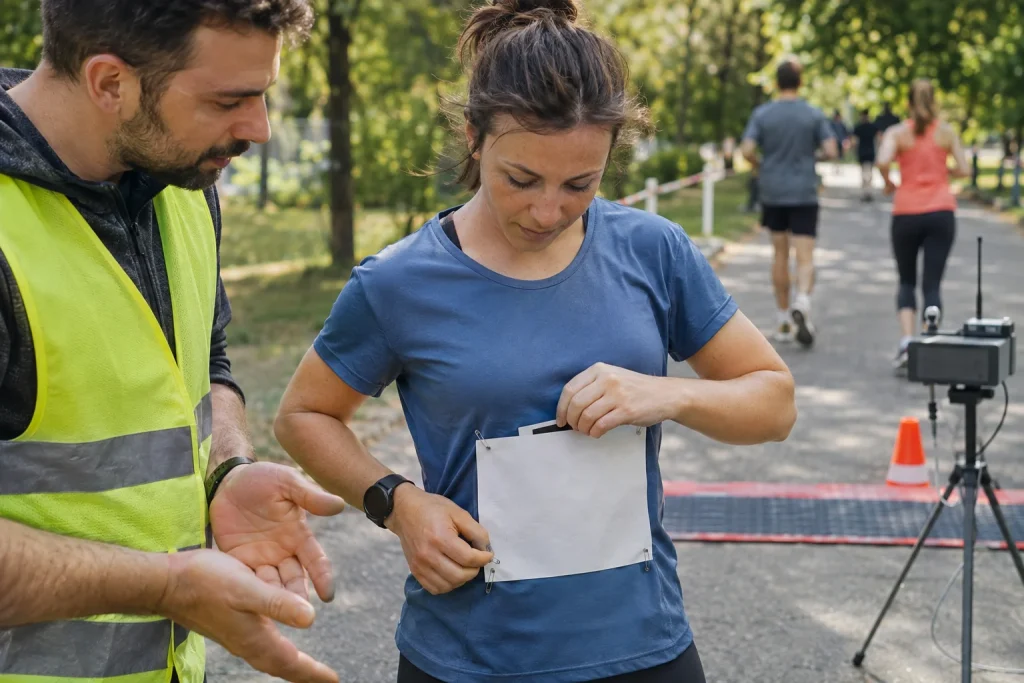
A race number today is both a visible marker and part of a larger information system. A runner can be identified on the course, crossings linked to timing points and data turned into a result. This relationship reflects long technical and organisational development. It is not simply that an old stopwatch was suddenly replaced with a chip.
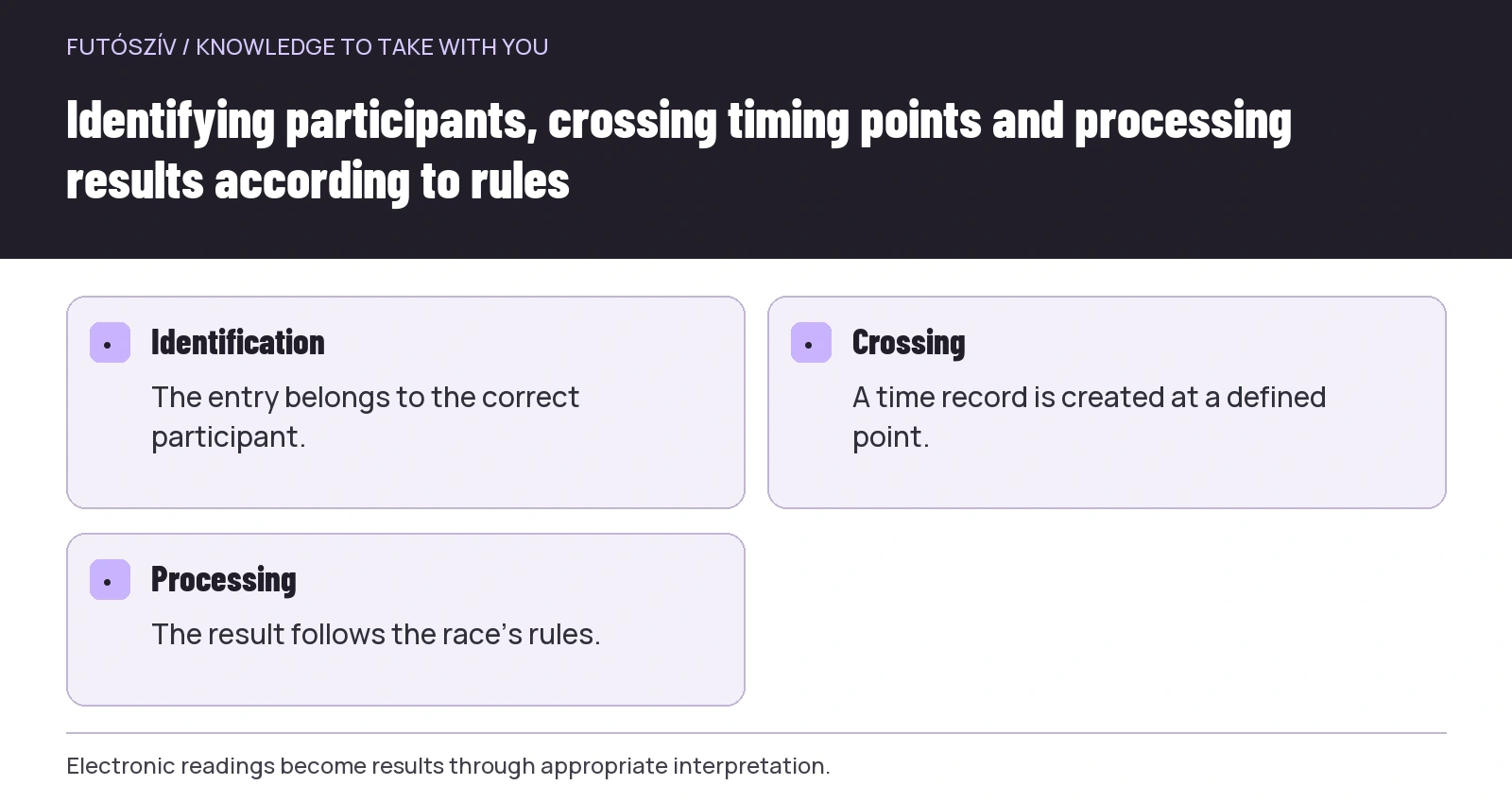
Running-event timing must combine three separate tasks: who passed, where the crossing occurred and which time belongs to it? A result then also needs processing for the correct event and rules. Viewing historical examples through these tasks makes them easier to understand and clarifies present-day bib use.
Identification and time are not the same information
A stopwatch shows time but does not itself know who finished. A legible race number can identify a participant but does not establish their finishing time. Finish order is further information needing connection to time and the correct starter. Organisation precisely involves consistently joining these separate data.
Reconciliation needs care even with small numbers, while several people may reach the finish almost simultaneously in a large field. The MYLAPS historical overview of timing highlights substantial human work associated with manual timing at mass events. Technical development should therefore be viewed beyond fractions of a second. Managing data for many participants matters equally.
Earlier manual work was consequently more than a primitive version of today’s system. Organisers had to develop workable procedures with available tools. Interpreting results requires understanding that period’s method and how information was presented. Fewer digits in an old result list do not alone explain the full measurement background.
Photo finishes created new possibilities for establishing order
To decide a very close track finish, passage across the finish line needs precise recording. The World Athletics article on timing heritage presents several earlier technical stages and discusses the video photo-finish system at the 1991 Tokyo World Championships in detail. This development addressed a task with a different emphasis from recording individual start crossings for thousands of amateur runners.
The article states that the 1989 international congress authorised video devices; in Tokyo, electronic storage allowed faster assessment than developing film. The familiar Carl Lewis finish therefore appears as both a sporting result and an object of technological history. A particular competitive situation shows finishing and recording together.
The unusual elongated shapes of a photo finish are not simple photographic mistakes. Such systems serve interpretation of passage over time at the finish line. Spectators see a striking image, while official assessment gives it a defined technical function. It should not be read like an everyday finish photograph taken from the side.
 Enlarge diagram
Text version of the diagram
- Identification
- The entry belongs to the correct participant.
- Crossing
- A time record is created at a defined point.
- Processing
- The result follows the race’s rules.
Mass road running raised a different-scale question
In a large road field, substantial time may pass between the starting signal and individual start-line crossing. At the finish, many participants’ information arrives over a long period. Electronic identification of individual crossings therefore supports more than the leaders’ closest finishing order: it makes other participants’ completion traceable too.
The Berlin organiser’s official year-by-year historical material specifically mentions finishing with chips for the 1994 event. This is a documented technical milestone at one large road race. It does not establish that every running event worldwide changed in the same year with the same system.
Technology spread at different rates in different places. First presentation of a development, use at a particular event and general adoption are not the same date. When a source mentions different years, first examine which event each describes. Accuracy comes from naming the claim properly, not finding a single first year at any cost.
The shoe chip gave runners a separate task
An early familiar chip solution was a device attached to the shoe. Participants had to receive it, fit it properly and perhaps return it later under system conditions. The chip thus became a physically separate item of running equipment. Collecting a bib and using the timing device correctly were two connected tasks.
The Dutch athletics federation interview with a timing specialist specifically discusses differing operational situations for shoe- and bib-attached systems. The point remains valid for runners today: use the device according to your race’s instructions. An appropriate location in one system is not necessarily appropriate in another.
If supplied instructions require a chip on the shoe, do not regard carrying it in a pocket as equivalent. Nor can a bib-integrated device be assumed to work with arbitrary folding, covering or placement under other equipment. Current technical instructions concern the specific system. Historical understanding explains differences but does not replace those instructions.
Bib-integrated devices reunited tasks
MYLAPS’ own corporate history describes its BibTag system introduced in 2010 as a bib-integrated timing solution. Read this as the manufacturer’s own product-history claim, not the full history of every market participant. For runners, the change is visible: some events no longer require a separate shoe chip because the bib carries the timing element.
The visible paper or other carrier can thus combine several functions. Human identification and electronic crossing information connect on it. This does not make the visible number redundant. Course staff, photographs and participant administration can still use a legible identifier in different situations.
Use may seem simpler but does not disappear. Your number must relate to your entry, be worn as requested and follow any return rule. Do not decide from appearance whether a device is disposable or must be returned. Event information provides the precise answer.
 Enlarge diagram
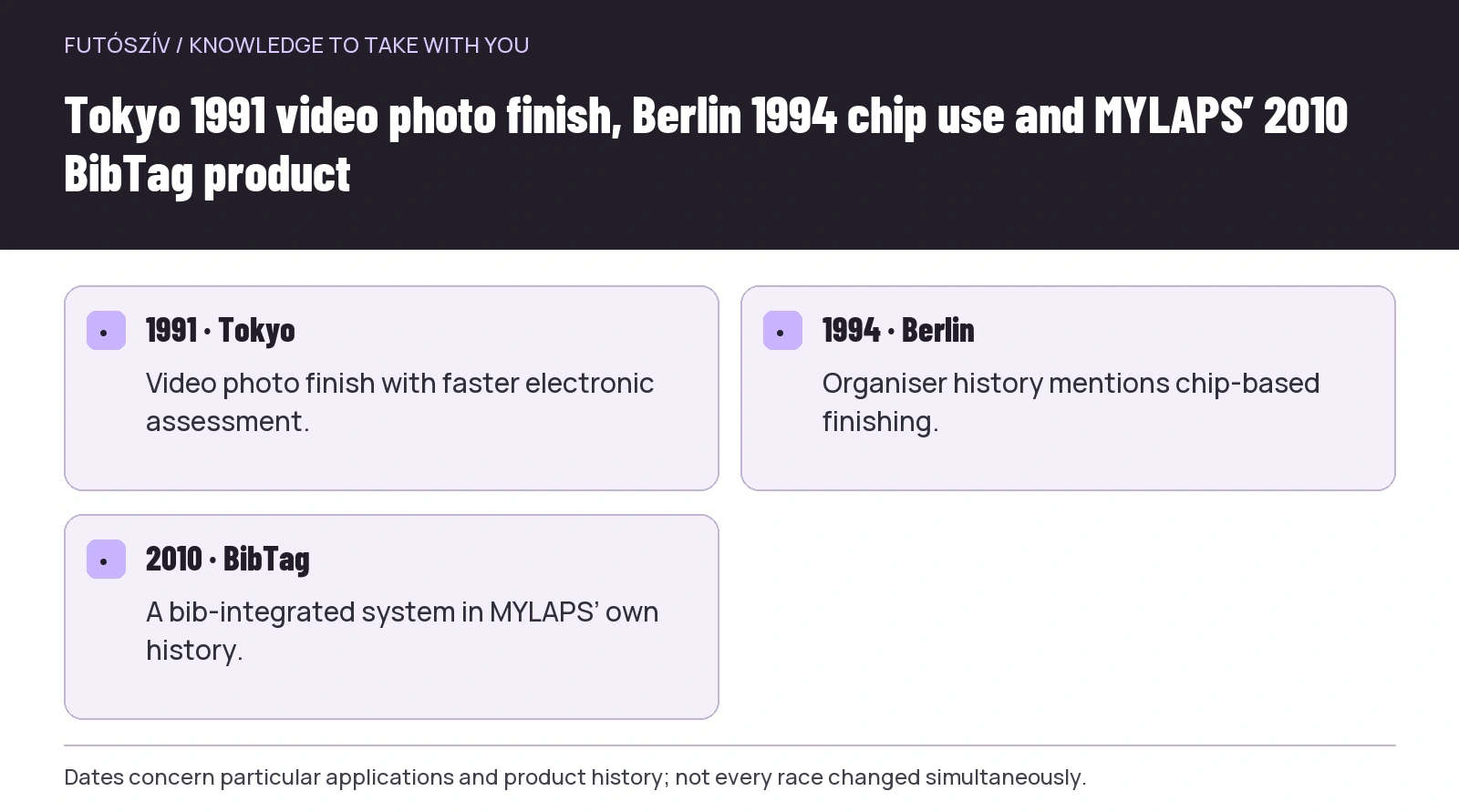
Text version of the diagram
- 1991 · Tokyo
- Video photo finish with faster electronic assessment.
- 1994 · Berlin
- Organiser history mentions chip-based finishing.
- 2010 · BibTag
- A bib-integrated system in MYLAPS’ own history.
Intermediate timing provided information beyond finish time
The MYLAPS historical article presents intermediate times at the 1995 Rotterdam Marathon and intermediate reporting at the 1996 Atlanta Olympics as separate development stages. In the manufacturer’s account, splits linked to results afterwards and transmitted live have different roles. They are not identical even if today we see both on one screen.
A timing point records a crossing event. The system and race rules can later turn it into a split, placing or another display. A broadcast or tracker may show estimates between actual points, however. Readers need to know whether they see a recorded crossing or a calculated expected position.
If a runner’s marker stops in an app, that alone does not prove the participant stopped. New information may not yet have arrived from the next point or the display may follow another logic. Learn the meaning of a particular signal from the system description. Fast electronic reporting does not turn every displayed estimate into direct observation.
A fictional example: one person, three different records
Imagine a runner crossing the start line three minutes after the signal. In the example, they take 52 minutes between start and finish lines. Their time from the signal would thus be 55 minutes, while time between individual crossings is 52 minutes. These invented numbers are neither expected performance nor award rules at a specific event.
If the watch uses another starting or stopping moment, it can display another figure again. Interpret differences by first identifying where each time begins and ends. Technology links several data types; race rules determine official ranking. Chip time alone is not complete award regulations.
| Data | What question does it answer in the fictional example? | What still needs rules? |
|---|---|---|
| Race number | Which participant does the record belong to? | Matching personal entry and category. |
| Crossing time | When did the participant pass the appropriate timing point? | The precise meaning of the result calculated from data. |
| Final result | Which time and place were published? | Ranking and award arrangements. |
| Personal watch | What did the participant’s device record? | Alone, insufficient to replace official information. |
Human checking remained alongside electronics
The Dutch federation interview presents the timer’s work as more than automatic collection: it discusses interpreting differing, seemingly erroneous or other-race detections. The important conclusion is that results processing remains a professional task. Reading a chip identifier and producing a correct final results list still have checking steps between them.
Participants can help by handling entry details correctly and reporting changes through event procedures. Someone else’s bib is more than another name on a photograph. It also changes the data linked to results and category. Learn whether and how transfers are possible from your event’s rules.
If a result is missing or wrong, ask specifically: which race, which identifier and what observed discrepancy? Present observations and available evidence factually. Fast technology does not remove the need for subsequent clarification, but precise details make resolution easier.
The bib remained a keepsake while its role expanded
Many people keep race numbers afterwards. The object can hold personal memories even when the digital result is accessible at any time. Technical development did not remove this human role. It added another meaning: times, intermediate data and searchable entries can attach to the visible marker.
When sharing the keepsake, consider what information appears and what you want public. You need not publish every related document or confirmation code with the finish photograph. A bib’s cultural value and the role of administrative information differ. You can tell your story by selecting only details you actually want to share.
The history of race numbers and timing ultimately connects three strands: recognising people, recording events precisely and interpreting results. Photo finishes, shoe chips and bib-integrated devices each offered new answers to different tasks. Today’s runner uses the system well by understanding their identifier, how to wear the device and what published results mean.
How Futószív articles are prepared: our editorial guidelines.