A certified road race course does not mean every participant’s watch will display the same number at the finish. Certification relates to a defined route, measurement procedure and documentation. Understanding it precisely helps interpret both race-regulation claims and your own running data appropriately.
Road-course measurement has a professional system. A runner’s task is not to reproduce it at home but recognise what the measurement concerns, what evidence can be sought and what a watch discrepancy alone cannot establish. This explanation draws on primary materials from World Athletics, AIMS and a professional course-measurers’ organisation.
First separate four concepts
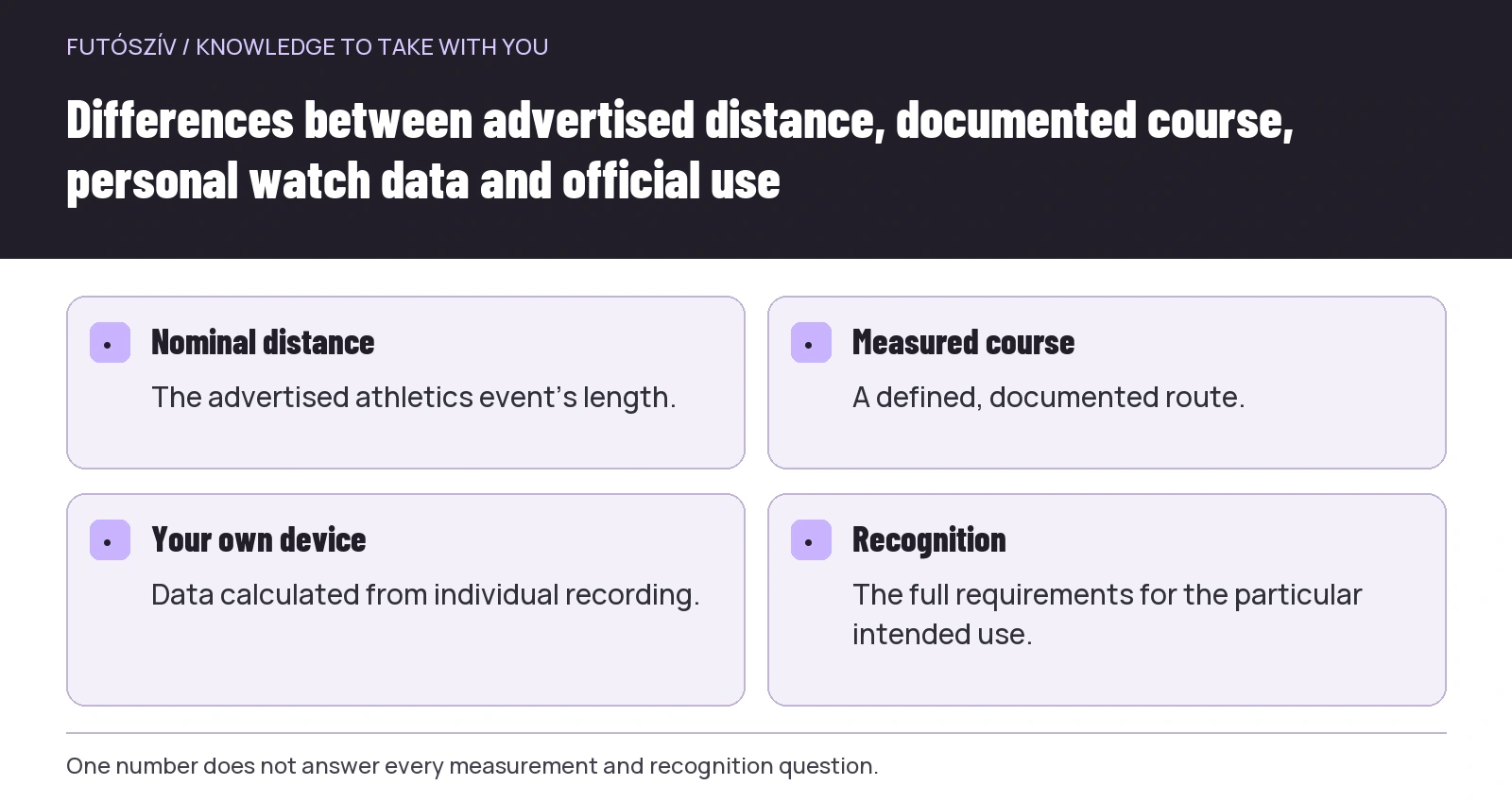
Nominal distance is the advertised number, such as ten kilometres. The measured course is the actual defined route. Certification belongs to measurement within the appropriate system and its document. Eligibility of a result for a particular purpose may depend on additional conditions. They relate, but none of the words automatically implies all the others.
An event name containing marathon still requires examining regulations and course information. Mentioning a certified course does not by itself guarantee every result’s acceptance for all international purposes. Seek the claim’s precise content rather than extrapolating from the strongest-sounding adjective.
Your watch distance is another concept: the individual journey your device records or calculates. This may matter in your diary but is not the same document as official course measurement. Without understanding the difference, people can argue while actually discussing different things.
Why measure with a calibrated bicycle?
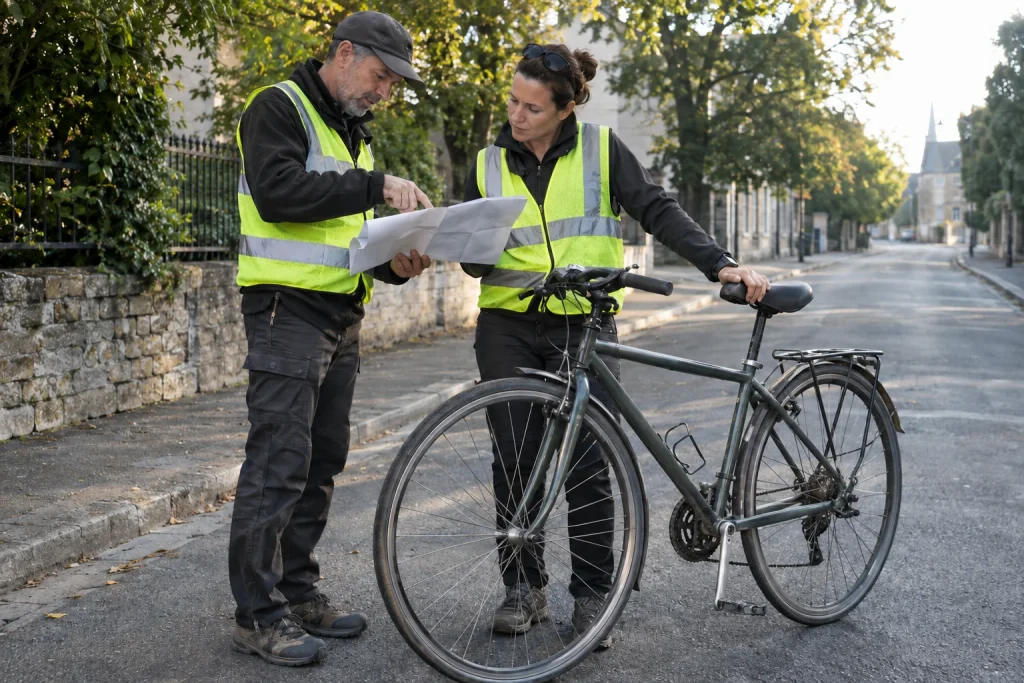
The AIMS measurement information explains that the method jointly accepted with World Athletics is calibrated-bicycle measurement. Readings from a counter attached to the wheel are related to a calibration course of known length. Measured by bicycle therefore does not simply mean someone switched on an everyday cycle computer and rode around.
The 2023 World Athletics–AIMS course-measurement manual describes calibration, course measurement, recalibration and documentation as a connected workflow. The useful understanding for runners is that establishing length is a controlled procedure, not a single arbitrary device display.
Relating a reading to a known length is a principle familiar from other measurements: first establish what the signal or counter value means. Without that, many digits merely look detailed. Measurement work gains value from method, appropriate expertise and traceable documentation together, not the number of decimal places a device displays.
 Enlarge diagram
Text version of the diagram
- Nominal distance
- The advertised athletics event’s length.
- Measured course
- A defined, documented route.
- Your own device
- Data calculated from individual recording.
- Recognition
- The full requirements for the particular intended use.
Which line is measured around a bend?
The manual uses the shortest route within the area permitted to runners as the measurement basis. Permitted is the key word. This is not an arbitrary shortcut drawn on a map or permission to ignore cones or course boundaries. The measured line must match the space actually available for the race.
Your position on a wide road’s bend therefore matters. Weaving through a field, staying further from a turn’s inside or diverting to a service point may make your journey longer than the measured baseline. This is not necessarily a course error. Extra travel and the device’s distance calculation can separately contribute to a larger display reading.
Equally, the shortest-permitted-route principle does not authorise dangerous cutting in. Other participants’ movement, the designated route and organiser arrangements still matter. Knowing the theoretical measurement line provides no personal priority in the field. Move without forcing others into sudden dangerous changes of direction.
An original geometry example: small differences can accumulate distance
Imagine four quarter-circle bends, adding up to one complete circular arc. If you followed a line with a radius one metre greater at every point of that theoretical arc, distance would increase by 2 × π × 1, or approximately 6.28 metres. This is simple geometric illustration, not an actual race’s measured route or a claim that runners always follow regular circular arcs.
The example shows that sideways position is more than a small distance from the course edge. Around bends, it affects travelled length too. With other deviations, the individual line can differ from the premeasured shortest permitted route. Actual extra distance cannot be calculated from the example without knowing your specific movements, however.
After a road race, it is therefore unhelpful to dismiss every discrepancy with a single explanation. Following the route, the actual course layout and device operation may be separate questions. Understanding relationships helps formulate precise questions rather than declare any party wrong without evidence.
The short-course prevention factor is not arbitrary extra distance
The Association of UK Course Measurers’ accessible explanation presents the short-course prevention factor. Accounting for measurement uncertainty, the procedure aims to prevent a course proving shorter than advertised. The organisation’s ten-kilometre example illustrates the difference between official distance and the small preventive addition used in measurement.
The World Athletics–AIMS manual gives this factor as 1.001. This is one part in a thousand: mathematically ten metres for ten kilometres and approximately 42 metres for a marathon. These figures explain the factor’s magnitude, not separate measurement reports about every real course’s condition.
This does not mean any large watch discrepancy is automatically justified or organisers may freely add arbitrary hundreds of metres. A defined component of a method and uncontrolled extra distance are different. Equally, you need not keep running beyond the finish line for your device to reach the expected number: the official course and finish determine race completion.
The document belongs to a particular layout
Measurement is usable when the documented route is actually available during the race. Start and finish positions, turn layouts and designated usable space matter. A cone-defined turnaround is not merely scenery: its position can affect distance. Measurement work therefore does not end with publishing one total kilometre figure.
The manual also covers course documentation and recording positions of non-permanent elements. For participants, this means checking current organiser information when routes change. An old course line and a new on-site version do not become identical because the same event name remains above them.
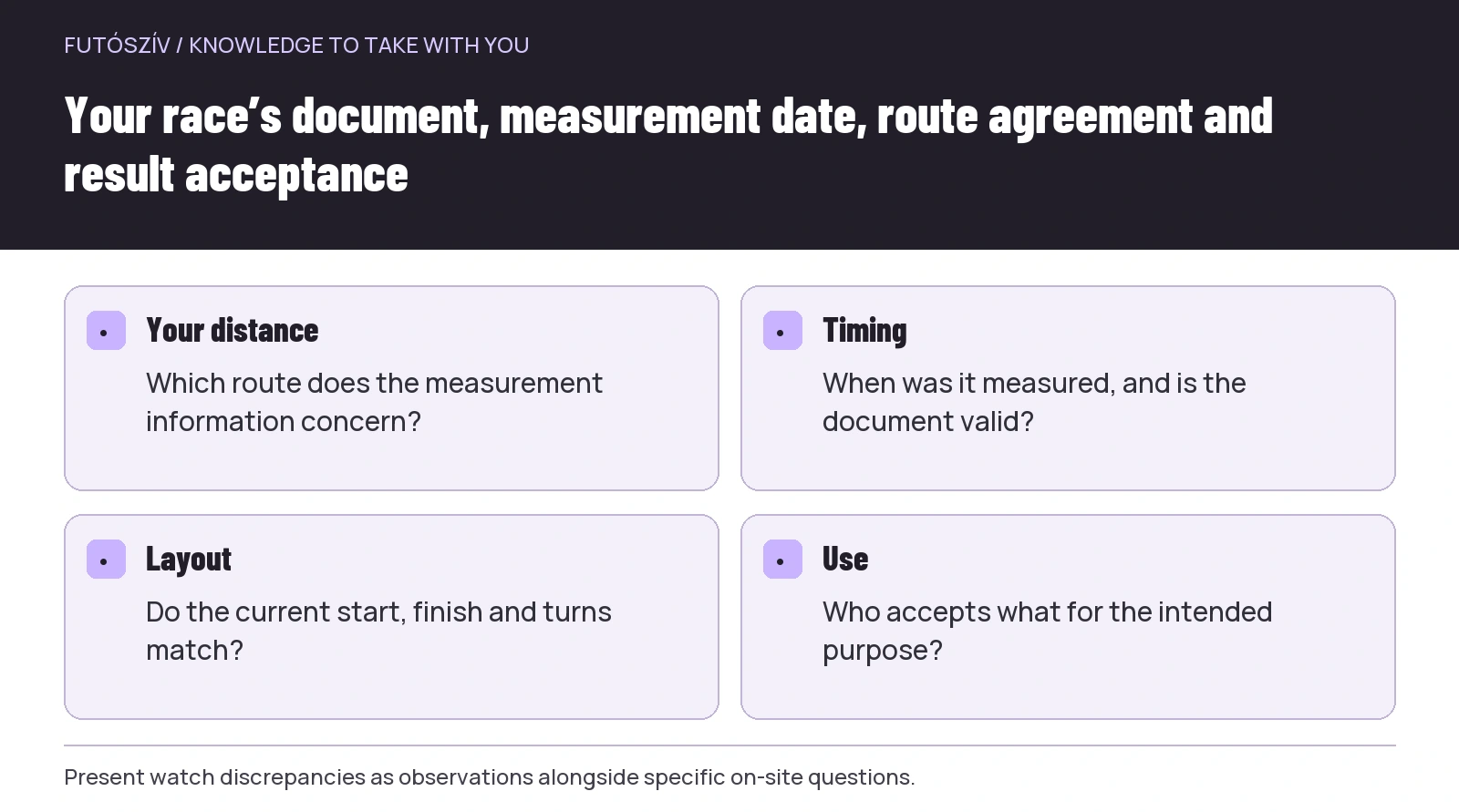
If regulations mention certification, find information for your own distance and that edition’s course. Several distances at one event may differ technically. A designation published for the longest race does not necessarily apply to every shorter programme. The precise question is not merely is the race certified, but what information belongs to which route of your event.
 Enlarge diagram
Text version of the diagram
- Your distance
- Which route does the measurement information concern?
- Timing
- When was it measured, and is the document valid?
- Layout
- Do the current start, finish and turns match?
- Use
- Who accepts what for the intended purpose?
What can you check as a runner?
The World Athletics page on certified road events presents conditions for international use and starting points for related registers. In that system, a valid course-measurement certificate’s timing matters too; the mere existence of a very old document is insufficient. Establish a particular race’s situation from its own details.
You can ask about the certificate, measurement date and whether the current course matches the documented layout. If seeking a result accepted for a particular purpose, such as another event’s entry requirement, check the receiving organisation’s conditions too. Your interpretation or a general adjective does not determine acceptance.
| What you see | What can you establish from it? | What needs further information? |
|---|---|---|
| Advertised ten kilometres | This is the event’s nominal distance. | Official measurement status. |
| Your watch distance | This is what the device recorded or calculated. | Professional determination of course length. |
| Course-measurement document | Measurement information for a defined route is available. | Validity and agreement with current layout. |
| International-use condition | This is required for a particular recognition purpose. | Acceptance of your specific result. |
Certification and a world-record-eligible course are different questions
World Athletics also discusses start–finish separation and elevation difference when assessing results for different purposes. This shows that accurately measured distance alone does not give every route identical status. A point-to-point race can nevertheless be a real sporting event and important personal experience.
Do not confuse course-measurement accuracy with flatness or the full requirements for a particular record purpose. A hilly course can be measured accurately. A visually flat route does not itself establish official status. Separate concepts answer separate questions.
When comparing your result with another performance, preserve race context too: distance, route, date and official result. Observing personal progress and international record recognition are different tasks. Understanding certification does not devalue other runs; it helps name precisely what a piece of data establishes.
Why might a phone or watch show another distance?
The GPS.gov explanation of accuracy states that several factors affect actual positioning, including signal blockage and reflection and receiver characteristics. Around urban buildings or trees, individual recording can therefore differ from an ideal track. This is general operational background, not a diagnosis of a particular runner’s discrepancy without evidence.
If the mapped track jumps between buildings, notice it, but do not conclude about the whole course from one screenshot. Examine where the discrepancy occurred, where you actually moved and which official information exists. Similar observations from several participants may raise a question for checking, but do not replace professional measurement.
Your device data can remain useful. You can follow running and observations with it when aware of its limits. Problems arise when every measurement situation is reduced to one device display or, conversely, every discrepancy is automatically called insignificant. A precise question is always a better start than a ready judgement.
How to ask about a possible discrepancy
Describe factually which race you entered, the discrepancy observed and where your question arose. Identify specific on-site circumstances separately if known, such as a turn differing from the published map. Present your watch data as observations, not a completed official course measurement.
Questions to organisers may concern the current route document and on-site layout. You need not immediately assert error or intent. Assess whether the reply provides verifiable information about your own event and specific question. A general reassuring statement and appropriate course data are different evidence.
A certified course ultimately provides one technical basis for shared trust: a named route, defined measurement and traceable information connect. You use this information well as a runner by understanding nominal distance, your own journey, device data and official use of the result as related but separate questions.
How Futószív articles are prepared: our editorial guidelines.