Running can help, but it is not a certificate about your body
After a PCOS diagnosis, contradictory advice may arrive: only easy movement, only intense training, as much cardio as possible or avoiding running entirely. A more reliable starting point is that movement can support health, but one weight target or online hormone rule does not determine a personal plan.
First, a recent terminology change: the international initiative led by Monash University introduced the name PMOS, polyendocrine metabolic ovarian syndrome, in May 2026 in place of PCOS. The new name emphasises the diverse hormonal and metabolic nature. The earlier term remains common in reports and research, so this article uses both.
The name change does not invalidate your previous diagnosis or mean you must resolve every symptom through a new running programme. The aim is manageable, health-supporting sport for you. Gynaecological and metabolic questions meanwhile still belong within appropriate healthcare.
Why is reducing the condition to the appearance of the ovaries insufficient?
PMOS/PCOS can affect different reproductive, metabolic and psychological areas, with individual presentation. Diagnosis is a medical task. An ultrasound description, irregular cycle or online symptom list alone cannot let a runner classify themselves.
For sports planning, the specific situation therefore matters more: your symptoms, treatment, other conditions and current movement. Exercise tolerance and goals can differ substantially between two people with the same diagnosis. The label does not automatically specify an appropriate pace or training form.
The 2024 Exercise and Sports Science Australia position statement places the exercise professional within multidisciplinary care. A coach can help with manageable exercise demands and implementing movement, but does not replace diagnosis, medication planning or gynaecological follow-up.
Weight change is only one possible outcome
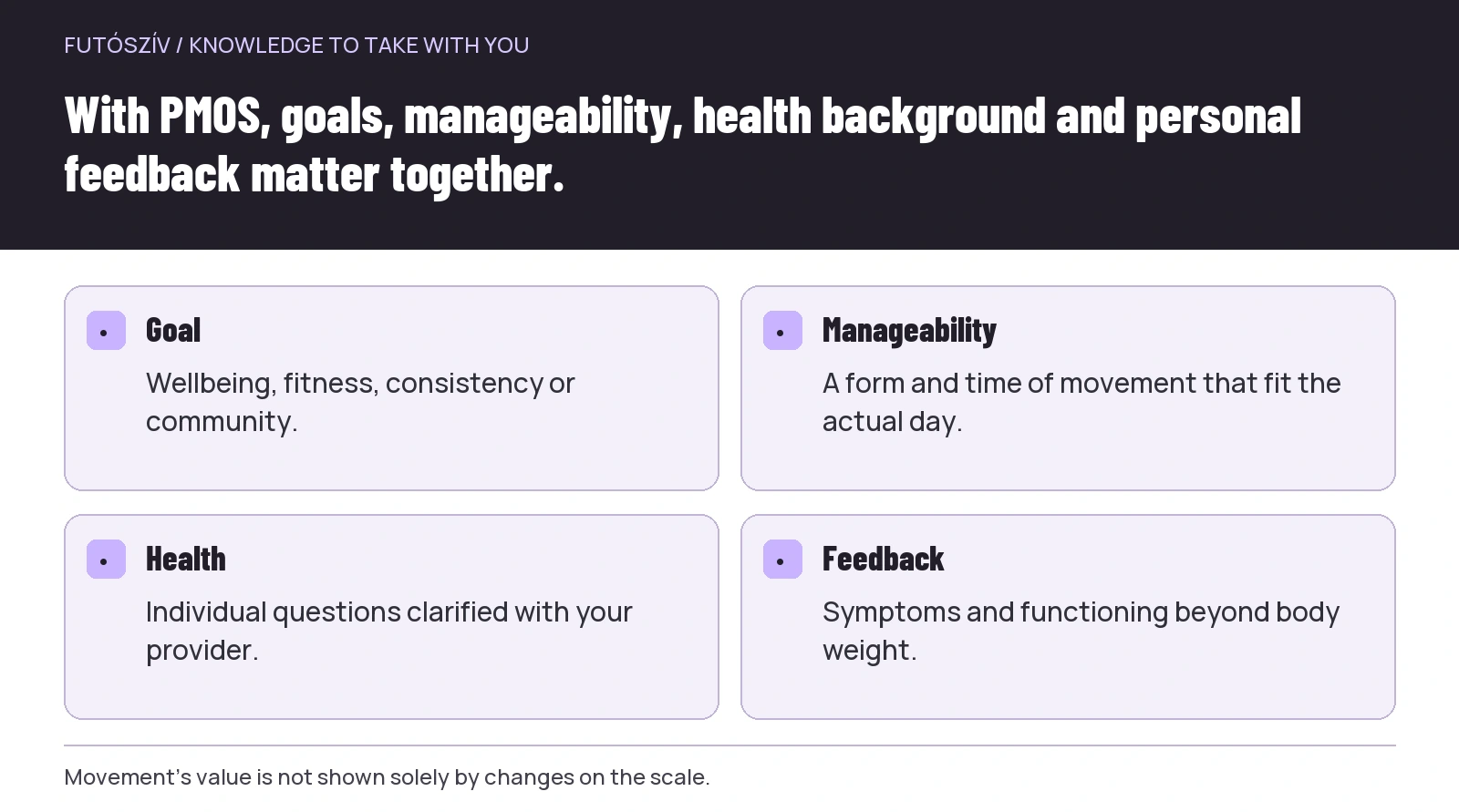
The international guideline updated with PMOS terminology in 2026 emphasises that a health-supporting lifestyle can benefit people without weight loss. Weight can be discussed within individual medical care, but there is no justification for reducing movement’s value to a scale reading every time.
As a runner, worthwhile goals may include more regular movement, easier stairs, more comfortable walk-running, fitness or community participation. These are not consolation goals. They are changes noticeable in everyday life which can help prevent sport becoming another monitoring task.
If weight change also belongs to your personal plan, consider it together with health circumstances, your relationship with eating and training load. Do not automatically start increasing running and reducing food simultaneously. Adequate energy and recovery matter with PMOS too.
 Enlarge diagram
Text version of the diagram
- Goal
- Wellbeing, fitness, consistency or community.
- Manageability
- A form and time of movement that fit the actual day.
- Health
- Individual questions clarified with your provider.
- Feedback
- Symptoms and functioning beyond body weight.
No training type is proven best for everyone
The international guideline identifies no single exercise type or intensity clearly superior across every important outcome. It supports sustainable movement adjusted to personal preferences and goals. This does not mean all programmes are identical, but that evidence for an exclusive solution prescribed to everyone is absent.
Running can be one choice. Walking, cycling, swimming and strength work may also belong if appropriate to your situation. If you dislike running, it need not be compulsory proof of commitment to treatment. If you enjoy it, diagnosis alone is no reason for an automatic ban.
Intense training is neither necessarily harmful hormonal stress nor a compulsory cure. Current health, exercise history, preparation and recovery determine what fits. For a beginner, an online PCOS-HIIT label does not replace gradual preparation.
What do two different interval studies show?
In a twelve-week 2022 study with twenty-nine participants high-intensity interval training produced more favourable changes in several measured outcomes than moderate continuous training. The study assessed a small, defined group. It cannot establish mandatory intensity or guaranteed cycle regulation for every woman with PMOS.
The IMPROV-IT trial involving sixty-four participants compared two interval versions and a control group. The twelve-month follow-up found no between-group difference in the primary outcome of menstrual frequency. This does not mean movement is worthless, but a specific reproductive outcome cannot be promised with certainty.
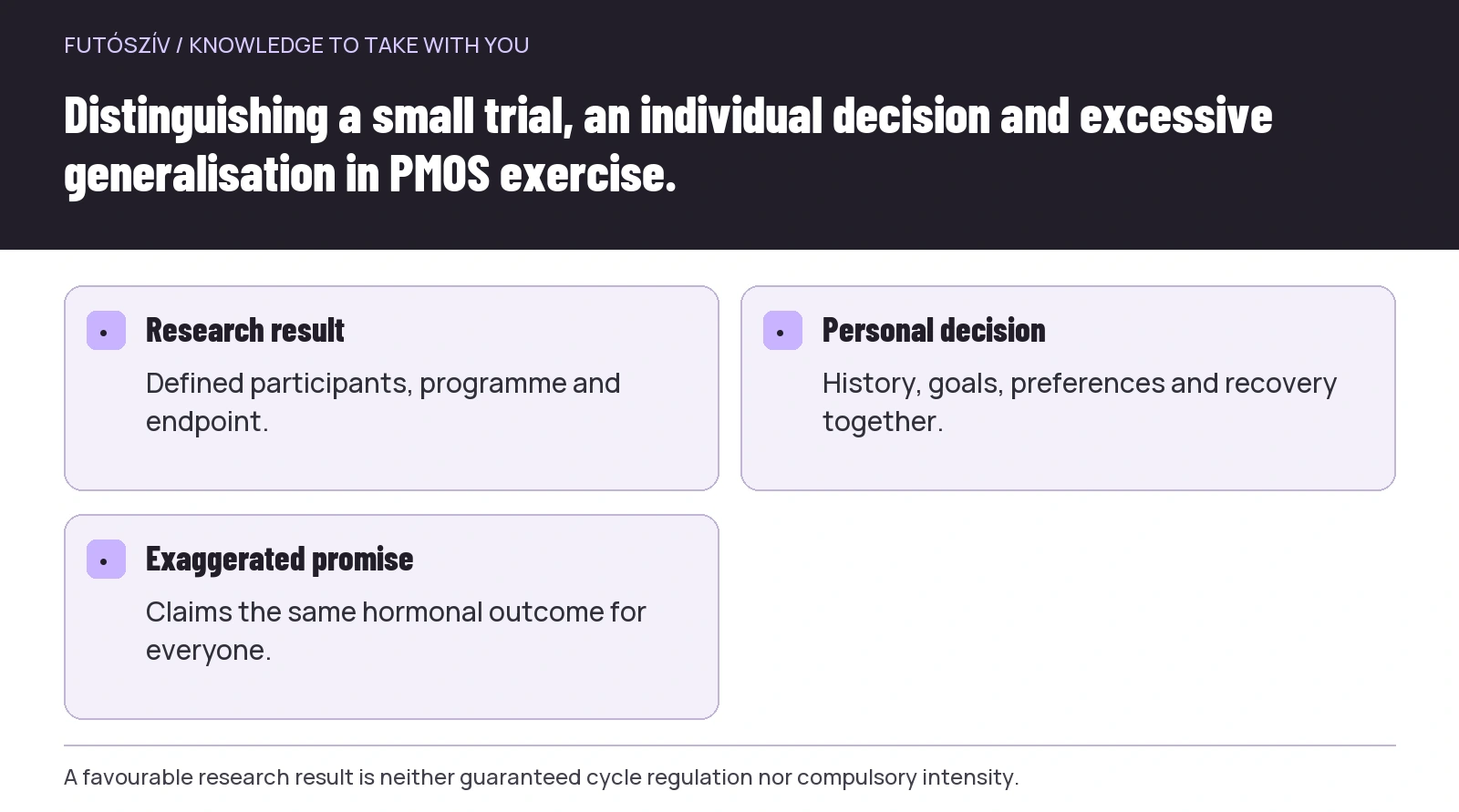
Different studies use different participants, programmes and endpoints. A favourable small study does not make all other data unnecessary, and a cycle that fails to improve does not prove you performed the training badly. Assess sporting effects across several areas and with realistic expectations.
How to choose a first running goal alongside the diagnosis
If starting now, make the goal specific and achievable from your current condition: a regularly manageable walk-run occasion, exploring a comfortable route or joining a beginner programme, for example. The precise amount follows history and response to exercise demands, not the diagnosis name.
If already running, you need not begin everything again. Review what works: consistent routine, enough easy days and room for strength training and recovery. Discuss questions arising from a new healthcare plan with your provider and a coach where needed.
A success criterion you can actually influence helps. Preparing clothes and attending a manageable occasion is a specific action. Ensuring a particular change in hormone results within a given month is not an equally directly controllable task.
Do not apply an automatic phase calendar to irregular cycles
If your cycle is unpredictable, an app’s ovulation or training-phase estimate calculated from previous dates may be particularly uncertain. You can record bleeding dates and actual symptoms, but do not turn estimated phases into compulsory hard and easy weeks.
Clarify persistently absent or changed bleeding with a doctor. Even with a known PMOS diagnosis, not every new symptom needs the same automatic explanation. Other causes, medication changes or possible pregnancy can arise; a calendar does not replace their assessment.
If using hormonal contraception, the bleeding pattern may also mean something different. Do not independently change treatment for cycle tracking. To coordinate gynaecological care and sport, state your actual goals while keeping health questions within the appropriate professional framework.
 Enlarge diagram
Text version of the diagram
- Research result
- Defined participants, programme and endpoint.
- Personal decision
- History, goals, preferences and recovery together.
- Exaggerated promise
- Claims the same hormonal outcome for everyone.
An eating plan should not become another prohibited list
The guideline identifies no dietary composition clearly superior across every important outcome. A personal plan must account for preferences, access and health aims. An exclusion diet circulating on social media does not automatically become appropriate because PCOS or PMOS appears in its name.
As a runner, maintaining space for usual meals in the day is particularly important. With many rules, breakfast or lunch can easily disappear while exercise demands remain unchanged. Discuss with a dietitian how a personal healthcare plan and sporting nutrition can fit the same real daily routine.
If thoughts about eating and weight occupy too much space, or sport becomes punishment or compensation, seek support. Emotional burden is not incidental to the diagnosis. The ESSA statement also highlights psychological circumstances and weight stigma when planning exercise.
Follow-up should connect to your own goal
In healthcare follow-up, the doctor determines appropriate investigations and frequency. You can ask why each result is checked and which symptoms or life changes require earlier contact. A running watch does not replace necessary assessment of blood pressure, metabolism or gynaecological health.
A sports diary can include consistency, wellbeing, feasibility of strength work and how comfortable easy running feels. Do not label a single bad day a hormonal setback. Consider trends with the health and life background.
New chest pain, fainting, severe difficulty breathing or another sudden illness requires urgent help. Do not call these a natural part of PMOS. Knowing the diagnosis supports care but does not automatically explain every new symptom.
What should a supportive running group be like?
A setting where performance and wellbeing do not revolve solely around body weight helps. A coach can ask about your goals and what makes participation manageable. Public weighing, unsolicited dieting advice or expectations assigned by body shape are unjustified.
You can state in advance which feedback you want: discussion of training consistency, technique or exercise demands. If weight change belongs to your medical plan, you need not share its details with the whole group. Respectful support and professional aims are compatible.
Small adjustments can matter greatly: several pace groups, a loop that can be shortened, a clear meeting point and communication that does not treat walking as punishment. These help beyond PMOS too. They generally make the enjoyment of movement accessible to more people.
A personal starting sheet avoiding weight stigma
- My goal: what should change in my everyday life or sport?
- My opportunities: which movement, time and social setting are manageable?
- My health plan: which question needs clarifying with my provider?
- My feedback: which physical or emotional changes do I monitor?
- My boundaries: what information do I share, and which comments do I not want?
Running with PCOS/PMOS is neither a guaranteed cure nor a continuous body-weight test. It can be enjoyable, social and ambitious movement within comprehensive healthcare. A good plan is strong not because it is the strictest, but because it considers evidence, personal circumstances and your own freedom to decide together.
Sources and further reading
- Monash University: PCOS renamed Polyendocrine Metabolic Ovarian Syndrome, 2026
- International Evidence-based Guideline, updated PMOS terminology, June 2026
- Exercise and Sports Science Australia: Exercise in the management of PCOS, position statement, 2024
- Patten and colleagues: HIIT versus moderate-intensity training in PCOS, randomized trial, 2022
- IMPROV-IT: High-Intensity Interval Training in PCOS, randomized controlled trial, 2022
How Futószív articles are prepared: our editorial guidelines.