
Do not begin booking the train home around your hoped-for finish time. Between the race ending and the station, you may still need bag collection, changing, meeting companions and local travel. Compressing all this into one optimistic minute can make getting home an unnecessary pressure before the start. A plan allowing realistic uncertainty about finishing is better.
This guide provides a personal worksheet and fictional calculation for planning a domestic rail journey home. Operator sources were checked on 18 November 2026. It identifies no ticket suitable for everyone and promises no automatic flexibility or refund. Learn these conditions for your own route, selected product and purchase method.
Separate three times
The first is when you finish the race. The second is when post-finish tasks are also complete and you can actually leave for the station. The third is when you are at the departure location ready to take the correct train. A journey planner mainly helps with the travel section; you must add the transition after the race.
None becomes certain because you write a neat round number beside it. Estimated finish may differ from reality, bag collection may depend on on-site operations and local travel on that day’s traffic arrangements. Planning is not about eliminating every uncertainty but avoiding a journey home that requires every favourable assumption to come true at once.
Give each of these three states a separate line on your sheet. Then add intermediate tasks: what remains to collect, whom you must meet, whether you have luggage at accommodation and where the local connection starts. This produces a more usable plan than easily make it written beside one train departure.
Expected finish is a range, not a booking promise
Your preparation and experience may suggest a running time, but examine several situations in the travel plan. Consider a more favourable finish, a less fast version and post-finish tasks taking longer. These are not new pacing prescriptions: they test how strongly the same return plan depends on a single estimate.
If the selected train fits only the fastest scenario, state that. Sometimes you may consciously accept the risk while knowing another solution. At other times a later departure is simpler. Decide with knowledge of the later train’s connections, arrival and ticket conditions; another timetable row alone is not a ready backup.
Do not reverse the logic by requiring yourself to complete the race faster because the journey home is tight. Personal running and safety decisions should not be shaped around reaching a booking to the minute. Transport fits your day when actual events still leave a manageable choice.
 Enlarge diagram
Text version of the diagram
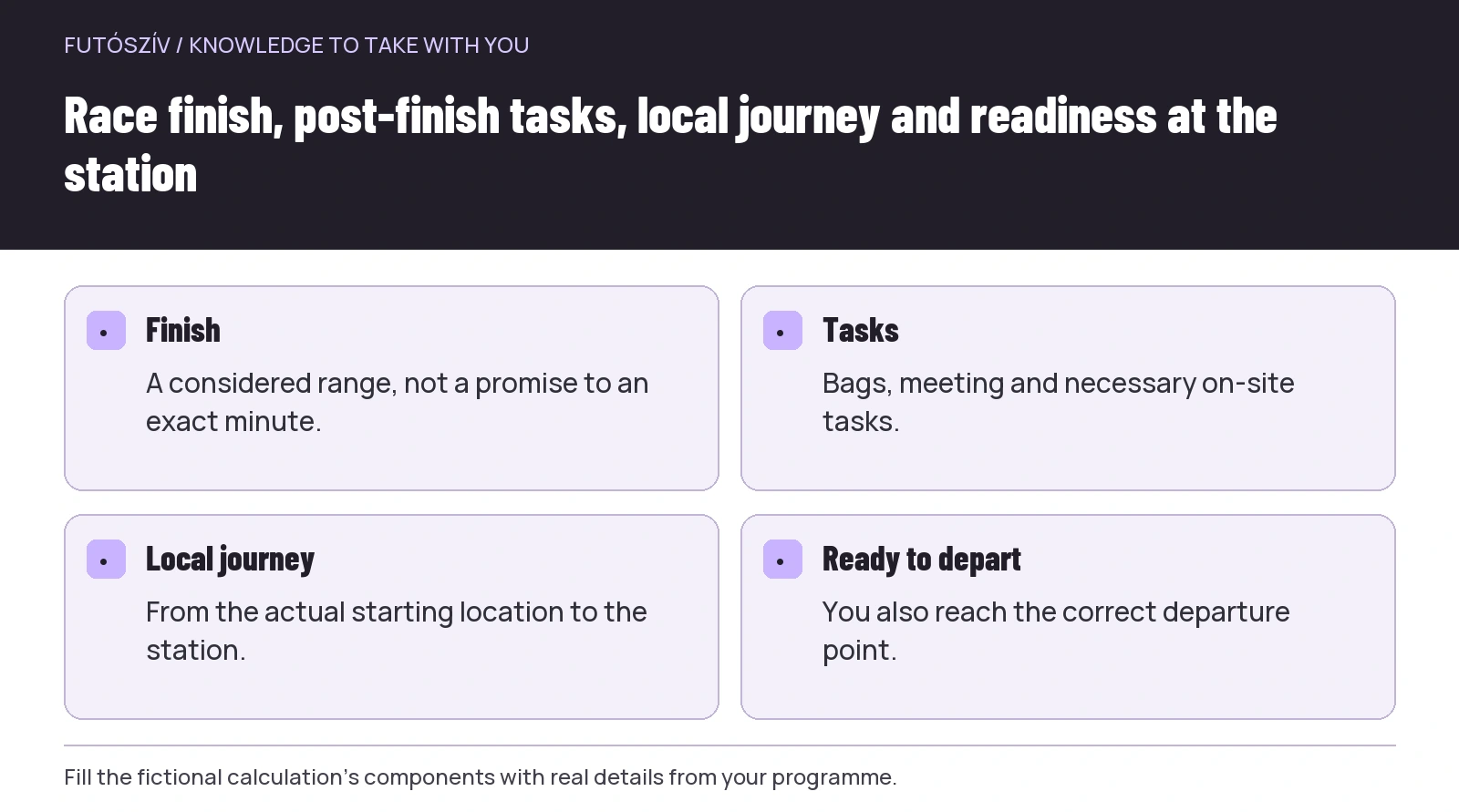
- Finish
- A considered range, not a promise to an exact minute.
- Tasks
- Bags, meeting and necessary on-site tasks.
- Local journey
- From the actual starting location to the station.
- Ready to depart
- You also reach the correct departure point.
A fictional calculation: several items lie between finish and train
Imagine a purely illustrative situation. Someone estimates finishing around 13:10, allows 35 minutes for their post-finish tasks, and their checked local route plus station transition requires another 40 minutes. Adding these three values gives readiness at the station at 14:25. These are invented numbers, not generally recommended buffers or data for an actual race or service.
The runner then examines what changes if finishing is 25 minutes later or tasks need more time. It becomes clear that a 14:30 departure offers different flexibility from a later option. The precise decision requires the actual timetable and personal circumstances, but the calculation has revealed the plan’s sensitive point.
| Component | What does your example include? | Why should you not omit it? |
|---|---|---|
| Race finish | Your realistically considered arrival range. | A finish time is a plan, not certain transport information. |
| Post-finish tasks | Bags, meeting, changing or other necessary tasks. | Passing the finish arch does not necessarily mean being ready to travel. |
| Local connection | The route from the actual starting location to the departure station. | Race-day closures and the chosen route matter. |
| Station transition | Reaching the correct departure location and necessary tasks. | Arriving at the station building does not always mean standing on the platform. |
The example’s value is the breakdown. Generate your own numbers from your programme rather than adopting these values. If a component is still unknown, mark it uncertain and seek verifiable information.
Travel tickets and seat reservations: check restrictions separately
The summary of MÁV rail travel conditions covers several travel documents and conditions. For your return, examine the travel ticket and necessary seat reservation separately. Knowing you have a ticket home from the town is insufficient: validity, route and conditions tied to the particular service matter together.
Before buying, find what the selected product entitles you to and what happens if you want another departure. Instead of the word flexible, ask specific questions: can it be used on a later train, is a new reservation needed, what is the refund deadline and through which purchase channel can it be handled? If no clear answer is available, ask the operator before completing purchase.
Check companions’ tickets individually too. A planned shared train does not mean everyone has the same discount, product or modification options. Arrange access to individual documents if later travelling separately. Having all tickets on a single phone that is elsewhere is not practical for every group situation.
Your own later arrival and a rail delay are different
The operator’s journey-planning FAQ addresses missed connections due to train delay or cancellation under specific conditions. This does not establish automatic entitlement when you finish a running race later and miss departure as a result. Separate the two situations during planning.
If your own schedule is uncertain, learn modification and refund options for your selected ticket. If rail disruption occurs during travel, find the operator procedure applying to that situation. Do not automatically apply online advice written for another case. In particular, do not assume every missed train entitles you to the same solution.
The official summary of exchanges and refunds also presents conditions depending on purchase method and product. Record administrative deadlines for your ticket rather than another passenger’s earlier experience. This article does not replace assessment of a specific case, but helps you ask the right question.
Check the backup journey home as a complete chain
If considering a later train, examine the whole journey to your final destination. A later departure may be more comfortable on the first leg while changing onward connections. Travel onwards from your home station, the last local service or an agreed pickup are also part of the chain.
Do not establish a guaranteed connection from your own optimistic walking estimate. Check which station you arrive at and where you depart next, the operator-provided connection and any known changes. Two different station names in the same city do not mean a transfer in the same location. The city journey between them is a separate task.
Ticket conditions also determine whether the backup is usable. If the required reservation on the later train is unavailable, the alternative in the original plan may not work identically. Do not assume spare capacity is guaranteed in advance. Consider what information you can verify now and what must be checked again before departure.
 Enlarge diagram
Text version of the diagram
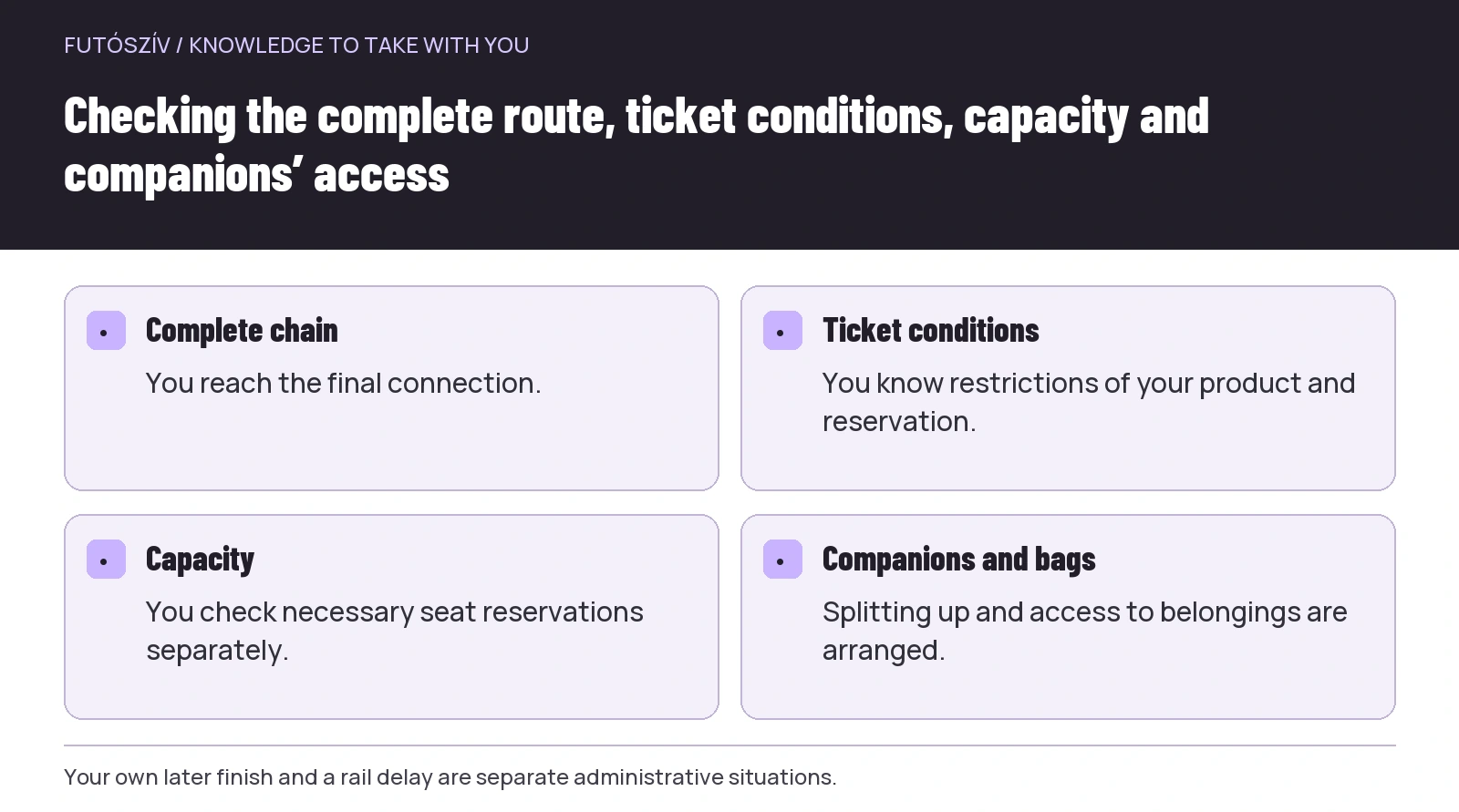
- Complete chain
- You reach the final connection.
- Ticket conditions
- You know restrictions of your product and reservation.
- Capacity
- You check necessary seat reservations separately.
- Companions and bags
- Splitting up and access to belongings are arranged.
A shared journey home should be a real agreement
If several of you are racing, finishing times and post-finish plans may differ. At booking, discuss whether you want to travel together in every circumstance or may split up. A shared weekend does not necessarily need the same homeward departure. What matters is participants knowing their commitments.
Check separately who can access shared luggage or an accommodation key. If one runner finishes earlier but can retrieve their belongings only through a companion finishing later, this affects train choice. It may be a consciously accepted dependency, but should not remain hidden behind the timetable. Describe shared tasks alongside how access works.
Make the station meeting precise. At larger buildings, at the entrance may be insufficient. Agree the end of the walking route, the shared waiting place and what happens if someone arrives later. Do not discover you should have travelled separately at the last moment, jeopardising someone else’s train.
When should you decide on a change?
Knowing your ticket’s deadlines, identify a point in the day when you can still meaningfully review the plan. This need not be a task during running. Often, booking already allows a departure less dependent on the fastest finish. Other times, knowing the final programme before the event allows simplification.
If after finishing you see the earlier train is no longer manageable, clarify your travel options first. Rushing towards the station should not be the sole answer to an excessively tight plan. The later route, ticket handling and informing companions are separate decisions. Follow current operator rules for administration, and do not use a ticket already submitted for refund.
If transport is disrupted, use current official information and operator staff. Estimates circulating in group messages may provide useful signals but do not replace checking your own route’s status. Basic timetable data, a traffic notice and actual station information are separate levels.
Plan waiting time, not merely departure
A more comfortable return choice often leaves more time after the race. Know beforehand where you will spend it, what you will carry and how you will then reach the departure station. Do not rely on a service whose access or opening hours are unchecked. A room used at an event may not remain open throughout your wait.
Assess the waiting place with your luggage in mind. If already checked out, you may be moving with the whole travel bag. If collecting luggage later, that additional journey belongs in the schedule. Every minute need not be filled with activities: the aim is a manageable, understood sequence until the chosen later departure.
Five lines on the return-travel sheet
The final summary’s first line should be the considered finishing range. The second covers post-finish tasks, the third the actual connection to the station. The fourth is the selected train’s complete journey, and the fifth the checked alternative and associated ticket-handling question. Keep operator sources and the check date accessible too.
If you can explain these five lines as the story of your own day, your journey home is more than a ticket on a phone. You need not predict every race minute. Uncertainties need space in the plan, and tasks after finishing must count as real time just as the journey itself does.
How Futószív articles are prepared: our editorial guidelines.