Fuel does not merely need to fit in your running vest: you also want to use it later. A packet safely tucked into the deepest rear compartment may be in precisely the wrong place for your next planned food intake. A bottle may be easy to reach, but knowing which contains what matters. Opened packaging can quickly become mixed with unused supplies. Well-designed fuelling organisation builds around these specific movements: take out the item, use it, then return the necessary object or rubbish to an orderly place.
This guide gives adult recreational runners a framework for packing and access. The number of pockets does not determine personal food and fluid quantities; develop those within a plan suited to your needs, exercise demands and health. Follow the particular instructions for your vest and drinking equipment. The examples are layout ideas, not identical compartment instructions for every model. The aim is a simple, repeatable system usable in your own equipment.
Start with the planned movements
List what you want to reach without removing the vest and which tasks you can comfortably stop for. Drinks, the next food to use, your own cup and a collector for opened packets often need separate access. Reserve food or a packet for a later section can occupy another place. Safety equipment requiring urgent access in your personal plan must retain an appropriate location too; fuel must not displace mandatory kit.
The Salomon manufacturer’s guide to running backpacks and vests highlights access to equipment, food and water, as well as securing the hydration reservoir properly. This is manufacturer guidance for use, not an independent product ranking. Learn your vest’s compartments and fastenings from that model’s description. Similar-looking pockets may have different capacities and be designed for different objects.
Do not begin packing by putting everything wherever space remains. Establish arrangements for frequently used items first, then other equipment according to requirements. If the necessary supplies cannot fit safely and comfortably, reassess the vest’s suitability or the overall carrying solution. Overstuffing a pocket does not replace missing volume, and a hard-to-reach place does not become appropriate simply because its zip can finally close.
Make a pocket map of your actual vest
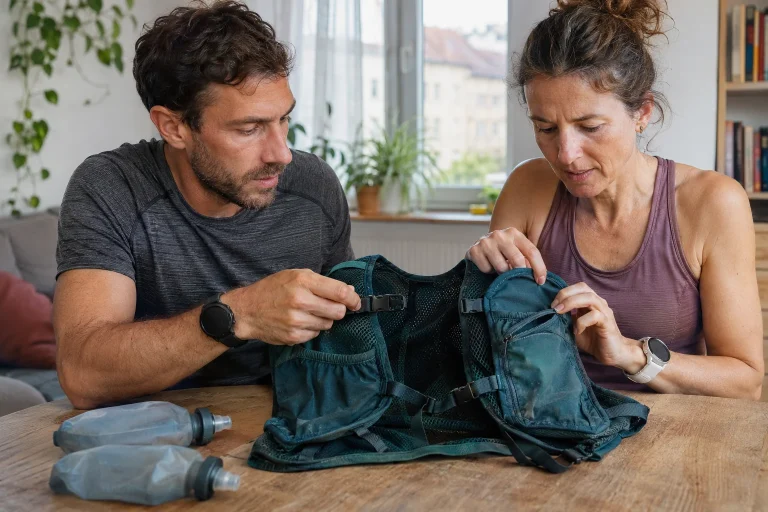
Lay out the clean, empty vest and name its real compartments. Simple names work: front bottle pocket, lower front pocket, zipped compartment, side pocket and rear section. Your names should remain identifiable when wearing it. Mirrored left and right can easily become confused, so always name the map from the wearer’s perspective. If a companion helps pack, use the same viewpoint.
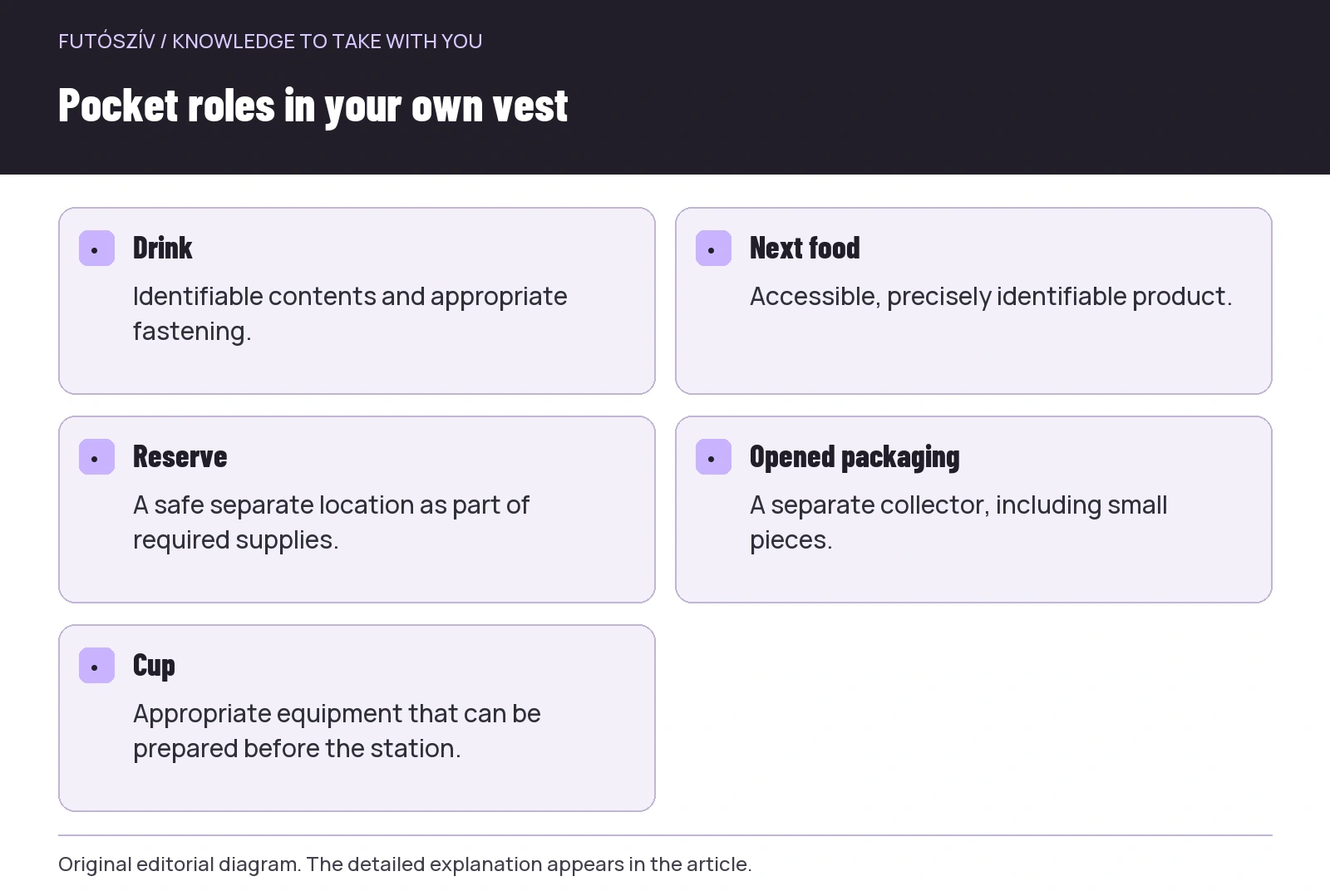
Assign each pocket a main task. For example, food for the next use, later reserves and collecting opened packaging should have separate roles. You do not need a separate pocket for every packet. A system is simple when its roles can be explained briefly. Unused here, opened there may be easier to follow when tired than many small rules changing on every occasion.
The Osprey Duro/Dyna S17 series owner’s manual separately describes pockets designed for bottles, smaller items and food, for example, alongside adjustments for that model. The document describes this older series, not a general map of all current running vests. The useful principle is to know the pocket’s original function and the manufacturer’s fastening before assigning your own fuelling task to it.
 Enlarge diagram
Text version of the diagram
- Drink
- Identifiable contents and appropriate fastening.
- Next food
- Accessible, precisely identifiable product.
- Reserve
- A safe separate location as part of required supplies.
- Opened packaging
- A separate collector, including small pieces.
- Cup
- Appropriate equipment that can be prepared before the station.
Make drinks identifiable
If using several bottles or reservoirs, identify their contents according to your plan. Two similar soft flasks may contain different drinks. Remembering position or colour can help, but a clear marking may reduce mistakes. Marking must not damage the equipment or obstruct cleaning. When filling a container, always follow instructions for the particular drink and bottle in line with your personal fluid plan.
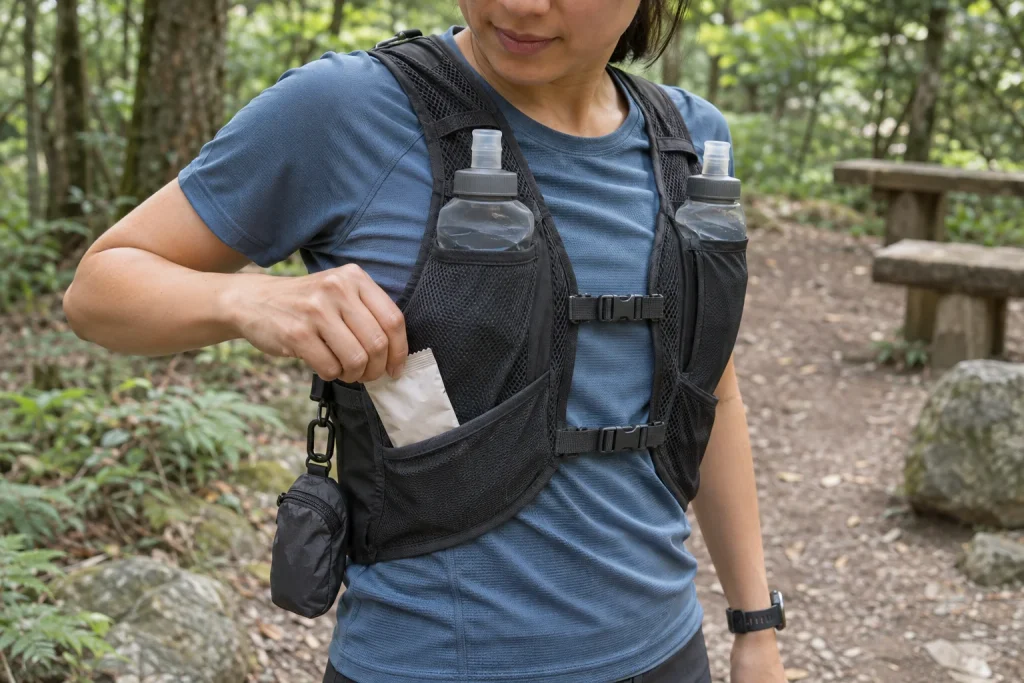
Place the bottle in its designated pocket and fastening if the model requires this. Check that it does not slip down, its valve is accessible and the cap seals properly. Test both full and partly empty states. A soft bottle’s shape may change as contents decrease, so replacing it may require a different movement. After a dry trial, you can explore this difference in a familiar, safe training situation too.
For a rear hydration reservoir, arrange its placement, fastening and tube routing according to the manufacturer. Do not route a tube so it obstructs movement or use of other equipment. Check tube access with the actual clothing too. Resolve leaks at the valve, connection or cap before a longer run. Moving food packets will not solve the problem of losing your drink.
The next food and reserve may need different access
Food intended for the near future in your plan can occupy an easy-to-reach place, while later supplies can be stored securely and separately. Check the precise version beforehand, particularly if carrying both caffeinated and non-caffeinated packets or other differing compositions. A simple order may help, but must not conceal basic product information. If packets shift in the vest, order alone may be insufficient for reliable identification.
The Australian Institute of Sport’s sports gel guidance also discusses differences in product composition and use. Base your packing on the exact label, not merely the packet shape. Treat different versions within a product family separately if your personal plan requires it. Easy access is useful only if you also know which product you have taken out.
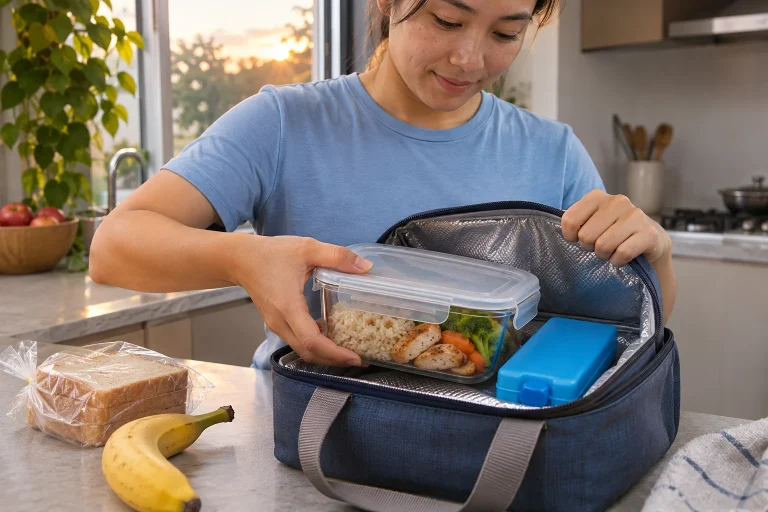
Carry a harder box, crumbly food or runnier contents in food-safe containers appropriate to their texture. Storage requirements must be met throughout the journey; a vest pocket alone does not provide refrigeration. A damaged or leaking product must not join the usable supplies. Separating clean food and used equipment matters more than filling every millimetre of space.
| Packing role | Access objective | Check |
|---|---|---|
| Drink | Identifiable and accessible as intended | Bottle fastening, valve, cap |
| Next food | Simple removal | Exact product version and a packet you can grip |
| Reserve | Safe storage and later access | Not trapped beneath mandatory kit |
| Opened packaging | Separate, retained rubbish | Does not stick the clean supplies together |
| Your own cup | Equipment ready to prepare before the station | Complies with your race rules |
Arrange the place for opened packaging before opening it
After a gel or another sticky food, the packet may not be entirely empty. Returning it to the compartment holding clean food and your phone may make the next retrieval harder. Create a separate, manageable collection space large enough for the expected packaging. Include small torn-off pieces too. The collector needs to be accessible when the packet is already open and in your hand.
Dispose of rubbish according to the event’s designated arrangements; until then, keep it in your own system. The Arc of Attrition by UTMB regulations explicitly require carrying packaging to the appropriate collection point, for example. This is an event example; follow the current regulations for your own participation. The packing system works when retaining rubbish does not emerge as an unexpected, unresolved task midway through a run.
If you later recall actual use from the used packets, distinguish this from reliable measurement of nutrient quantities. Food may have remained in a packet or leaked out. Notes on the plan as carried out may include estimates, but do not call an uncertain value precise data. Storing opened and unopened supplies separately helps organisation, but alone does not provide complete certainty about the quantity consumed.
Check adjustments with the full, actual load
Put the vest over the clothing used for running and adjust it according to the model’s instructions. Do not automatically copy movements for another manufacturer’s or model year’s strap system. The vest should fit appropriately, movement and breathing should be comfortable, and contents should be stable. If a comfortable setting is possible only by displacing a necessary item, reassess the whole packing arrangement or equipment suitability.
During a short, safe movement trial, notice what shifts. Is a food-box corner, bottle or packet edge causing the troublesome sensation? Change the specific item’s position or packaging rather than beginning by tightening all straps without limit. Make small changes within the manufacturer’s specified boundaries, then check again. The aim is stable, comfortable use, not pressing equipment as tightly against your body as possible.
Try retrieval with both a full and partly depleted load. Fluid consumed and food used during running may alter how full pockets are. A packet previously held firmly may shift more easily later. Your system should therefore include a later check at a safe stopping place. The initial packing arrangement will not necessarily stay unchanged throughout the run.
 Enlarge diagram
Text version of the diagram
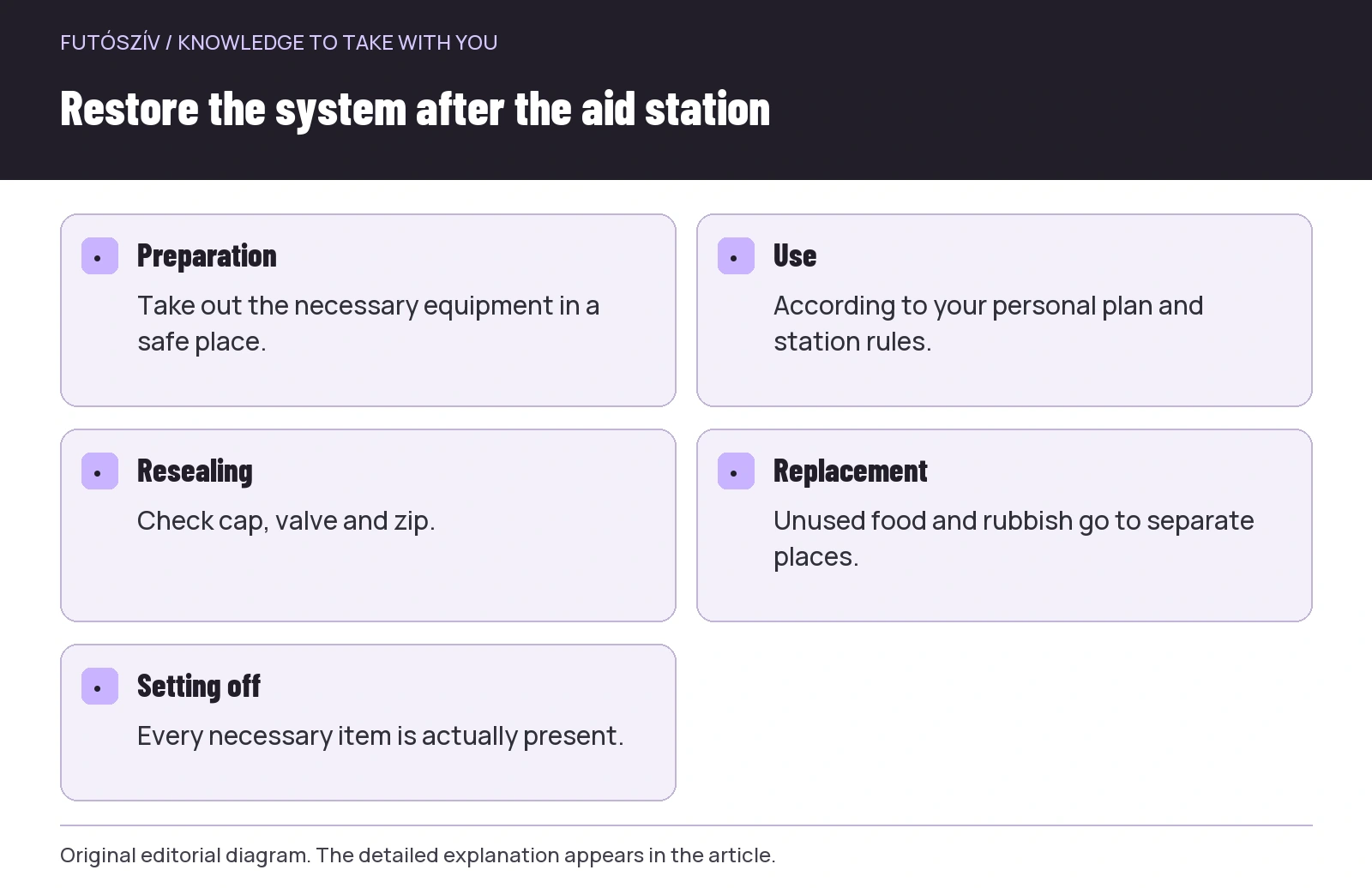
- Preparation
- Take out the necessary equipment in a safe place.
- Use
- According to your personal plan and station rules.
- Resealing
- Check cap, valve and zip.
- Replacement
- Unused food and rubbish go to separate places.
- Setting off
- Every necessary item is actually present.
At an aid station, a sequence of movements helps
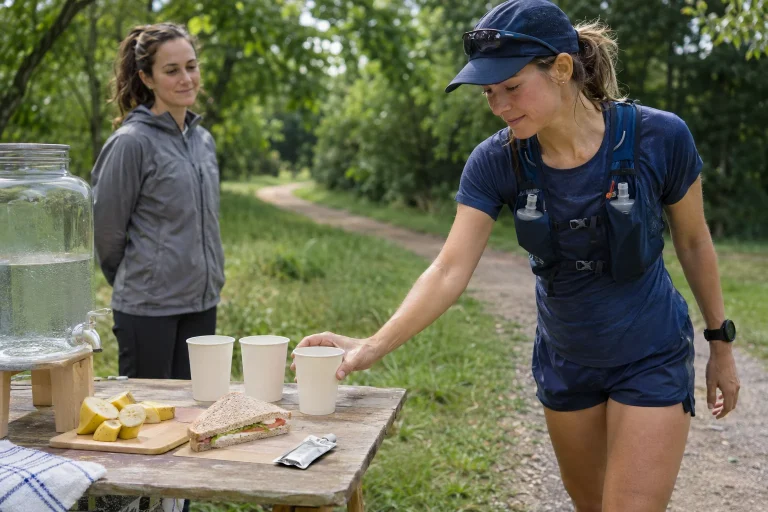
Before arriving, prepare your own cup or bottle in a safe place if the regulations and personal plan call for it. Do not begin learning a hidden pocket in the middle of a crowd. After filling, check the cap and fastening, then the position of new food or stored packaging. You can practise station movements during training under calm conditions too. Everything need not fit into a single rushed hand movement.
Before setting off, check that necessary items have actually been returned. Do you have the bottle, cup and collector? Is the zip closed? Is the unused product in an identifiable location? The short check is not intended as an unnecessary stop, but to prevent discovering an open cap or lost item on the next difficult section. Executing a personal plan includes orderly replacement of objects.
Three common mistakes and targeted corrections
If several products fall out together during retrieval, examine pocket fullness and packet arrangement. A simpler order or another compartment suitable for the object may help. If an opened packet sticks to clean supplies, separating rubbish storage is the next task. If replacing a bottle is difficult, check the appropriate pocket, fastening and manufacturer’s usage method. Match each specific obstacle with a specific change.
If the system feels too complex, reduce the rules to remember while retaining necessary kit. Two identifiable food groups and one separate rubbish space may be clearer than many small temporary bags. Personal needs and race requirements remain the basis. An unnecessary item and a necessary reserve are different things, so do not simplify by dropping safety requirements.
After the run, evaluate the pocket map too
Empty the vest, separate remaining products and rubbish, then clean the necessary parts according to the equipment’s care instructions. Follow the bottles’ and reservoirs’ own cleaning arrangements and dry them appropriately. Do not leave sticky residue in a pocket until the next outing. Clean, dry equipment provides a usable starting point for the next packing session.
Finally, note a single improvement on your pocket map. Which position worked, which required stopping and where was there potential for confusion? If the product, clothing or vest changes, check the affected movement again. Good fuelling organisation does not consist of one mandatory left–right rule for everyone. The relationship between identifiable places and repeatable movements in your model makes it usable alongside the personal supply plan and race conditions.
Sources and further reading
- Salomon: How to choose a running backpack
- Osprey: Duro/Dyna S17 Owner’s Manual
- Australian Institute of Sport: Sports gels
- Arc of Attrition by UTMB: Race regulations
How Futószív articles are prepared: our editorial guidelines.