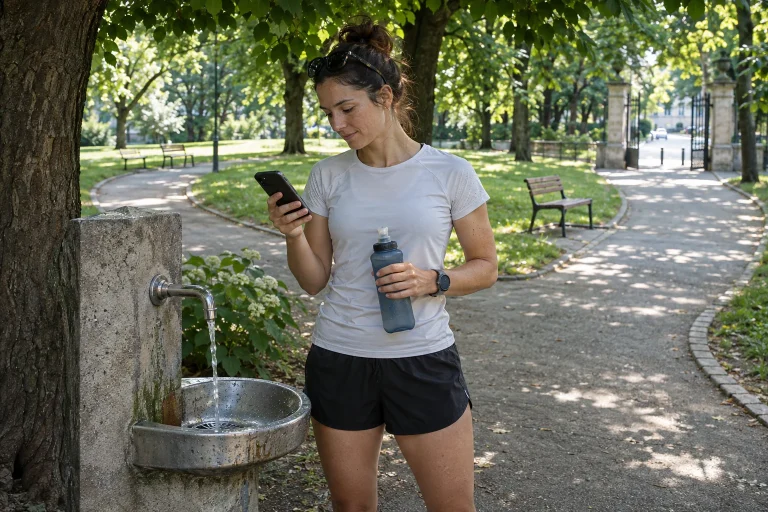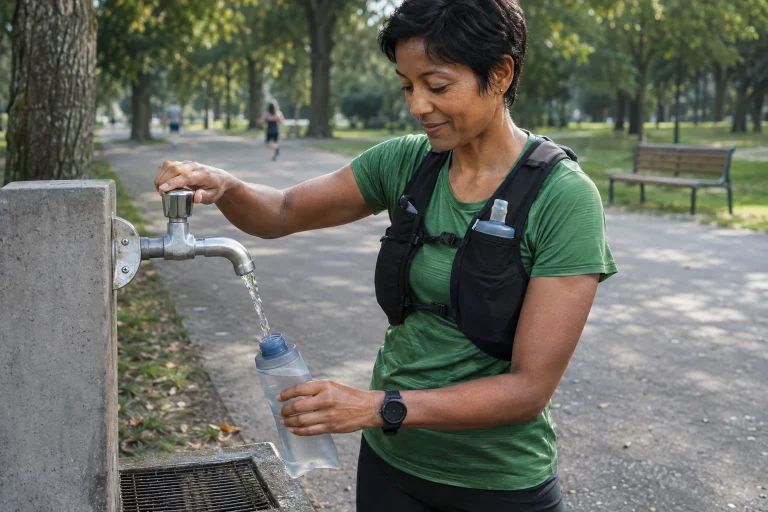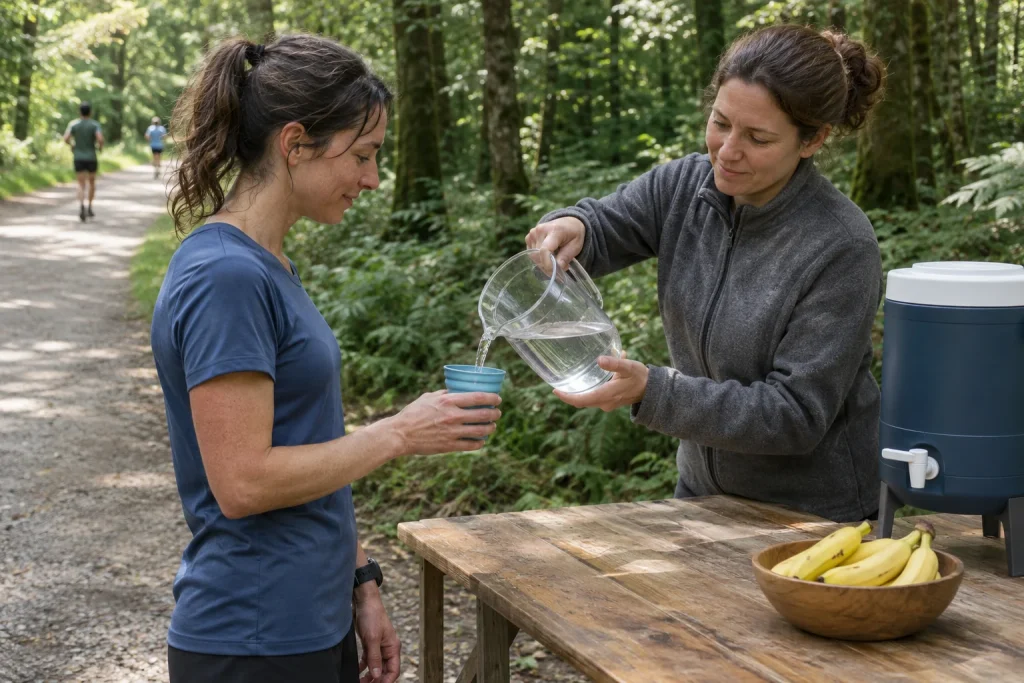
A race aid-station list is important basic information, but does not read your own needs for you. A station marker may not identify available food, whether you have an appropriate cup or how long reaching the next station will take. A useful race plan needs the map, detailed list, rules and personal fuelling approach together. The goal is to distinguish specific organiser information from what you merely assume.
This guide presents adult recreational runners with a way to read and organise information. It does not prescribe identical food, fluid or salt amounts for everyone. Establish personal needs within a plan suited to event demands and health, with a sports dietitian if necessary. Numerical examples here teach reading imaginary routes, rather than supplying real race data. For your start, always use current official information for that year, distance and race.
First check which list you are reading
The year, distance and race should be clear alongside the event name. One event may have several routes and different provision, so another distance’s list is not a substitute. A PDF or social post remaining from an earlier year may provide background but not describe the current route. Find the latest guide linked from the official site and note the document date or version too.
Save three facts for checking: the precise page or document title, the day you viewed it and the distance concerned. Later updates will then be easier to recognise. Keep the original source link beside an image saved to your phone. A table cropped without headings and footnotes is easily misunderstood, so retain its key and important additions as well.
If two official sources disagree, do not automatically choose the seemingly more favourable one. Check which updated later and ask through the organiser’s information channel if needed. Mark uncertainty in your plan. Contradictory station locations are not a detail an old race account will certainly resolve. Current organiser information takes priority, and checking changes is part of pre-departure preparation.
Cumulative kilometres and the section between two stations
The table often shows cumulative distance from the start. Calculate distance between stations by subtraction. If an imaginary list has the first station at kilometre eight, the second at fifteen and the finish at twenty-three, the sections are eight, seven and eight kilometres. Fifteen kilometres beside the second station therefore does not mean another fifteen from the previous one. Always check units and the heading.
Do not omit the final section before the finish. It is easy to record only distances between aid stations while the last station to finish also involves a route needing provision. The start to first station is likewise a separate section. Start and finish can have their own rows in your table. You then see the whole route rather than only middle stations.
The imaginary example does not determine supplies needed for a section. That also requires your individual plan, expected moving time and conditions. Reading distance information simply refines the foundation. If your watch shows a different covered distance before the station, do not immediately assume the organiser’s station has vanished. Your actual route and measurement differences may matter, so follow on-site signs and official guidance too.
| Imaginary location | Distance from start | From previous point |
|---|---|---|
| Start | 0 km | Starting point |
| First station | 8 km | 8 km |
| Second station | 15 km | 7 km |
| Finish | 23 km | 8 km |
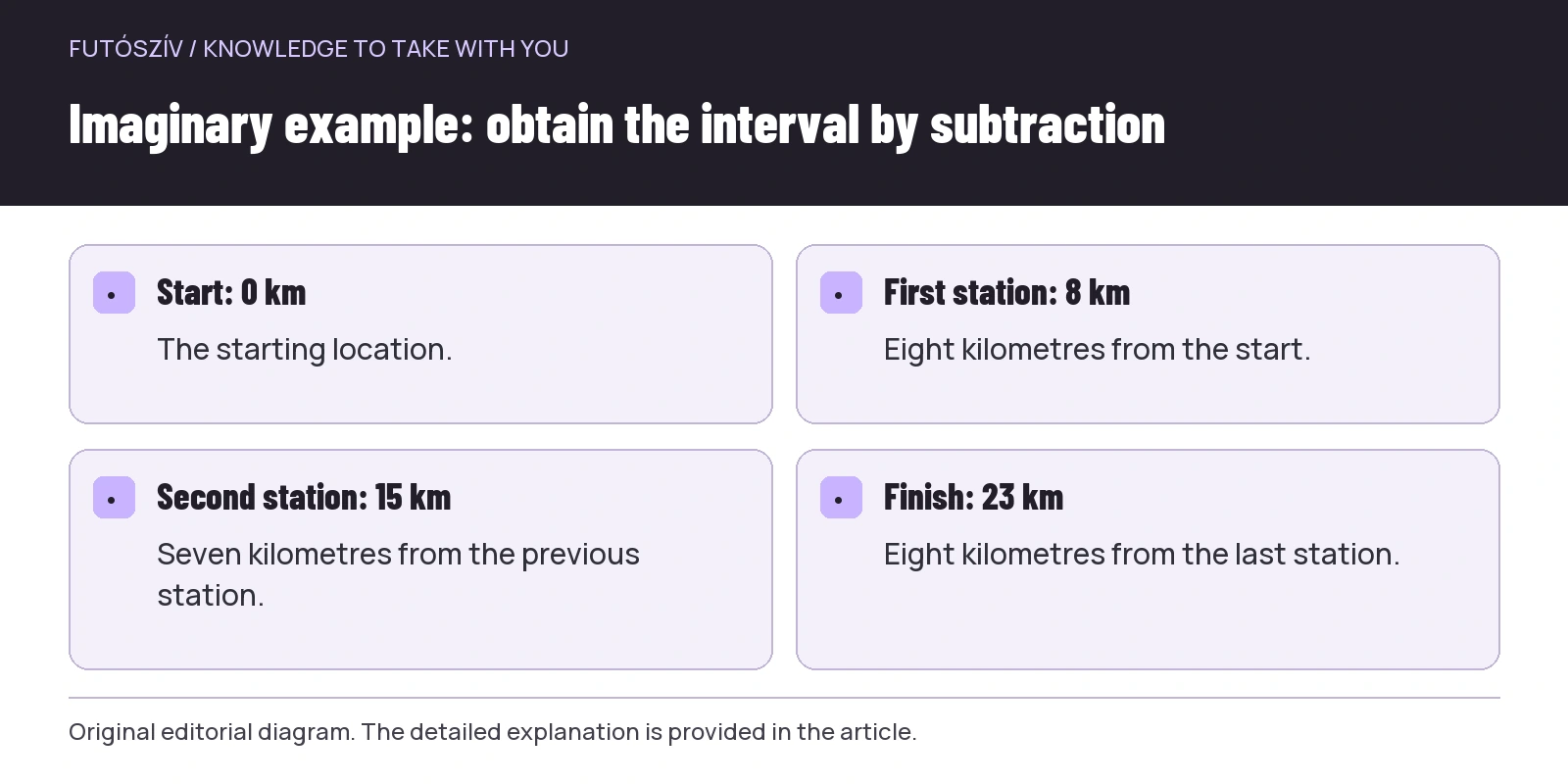 Enlarge diagram
Text version of the diagram
- Start: 0 km
- The starting location.
- First station: 8 km
- Eight kilometres from the start.
- Second station: 15 km
- Seven kilometres from the previous station.
- Finish: 23 km
- Eight kilometres from the last station.
Time between stations may matter more than apparent closeness on a map
Two equally long sections do not necessarily take the same time. Climbs, descents, technical terrain and your way of moving shape duration too. A small map distance on harder terrain may mean a longer provision window. Include elevation profile and terrain in your preliminary estimate. It remains an estimate: arrival to the exact minute cannot be guaranteed in every circumstance.
Time at the station is part of the day too. Refilling bottles, retrieving food, adjusting clothing and checking before departure involve separate actions. Practising your own system supports realistic planning. You do not need to rush at every station because of an imagined table time. Appropriate equipment and personal supplies for the next section matter more than sticking to a dreamed-of short stop.
Weather and course changes may alter earlier estimates. If the organiser announces a new route or station location, update your own table too. Mark an old phone image obsolete or replace it with the current version. Organised documents are practical help: you are less likely to rely on an old interval when seeking quick information in the last pre-race check.
Read station offerings item by item
A water point, aid station, hot-food point and personal-bag collection location may provide different services. The key explains icons. A bowl or cup image does not provide a precise ingredients list. If relying on a specific product or food, check official descriptions for which stations it concerns and any additional conditions. A general sponsor list is not necessarily a station-by-station menu.
Alongside the name sports drink, the exact version may matter for your diet and previous experience. The Australian Institute of Sport material on sports foods addresses differences in composition and use too. Do not automatically treat food or drink offered on the course as identical to another version tried at home. Connect questions about personal needs and allergens to the actual product.
A food name on a list does not reveal every ingredient or preparation detail. With a known allergy or prescribed diet, you need appropriate information. If that cannot be provided, have another rule-compliant option in your own plan. You can ask station volunteers on site, but clarify important personal requirements beforehand where possible. You need not resolve uncertainty during the race by noting everyone else eats the same thing.
Personal cup and bottle: derive equipment from the event information
Check whether disposable cups are supplied or you need your own. The official NN Ultrabalaton team-race information , for example, describes provision into personal cups or bottles in the currently published conditions, avoiding single-use plastic items. This is that event’s condition, rather than a universal race rule. The lesson is to check the equipment needed to consume offerings alongside the menu.
A personal cup and a bottle for carrying fluids may serve different roles. The event information may prescribe which is accepted and under which conditions. Do not assume any small container automatically meets every requirement. Try the device at home and during training according to its instructions: can you retrieve it, hold it steadily and put it away appropriately? Rule compliance and practical usability are separate checks.
If food requires a personal utensil or bowl, give it a place in the bag too. Keep clean and used utensils separate. Read waste-collection arrangements and prepare an appropriate place for your own wrappers. Equipment lists connect to fuelling through such details: food on the menu is of little use if the utensil required to eat it remains at home.
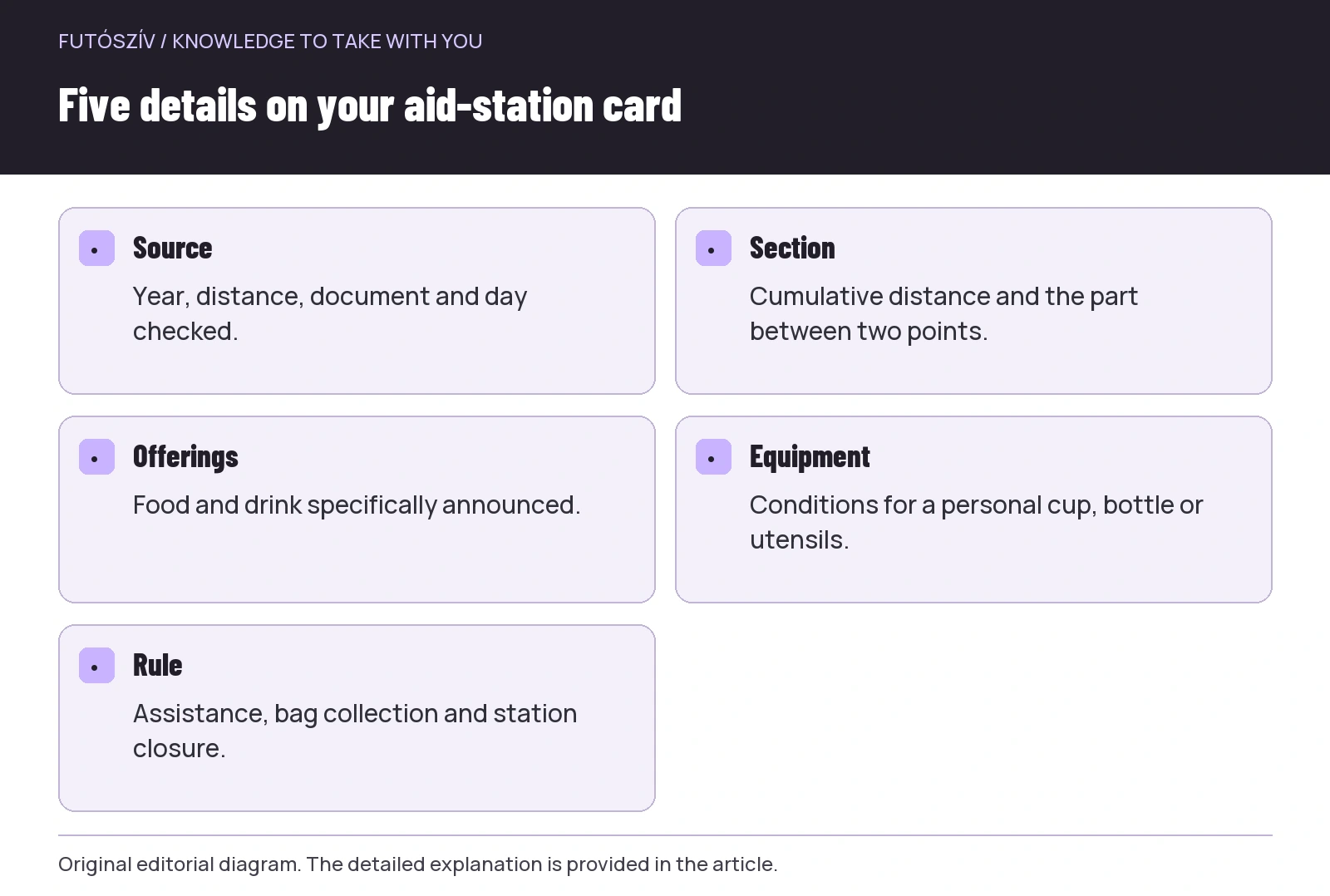 Enlarge diagram
Text version of the diagram
- Source
- Year, distance, document and day checked.
- Section
- Cumulative distance and the part between two points.
- Offerings
- Food and drink specifically announced.
- Equipment
- Conditions for a personal cup, bottle or utensils.
- Rule
- Assistance, bag collection and station closure.
Food available at a station and supplies you may take away are not always identical
The rules should clarify what can be consumed on site, what you may fill into bottles and which personal supplies are permitted. The official Arc of Attrition by UTMB regulations , for example, discuss on-site offerings, bottle filling and responsibility for provision between stations separately. These are that particular event’s rules. At another event, read its own conditions equally carefully.
Plan the location of personal supporters, companions and drop bags according to rules too. The same help is not allowed at every station, and a place reachable by car on a map is not necessarily an official support zone. If a companion helps, use the same current document and identify the permitted handover location clearly. Good intentions do not replace following participation conditions.
Read the meaning of a time limit or station cutoff precisely as well. Does it apply to arrival or departure, and which start wave is it linked to? Do not infer this from a system learned elsewhere. Clarify unclear information beforehand. Your moving and supply plan needs to fit these actual boundaries. Decisions to stay at a station or proceed can involve healthcare and organisational considerations too.
Make your own source-based station card
Include station name, cumulative distance, previous and next section, known offerings and necessary equipment. Beside uncertain information, write a short description rather than just a question mark: for example, the exact product version has not been announced. This tells you what to recheck later. “Everything will be available” appears reassuring but provides no useful information for your own plan.
Add your action: which item to take out, which bottle to fill under your individual plan and what to check before leaving. Take food and fluid quantities from your professional plan rather than inventing them from station intervals that look uniform in a table. Keep the card brief enough to understand while tired. Detailed sources and rules can remain saved, while the working extract supports actual actions.
Make the final check about changes
In the days before departure, check for organiser updates on route, supplies or compulsory equipment. Apply the same changes to your station card and the version held by your supporter. Keep the date of checked information. Follow on-site information too, as circumstances can change. A saved earlier plan is a reference, rather than a way to override fresh organiser instructions.
Reading an aid-station list well does not remove every uncertainty, but clearly shows what you know and what remains to clarify. Your personal supply plan joins distances, expected sections, offerings and equipment. This can produce a system you can practise during training and whose sources you know. Stations then become concrete parts of your own rule-compliant preparation rather than mere icons on a map.
Sources and further reading
- NN Ultrabalaton: Team race – official race information
- Arc of Attrition by UTMB: Race regulations
- Australian Institute of Sport: Sports gels
How Futószív articles are prepared: our editorial guidelines.