At the finish of a crowded evening run, a group can easily split in several directions. You arrive at different times, leave by different exits, someone goes to baggage while another still wants photographs. Darkness, music and similar glowing or costumed outfits can make “we will spot each other” insufficient. Discuss meeting again as a separate programme part before the start.
This needs no complicated tracking system, but a precise place, workable access and a clear agreement. A phone can help, but not everything should depend on reaching everyone immediately at the finish. The following method is our own organisational aid for an adult group. For accompanying and collecting children, the event’s separate procedure and agreed adult supervision add further conditions.
Several on-site steps may follow the finish line
Finishing the run and reaching companions are not necessarily the same moment. There may be a finish corridor, refreshment or handover area, exit and baggage collection. On the event map, check the participants’ path and where people from another race or spectators can meet them. Waiting under the finish arch is not automatically permitted.
Large events may provide a separate meeting area. The official Boston Athletic Association volunteer description names a dedicated family meeting area and a role helping people find their way at its own race. This is an overseas organiser’s example, rather than a location transferable to a Hungarian evening event. The practical lesson is separating the runner’s finishing process from the shared meeting.
Use your own event’s current site map as the basis. A previous year’s exit, old baggage-tent location or a gate identified by an acquaintance can change. Even if start and finish occupy the same large area, internal pedestrian connections may differ from the route used on arrival. Understand the actual way out.
Choose a point accessible to everyone
A good meeting point can be approached legitimately by runner and spectator alike and does not occupy others’ path. Give it a clear name or identifier rather than a general object. “By the bright gate” or “at the big tent” may be insufficient if several similar elements occupy the square. A precise side or entrance can accompany the name.
The place should work beyond the map. Check which exit and route reach it, with no barrier, fence or participant-only zone in between. If meeting would require crossing the course wherever you choose, find another solution. Your group’s interests do not override on-site crossing arrangements.
Recognisability in the evening matters too. A tree or architectural detail clear in a daytime image can look different among lights and crowds. Choose a point findable at the event with actual information and on-site signs. A continually changing group of people is not a suitable fixed landmark.
Think through the route there before the start
Everyone should be able to explain where to go after their own finish to reach the agreed point. Someone waiting as a spectator may have a separate route and needs to know it too. Every detail need not be memorised, but understand the main connection. A saved map or short text can support necessary orientation.
If possible and permitted by local arrangements, look at the point together before the event. This does not mean entering closed zones or obstructing setup. Knowing an actually accessible location is much clearer than a randomly forwarded map crop. If staff later request another approach, adapt to it.
Do not omit the viewpoint used for map directions. Left relative to the runner’s movement differs from left for a spectator facing them. A precise entrance or official sign is easier to repeat. The aim is not professional navigation wording, but everyone meaning the same specific place.
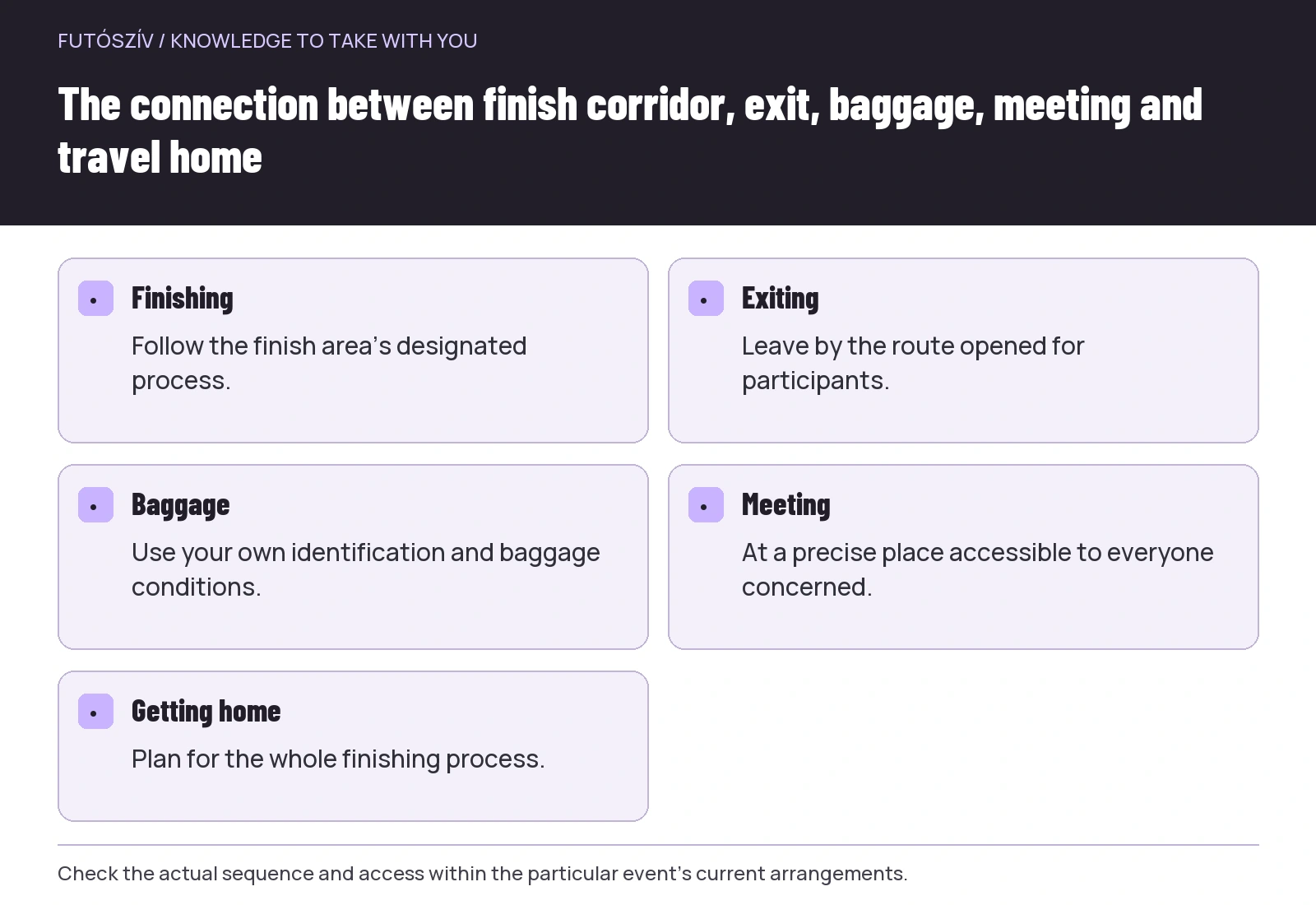 Enlarge diagram
Text version of the diagram
- Finishing
- Follow the finish area’s designated process.
- Exiting
- Leave by the route opened for participants.
- Baggage
- Use your own identification and baggage conditions.
- Meeting
- At a precise place accessible to everyone concerned.
- Getting home
- Plan for the whole finishing process.
Do not rely on one estimated finishing minute
Companions may arrive at different times and cross the start at different times too. Exiting and baggage administration can add to an estimated finish time. If meeting works only in one very narrow instant, normal variation becomes needless searching. Think through the entire finishing process instead.
Anyone reaching the point first should know what waiting they agreed to. If they need the toilet or another necessary location meanwhile, they should inform affected adults according to the prior arrangement. A new location does not become a shared agreement merely because one person sent it in a message. Others need to understand and confirm the change too.
Do not invent a general compulsory waiting period for every situation. A later normal finish, lack of technical connection and a genuine need for help are different. If a specific problem arises, use on-site organiser help or emergency assistance as necessary. A group agreement is no reason to delay a necessary report.
Keep phone messages brief and specific
A precise message may offer more than “where are you?”: I have reached the agreed point, I am beside the designated sign and will stay here as planned. If change is needed, include why, the new location and the request for confirmation. You do not need a long report in the crowd.
Give the group a known communication method. Do not discover after the finish that one person is searching in another chat or shared information exists only on the phone of someone still running. Share contact details and the brief meeting description beforehand with those actually concerned. Do not put more personal information on a public platform than necessary.
Do not regard continuous location sharing as a meeting solution working in every circumstance either. Device settings, battery condition and local connection all matter. A map marker alone may not tell you at which gate or on which side of a barrier your companion stands. Precise, agreed on-site arrangements remain useful alongside technology.
Baggage collection is a task of its own
Stored belongings may involve identification, a claim or race number, opening hours and bag-size conditions. Companions should not assume anyone can collect anyone else’s bag. The specific event information should clarify who follows which procedure and how that connects with meeting.
The Sportoló Nemzet 2026 LED’s Run page , for example, described its own baggage procedure and opening hours for the evening programme. By 18 November 2026, these were archived conditions for a completed event, rather than rules for the next light run. The example draws attention to bag access as an actual part of finishing that cannot automatically be delegated to someone else.
When distributing keys, tickets or other essentials, consider separate departures too. Someone going home earlier should not find their only means of entry in the baggage of a companion still running. Treat meeting plans together with the movement of belongings. A good group outing does not make everyone unnecessarily dependent on one person’s timetable.
Your own four-line meeting card
The following sheet is a simple shared reminder. It does not replace the event map or staff instructions, but helps everyone understand the agreed point identically. Fill actual names and connections from checked information for the current event.
| Line | What should it contain? |
|---|---|
| Point | An official or clear place name with a precise entrance or sign |
| Approach | Participant exit and spectator route separately if different |
| Arrangement | Who comes here, and what does the first arrival do? |
| Change | What discussion is needed for a new place, and where do you seek help? |
Everyone concerned should know the card in a format accessible to them. Someone not using the group messenger still needs the agreement. A short text or saved image should contain only information you can manage appropriately. Detailed personal information is unnecessary to understand a meeting point.
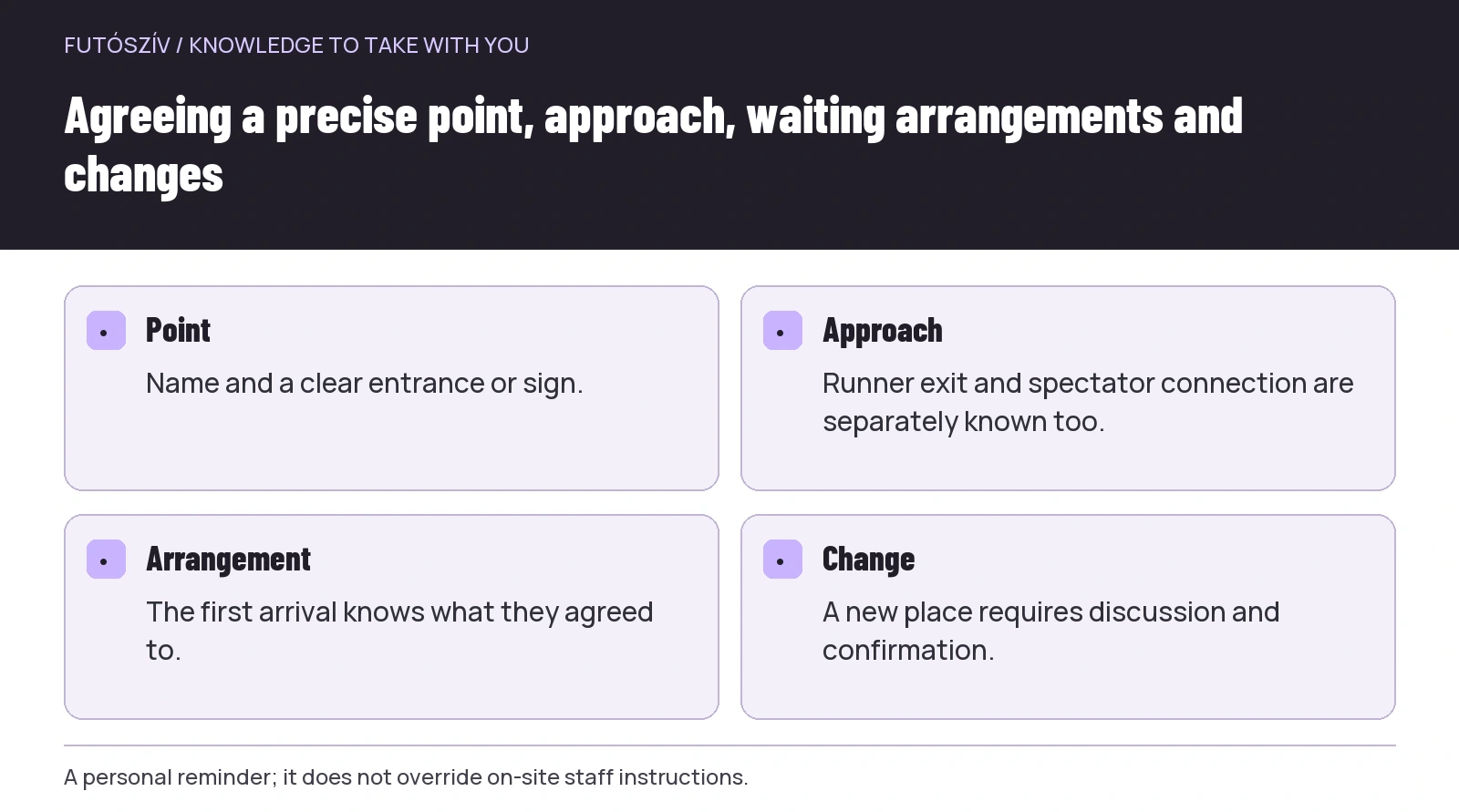 Enlarge diagram
Text version of the diagram
- Point
- Name and a clear entrance or sign.
- Approach
- Runner exit and spectator connection are separately known too.
- Arrangement
- The first arrival knows what they agreed to.
- Change
- A new place requires discussion and confirmation.
An imagined example with three different finishes
Three friends attend the same evening event but enter two separate races. One finishes earlier and the other two reach the finish at different times. The example is fictional rather than an actual event timetable. They agree to meet at a checked point accessible to everyone after the runner exit.
The friend finishing earlier deals with their own baggage according to event rules before going to the shared point. They do not start searching at the other race’s finish line, because companions do not expect that. Later arrivals know that “I am here” in a message means the specific point originally agreed. Shared departure follows only after meeting again.
Now suppose a move is needed because staff close the designated area. The friends follow current on-site instructions and agree a new point through their established contact procedure. They do not remain at the old place citing their own plan. The meeting card helps communication but does not override actual event arrangements.
Costumes and lights are only additional identifiers
You can discuss what you will wear, but a themed crowd may contain many similar outfits. A red hat, white shirt or glowing wristband may be insufficient for recognition. Put clothing descriptions beside a precise place, rather than instead of it. Make the shared point understandable before searching for a person from a distance.
Do not undertake conspicuous signals that disturb others to find one another. You need not climb equipment, enter the course or block pedestrians. Do not point light into others’ eyes for recognition either. Event signs and staff information can provide a more reliable basis than an improvised stunt in a crowd.
Loud music and announcements may mean you cannot hear one another. Meeting should therefore not rely solely on shouting. A brief description known beforehand works in more situations and provides a starting point for necessary personal discussion. You do not need to keep calling everyone to have a shared plan.
Plan getting home before the meeting
At the end of an evening programme, different transport connections or stops may be usable from those on arrival. Event closures, operating arrangements and the provider’s current timetable matter together. With a fixed connection, include the whole post-finish process, meeting and walk to the stop.
Anyone leaving separately should say so beforehand and have access to necessary belongings. Make the agreement for shared-car travel clear too: who goes together, from where and how changes are discussed? Do not build the entire group around one optimistic finish time. Allow normal variation in the journey home as well.
Anything afterwards is a separate decision. If some want more conversation or photographs, others leaving should not feel awkwardly excluded from the community. An organised meeting makes clear when the shared commitment ends. Separate continuations can then remain transparent too.
Review the agreement afterwards, rather than one another’s searching ability
If meeting was difficult, identify what was uncertain: the place name, exit, time window or confirmation of changes? A specific gap can lead to improvement. Saying someone “did not pay attention again” rarely gives a more useful next plan. An on-site change may not have been preventable in advance either.
At the finish of a crowded evening run, meeting again works through a few precisely agreed connections. Runner exit, shared point, baggage and the journey home together make up finishing. With an understandable arrangement, less searching and more genuine shared time remain after the race, even when you do not cross the line together.
How Futószív articles are prepared: our editorial guidelines.