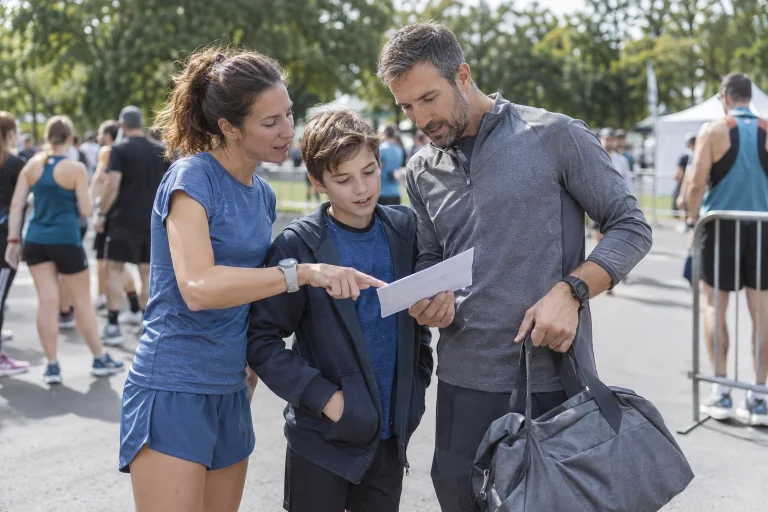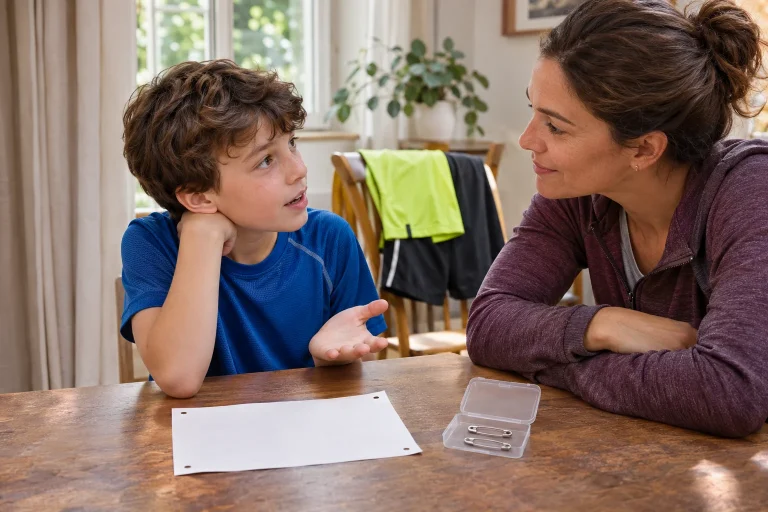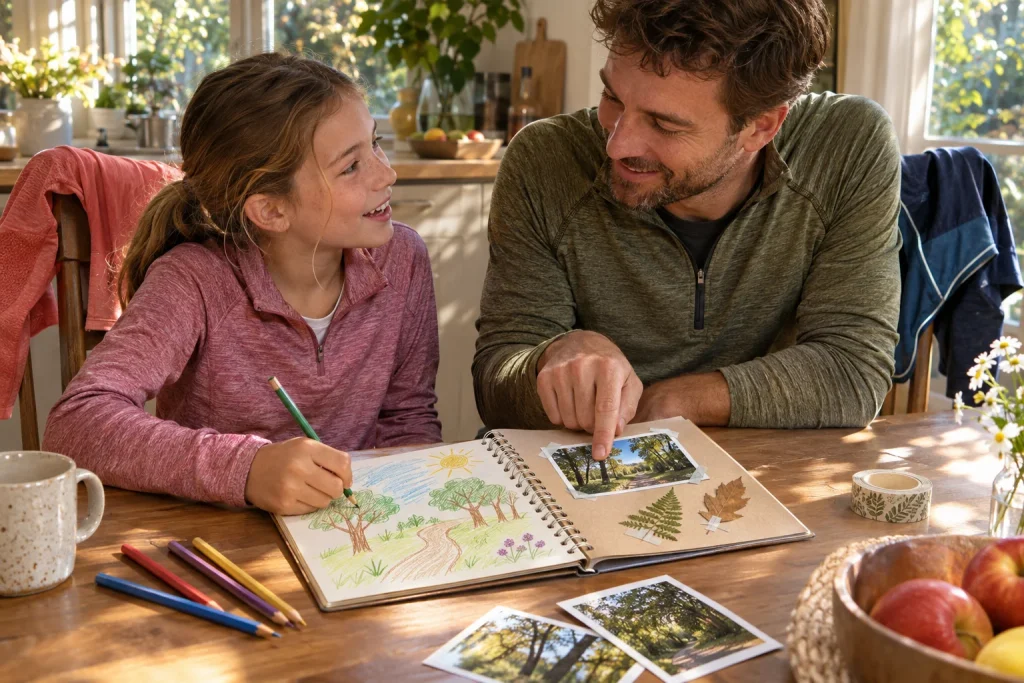
Memories of a run together can easily shrink to a few numbers: this many kilometres, this many minutes, this finishing place. Those can be part of the story, but they do not have to determine everything the family preserves. An interesting remark, a route chosen together or a drawing can bring the day back just as well, even if nobody timed it.
Preserving memories does not require another app or a carefully curated family sports archive. A format that participants enjoy contributing to, and that does not turn shared outings into a competition, is enough. The following ideas are suggestions for your own family creations. They are neither performance-assessment methods nor compulsory tasks at the end of an activity.
First decide who the memory is for
A drawing to look at at home, a short account sent to a grandparent and a public social-media post are different things. If you merge them, a child or adult family member may find themselves appearing in something they did not choose. It is therefore worth briefly discussing the format and its later use before making it.
Everyone might enjoy making a shared page but not want their name on it. Someone else may contribute only one drawing or prefer not to keep their own remark. A family memory is not shared because it compulsorily contains every detail. Participants can connect with it in different ways, and there can be room to decline.
Do not let shareability direct the day. If everyone is arranged around a future post from the start, moving together may recede into the background. Let the memory be an optional continuation of the experience, rather than a product the family has to deliver by the end of the day. It is equally valid for an outing to leave nothing tangible behind.
The day can have a title without a finishing time
Try naming the outing with a single word or short title. It might relate to a shape you noticed, a story you invented together or an unexpectedly interesting detail. It does not have to be a literary achievement. A phrase of your own can later recall much more than a sporting slogan used in exactly the same way by another family.
Children and adults can give the same day different titles. You do not have to choose the “correct” version. There could be one shared page with two or three titles, or a separate little memory entry for everyone. Multiple viewpoints show precisely how different details from the same outing can remain important.
If someone only wants to record their running time, there can be space for that in their own section too. The aim is to avoid compulsory comparisons, rather than ban numbers. An adult’s personal training diary and a shared family memory page can serve different purposes. You do not have to channel every participant into the same data format.
Your own three-section memory page
Three sections on plain paper may be enough: something I noticed; something we did together; and something I would choose again. Everyone can contribute a word, drawing or short sentence. These sections are suggestions for your own layout, not a developmental test or a compulsory sports-journal system.
There is no need to ask for answers of equal length. One child might draw a colour or shape; someone else might tell a longer story, from which an adult writes down only an approved short extract. Anyone who does not want to answer now can add something later or leave their section blank. Making the page should not become another performance test within the outing.
The Play Their Way introduction to the Sport in Mind Journey Journal presents journals that support young people in expressing their own experiences and ideas. Here we use only that general possibility as a starting point. The three-section family page is our own idea, rather than a copy or adaptation of the downloadable publication.
| Your section | Possible content | What it need not become |
|---|---|---|
| I noticed | A shape, sound, colour or interesting detail of a place | A quiz with correct answers |
| We did it together | A shared story, activity or break | Grading one another’s performance |
| I would choose it again | A short section or a new idea | A compulsory next event entry |
Even if the memory page uses the same three questions on another occasion, you do not have to run a competitive series. You need not make up missing outings or prepare a page for every week. The system helps preserve memories and can work even if you use it only occasionally.
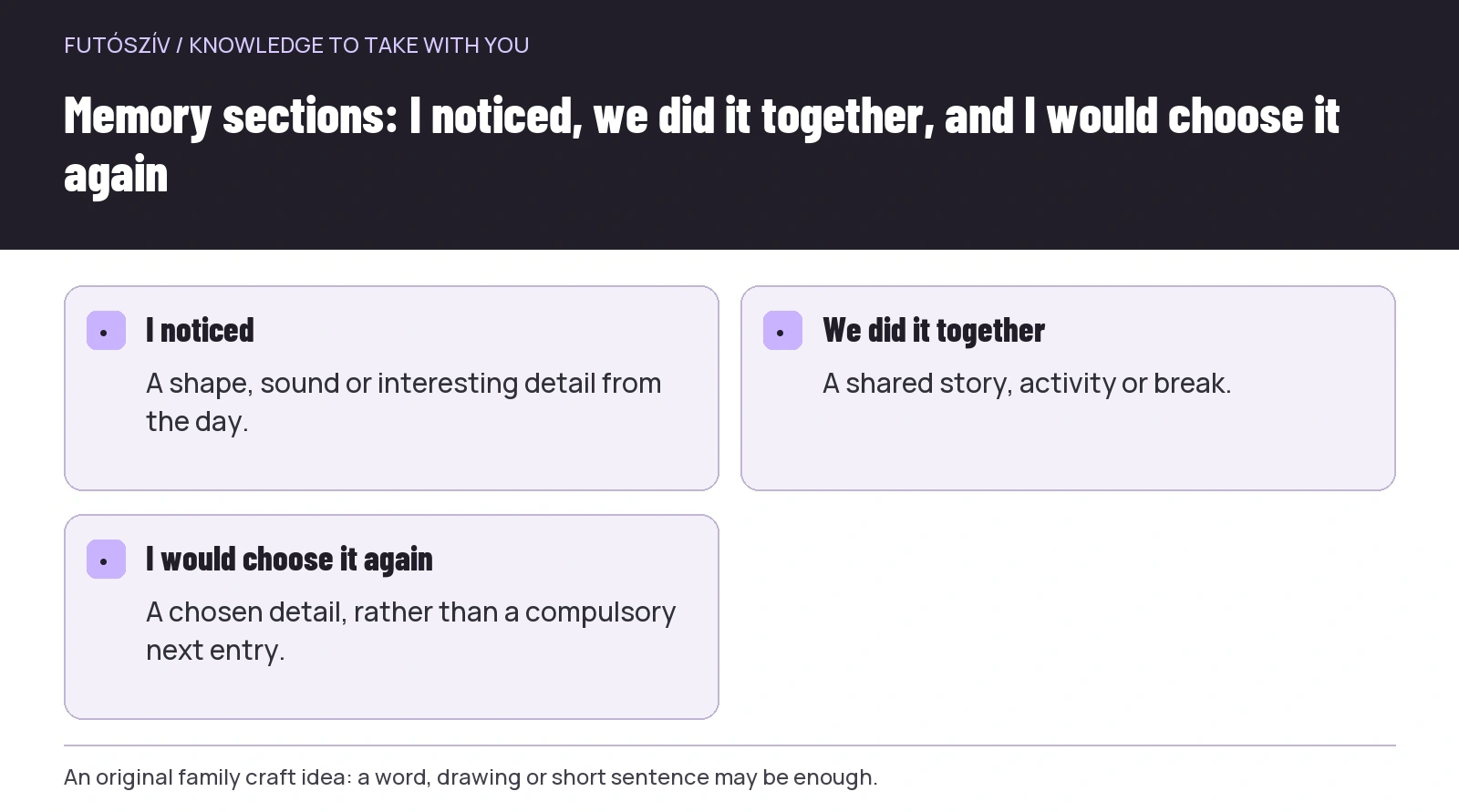 Enlarge diagram
Text version of the diagram
- I noticed
- A shape, sound or interesting detail from the day.
- We did it together
- A shared story, activity or break.
- I would choose it again
- A chosen detail, rather than a compulsory next entry.
Draw a route without a scale
A drawing can preserve the memory of a place explored together. The page can include the starting point, an interesting stop and the finish, but it need not be an accurate map. It can have an imaginary symbol or a name given by a child. The aim is to recall the experience, rather than test navigation skills.
It is important not to use the memory map later as actual directions. It does not assess traffic, access or current closures. If you return, an adult checks the real route and rules again. The drawing belongs to the story, rather than to a verified navigation file.
If the drawing may also be shared, consider how much it reveals about the family’s usual starting point, home surroundings or regular schedule. A public memory page need not carry every personal detail. Naming the location generally or leaving out the departure from home can also be a deliberate editorial choice.
Visual memories do not require a photograph
A race number, your own drawing or a small card made for the outing can all become keepsakes. Keeping them is optional too, and you do not have to save every object for the day to remain important. A photographed detail or a short text can sometimes replace items accumulating in a large box, if that is what the family wants.
Sort through things brought back from the event: which genuinely have a story attached, and which merely ended up in the bag by chance? Do not take plants or other objects from nature for a keepsake, or leave a mark at the site to show you were there. The shared story can be preserved without changing the area.
If there is a medal, do not let it turn the family shelf into a ranking. It can have a place belonging to the person who enjoys it, without diminishing the memories of a sibling who did not enter. Different forms of participation do not need the same object manufactured for them. A family walk, a race day spent spectating and an event run with a number can offer different stories.
Treat taking a photograph and using it as separate matters
Someone happy to stand in a family photograph now may not want it to appear publicly. Taking the picture, showing it to a small circle and publishing it on a new platform are different situations. Do not regard them as covered by one fleeting moment of agreement. A child’s own wishes can be taken seriously in family practice as well.
Section 2:48 of the Hungarian Civil Code on the right to one’s image and voice recordings generally requires the person’s consent to making and using a recording, subject to specified exceptions. The legal position of a particular family event photograph also depends on the circumstances. This article is neither a child-photography consent form nor individual legal advice.
As a practical step before sharing, look through who is identifiable, what appears in the background and what text will accompany the picture. Another family’s child, information showing a full name or a precise regular route deserve particular attention. An event taking place in public does not, by itself, provide general permission to depict every participant for every purpose.
Make the agreement clear to the family circle too
If you send a picture to relatives, explain what it is intended for. A memory sent privately is not an automatic invitation to repost publicly. Your family agreement should clarify whether you ask for prior discussion before forwarding or displaying it elsewhere. Others may not share your understanding of sharing if you have not talked about it.
The NMHH information on sharenting draws attention to the later digital effects of content shared about a child. The useful practical question for family memory-keeping is whether the same content needs to be shown to a wider audience. The page is not permission for your particular photograph and does not replace arranging the applicable conditions.
If someone later asks for a picture to be removed from the family platform, have a known contact who will handle the copy under their own control. Do not promise complete disappearance from the internet if others have already forwarded the content. A realistic, manageable family process is better than a reassuring statement whose fulfilment nobody can verify.
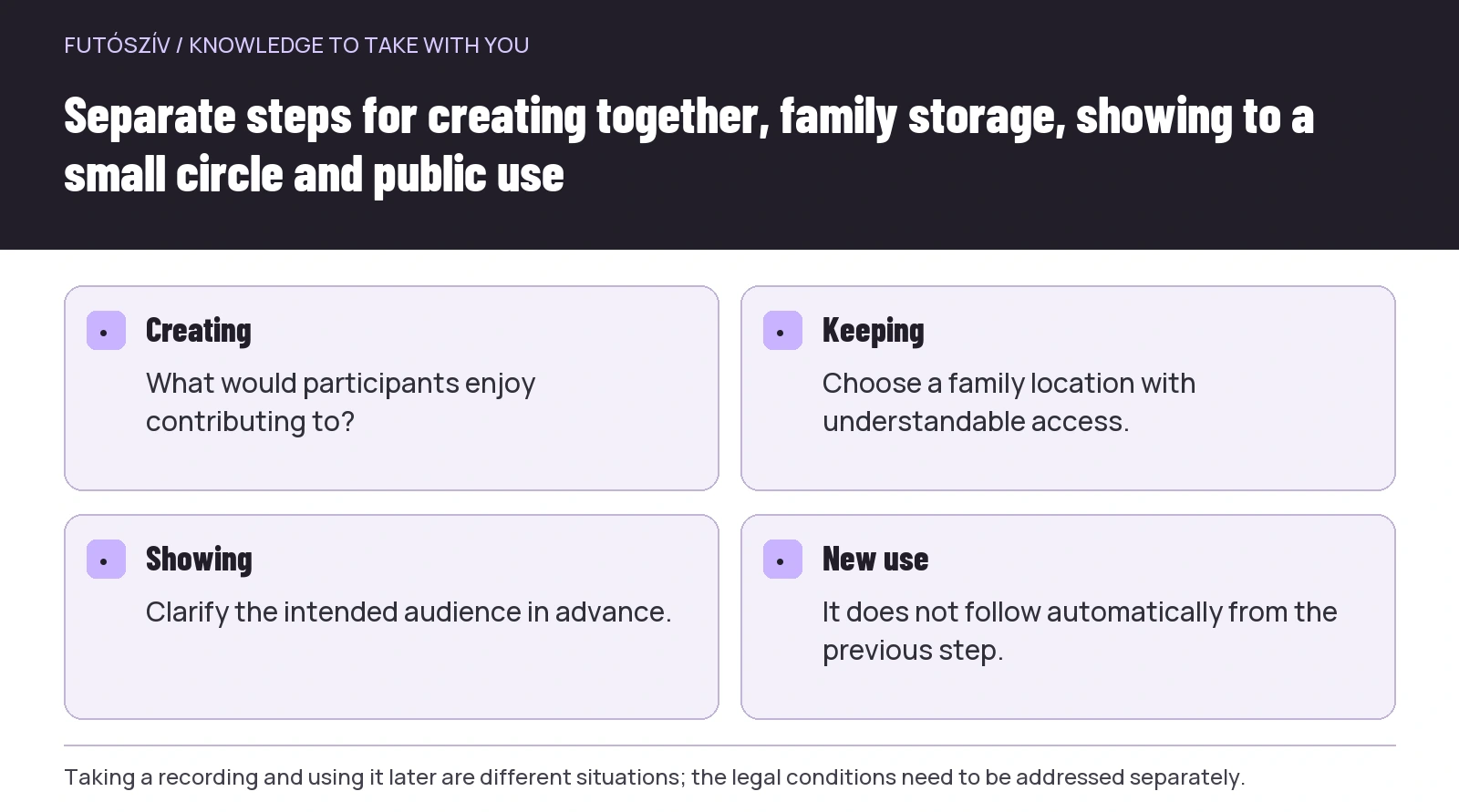 Enlarge diagram
Text version of the diagram
- Creating
- What would participants enjoy contributing to?
- Keeping
- Choose a family location with understandable access.
- Showing
- Clarify the intended audience in advance.
- New use
- It does not follow automatically from the previous step.
A finishing time can be a fact without becoming a family ranking
Anyone who wants to record their own result can decide to do so in their personal memory. On the shared page, however, you need not rank siblings or different days by speed in a table. When routes, conditions and purposes of participation differ, the numbers alone do not describe the same situation anyway.
You can answer a child asking about a result honestly without immediately turning it into an improvement plan. If they are interested, you can look at the event’s official result and also discuss what happened during other parts of the day. A family memory page is not there to decide whether a result was good enough. The value of the shared outing does not depend on the precision of its data recording.
The official parkrun milestone information recognises several forms of participation within its own system, rather than fast running alone. This is an example from an overseas organiser of how community recognition can be built around a different principle. A family need not adopt either its numerical thresholds or its badge system, however, and the link does not verify a location in Hungary.
An imagined family memory of the same day
Imagine a family outing in a park where one child chose a name for the shared story, another drew an interesting detail of a gate, and an adult noted which short loop was useful. Nobody timed anything. The memory fits onto one page and does not state who contributed most.
In another version, one family member entered an event with a race number. They keep their own result in a personal diary, while the shared page records where everyone met afterwards and the welcome card made by those waiting. The runner’s performance is preserved while spectators’ and children’s experiences have a place of their own.
The examples do not suggest that you must always create something. If everyone would rather go home at the end, preserving the memory can wait until later or not happen at all. An experience does not become invalid because there is no attractive page ready immediately. Memory-keeping is a tool that should serve the family.
Choose storage that is easy to maintain
A small folder can hold papers; digital items can have a clearly named, appropriately managed family location. You do not need several copies of everything. Be clear about who has access, and make sure the private collection does not accidentally end up on a public platform. You need to understand the settings and terms of the service you use separately.
A date and a short place name can help you find the memory later, but do not add unnecessary personal data. Full dates of birth, contact details or the exact home address you left from generally do not help explain the shared story. With a photograph of a race number, check what is legible before sending it to others as well.
From time to time, you can review the collection with the children and decide what should stay. You do not have to keep everything forever simply because you once called it a keepsake. If someone’s relationship to a picture or story changes, it can be discussed again. A family archive should not be an irreversible public appearance about which a participant can never have another say.
Do not turn looking back into the next obligation
When bringing out an old page, you can talk about what it brings to mind. You need not immediately ask when you will repeat the outing or run faster. A child might choose a different activity now. Past enjoyment and a different present interest can both be true.
If you plan another outing, use a specific detail from the memory: the shared starting point worked well, the wait was too long, or the story was interesting. Changing conditions at the location need checking again. The saved page is experience, rather than a ready-made itinerary or a fixed family tradition.
The memory of running together remains the participants’ own when they can help decide what goes into it and who sees it. A word, drawing, chosen picture or story told at home may be enough. Alongside performance data, this leaves room for what brought you there together: your own perspectives and the day you shared.
How Futószív articles are prepared: our editorial guidelines.