Outer knee pain location is not yet a diagnosis
Runners often immediately label pain outside the knee an IT-band problem. That connection is possible, but location alone does not determine the cause. Individual assessment is particularly important after a fall or twist, substantial swelling, locking or difficulty bearing weight. A familiar old label does not explain every new symptom.
The information from the American association of rehabilitation physicians discusses iliotibial band syndrome among outer-knee symptoms and explains the roles of history, examination and further assessment where necessary. This is not an exclusion test to perform independently at home. The aim is not proving band tightness on the sofa but giving an understandable picture of symptoms.
This article organises common IT-band claims and useful decision questions. It does not provide a personal treatment protocol. With severe pain, significant injury, a hot red knee with fever or inability to bear weight , prompt and, where necessary, urgent care is needed; do not begin by trying foam rolling.
What is the IT band?
The iliotibial band is a strong connective-tissue system outside the thigh, connected with structures around the hip and knee. “Band” can suggest a freely moving strap that can be pulled, but the anatomy is more complex. Treat simple mechanical analogies cautiously for that reason.
An anatomical study examined 15 specimens, imaging of six asymptomatic volunteers and information from two symptomatic athletes. Based on attachments to the femur, it questioned the simple notion of the IT band freely rolling forwards and backwards over the outer bony prominence. The study by Fairclough and colleagues proposed a possible role for compression of surrounding tissues.
This research does not describe the cause of every runner’s pain or prove one treatment. It illustrates how “stretch the rubbing strap” may be too simple an explanation. A comprehensible analogy does not become an individual diagnosis or certain therapeutic justification.
Feeling easier after stretching does not prove the band lengthened
A movement or treatment may temporarily make your leg feel more comfortable. That is real experience but does not itself identify precisely which tissue changed and how. Well-being, movement range and mechanical tissue properties are different measures. We need not deny improvement to describe the explanation more precisely.
A 2021 randomised study found no change in measured IT-band stiffness after a single foam-rolling or stretching session. Important limitations are that participants were healthy with no history of IT-band syndrome and immediate effects were examined. The study of mechanical properties therefore does not prove every treatment useless for every symptomatic person.
The practical lesson is not to try to “break up” or forcibly lengthen the band through painful pressure. If an additional element belongs to your plan, know its goal and how it will be assessed. Pain intensity on a roller does not measure rehabilitation effectiveness.
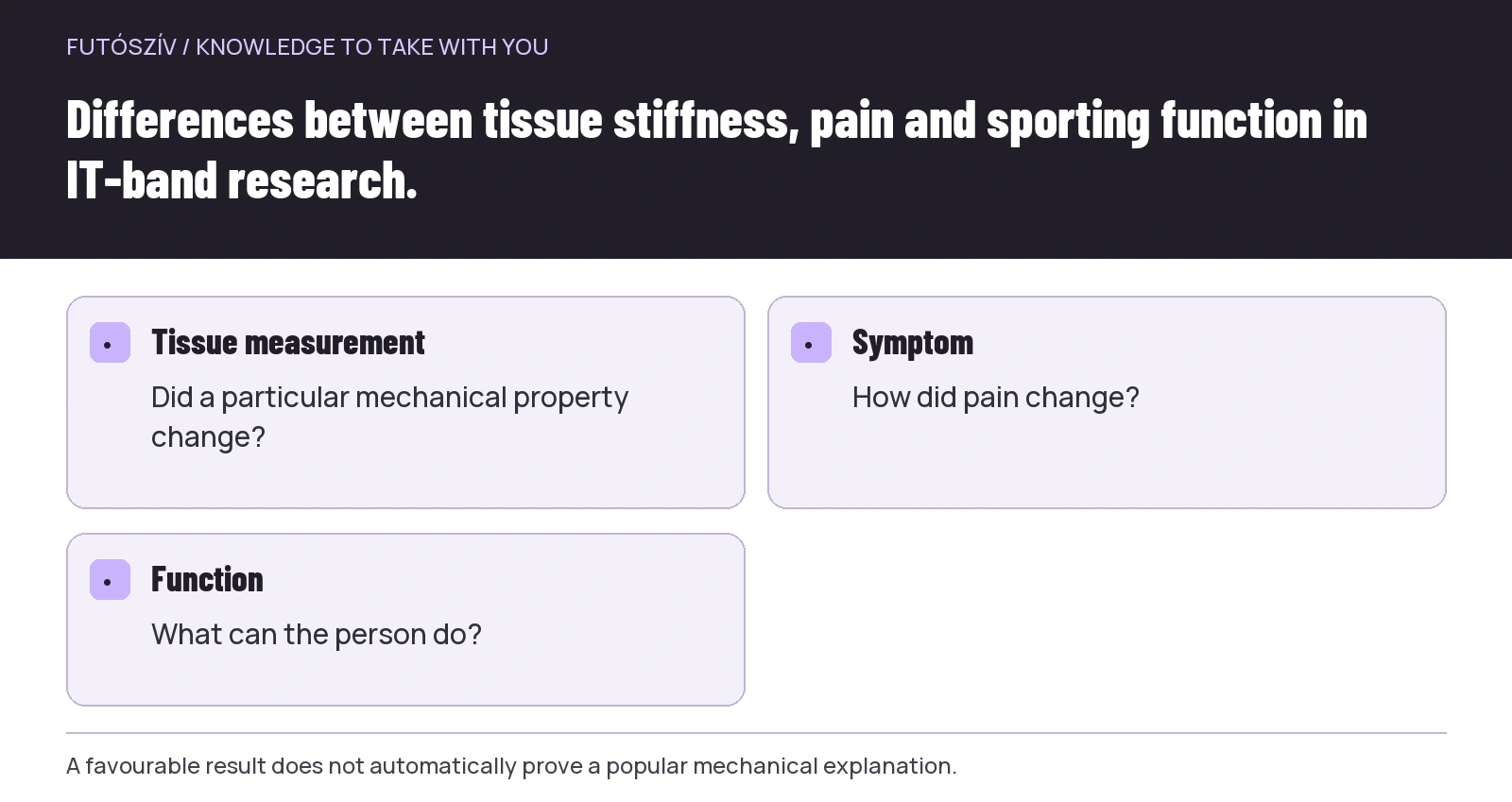 Enlarge diagram
Text version of the diagram
- Tissue measurement
- Did a particular mechanical property change?
- Symptom
- How did pain change?
- Function
- What can the person do?
Do not turn treatment research into one compulsory method
A small pilot randomised study compared several exercise programmes in female runners with IT-band syndrome. The 2020 pilot study is interesting because it examined rehabilitation as an organised active programme. Its small size and defined participant group cannot establish one exercise as the winner for every runner, however.
A randomised study published in October 2026 compared strengthening with a combination also including foam rolling and stretching in twenty athletes over eight weeks. The recent study reported better results for the combination on certain outcomes, but its authors also consider larger studies and other groups necessary. Such a small study is not a promise of certain recovery.
Do not confuse the two research questions either. Tissue stiffness after one treatment and pain or function during a multiweek programme are different outcomes. A favourable clinical change does not automatically prove a popular mechanical explanation. Follow the goal and personal response in your treatment plan.
Which training history supports assessment?
List when symptoms began and how much running precedes them. Did the course change, are there more descents, more frequent sessions or a longer programme for a new goal? No preceding detail proves the cause alone. Together, details help explain the loading situation.
Recurrence matters: does it appear at the same spot after the same time, or with other activity now too? How does stopping change it? What is walking like the next day? Record changed shoes or routes too without ending the story there. All symptom-associated changes are more informative than one suspicious product.
The Kent Community Health NHS information also discusses understanding the condition and appropriate activity management. You need not select anatomical terminology before an individual examination. “Outside, at this point, after this amount of time, with this everyday limitation” is already a good starting point.
Why is one hip test or video insufficient?
Examining hip and lower-limb movement may form part of assessment, but one task cannot establish the cause of pain with certainty. A difference seen during single-leg standing or squatting may be an important observation without an independent final explanation. Interpret the task, symptoms and sporting situation together.
Do not write your body off with a “weak glutes” label. The aim is identifying abilities or tasks that can be developed and how they fit the whole plan. If given strength exercises, request precise demonstration, appropriate amounts and monitoring considerations. Diagnosis is not a moral judgement on previous training.
For running videos too, ask what they aim to observe and what would change from findings. One striking frame does not require changing every movement element. Technique changes should be justified, trialled and reviewed; you should not have to change stride, shoes and distance all at once.
How should temporary training arrangements look?
First clarify with the clinician which movement and boundaries are permitted. Running that repeatedly provokes pain should not be treated as a compulsory test. Equally, an article cannot prescribe identical complete rest for every outer-knee pain. Decide according to personal condition and diagnosis.
If running can be modified, name the variable: duration, terrain, pace or frequency. A plan is manageable when you know what to observe during and afterwards and when to seek reassessment. You need not increase the amount until symptoms definitely appear. The goal is not a pain-threshold record.
For cross-training, do not assume every other movement is gentle for the same area. Discuss the chosen form’s loading and execution too. Workplace walking and daily tasks should remain visible in the whole week. Rehabilitation fits a real life, not an empty training calendar.
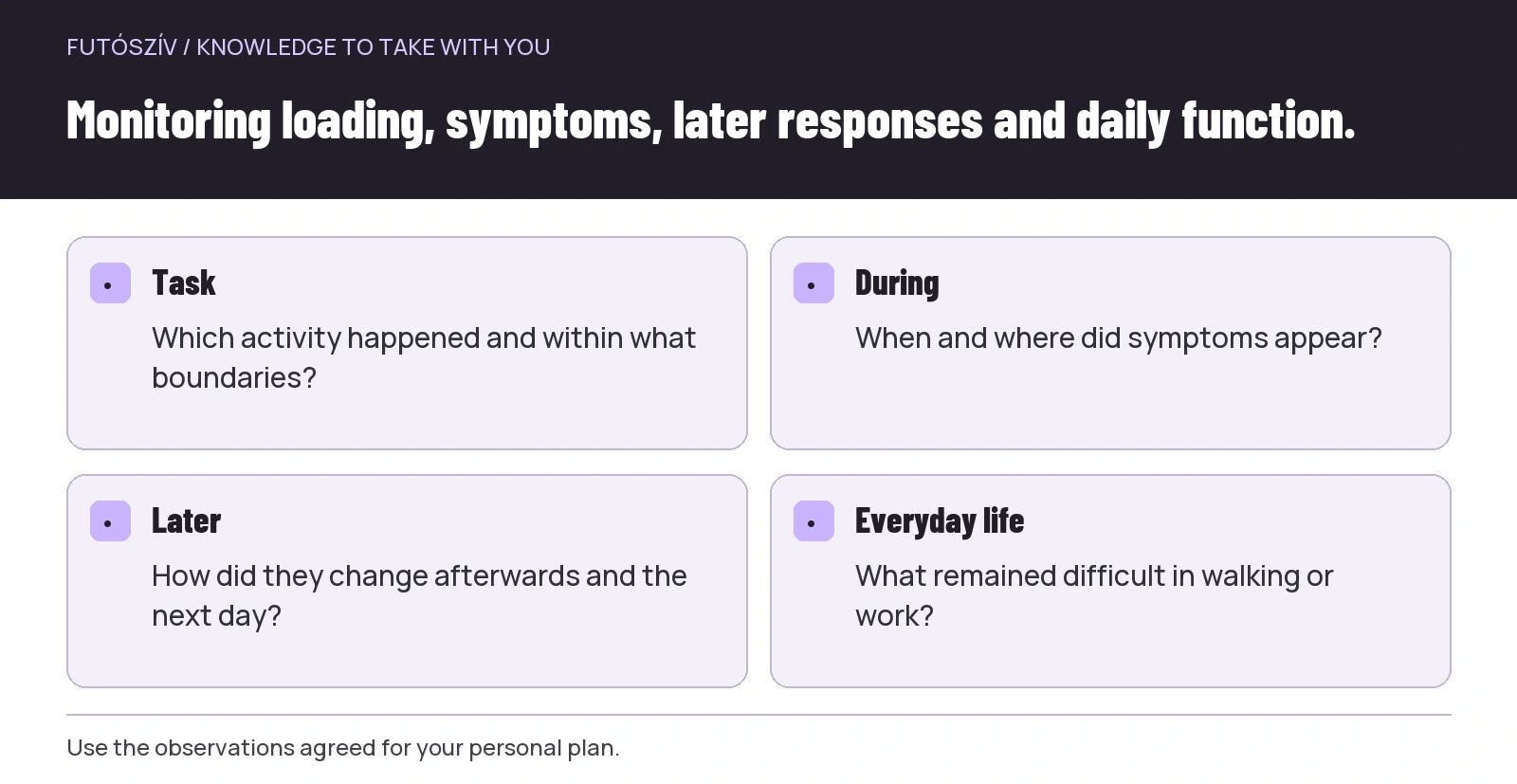 Enlarge diagram
Text version of the diagram
- Task
- Which activity happened and within what boundaries?
- During
- When and where did symptoms appear?
- Later
- How did they change afterwards and the next day?
- Everyday life
- What remained difficult in walking or work?
For additional equipment, purpose and assessment matter
If insoles, tape, a roller or another device is discussed, ask why recommended specifically for you. Is the goal temporary comfort, supporting a task or something else concrete? Duration and review should be clear too. An addition is not good merely because every runner knows its name.
If equipment would serve only to complete the same symptomatic long workout, pause at the planning stage. Suppressing symptoms and returning to loading are different questions. Do not choose medication or injections from another runner’s account; discuss indications and risks with a healthcare professional.
Describe your experience precisely: which task felt easier, how long the change lasted and what remained difficult. That provides better feedback than “it worked” or “it did not”. The treatment goal determines relevant changes and when adjustment is justified.
Before a race, do not make one last trial decide at all costs
An approaching start can encourage repeatedly running the distance where symptoms usually appear. This may add little to the decision while every occasion adds loading. Consider conditions agreed with the clinician, current function and response instead.
Alongside distance, descents, turns, cut-off times and withdrawal options matter. A shorter event is not automatically easier if its terrain is currently unsuitable. Entry and travel may be real losses but provide no health evidence that starting is manageable.
If the event is missed now, goals can be rewritten with the coach. Belonging to a community need not mean finishing only, but consider demands of volunteering or spectating too. You need not stay on your feet all day to compensate for missing running.
What should the next useful question be?
Do not tell the care provider only that you want to run again. Describe which running matters, your current everyday limitation and the uncertain step. Ask conditions for changing load and which signs need review. A good question can produce an actionable answer.
Keep a few consistent points in the log: designated task, sensations during it, later response and everyday functioning. Do not aim to examine yourself with a new home test daily. Observation should support the personal plan rather than create constant worry.
Information about outer-knee pain helps when it turns uncertainty into organised questions. The IT-band name is not a ready answer, a roller is not diagnostic equipment and no single study is a personal prescription. An accurate history, assessment and manageable plan together underpin the next running decision.
Sources
- AAPM&R: Iliotibial band syndrome
- Fairclough and colleagues: Functional anatomy of the iliotibial band
- The immediate effects of foam rolling and stretching on iliotibial band stiffness: randomized trial
- Iliotibial band syndrome rehabilitation in female runners: pilot randomized study
- Naderi and Azizi: Combined foam rolling, stretching and strengthening versus strengthening in ITBS, 2026
- Kent Community Health NHS: Iliotibial band syndrome
- NHS: Knee pain
How Futószív articles are prepared: our editorial guidelines.