When the old training logic does not provide an appropriate answer
If coping with the day remains different after COVID, it is easy to blame running fitness. The familiar response would be to begin easier and increase every week. With persistent symptoms, however, first understand what happens in response to exertion. This is particularly important if an apparently tolerable activity is followed later by more symptoms and worsening everyday functioning.
Long COVID can be an infection-associated chronic condition affecting several organ systems. According to CDC clinical guidance, symptoms may evolve, disappear and recur, while no single laboratory test can reliably confirm or rule out the diagnosis. The 2026 clinical summary emphasises taking symptoms seriously and care based on personal goals.
This article does not provide a home diagnosis or return-to-running programme. It helps explain how to describe your experience, why recognising delayed deterioration matters and how to seek help that treats more than reclaiming previous kilometres as its goal. While new or concerning symptoms are investigated, you need not prove your willpower is strong enough.
What does post-exertional symptom worsening mean?
The abbreviations PEM and PESE refer to worsening symptoms after exertion. The CDC describes it as potentially occurring even after minor physical or mental effort, often delayed by 12–48 hours and lasting days or longer. This is not simply the familiar tiredness you would expect after a previously manageable workout. To understand the concept precisely, review your own symptom pattern with a healthcare professional.
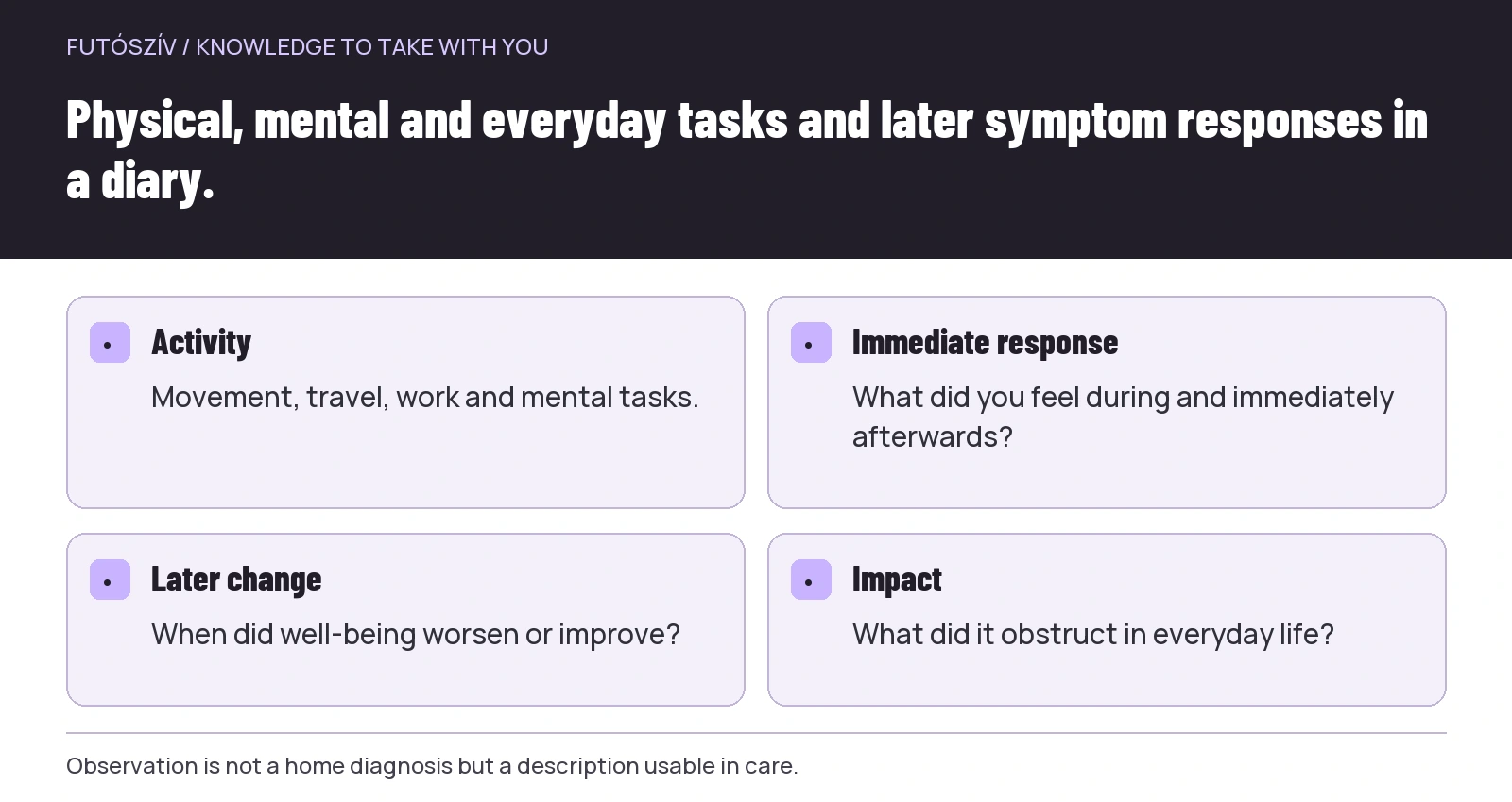
Do not count only running as exertion. Getting to work, shopping, a long conversation or a task requiring concentration may also form part of the whole day. If recording only workouts, you may omit the background preceding deterioration. The diary is not intended to declare every activity dangerous but to make actual total demands easier to understand.
The delay is misleading because the session may still feel successful at its end. It is then easy to attribute next-day worsening to something else and undertake more activity based on feeling well that day. One event need not establish a definite cause, but tell your clinician about recurring patterns. Symptom timing is as important as severity.
Why might fixed-rate increases be a poor idea?
The WHO 2025 clinical guideline does not recommend rehabilitation that increases activity duration in predetermined increments for people with PESE. Instead, it discusses teaching and personally applying energy-conservation approaches such as pacing. The WHO recommendation is conditional and based on expert input and patient preferences; it is not a method promising certain recovery.
For runners, this means the calendar must not override symptom responses. Completing yesterday’s short walk does not make going longer today compulsory. Nor is tolerating an unpleasant state as a training stimulus an appropriate goal. Persistence familiar from sport may here mean taking limitations seriously and asking for help.
WHO distinguishes the presence and absence of PESE: in rehabilitation for certain symptoms, cautious symptom-adapted exercise is considered only without PESE. This cannot support a general conclusion that all activity is forbidden with every case of Long COVID or that everyone improves with the same exercises. Individual assessment is decisive.
 Enlarge diagram
Text version of the diagram
- Activity
- Movement, travel, work and mental tasks.
- Immediate response
- What did you feel during and immediately afterwards?
- Later change
- When did well-being worsen or improve?
- Impact
- What did it obstruct in everyday life?
Pacing concerns organising everyday life too
Pacing does not mean running speed or another performance contest for moving as little as possible. It involves managing activity and rest flexibly according to symptoms. Learn this with your clinician or an appropriate rehabilitation professional. The plan also needs to include tasks you cannot simply cancel.
Write three questions beside an average day: which tasks are essential, what can be divided into smaller parts and where can someone help? You do not need an immediate perfect solution for everything. Reorganising shopping, a task done sitting down or shortening a meeting may be practical changes. These do not replace medical care but show what the personal plan needs to address.
The NHS inform information on fatigue also discusses activity and energy management and the role of a diary. In implementation, consider work, family tasks and available support. Simply telling everyone to rest without limit is unrealistic. Seeking help may be part of making necessary adaptation possible at all.
Normal test results and real symptoms can coexist
According to the CDC, objective laboratory or imaging findings must not be the sole measure of health and well-being. A normal test may carry important meaning without erasing experienced limitations. Ask your clinician precisely which question the test answered and what remains open. This helps avoid interpreting a result as complete certification of exercise capacity.
Equally, possible Long COVID does not automatically explain every new symptom. Other treatable conditions or urgent problems may need recognising too. The care provider determines investigation from symptoms and history. Do not order unlimited testing packages for yourself, but do not remain without help because the first result gave no final answer.
Explain separately what changed in your functioning. For example, cooking after work used to be straightforward, but now even a brief task is interrupted by rest. Such descriptions matter no less than running pace. Everyday self-care and quality of life are valid goals alongside sporting performance.
A useful diary does not require constant self-monitoring
Choose a brief, manageable format. Date, main activities, a short description of well-being and later changes can already say a great deal. Mark new symptoms and usual tasks becoming unusually difficult separately. The diary is not for scoring every minute or retrospectively blaming yourself for a worse day.
If health worsened later after an activity, record intervening events too. You need not make a definite causal claim; the sequence is enough: what you did, when well-being changed, how long it lasted and what it obstructed. Record good days too so your care provider sees more than the hardest moments.
The NHS Long COVID information also recommends a symptom diary and setting goals with professionals. If writing or using an app is itself demanding, simplify the format or ask for help recording. The system needs to adapt to you. A missed entry does not invalidate the whole observation.
What should you take to the medical conversation?
Prepare a brief timeline of infection, symptoms changing since then and current limitations. Explain any temporary improvement followed by relapse too. If you had no confirming test, say so; do not invent a certain infection date. The CDC says a previous positive viral or antibody test is not itself required for a Long COVID diagnosis, although available documents can support assessment.
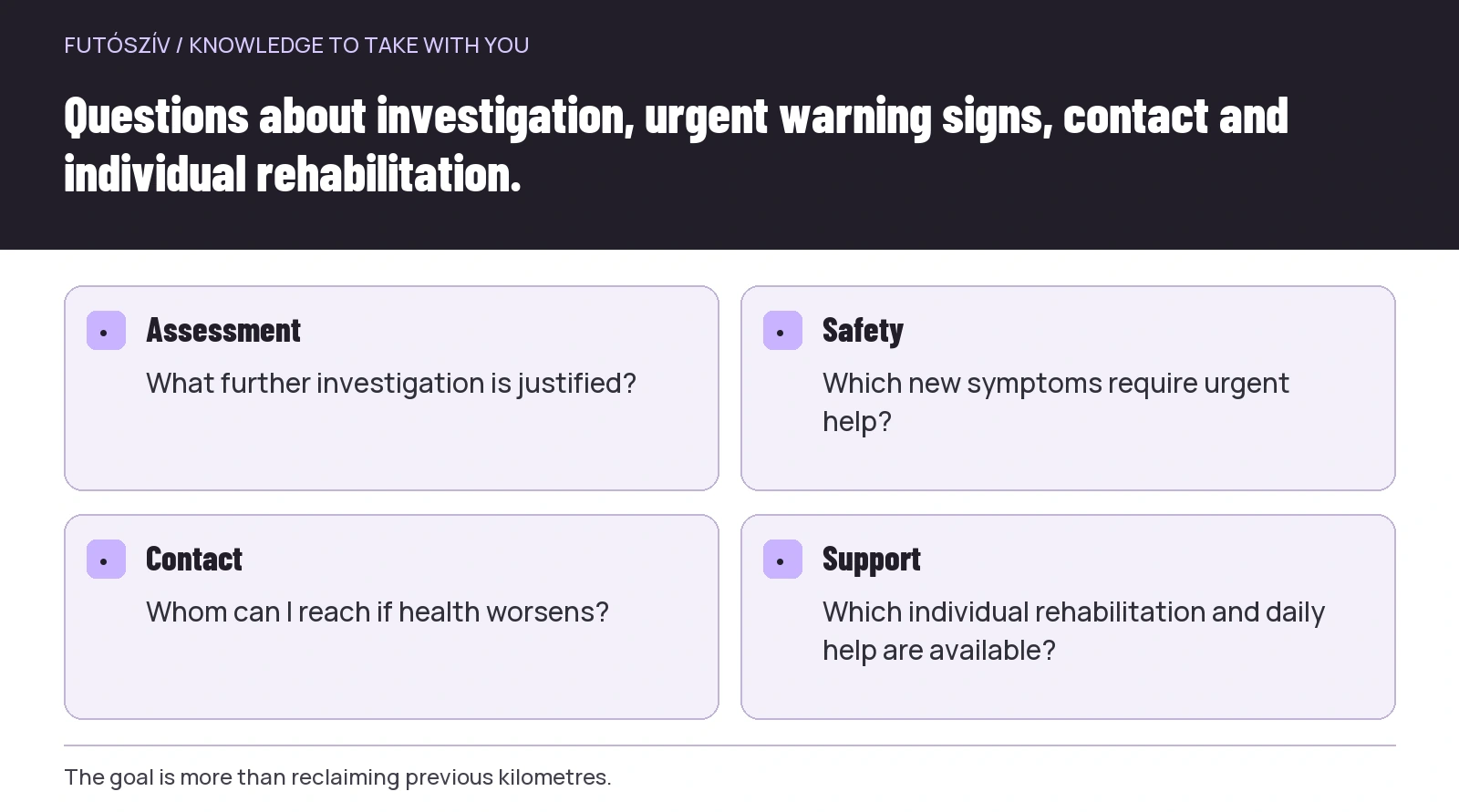
Key questions may include whether further investigation is needed, which symptoms require urgent help, whom to contact if worsening and which rehabilitation support fits your circumstances. Do not seek only an answer to “Can I run yet?” This is too broad if daily capacity changes or delayed symptoms occur.
The NICE care recommendation discusses personalised multidisciplinary assessment and a rehabilitation plan. Care pathways in Hungary may differ from the UK, so discuss accessible options with your GP or care service. The principle can help formulate questions but does not provide automatic referral to an overseas service.
 Enlarge diagram
Text version of the diagram
- Assessment
- What further investigation is justified?
- Safety
- Which new symptoms require urgent help?
- Contact
- Whom can I reach if health worsens?
- Support
- Which individual rehabilitation and daily help are available?
A watch is an aid, not a diagnostic judge
Heart rate, step counts or sleep estimates may help recall a day if tracking does not become another burden. An apparently usual graph does not override symptoms, and an unusual reading cannot independently identify a cause. Consider consumer devices’ measurement limitations too.
Do not set yourself an online heart-rate ceiling claimed to be certain for everyone. If your care provider requests a measurement or agrees a limit, clarify what it concerns and what to do from the result. A measurement’s value comes from a usable decision connected to it. Constant screen checking is not rehabilitation in itself.
Feel free to turn off daily targets or missed-activity notifications in community apps if they create pressure now. Maintaining a previous training streak is not a health goal. Rest and adaptation are real information in the log too. You do not have to generate activity merely so a profile does not look empty.
Belonging to the community should not depend on that day’s run
Running gives many people company, identity and fresh air. Losing or changing these can understandably be difficult. Support helps when it arrives without another performance expectation. A friend can ask what kind of contact is manageable and accept that today the answer may be a short message.
As a running group, send more than workout invitations to someone living with persistent symptoms. Ask whether and how they want news about events. Social presence should not mean compulsory volunteering or a long on-site programme, since these can also be demanding. Part of inclusion is not requiring a fresh explanation for no every time.
You can seek help for emotional difficulties affecting quality of life too. This does not mean physical symptoms are regarded as imaginary. Support can address several needs simultaneously. The NHS also recommends discussing work-related difficulties; talk with an employer about actual tasks and possible adaptations.
When is the next diary entry not the task?
New severe chest pain, severe breathing difficulty, fainting or another sudden severe illness may require urgent care. In Hungary, if a life-threatening situation is suspected, call 112. Known Long COVID is no reason to automatically wait out every new symptom as part of the previous condition. Precise location and following emergency-service instructions matter more than any sporting data at that point.
With less intense but new or worsening symptoms, contact your clinician in the agreed way too. Clarify beforehand whom to reach in which situation. A safety plan needs more than the next review date. If you have no clear point of contact within care, bring this as a separate question to the next conversation.
The next meaningful step may be an organised symptom description, a care appointment or help with daily tasks. You need not demonstrate progress through a run. Your later relationship with sport can be discussed too, but present needs already deserve attention and individual care.
Sources
- CDC: Long COVID Clinical Guidance, 2026
- WHO: Clinical management of COVID-19, living guideline, June 2025
- NICE NG188: Management
- NHS: Long COVID
- NHS inform: Long COVID, fatigue
- OMSZ: Urgent help and out-of-hours care
How Futószív articles are prepared: our editorial guidelines.