A food diary can be a few factual lines about your day, not necessarily a calorie counter or all-day scorecard. As a runner, it may help explain when food was unavailable, how a meal shifted between work and training or which question you want to clarify with a dietitian. A useful diary has a purpose and is easy to review. This article offers a template for simple notes supporting organisation and consultation. It does not establish nutrient deficiency, allergy, disease or precise energy needs, and does not prescribe constant self-monitoring for everyone.
Name your question first
Understanding how late-evening eating is arranged requires different information from a detailed dietary assessment requested by a professional. Write one sentence describing what you want to clarify. For example: I regularly cannot find suitable food between work and running, or I want to show the dietitian what my actual training days look like. The question helps determine the scope of notes. Gathering every possible detail in advance can easily create more work than information you actually use for the purpose.
If you already have a professional appointment, ask whether a diary is wanted and in which format. The Dietitians Australia consultation information also says a dietitian may request a food diary or questionnaire beforehand. This is not automatically an identical task for everyone. Follow your own professional’s request and explain if recording a detail is difficult or uncomfortable. The diary serves cooperation. You do not need a perfect diet prepared in advance to seek meaningful help with your real everyday life.
Four fields for the simplest organising diary
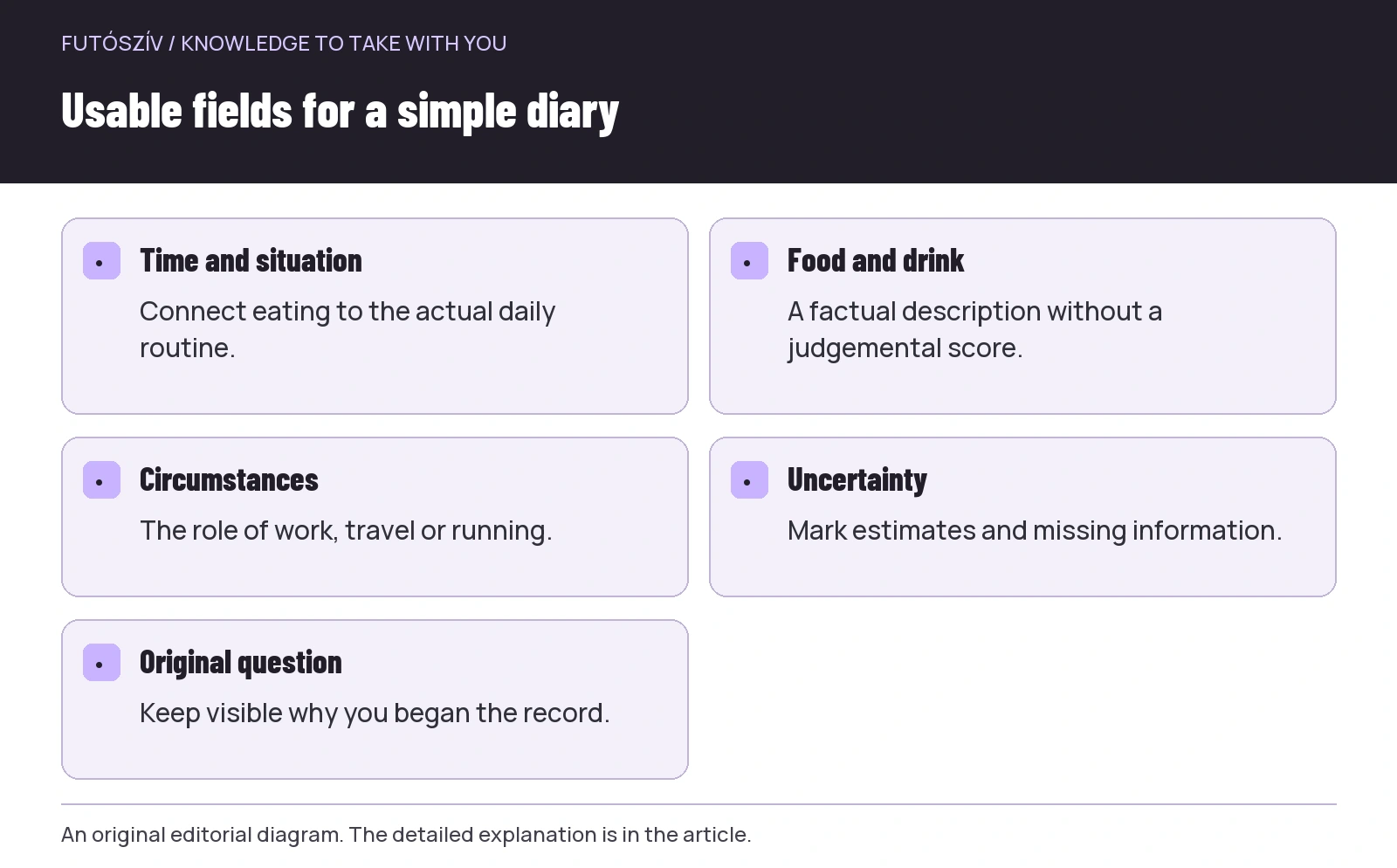
Light notes may need only the time or part of day, a brief account of food and drink, the situation and your question or experience. The situation may mean work, travel, eating at home or running time. Every bite needs no evaluation. If the purpose is to reveal a scheduling conflict, actual access may matter more than calculating every nutrient at home. A professional assessment may require different detail; the two purposes are not the same.
The Leicestershire Nutrition and Dietetic Service diary information separately mentions food, food-and-symptom and food-and-activity records. This distinction is useful: choose information gathering suited to the purpose. If only examining weekly organisation, you need not automatically begin a symptom log. If discussing symptoms with a professional, precise timing may be relevant, but interpretation is not merely an online template’s task. Observation can support conversation; identifying a cause is a separate step.
 Enlarge diagram
Text version of the diagram
- Time and situation
- Connect eating to the actual daily routine.
- Food and drink
- A factual description without a judgemental score.
- Circumstances
- The role of work, travel or running.
- Uncertainty
- Mark estimates and missing information.
- Original question
- Keep visible why you began the record.
Describe what happened, not what should have happened
The diary should contain actual eating. If the planned lunch became another option, describe it briefly with the circumstances. You need not retrospectively align the story with the plan or make it look better. A missing line does not automatically prove a missed meal either; mark when you simply do not remember or did not record it. Honestly indicating uncertainty is part of accuracy. An idealised diary helps less with real barriers than brief, even incomplete but factual notes.
A note made around the time or a suitable photo may help memory, but neither is compulsory. A picture does not always reveal every ingredient and the amount eaten, so add brief text if necessary for the purpose. Paper or simple notes can replace a phone app. Choose the method for your comfort and the needs agreed with the professional. You do not need a new subscription or large database to show the order of work, running and eating clearly.
Quantity information and calorie counts are not the same
If a dietitian asks for a quantity description, clarify the appropriate detail. Product information for packaged food, understandable household measures for other food or another agreed form may help. This does not automatically mean you must calculate all calories and nutrients. The simple NHS Wales food-diary template separates days of the week and eating occasions within each day. Another purpose may need a more detailed format; always adapt fields to your purpose and the professional request.
Call an estimate an estimate. Do not assign artificially precise grams to food remembered later or assume an app search result is certainly your dish’s value. A homemade recipe, actual portion and another food appearing in a search may differ. If the purpose is organisation, detailed calculations can distract from the original question. If the purpose is nutritional assessment, clarify data quality with the appropriate professional. More decimal places do not themselves mean greater certainty.
Add only the necessary context from running data
You can mark when the run happened, roughly what kind it was and where it fitted in the day. A simple organising question does not require copying every GPS point or watch estimate into a food diary. If preparing for professional consultation, ask which training data they want. A sports watch’s energy-expenditure estimate is not automatically an accurate dietary prescription or a measure of whether food is allowed. The diary supports understanding food and circumstances, not accounting between running and eating.
Do not retrospectively turn a missed or shortened workout into a food deduction in the diary. Record the actual change and its circumstances. Assessing personal needs requires the whole situation and professional knowledge, not one activity number. If the purpose is to make the routine between training and dinner workable, for example, keep that question visible at the top. This reduces the chance of the diary gradually becoming tiring scoring unrelated to its original purpose.
| Field | Illustrative content | What does it help explain? |
|---|---|---|
| Time or part of day | Workplace lunch break, arriving late in the evening. | The actual place in the routine. |
| Food and drink | A brief description of the real choice. | What was accessible and consumed. |
| Circumstances | A meeting running late, training, travel. | What influenced implementation. |
| Note | No fridge was available, or the backup worked well. | The next specific organising question. |
| Uncertainty | I did not record this precisely. | The limit on interpreting the information. |
With symptoms, timing helps; a quick search for causes may mislead
If you want to discuss symptoms with a professional, describe the actual issue and its timing in the requested form. Do not immediately label it a food problem when the cause is unknown. A symptom appearing after a meal does not by itself prove a particular ingredient caused it. Sleep, exertion, medication or other circumstances may be professionally relevant, but you need not diagnose from them yourself. The BDA information on keeping a diary also connects recording circumstances with understanding them alongside a professional within its own information context.
Do not randomly begin excluding whole food groups or changing medication based on the diary. Assessing persistent, recurring or concerning symptoms is an appropriate healthcare task; notes can only support consultation. If a professional requests a detailed symptom diary, clarify fields and duration with them. A general running portal cannot judge your personal medical situation. Observation’s value lies in communicating clear, real information without presenting an uncertain cause as established fact.
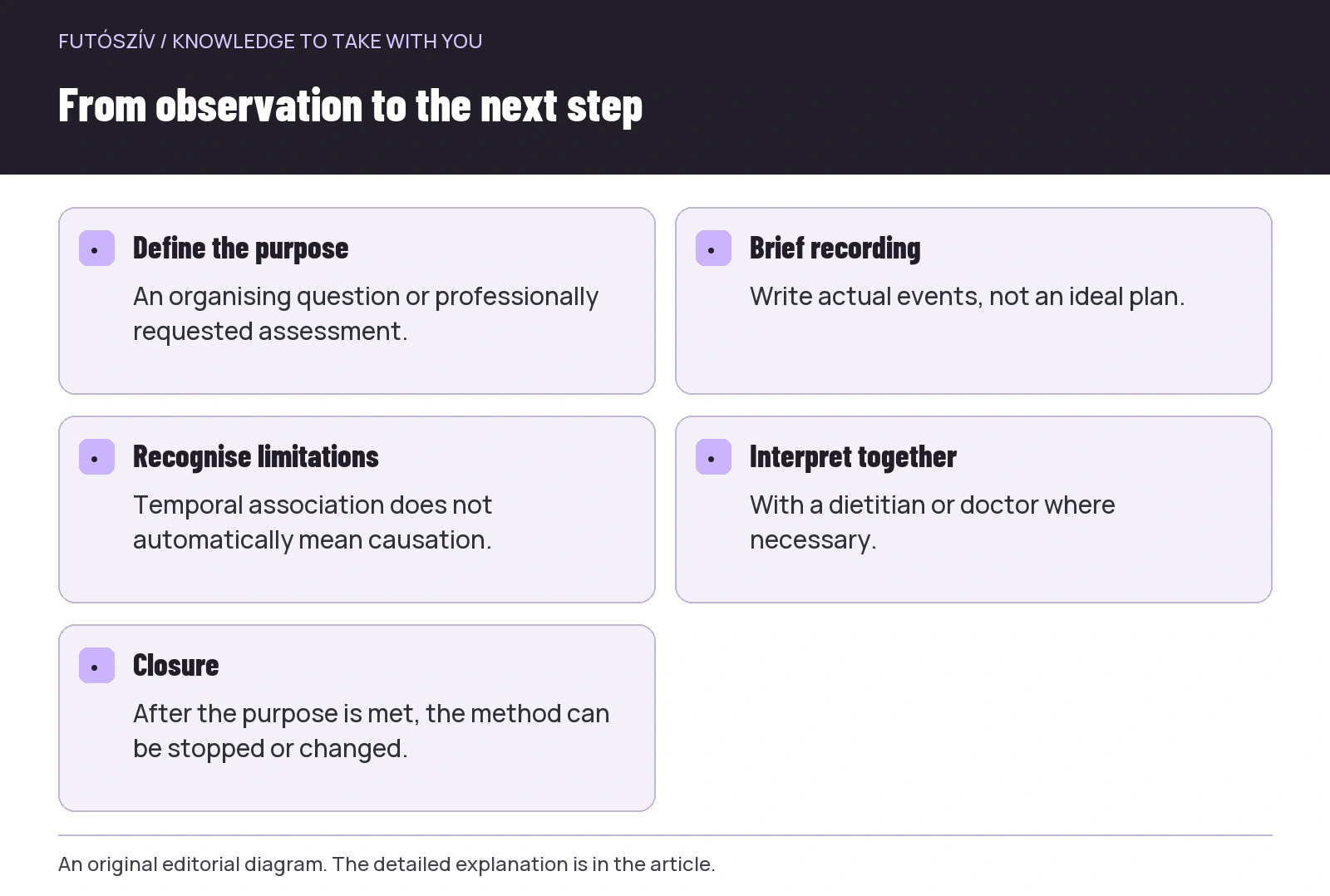 Enlarge diagram
Text version of the diagram
- Define the purpose
- An organising question or professionally requested assessment.
- Brief recording
- Write actual events, not an ideal plan.
- Recognise limitations
- Temporal association does not automatically mean causation.
- Interpret together
- With a dietitian or doctor where necessary.
- Closure
- After the purpose is met, the method can be stopped or changed.
How long should observation last?
Name a purpose and review point beforehand. For a professionally requested assessment, follow that person’s guidance. For your own organising question, choose a short period in which the important everyday situation occurs, then stop and review the lesson. You need not maintain a diary indefinitely merely because you started. If selected days were unusual, note that. A longer series is not automatically better if the purpose is lost or recording becomes a burden.
If notes increase tension, compulsive checking or discomfort around eating, tell the appropriate professional and choose another method better suited to you together. A diary is not a compulsory self-knowledge examination. A simple verbal review, routine outline or another agreed form may work. The method should help the person, not the reverse. Information needed for a purpose can be gathered in several ways, and professional consultation provides an opportunity to fit the tool to your circumstances.
Let the review produce a question and a small step
Look for a recurring specific barrier. For example, suitable food was unavailable several times before leaving work for training, or dinner would have required too many steps on arriving home. An organising change may follow: a known option, suitable packing or a simpler meal card. A diary does not automatically prove your whole diet adequate or inadequate; personal assessment may be needed. A small, targeted finding is more valuable than a general “I eat badly” judgement that does not identify the next step.
If taking observations to a dietitian, place the original question, recorded period and important limitations at the beginning. Mark unusual days and estimated information. You need not explain or defend every line in advance. The professional may request clarifications relevant to their purpose, and you can interpret patterns together. The diary remains a basis for conversation: it shows real routines, eating and circumstances, not a copy of someone else’s supposedly perfect lifestyle.
Let the record remain your information
Consider where you store information and with whom you share it. Food and possible health notes are personal information, not necessarily a public training post. Choose a format you can manage easily and share with the professional through the agreed channel. You need not submit the entire diary to a running group for judgement when the aim is a specific organising or dietetic question. A good food record leaves the next step clearer and need not remain a constant companion to every meal once its purpose is fulfilled.
Sources and further reading
- Dietitians Australia: What to expect
- Leicestershire Nutrition and Dietetic Service: Food Record Diaries
- NHS Wales: Food Diary
- BDA: Keeping a diary
How Futószív articles are prepared: our editorial guidelines.