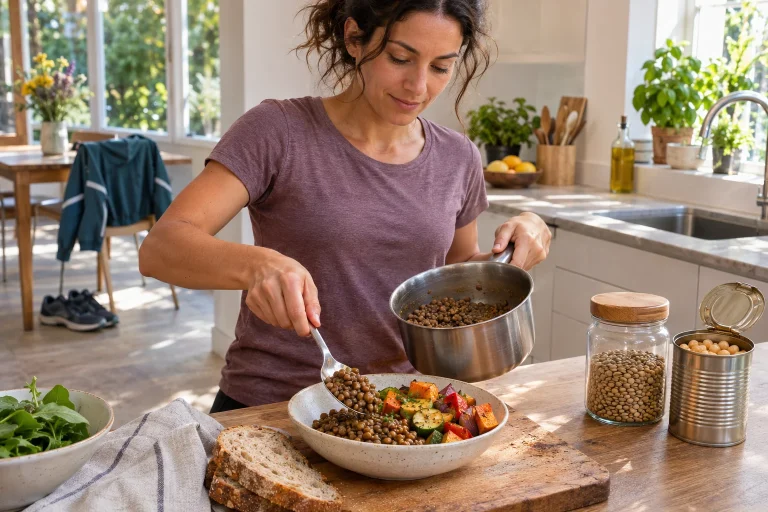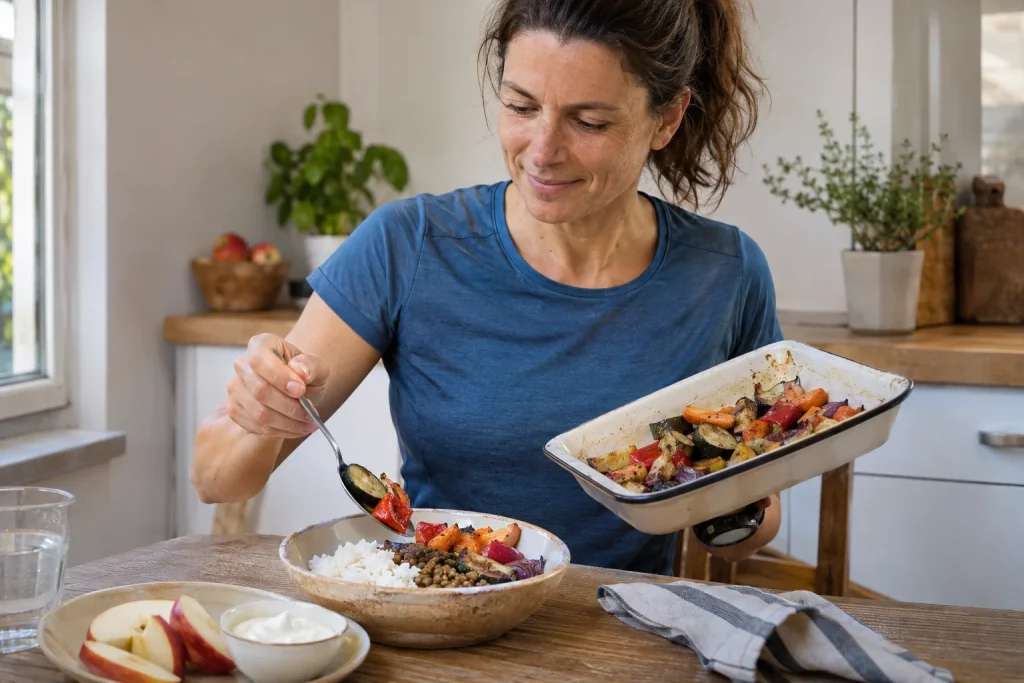
It is easy to associate varied eating with beautiful plate photos: many colours, separate ingredients and a new recipe every day. Everyday implementation can be simpler. Variety can mean several food groups, different ingredients within them and different dishes from the same familiar elements. For runners, appropriate quantities, individual needs and comfort around training also matter. This article offers practical ideas for healthy adults’ food choices without a personalised diet, nutrient target or recommendation to treat disease.
Variety within the day and week
You need not squeeze every possible ingredient into each meal. Reviewing the whole day and longer-term habits can reveal how narrow the selection is. The WHO information on a healthy diet discusses principles of adequate, balanced and varied eating while considering individual and environmental differences. This is not a diet derived from running distance. In everyday life, it provides a starting point for making room for several suitable foods alongside a few familiar meals, according to your needs.
Looking back over a week, ask whether the same bread topping always appeared, the same vegetable was used or there were several main-meal bases and protein sources. This is not scoring or collecting mandatory numbers. It helps identify where a familiar, suitable alternative could fit easily. If someone eats a restricted selection because of allergy, illness, finances or another reason, changes need to respect that. For a special diet, clarify suitable alternatives with a dietitian rather than a general online substitution list.
Food groups and specific ingredients offer different views
The MDOSZ OKOSTÁNYÉR page for adults provides a starting point for reviewing general food choices in Hungary. Food groups help reveal the whole picture but do not make every product within a group identical in composition. At the shop, you can therefore ask two questions: does the day include several important kinds of food, and can you vary choices appropriately within familiar groups? The second does not necessarily require a new, unusual ingredient. Another vegetable, side dish or meal already enjoyed can broaden the selection too.
Do not treat the general adult plate model as precise portions for every runner after every session. The British Dietetic Association information on sports nutrition also discusses individual sport-related needs alongside varied foundations. Specific amounts, timing and matching training demands may be separate questions. Variety is not meant to push adequate food aside: a colourful meal unsuitable for your needs does not become appropriate merely by containing many elements.
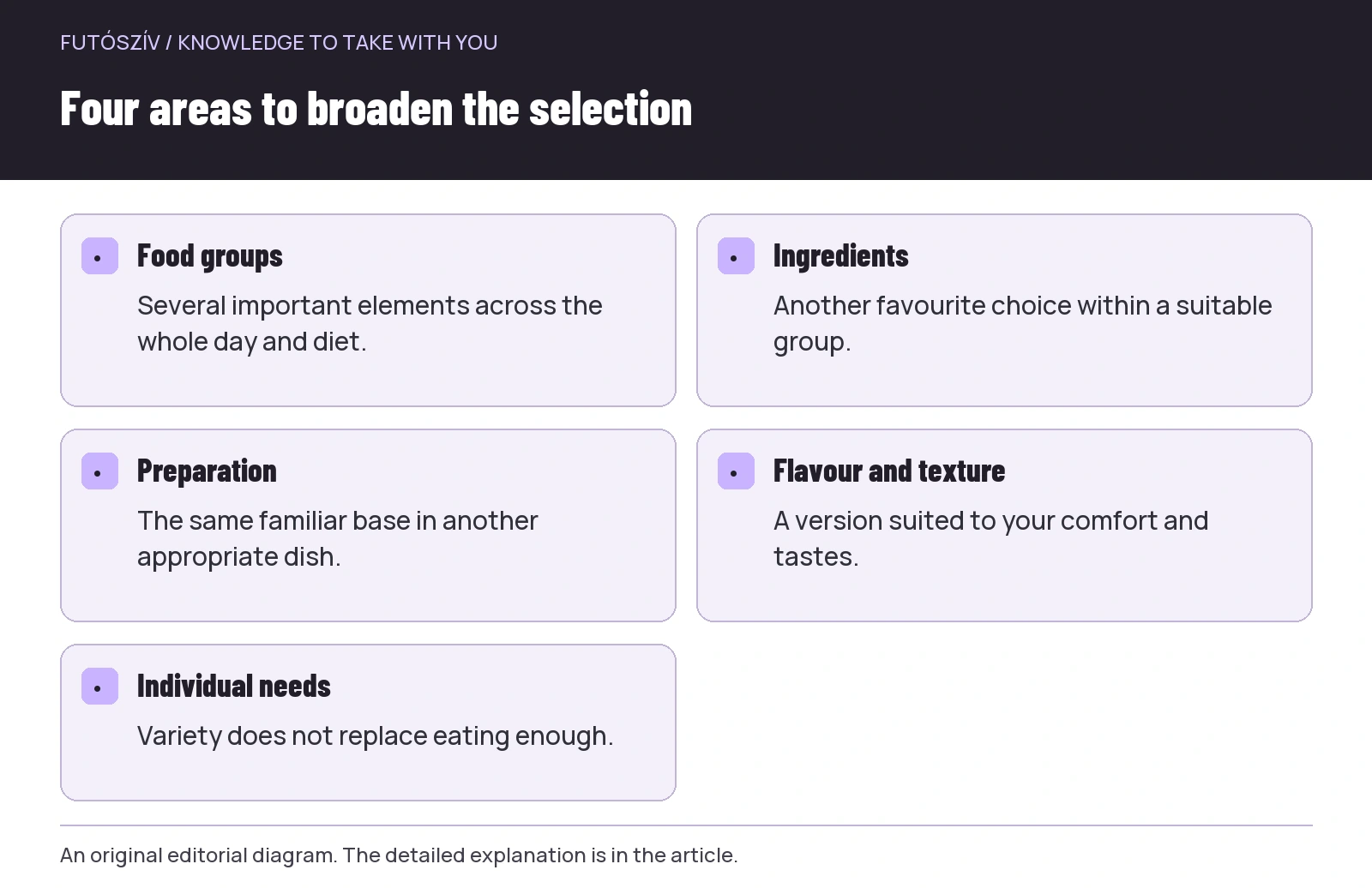 Enlarge diagram
Text version of the diagram
- Food groups
- Several important elements across the whole day and diet.
- Ingredients
- Another favourite choice within a suitable group.
- Preparation
- The same familiar base in another appropriate dish.
- Flavour and texture
- A version suited to your comfort and tastes.
- Individual needs
- Variety does not replace eating enough.
One familiar base, several different dishes
Choose a food base you enjoy, can prepare and can include in your diet. For example, a familiar side-dish base can become a hot bowl with different suitable toppings, then part of another dish on another day if safe preparation and storage are arranged. Different vegetables, seasonings and protein sources can provide variety too. You do not need to replace the whole recipe every time. The organising foundation can stay the same while the food’s experience and composition change. A particular substitution, however, is not always nutritionally equivalent.
For a bread-based meal too, several toppings and accompaniments suited to your needs can be used. You can choose familiar egg, pulse-based, dairy or other appropriate options if they fit your diet and can be prepared safely. You need not eat all of them, and different products are not automatically identical portions. Check the particular ingredient list, allergens and storage instructions separately for every new product. Variety broadens suitable choices; it does not mean abandoning known limitations or forcing unfamiliar food.
Vegetables and fruit: colour is only one consideration
Differently coloured ingredients can help diversify choices, but the whole meal cannot be reduced to a rainbow picture. Start with products that are accessible, liked and manageable appropriately. Fresh options and frozen or otherwise processed versions suited to your use may each offer practical possibilities; always examine composition and preparation instructions. Frozen products are not automatically ready to eat. Handle ingredients according to packaging and food-safety guidance regardless of attractive presentation.
You can change form too: one suitable vegetable can be part of a cooked dish, another appropriate choice a fresh accompaniment, or an ingredient in soup according to the recipe. Your own digestive comfort and tastes matter. If you dislike a certain texture, you do not need to buy a large supply merely for idealised variety. Seek another suitable option. In a good system, the selection is actually eaten rather than merely displaying diversity in the fridge. Planned use helps prevent experimentation becoming regular waste.
Varying protein sources within your own diet
Protein-containing foods can appear in several traditional and plant-based dishes. Consider variety within the possibilities of your own diet, while recognising that ingredients’ proportions and roles differ. Not every meat alternative offers the same things, and not every dairy product or alternative has identical composition. Packaging information and personal needs matter together. If omitting a whole food group or following a specific sports nutrition goal, clarify appropriate dietary combinations and substitutions with a dietitian.
For everyday organisation, make a short selection list of already familiar, suitable meals. A favourite pulse-based main meal, appropriate egg dish or another usual protein source might go on separate days, for example. The list is not a compulsory sequence or an exchange of identical quantities. It is a reminder that variety already exists among proven recipes and is not always used. Instead of major innovation, sometimes bringing back a forgotten suitable dish is enough. Eating can become more varied without transforming the entire shopping and cooking system.
| Where to change | A simple possibility | What should you not assume? |
|---|---|---|
| Within a food group | Another favourite, suitable ingredient. | That every substitution has identical nutritional value. |
| Preparation method | Another dish appropriate to the ingredient. | That cooking instructions can be omitted. |
| Seasoning | A familiar base with different seasoning. | That this replaces every missing food group. |
| Weekly rhythm | Bringing back a forgotten, proven meal. | That every day requires a new recipe. |
| Around sport | A choice fitting comfort and needs. | That a general model is a precise sports diet. |
Flavour and texture are part of feasibility
Even a meal intended to be nutritionally appropriate is hard to eat over the long term if you dislike it. Seasoning, temperature and texture can shape the experience. Variety can therefore mean different spices, another sauce or serving elements separately according to your own recipe. Check labels on new flavourings too, especially with allergies or dietary restrictions. The aim is not heavily seasoning every meal but a repertoire of appropriate dishes you enjoy. Your own tastes also inform decisions rather than being an obstacle to putting nutrition into practice.
Instead of a mixed dish, separate serving can sometimes offer easier choices. Family members can make different combinations from the same suitable basics while respecting necessary separation and individual needs. This does not mean everyone must eat the same portion. Shared cooking and personal appetite can coexist. One sustainable everyday form of variety is modular food served in several ways, if ingredients are genuinely suitable for everyone involved and safe handling is arranged.
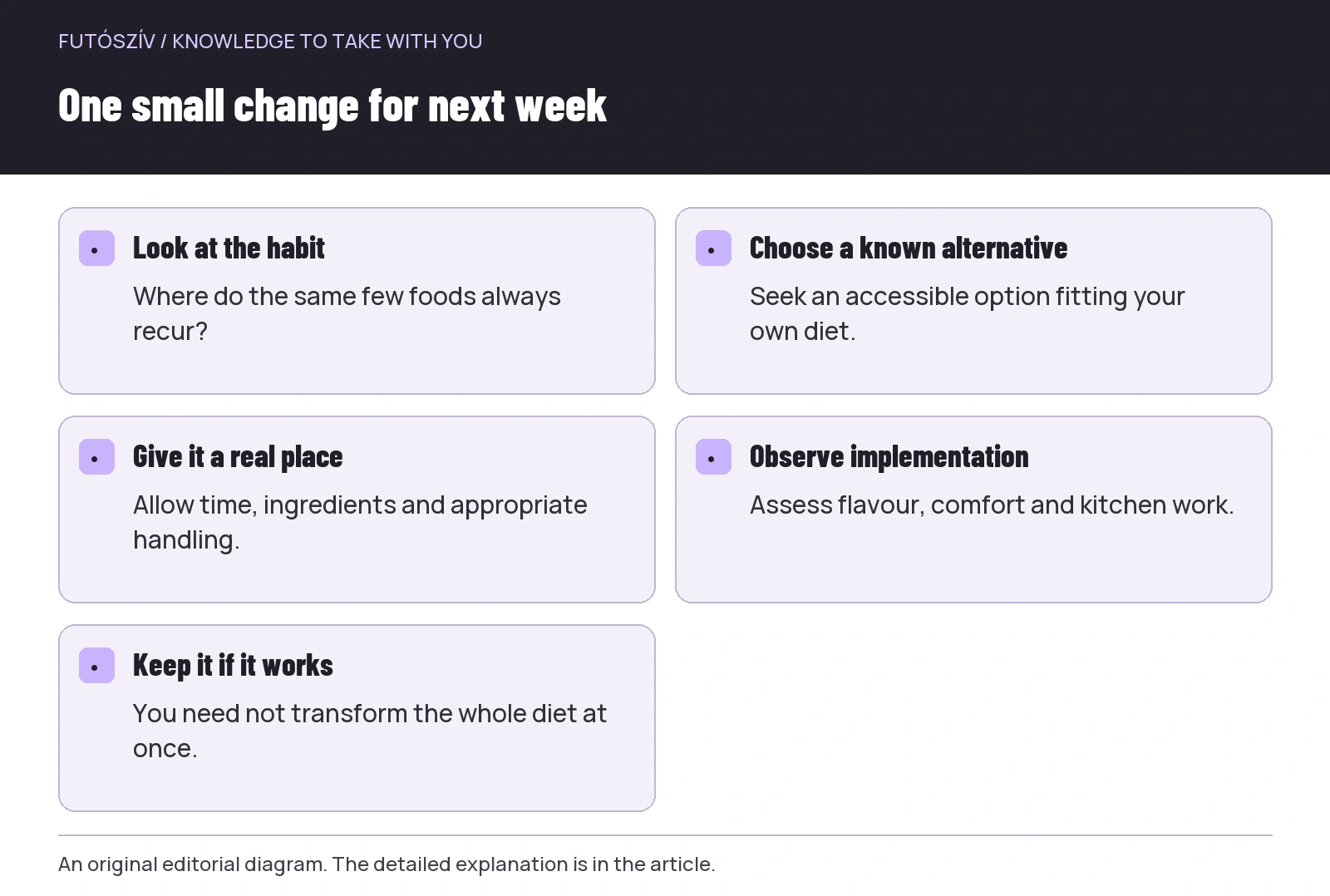 Enlarge diagram
Text version of the diagram
- Look at the habit
- Where do the same few foods always recur?
- Choose a known alternative
- Seek an accessible option fitting your own diet.
- Give it a real place
- Allow time, ingredients and appropriate handling.
- Observe implementation
- Assess flavour, comfort and kitchen work.
- Keep it if it works
- You need not transform the whole diet at once.
Familiarity has a place around running too
You do not need to prove variety through an unfamiliar food experiment before important training or an event. Your own proven, appropriate option may be useful while the rest of the day’s and week’s meals offer a broader selection. The NSWIS meal-ideas information also notes that proportions and portions depend on individual circumstances alongside varied combinations. General examples need not therefore be used as an exact personal plan before a running event. Individual timing and comfort require separate attention.
If you want to try a new ingredient, begin in a situation where you can calmly observe your experience and the food fits your known diet. This is not an allergy test or home investigation of health symptoms; known or suspected allergy must not be addressed through random food experiments. The practical aim is to learn the new dish’s preparation, flavour and everyday usability. Do not automatically turn one unpleasant experience into a conclusion about an entire food group. Assessment of persistent symptoms is an appropriate professional task.
Variety with limited time and money
Not every new idea requires an unusual, expensive ingredient. A broader repertoire can also be developed from food available locally, of appropriate quality and manageable for you. Examine which purchase can serve several familiar meals and which product would be needed only for one untried recipe. Match pack size to actual consumption and storage. A larger selection does not necessarily mean more perishable foods opened simultaneously. Alternation spread across the weekly plan can also be a solution with safe handling.
To simplify preparation, keep a few stable recipes in which individual elements can change. For example, a familiar main dish with another suitable vegetable or a proven breakfast with another favourite fruit. Interpret every substitution alongside the handling and dietary conditions for that ingredient. There is no need to track every difference through nutrient calculations without an individual professional reason. The aim is achievable, adequate and varied eating, not another performance task. Kitchen time and finances are important real limitations to which the method needs to adapt.
One small, specific change for next week
Choose one point where your repertoire can easily expand. For example, bring out an old favourite main dish, choose another suitable topping for a familiar meal or plan a known vegetable currently used infrequently. Do not begin by replacing every ingredient simultaneously. A change helps when it fits the routine, can be prepared appropriately and is genuinely enjoyable to eat. If successful, it can remain on your personal meal list; if not, adjust flavour, preparation or access without moral judgement.
Variety on the plate then becomes neither a compulsory colour code nor an endless recipe search. Several suitable foods find a place in the whole diet, while familiar basics can offer new combinations. Individual amounts and sport-related needs still matter, and favourite foods retain a role. The best everyday variety is what you can actually achieve and what supports appropriate eating for yourself alongside running.
Sources and further reading
- WHO: Healthy diet
- MDOSZ: OKOSTÁNYÉR for adults
- BDA: Sport and exercise nutrition
- NSWIS: 38 balanced meal ideas for athletes
How Futószív articles are prepared: our editorial guidelines.