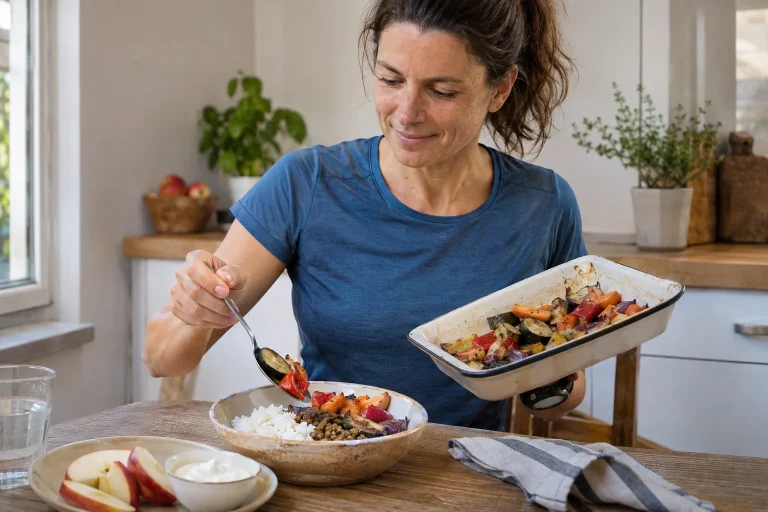
After an uncomfortable run, it is easy to find one explanation: the food eaten beforehand contained too much fibre. Meal timing or composition may indeed be part of the situation, but one memorable occasion is insufficient for a firm conclusion. Fibre is an important part of a varied everyday diet, while individual comfort also matters immediately around activity. Separate these two questions before every vegetable, fruit and wholegrain goes onto a general prohibited list.
This article helps healthy adult runners observe their experiences and discuss them with a professional. It does not prescribe a low-fibre diet, treat gastrointestinal disease or recommend long-term exclusion of food groups. With a known condition or prescribed diet, follow your individual guidance. Seek medical help for recurring, worsening or troublesome symptoms. Symptoms during running may involve several factors, so accurate description matters more than quickly identifying a culprit.
Fibre is not one single food or product
The Food Standards Scotland information lists several groups of plant foods as fibre sources: cereals, pulses, vegetables, fruit, nuts and seeds. Wholegrains are therefore only part of the picture. Bread colour alone is not reliable composition information; the label can help compare similar products. Variety matters in everyday choices too, rather than eating as much as possible of one product.
When describing a pre-run meal, record more than “high-fibre breakfast”. Which cereal did it contain, which fruit or other toppings, and approximately how much did you eat? Bowl size, ingredients and timing together describe the situation. Two apparently similar muesli bowls can have different combinations. Precise naming helps distinguish a genuinely recurring pattern from an overly broad category.
Added fibre or a prominent packaging claim may deserve separate attention. You need not infer a favourable or unfavourable judgement from this alone, but it is worth knowing what changed from your usual food. If you switched from an old product to a new version with a different composition, do not automatically regard it as the same starting point. Record the specific product in your own diary, particularly when a new experience followed the change.
The whole day and the pre-run period are two different questions
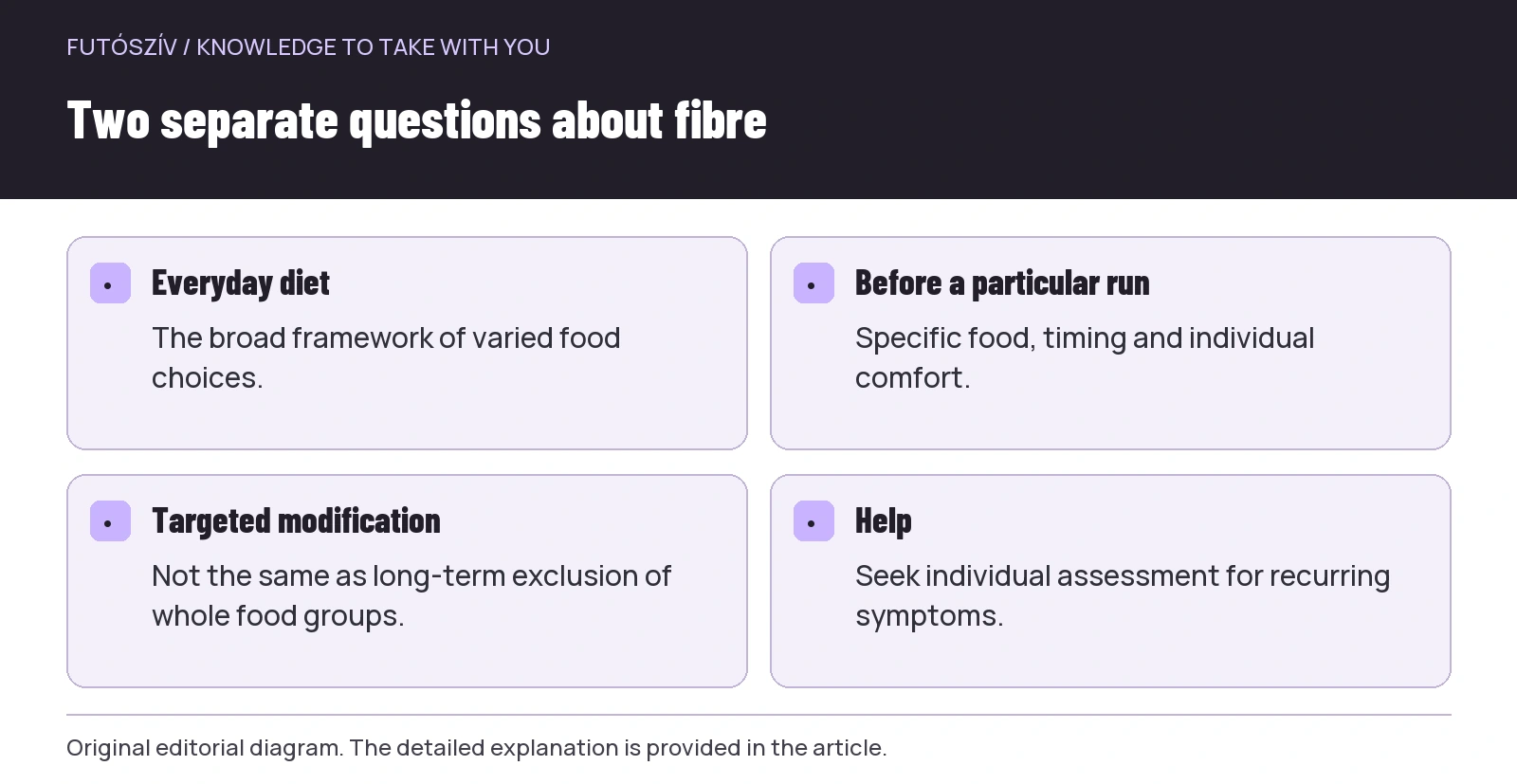
Variety in everyday eating and a meal planned immediately around a session involve different levels of decision. Choosing another combination that is more comfortable before one run does not mean removing the original food group from the whole day’s diet. Instead, ask how that food fits elsewhere in the day. A targeted timing adjustment is not the same as a long-term dietary restriction.
The NHS balanced-diet guide emphasises varied choices across several food groups. Do not replace this broad framework with a rule system created from one uncomfortable session. If a pre-run meal needs changing, plan it alongside an appropriate overall diet. A professional can help preserve adequate nutrition while making timing more comfortable.
A specific pre-race eating plan may also have its own conditions. These are not automatically year-round prescriptions for everyone. Distance, load, previous experience and health shape requirements. Do not copy another runner’s targeted race plan onto your everyday breakfast. Understanding a solution designed for a particular situation also requires knowing its purpose and boundaries.
 Enlarge diagram
Text version of the diagram
- Everyday diet
- The broad framework of varied food choices.
- Before a particular run
- Specific food, timing and individual comfort.
- Targeted modification
- Not the same as long-term exclusion of whole food groups.
- Help
- Seek individual assessment for recurring symptoms.
The label helps comparisons but is insufficient for symptom diagnosis
If fibre appears in the nutrition information, compare figures for the same quantity. Then consider the portion you actually ate. The serving printed on the pack may not match your bowl. Toppings and additions count in the full recipe too. A label refines the food description, but cannot establish on its own that a particular ingredient definitely caused symptoms.
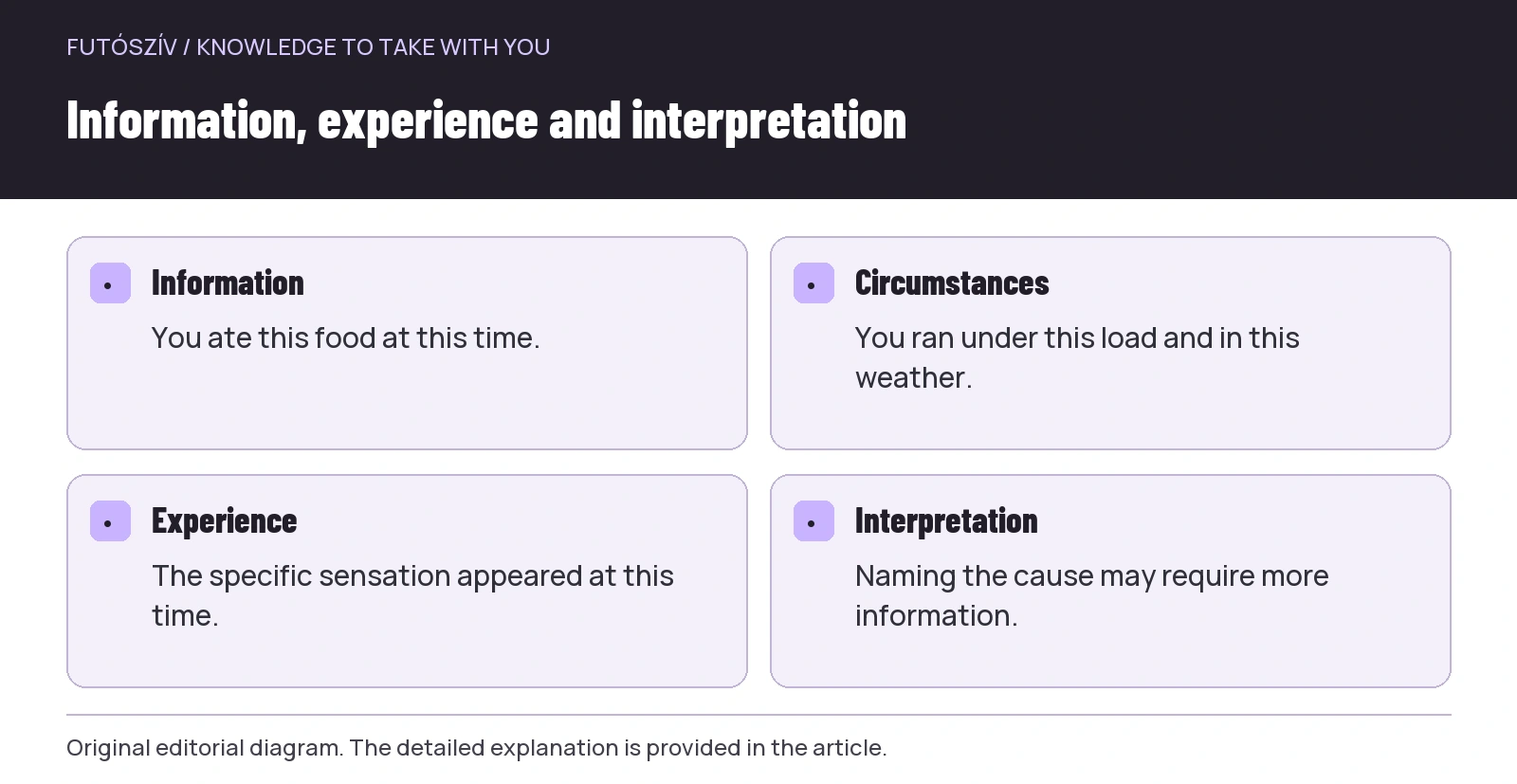
Distinguish directly readable information from your own conclusion. The product name, ingredients and fibre content may be directly readable. An observation might be that you set off a certain time after eating and experienced a particular sensation. Naming the cause, however, is interpretation that may require more information. Keeping these three levels separate makes notes more accurate and easier to discuss at a consultation.
Do not estimate composition with certainty from colour, a natural-looking appearance or a sporty name. Seeing seeds sprinkled over a product is not complete nutritional information. Versions within a product family can differ too. When recording observations, use the precise name on the pack you have. If fibre information is unavailable, simply mark that; you need not fill the gap with another product’s value as if it were established data.
Record activity and drinking circumstances beside symptoms
Comfort during running is described by more than one food label. At what intensity did you start, what was the weather like, how long had you been running and what happened along the way? Was there another new product or drink? Experience of a new meal before an unusually hard session differs from a familiar easy loop. Keep these circumstances in the observation too, so one nutrient does not automatically receive all responsibility.
The 2025 joint position statement from Sports Dietitians Australia and the Ultra Sports Science Foundation discusses multiple influences on gastrointestinal symptoms during exercise and the importance of individual professional assessment. Your notes are not there to prove a disease or food intolerance at home. They help describe a recurring situation accurately instead of leaving only the general claim that “fibre does not agree with me”.
You can record fluid consumption factually too, following your own prescribed plan. Do not try to correct discomfort by forcing yourself to drink or by avoiding drinking. Appropriate quantity and timing are individual questions, with run duration and conditions also relevant. If eating and drinking together cause uncertainty, show the whole pattern to a professional. Separate observations can help; extreme experimentation is unnecessary.
| Observation level | Specific information | What does it not establish on its own? |
|---|---|---|
| Food | Precise ingredients and your own portion | Unsuitability of an entire food group |
| Time | End of the meal and start of the run | One waiting time identical for everyone |
| Load | The run’s character and unusual parts | That food alone was the cause |
| Environment | Weather and other changes | An automatic diagnosis from the circumstance |
| Experience | When was something troublesome, and what was it? | A food allergy or intolerance |
Small changes produce more interpretable experience
If there is no health symptom needing investigation first, you can review one practical detail of your familiar routine. For example, eat the same food at a different time or choose a familiar component rather than a new product in your pre-run combination. Maintain an appropriate overall diet meanwhile. The goal is not the least fibre possible, but understanding the situation and developing a comfortable, appropriate routine.
Do not introduce a new breakfast, remove several food groups and increase running load together. Later experience then becomes difficult to interpret, while restrictions may expand unnecessarily. If comfort improves alongside one change, keep the conclusion precise: on that occasion, with that combination, this is what you experienced. A later similar situation may help confirm the practical solution, but a home trial still does not become a diagnostic procedure.
Gradual change matters in everyday eating too. Food Standards Scotland highlights a gradual transition and appropriate fluid intake when changing fibre intake. Do not turn this into a personalised therapeutic rule. If you want a larger dietary change or follow a prescribed diet, seek individual guidance. A sudden change introducing many new elements is harder to interpret observationally as well.
 Enlarge diagram
Text version of the diagram
- Information
- You ate this food at this time.
- Circumstances
- You ran under this load and in this weather.
- Experience
- The specific sensation appeared at this time.
- Interpretation
- Naming the cause may require more information.
Three examples of asking a more precise question
In the first example, someone adds a new, larger seed-based topping to their usual cereal breakfast, then leaves sooner than usual for a harder run. The useful question is not whether every cereal should be removed. First recognise that topping, quantity, timing and load changed simultaneously. The next step may be restoring a simpler situation fitting the personal plan and discussing it professionally if needed.
In the second example, several hours pass between a working-day lunch and an evening run, yet a single lunchtime vegetable receives responsibility for every discomfort. Accurate observation also includes afternoon food, drinks, departure circumstances and fuelling during running. Without the day’s timetable, the selected food may be merely the easiest memory to name, rather than the proven explanation.
In the third example, someone turns a pre-race eating version found comfortable into a compulsory rule for the whole year. Here the question is which purpose the solution for that race situation served, and how a varied daily diet returns alongside it. Short, targeted planning need not extend to every everyday meal. An individual professional plan is useful precisely because it distinguishes situations and goals.
When should the next step be something other than another food trial?
If symptoms recur regularly, worsen or affect everyday eating too, do not extend home experiments indefinitely. In a medical discussion, explain when they occur, their character and whether appetite, general wellbeing or weight has changed. The professional decides which investigation and further care are appropriate. Enduring discomfort during training does not establish that there is no health question to clarify.
Short food and timing observations can be useful at a sports nutrition consultation. Show which foods you have already removed and why. The professional can then review the risks of restrictions and adequacy across the whole day. Bring more than the food eaten before the latest run into the conversation. An appropriate solution can emerge from understanding symptoms, the whole diet, training and feasibility together.
You address fibre and running comfort accurately when you do not try to put one nutrient into a good or bad category. Within the broad framework of a varied diet, consider the particular food’s place, running circumstances and limits of your own observations. This can lead to a targeted question, professional help where needed and a better-working routine. A useful endpoint is appropriately structured, sustainable eating, rather than a growing list of foods you no longer dare to try.
Sources and further reading
- Food Standards Scotland: Fibre
- NHS: Eating a balanced diet
- Sports Dietitians Australia and Ultra Sports Science Foundation: position statement, 2025
How Futószív articles are prepared: our editorial guidelines.