A shared session can have its own social purpose
A friendly run can begin with the pleasure of being together, yet conversation quickly turns to comparing results. Who ran how much this week, who owns which watch and who entered a longer distance? These can be interesting topics too, but participants do not all arrive for the same reason. If you specifically want a social session, you can plan its purpose and arrangements as well.
The aim is not a general ban on discussing results. We are giving the shared programme a framework in which participation does not require presenting performance data. Running, conversation and moving together more quietly can all have a place according to the format actually advertised.
Name why you are meeting
The phrase “social run” can describe several kinds of session. It might be a short, regularly repeated loop, an introductory programme or an event with a shared conversation after running. If you say only that it will be relaxed, participants may imagine different tasks.
State the session’s role in one sentence. For example: today we meet on a familiar route, the aim is shared participation and we adapt the group’s arrangements accordingly. Then describe the actual format: moving together throughout, several suitable groups or a programme of short loops. A social purpose also requires organisation.
The official introduction to the RunTogether programme describes several forms of friendly, led group sessions. This particular English system is not how every Hungarian community operates. A useful principle for your own organising is to choose a session suited to the shared experience, with an understandable description and real support.
Conversation should be an opportunity, not a compulsory task
Not everyone wants to talk at length while running. Some initially observe the group, others enjoy the surroundings and others want to connect only after finishing. A social purpose does not require constant verbal participation from every person.
You can briefly mention this in the invitation and at the session. People can move together more quietly and ask questions or talk at a shared meeting point. The group leader need not fill every silence as though it were awkward. Necessary route and organising communication should still remain accessible to everyone.
Do not require personal stories in an obligatory round either. How much someone opens up should remain their choice. If someone shares something, others should not immediately turn the conversation into advice or competition. A social running session does not replace healthcare or psychological help and need not promise such a service.
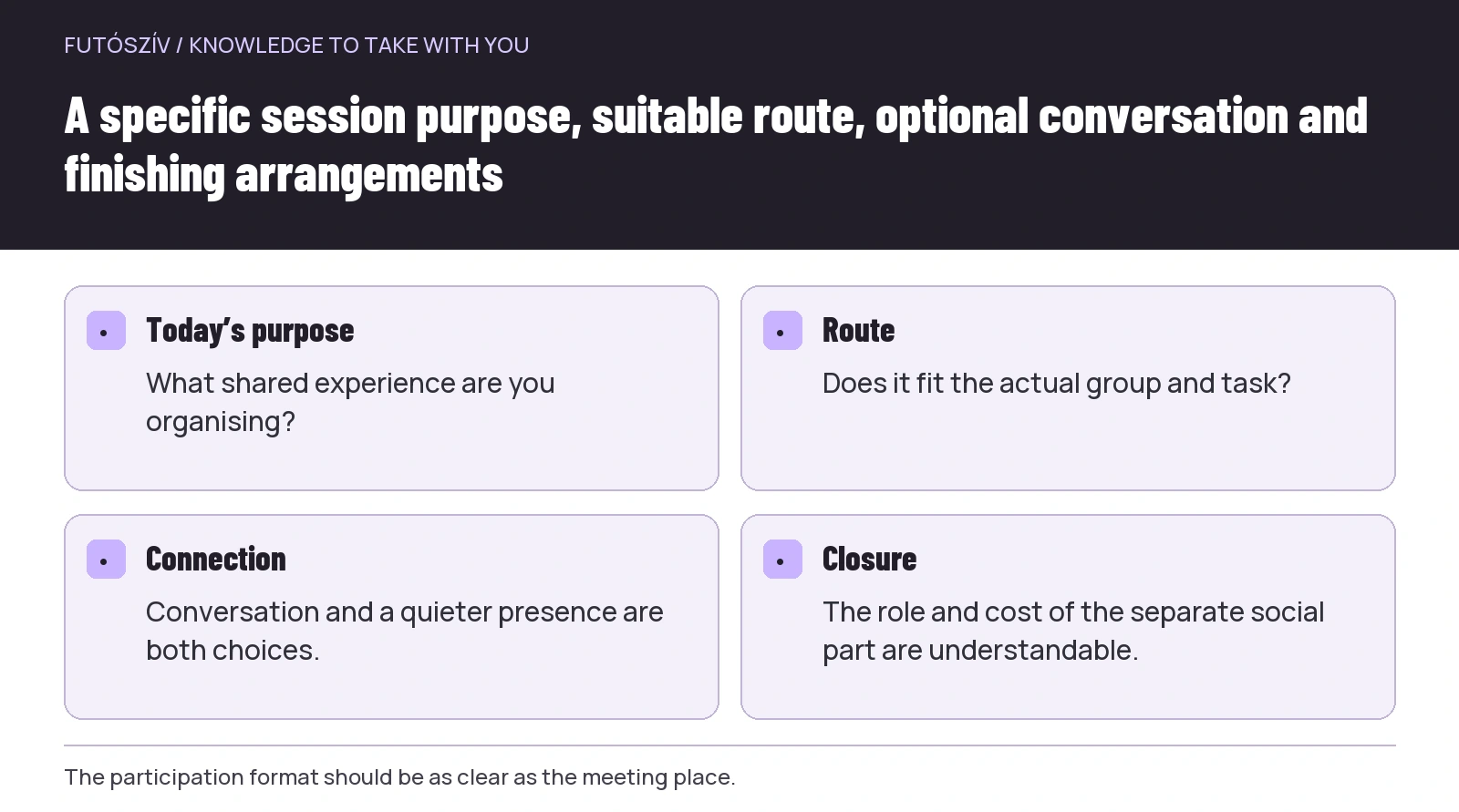 Enlarge diagram
Text version of the diagram
- Today’s purpose
- What shared experience are you organising?
- Route
- Does it fit the actual group and task?
- Connection
- Conversation and a quieter presence are both choices.
- Closure
- The role and cost of the separate social part are understandable.
Describe participation in the invitation, not a picture of results
An invitation showing only fast finishers and long race distances may create a different expectation from a socially focused programme. Pictures and text should show the same session. If you advertise an introductory shared loop, show the actual route and participation format too.
Continue to specify necessary pace and experience conditions precisely. Omitting performance comparisons does not mean the session is automatically suitable in every personal situation. Participants need to know what they are signing up for and where to ask about the fit.
| Invitation element | An approach suited to a social purpose |
|---|---|
| Essence of the session | A specific shared programme and arrangements |
| Level description | An understandable condition without personal rankings |
| Image | Showing the actual participation format |
| Opportunity to ask | An appropriate person and usable channel |
| Finish | Exact place and the role of the separate social part |
Choose a route that supports the programme
A complex new course requiring considerable attention can make connecting harder. If the session’s main purpose is getting acquainted, seek a structure appropriately familiar and easy to follow for participants. This does not mean the same distance or surface everywhere, but matching the task to the shared goal.
The group should consider other users’ movements too. Do not form a line across the full width of a narrow path while talking. Stopping points, map-reading and regrouping procedures should be understood beforehand. A social experience does not give priority over the entire route.
Check current access and conditions separately. Simplicity does not make weather, local or organising information unnecessary. If the loop needs changing, all participants should understand the new meeting and finish too.
The group leader’s language can set an example
You need not monitor every sentence, but recurring wording matters. If the shorter option is always called “only the little one” and slower participants are described apologetically, a hierarchy can emerge even within an officially social programme. Use precise names referring to the task instead.
In feedback, recognise specific arrangements that worked. For example, today’s meeting procedure was easy to follow, or newcomers easily received route information. This makes community contributions visible without requiring faster kilometres.
Someone pleased about their race can share the experience. The leader’s task is rather to ensure this is not the sole measure of connection. Conversation suited to the session’s role can include route experiences, everyday stories and someone simply wanting to be present today.
Sharing personal data should not be an entry ticket
Sharing watch-recorded pace, weekly volume and an app profile is a separate decision. Information needed for organising should be clarified with the appropriate leader. You do not have to place every personal number before the entire group to attend a social session.
If there is a community activity group, make clear what it is used for and what requires joining it. Basic information about the next meeting should be available in the way the programme actually commits to providing. If participation does not require a public performance platform, that should not be the only way to learn where the next session will be.
A shared photograph and tagging also require separate agreement. Anyone not wishing to appear should still receive information needed for closing the programme and attending next time. The choice should carry no social penalty.
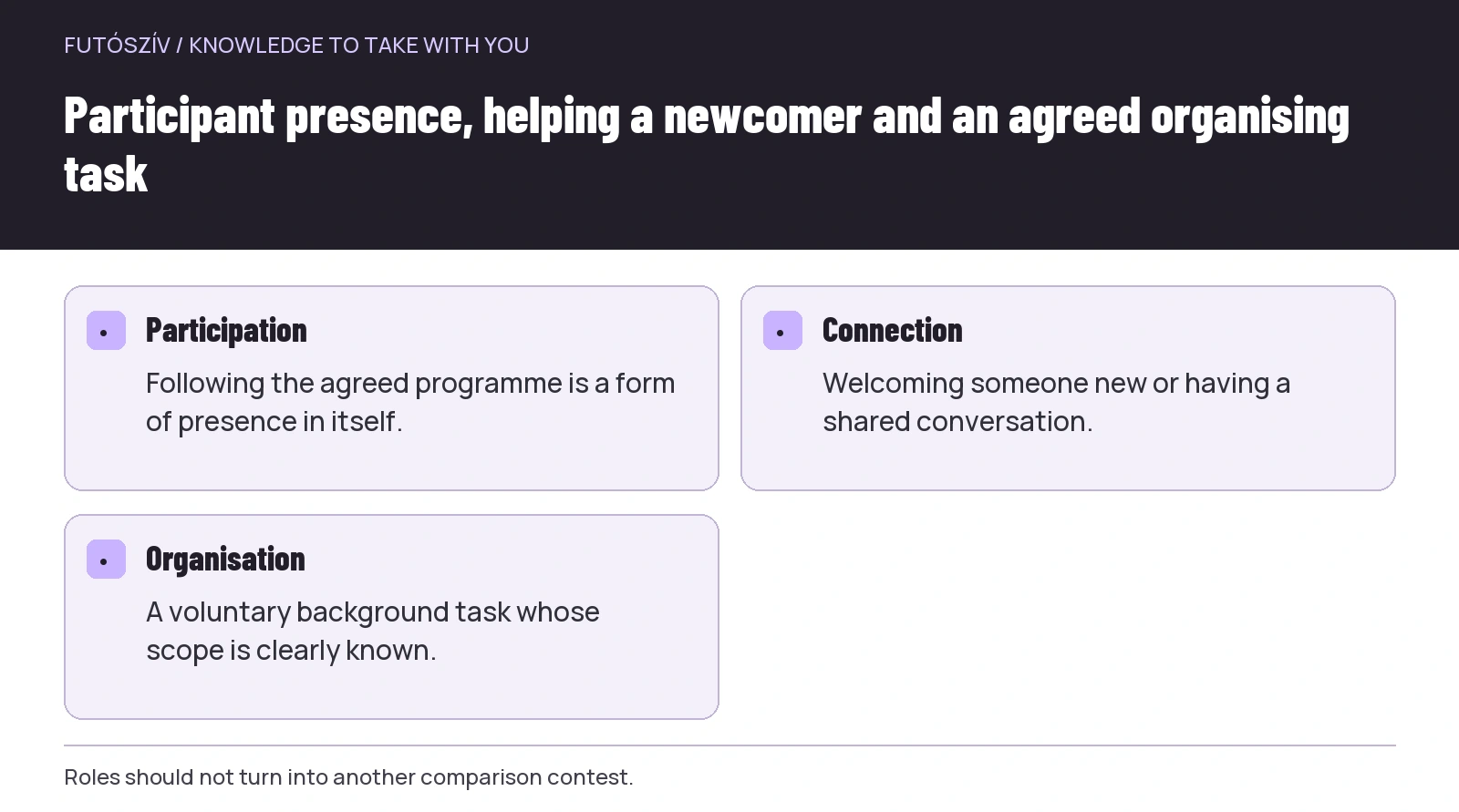 Enlarge diagram
Text version of the diagram
- Participation
- Following the agreed programme is a form of presence in itself.
- Connection
- Welcoming someone new or having a shared conversation.
- Organisation
- A voluntary background task whose scope is clearly known.
The post-run part should not hide a new cost or obligation
If coffee or another gathering follows, say whether this is a separate optional part. Participants’ finances and available time may differ. Belonging to the shared run should not be proved by later purchases or staying for the whole evening.
Choose the venue for the actual group and check its current availability. If the shared part ends at a public point that can be used appropriately, give that clear arrangements too. Organising a session does not necessarily require a café or other hospitality venue.
The parkrun resources page interprets participation in several ways, including volunteering and social presence. This is its own event system’s approach. For your community, it can prompt the question of how to offer several genuinely manageable forms of connection.
An edited example of changing a results-centred conversation
In a recurring group, everyone regularly announces their weekly kilometres after the run. This was originally a habit of a few members, but newcomers may perceive it as part of introducing themselves to the community. The organiser wants a social session, so clarifies the framework at the next meeting.
At the beginning, they explain today’s purpose and arrangements; at the finish, they request brief, optional feedback about the route and organisation. Results can still be discussed separately, but not in a compulsory round for everyone. The next invitation shows the shared experience and specific participation format.
The example is an original editorial construction and does not claim every running group has this habit. The lesson is that an informal ritual may look like an unstated entry condition. A clear programme purpose and room for choice make this a manageable organising question.
Social support has boundaries too
If someone brings a difficult personal topic into conversation, listening does not automatically confer a professional counselling role. A running group cannot promise treatment or therapy merely on the basis of shared activity. Appropriate help may require a separate professional.
The entire group need not decide about passing on a personal story either. Do not turn a confidential conversation into community content or a quotation for the next invitation without clear agreement from the other person. Part of the value of social presence is that participants understand its boundaries.
The leader need not solve every situation alone. Organisational frameworks, appropriate training and knowing how to obtain necessary help may be separate tasks. Define the commitment for today’s social programme consistently with these.
Community contributions can be visible in several forms
One person clarifies route information, another helps a newcomer and another undertakes an agreed organising task. These contributions help the shared session work. Make them visible without creating another contest out of volunteering.
Undertaking tasks should be a genuine choice with clear boundaries. The person less inclined to discuss their results should not regularly end up packing equipment or coordinating. Community roles also require time and appropriate knowledge. A social run is not open because it invisibly loads all background work onto a few members.
If you offer a new role, explain what it includes and whom the volunteer can ask for help. Properly organised contributions allow several ways to connect. Everyone need not do the same thing, and simply participating can be a fully valid presence.
Choose an evaluation suited to the advertised purpose
After a social session, ask whether the location was findable, the shared arrangements easy to follow and any practical gaps remained. These questions concern programme quality. You do not need to compare every participant’s pace to establish whether the organising worked.
It is particularly worth hearing a newcomer’s feedback. Something regulars take for granted may not have been clear. Make changes concrete: a more precise invitation, clearer group format or more optional ways to finish. Named arrangements should support the good atmosphere.
A social run independent of performance comparisons is therefore not a judgement on the value of results. It is a shared session with its own purpose, participation arrangements and opportunities to connect. A runner can belong by coming along, following the agreed programme and connecting with others in their own way.
How Futószív articles are prepared: our editorial guidelines.