A good invitation helps even a first-time visitor plan
A community running invitation can be energetic and personal while still making essential information easy to find. A new participant needs more than encouragement. They also need to decide whether the session suits them, how to get there, what to prepare and how the programme ends. If these are missing, the comments below an attractive picture try to make up for the organising afterwards.
The invitation is therefore also a brief user guide to the programme. There is no need to crowd every detail into one long paragraph. Put the essence of the session in the opening lines, followed by information that is easy to scan, then ways to ask questions and follow changes. Concrete content makes the atmosphere credible.
Define the programme before writing the copy
An invitation does not solve organising questions that have not yet been worked out. Before drafting, be clear about whom the adult group session is for, its purpose and its format. A social loop, a guided introduction and a training session create different expectations.
Do not fill a missing description of suitability with “everyone welcome”. Alongside openness, name the actual task. Participants can then ask how it fits their circumstances. A precise limitation is not necessarily unwelcoming; often it helps someone make an appropriate choice.
The organiser’s commitment should be clear too. What does the session include, who leads it and what advance registration is needed? If a condition is still unknown, resolve it before publishing or clearly indicate where later clarification will appear. An assumed answer should not be presented as established fact.
Let the first two sentences describe the real experience
A useful opening can name the shared session you are inviting people to. For example, a social run around a familiar urban loop or a guided introduction to a new route. This already creates atmosphere because participants can imagine what will happen.
Avoid piling up general adjectives that reveal nothing about the task. “Great atmosphere”, “all levels” and “a fantastic experience” need a concrete programme alongside them. If you will stop at a point on the loop, have two groups or hold a separate conversation afterwards, name it.
The session type and date can help in the title. Do not replace the precise event date solely with “on Friday”. A shared post may reappear later in another week. Stating the year and day unambiguously is a simple way to keep information usable.
 Enlarge diagram
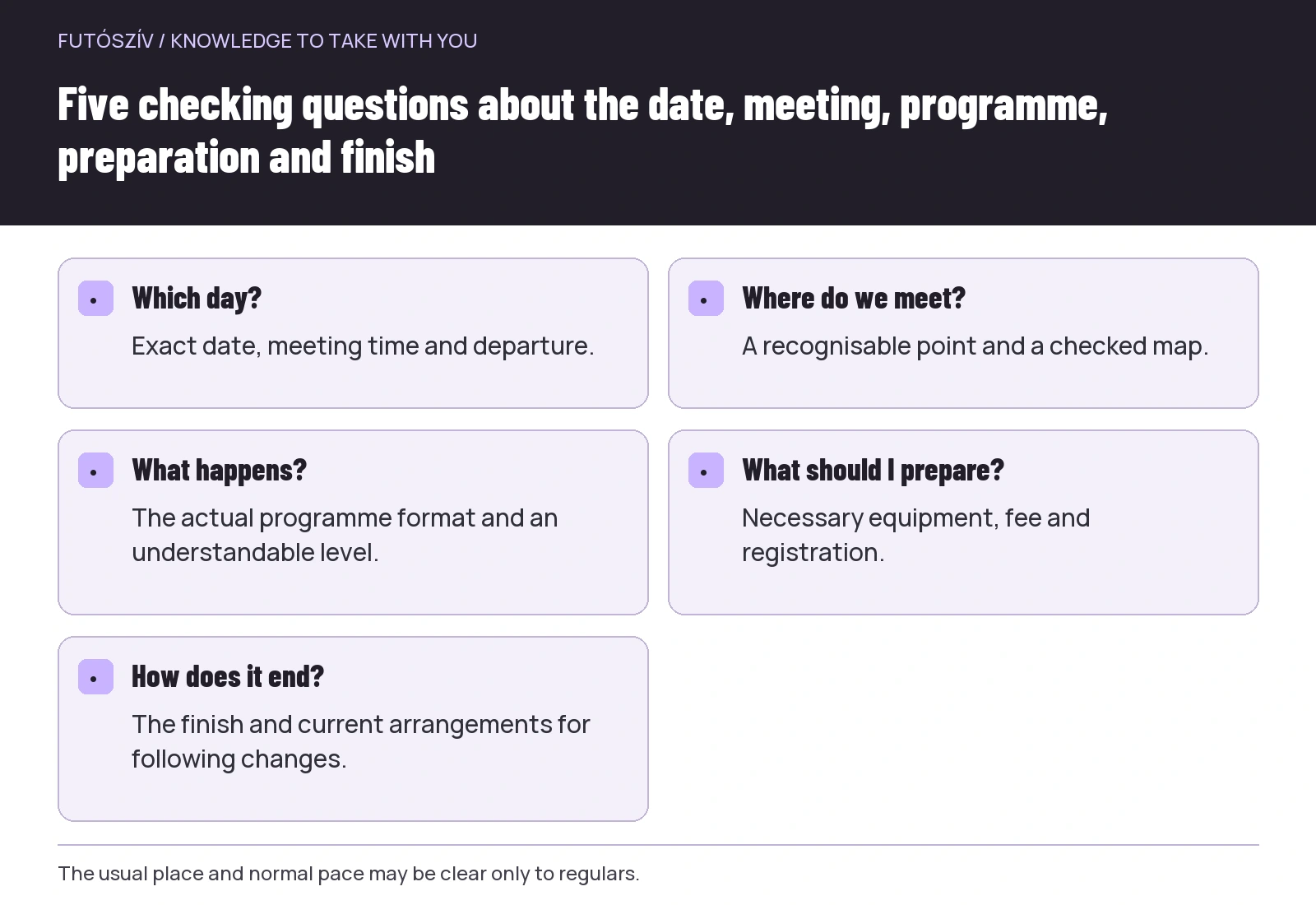
Text version of the diagram
- Which day?
- Exact date, meeting time and departure.
- Where do we meet?
- A recognisable point and a checked map.
- What happens?
- The actual programme format and an understandable level.
- What should I prepare?
- Necessary equipment, fee and registration.
- How does it end?
- The finish and current arrangements for following changes.
Put the eight basic details in one place
| Detail | What should it include? | What makes it usable? |
|---|---|---|
| Date and time | Meeting and actual start | Participants understand the difference |
| Meeting place | Exact name, recognisable point, map link | Not only regulars can find it |
| Programme format | Moving together or splitting into groups | The advertised support is concrete |
| Distance or time frame | The actual structure of the session | Estimates and required elements are distinguished |
| Route character | Surface, main terrain features, experience needed | People need not infer everything from kilometres alone |
| Preparation and fee | Precisely required equipment, actual cost | No condition remains hidden |
| Registration and questions | Method, deadline, appropriate contact | There is a clear next step |
| Finish and changes | Location, planned arrangements, channel for fresh information | The whole session and current status can be followed |
The table is an original editing aid. A particular organisation and programme may require additional information. The aim is to organise the basics, not squeeze every administrative or professional question into a single post.
Explain the pace and level
Easy, beginner and moderate pace can mean different things in different communities. If you give a number, explain what it refers to: a continuous section, the whole session or the group’s chosen arrangements. Rest, looping back and stops may make the overall average different from the pace of a particular section.
The RunTogether runner FAQs distinguish session types by pace, distance and experience. This is an English system’s own classification. The lesson for your invitation is that a level description must have understandable content.
Briefly explain the promise of staying together too. Will you move together throughout, regroup at preannounced points or set off in several independent groups? Waiting at the finish is a different commitment from support along the route. Applicants need to know this before departure.
An edited basic template with fields to complete
The following template is a fictional editing example, not an advertised event. Replace fields in square brackets with real, checked information and omit anything that does not fit.
[Session name] – social run [exact date]
[The session’s specific purpose and format in one sentence.] Meet at [time] beside [precise point], departing at [time]. Look for this location on the map: [checked link]. [Name or role] will welcome newcomers so you can learn about today’s programme before setting off.
The planned [distance or time frame] takes place in [route character] surroundings. Group arrangements: [specific procedure for staying together or splitting into groups]. The advertised pace means: [brief explanation]. If you are unsure which format suits you, ask here before registering: [appropriate channel].
Preparation needed: [precise requirements for this particular session]. Participation fee: [actual amount or an unambiguous statement that it is free], registration: [method and deadline]. The programme’s planned finish is [location and arrangements]. If anything changes, current information will appear here: [primary channel]; check it before departure.
The template becomes an invitation when real organising decisions stand behind it. A question remaining as you fill in the fields is the next task in preparing the programme, not a gap to cover with decorative copy.
Give the finish its own sentence
Does the run finish where it starts? Is there a separate social part afterwards? Which of these belongs to the agreed programme? These details let participants plan their journey home and total time away.
If the programme uses a one-way route, returning is especially important. The invitation should not imply that reaching the run’s endpoint automatically ends the organising for every participant. If everyone arranges their own transport, say so clearly.
Describe the planned time frame appropriately. An estimated finish is not a guaranteed timetable, and excessive precision should not disguise that. A related service or transport departure, however, may be a checked fact. Keep the roles of the two kinds of number understandable.
 Enlarge diagram
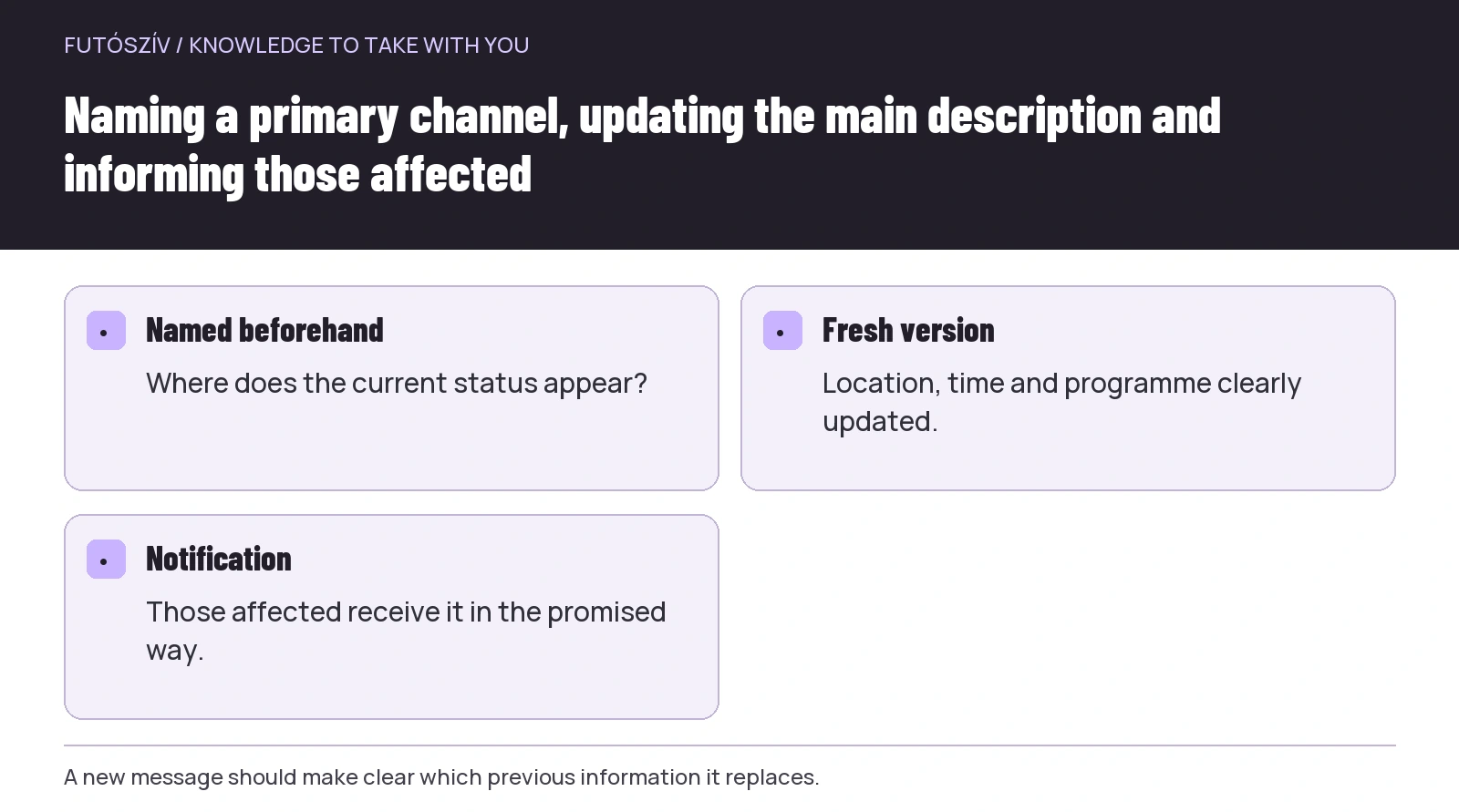
Text version of the diagram
- Named beforehand
- Where does the current status appear?
- Fresh version
- Location, time and programme clearly updated.
- Notification
- Those affected receive it in the promised way.
Give changes a primary channel
If the route, meeting or conditions for holding the session change, applicants should know where to find the current announcement. State this in the invitation beforehand. A social event description, a separate group message and a personal email may reach participants differently.
The parkrun information on cancellations asks people to check the current website and social channel for its own events and mentions the possibility of last-minute changes. This is a concrete organising example showing that a recurring time alone is not current confirmation that an event will take place.
For your own session, update the main description and notify those affected in the promised way. The new message should identify which previous detail it replaces. Applicants should not each have to work out the valid meeting place from several comments correcting one another.
You can prepare both brief and detailed versions
A short social-media introduction can direct people to a detailed, current event page. It should contain the specific experience, precise date and location of further information. In the detailed version, present the basic details clearly in one place.
Do not squeeze all necessary information into an image file. A text description is easier to update and may be accessible in more usage situations. If the poster shows a time or location, it should match the description. After a change, the old picture can remain misleading if it continues circulating.
The image caption and event page should not promise two different programmes. If the short text mentions a run for all levels that stays together throughout, the detailed page should not reveal an unstated, completely different expectation. The atmosphere and information should describe the same session.
Test the invitation with someone who has never attended
Read through the finished invitation using five practical questions. Do I know which day it is for? Can I find the meeting? Do I understand what happens and whether it suits me? Do I know what to prepare and what it costs? Do I know how it ends and where information may change?
If answering any question requires knowing the club’s previous habits, the text is still incomplete for a newcomer. Use precise descriptions instead of “the usual place”, “normal pace” and “last time’s loop”. Regulars can also check more easily whether you are talking about the same session this time.
Test reading should not focus on the number of marketing adjectives. The main question is whether someone can make an actual decision from the text. Brevity is valuable when necessary content remains; a longer description is useful when it answers a real question.
Request necessary personal information in the appropriate place
Do not ask everyone to give personal health histories or contact information in public comments on the invitation. Use the organisation’s appropriate registration and information procedures. This article does not provide a complete data-protection or legal guide; it draws attention to distinguishing communication purposes.
But the opportunity to ask questions should be real. If participation requires a prior discussion, applicants should know whom to contact and how. Do not offer only a general messaging button if the organiser will not monitor it before the event.
Make organising information about photography and public sharing available too. Joining a running session and appearing in content creation are different questions. New participants should be able to request information about this from the appropriate person.
Improve the next invitation from real questions
After the session, examine which questions recurred. If several people could not find the entrance, clarify the location and approach. If the pace description was ambiguous, explain the term. Turn feedback into a specific editing task.
When copying an old event page, check every variable detail separately. Date, location, person responsible, distance, fee and update channel must not automatically remain as before. A consistent format helps, but the content must match the current programme each time.
A usable community invitation provides both encouragement and a basis for deciding. Participants understand the experience, find the organising information and know the next step. That can lead to more orderly arrivals and a shared run that better fits the advertised format.
How Futószív articles are prepared: our editorial guidelines.