
“Do I need an ECG, heart ultrasound or exercise test before taking running more seriously?” The question is understandable, but answers differ. Appropriate assessment begins with symptoms, personal and family history, current activity and planned load. Tests address these questions rather than simply completing a package.
This guide helps prepare for consultation. It does not establish individual fitness or exempt you from assessment at home. If you currently feel unwell, urgency of care matters more than arranging a later screening appointment.
Investigating symptoms and symptom-free screening are different situations
Report exercise-related chest symptoms, dizziness, feeling close to fainting or other unusual symptoms precisely. The American College of Cardiology information recommends healthcare discussion before continuing sport with such warning signs. You need not wait for a scheduled annual check.
For severe chest pain, severe breathing difficulty, unconsciousness or another life-threatening situation in Hungary, call 112, as the National Ambulance Service information also emphasises. Stop exertion, request help and follow the emergency dispatcher’s instructions.
A symptom-free preventive discussion is different. Personal risk circumstances and intended sport can determine appropriate assessment. Absence of symptoms and complete absence of risk are not identical concepts.
Explain the running you plan
“I run” is too broad. It can mean a few short comfortable weekly outings, intense track training or a long race in heat. Describe both your actual current programme and intended change at consultation.
Session frequency, typical duration, demanding tasks and recent interruptions are useful information. If previously active but now returning after a long break, mention this separately. An old record does not automatically describe today’s exercise tolerance.
Goal details matter too: whether you want to race, expected activity duration, environment and how soon you want to reach it. Medical terminology is unnecessary. A clear description of the concrete task matters most.
Prepare personal history in chronological order
Note known previous illnesses, important examinations and treatment. Bring available reports in an accessible format. Dates help the doctor understand which condition a document describes.
Carry an accurate medication and regularly used preparation list. Do not say only “something for blood pressure”. Do not independently change or stop medication for the test or running; agree preparation with the testing facility.
If uncertain about an old event’s significance, describe it factually. You need no self-diagnosis. The doctor interprets which further questions or investigations follow.
Precise known family-history details help
Report known heart disease, inherited conditions or unexpected deaths in the family. Where possible, record who was affected, their relationship to you and age when it occurred. State when the cause is unknown too.
You need not turn every family story into a definite medical fact before consultation. “As far as I know” and “unclear” may be more accurate than confidently repeating a heard diagnosis. Uncertainty itself matters.
You might ask: “Does this history change which assessment or follow-up you recommend?” Family information then belongs to personal evaluation rather than an independent online risk calculation.
 Enlarge diagram
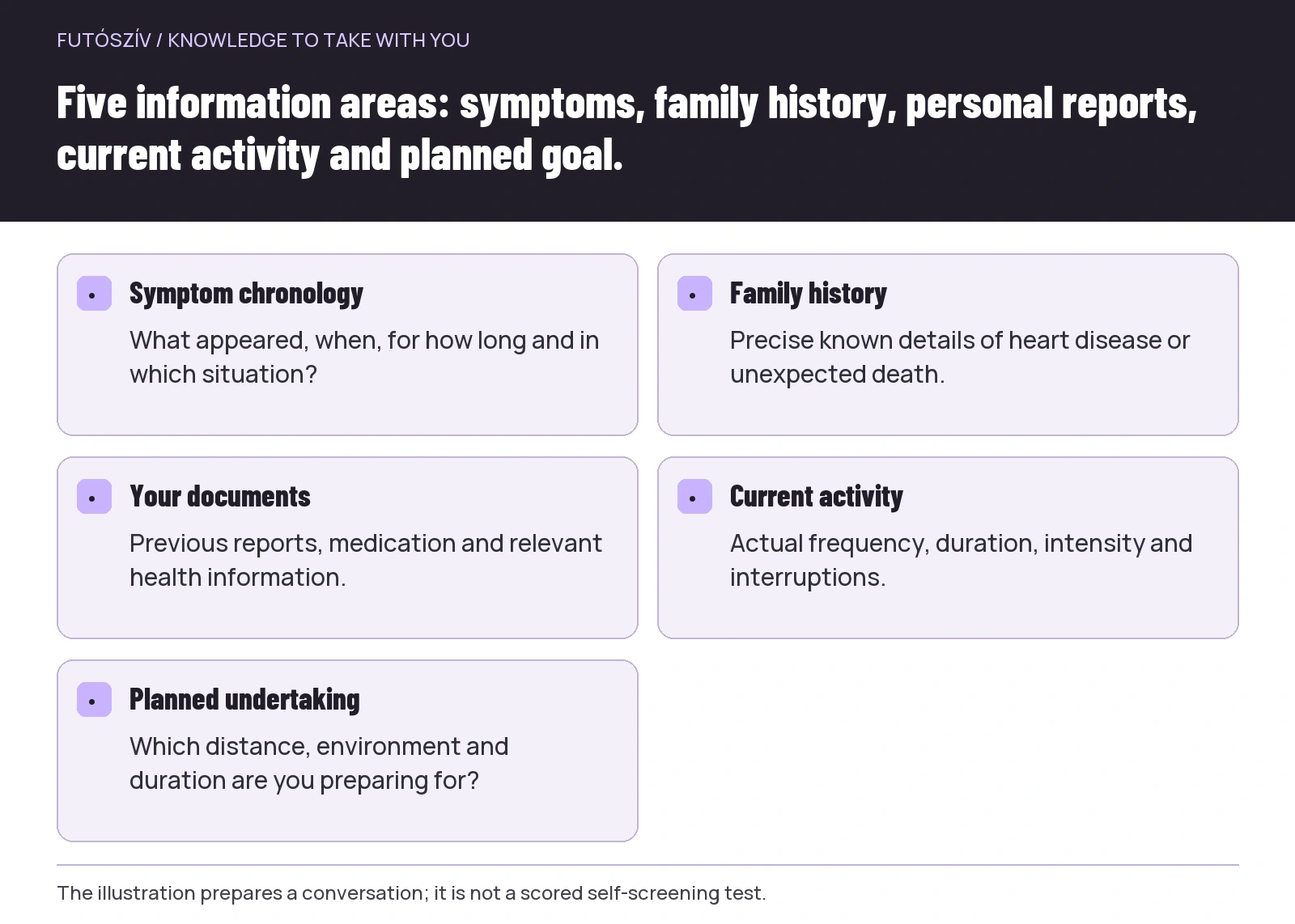
Text version of the illustration
- Symptom chronology
- What appeared, when, for how long and in which situation?
- Family history
- Precise known details of heart disease or unexpected death.
- Your documents
- Previous reports, medication and relevant health information.
- Current activity
- Actual frequency, duration, intensity and interruptions.
- Planned undertaking
- Which distance, environment and duration are you preparing for?
What might an initial assessment include?
The 2025 AHA/ACC statement on competitive athletes also emphasises medical history and physical examination’s fundamental roles. Its framework assesses competitive athletes; a recreational runner’s specific investigation plan depends on individual circumstances.
Conversation is no less important than a device-based measurement. Symptoms, history and intended sport help determine the question being addressed. A brief note prepared before the appointment can therefore help.
Ask what a test is for too. Tests do not all assess the same thing, and not every further step is indicated for everyone. The aim is answering the appropriate question rather than collecting the maximum number of investigations.
An ECG is important but not a complete heart description
A resting ECG records the heart’s electrical activity, as the American Heart Association patient information explains. A normal result does not mean every possible cardiovascular question has been answered.
The 2025 AHA/ACC document treats adding a resting twelve-lead ECG in competitive-athlete screening as a reasonable option with appropriate interpretation and further evaluation support. This is not the same as every runner choosing recurring test packages independently.
Interpreting athlete findings requires appropriate expertise. If a report notes an abnormality, ask its precise meaning and next step. Do not determine significance independently from automatic text or an internet image.
Screening methods have limitations
A prospective study in high-school athletes compared the AHA history-and-physical evaluation system with ECG. Its findings concern a specified young-athlete setting, not a complete risk assessment for an older returning runner.
A test can reveal something needing clarification even if disease is not later confirmed. Conversely, questions can remain unrecognised despite normal results. Interpret findings, history and symptoms together.
Screening supports prevention rather than removing every uncertainty. The 2025 professional document does not regard one approach as protection excluding every event. New symptoms may require fresh assessment despite an earlier favourable examination.
Ask about exercise testing individually
The 2020 ESC sports-cardiology guideline considers symptoms, risk factors and intended activity together in further assessment. It cannot justify one automatic testing schedule identical for all symptom-free runners.
You might ask: “Given my history and intended load, do I need an exercise test, and what would it answer?” Also ask whether another method is needed to clarify a question.
Agree test preparation directly with the facility. Do not change medication, eating or training by guesswork. Interpretable assessment requires professionals to know the circumstances in which you arrived.
Watch data can supplement the story
You can show data associated in time with symptoms alongside a precise symptom description. Device type, measurement method and circumstances help too. A screenshot alone cannot replace healthcare assessment.
Do not wait for the watch to validate feeling unwell. With concerning symptoms, absent data or a reassuring display does not justify delaying help. Your condition and professional assessment matter more than a consumer-device signal.
Ask at consultation which information to record later if the situation recurs. You need not collect every measurement without limit. The aim is interpretable information, not an ever-growing dataset.
 Enlarge diagram
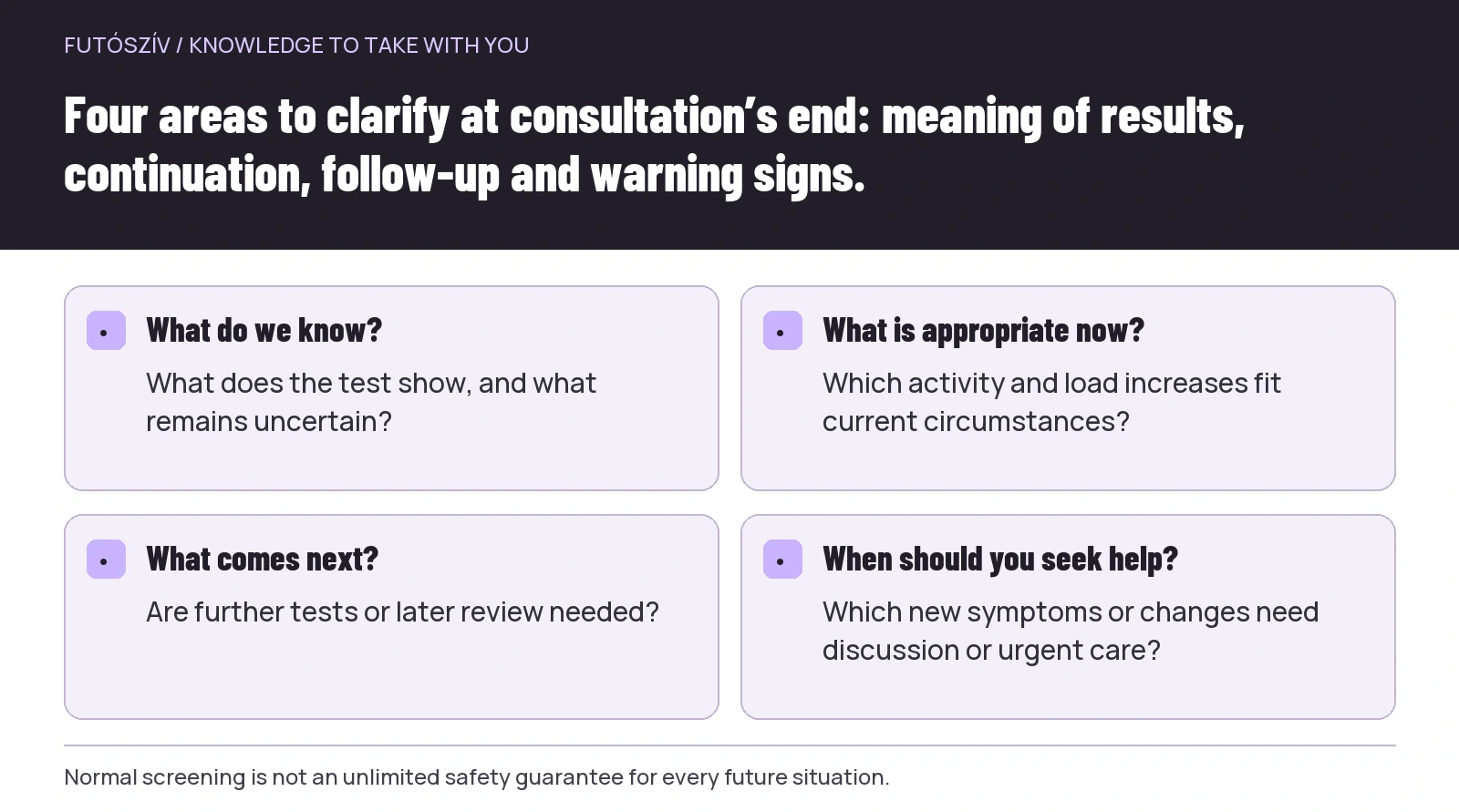
Text version of the illustration
- What do we know?
- What does the test show, and what remains uncertain?
- What is appropriate now?
- Which activity and load increases fit current circumstances?
- What comes next?
- Are further tests or later review needed?
- When should you seek help?
- Which new symptoms or changes need discussion or urgent care?
Ask for an understandable activity plan before leaving
Clarify activity recommended now, any temporary adjustment and when load can be reassessed. If findings need clarification, ask what to do meanwhile. Seek a more precise framework than the vague phrase “exercise carefully”.
The plan must connect to your sporting task. Are you discussing easy running, intense training or racing? Are there separate considerations for longer activity or demanding environments? Agree these with the doctor rather than converting them afterwards into independent permission.
If working with a coach, share load-related recommendations in your chosen way. The sporting programme can then reflect professional assessment. A coaching conversation should not replace discussion of medication or other treatment.
What does shared decision-making mean?
With a known condition, personal goals and medical assessment may both matter in sport decisions. This does not automatically permit a desired race despite every risk. Discuss uncertainty and options understandably.
Explain what you want from running and ask about alternatives. Different intensity, another race goal or returning after further assessment may be possible. An individual plan uses more information than a general online sentence permitting or prohibiting sport.
Ask for another explanation when unclear. The consultation aims not at memorising every technical term, but knowing what the situation means for activity over coming days and months.
Agree follow-up too
Ask whether later review is needed and which changes require an earlier appointment. Increased planned sporting load, new symptoms or another health change can create a new question. Timing and action depend on individual circumstances.
Keep reports and recommendations accessible and organised. This makes changes easier to follow at the next consultation. A document is not a trophy but information supporting continuity of care.
Treat administrative race requirements separately too. An event’s declaration or certificate may differ from personal healthcare assessment. Check current organiser rules and clarify health decisions with an appropriate professional.
A good opening question can be brief
“This is how I currently run, this is what I want to undertake, this is my history and these points are uncertain. What assessment and activity framework do you recommend?” This starts from your situation and allows tests to fit the real question.
Screening’s value is not the number of investigations or a reassuring stamp covering everything. It lies in seeing important questions more clearly and knowing how to continue activity, when to request review and which new signs to respond to.
Health information belongs in running planning alongside a training diary. Together they can support realistic decisions, while neither makes the future entirely predictable.
Sources and scope
- 2025 AHA/ACC statement on competitive athletes – with appropriate professional interpretation and individual application.
- 2020 ESC sports-cardiology guideline – considering symptoms, risk and sporting load together.
- Prospective comparison of screening methods in high-school athletes.
- AHA: ECG information; ACC: warning signs.
- Hungarian National Ambulance Service: urgent help and out-of-hours care information.
How Futószív articles are prepared: our editorial guidelines.