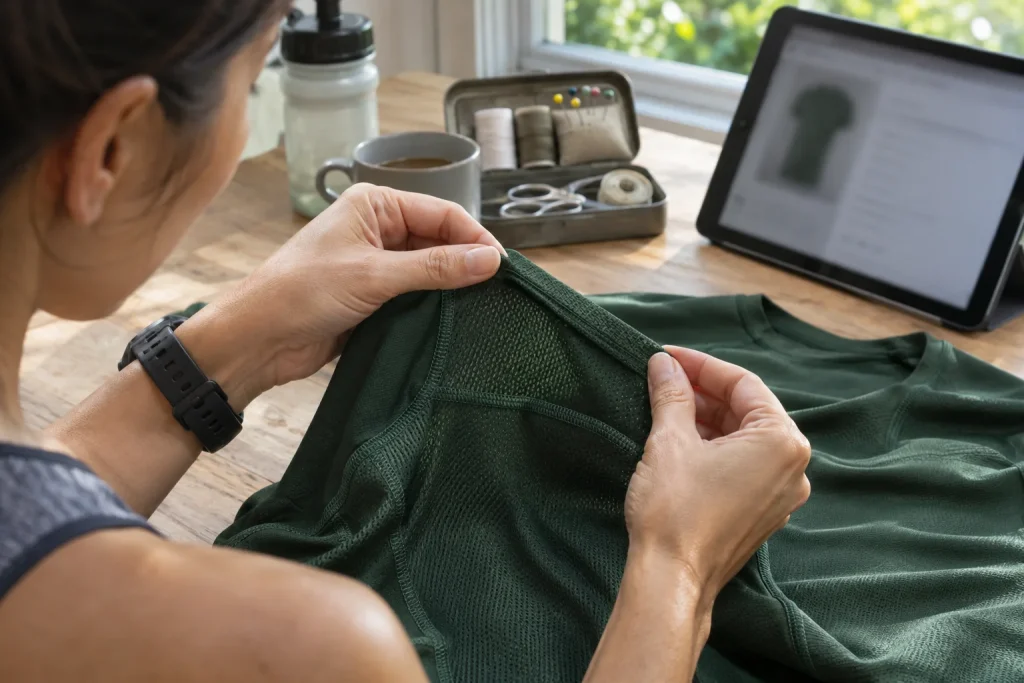
A running-top product page may carry several environmental claims: recycled material, responsible manufacturing, a smaller footprint, tested textiles or repairable design. These do not necessarily concern the same thing. A useful buyer’s question is therefore not merely whether the product is green, but exactly what is claimed, what it covers and which evidence supports it. This guide offers a method for reading wording and evidence. It does not rate brands remotely or turn one certificate into an environmental ranking valid in every circumstance.
Turn the claim into a checkable question
Find the exact product claim first, then convert it into a short question in your notes. “The outer fabric contains recycled polyester” concerns material origin and a named part. “Lower emissions” implies comparison, requiring a reference and method. “Repairable” raises which fault, component and service are covered. Do not merge different questions into one “good product” adjective. Clarification is not a game of mistrust, but understanding how information can be used.
Look at the marketing block’s context too. One page can contain specific product data, a collection-wide statement and a company’s future goal. Keep these separate. Next year’s commitment is not a verified property of today’s item; changed packaging material does not equal improvement across the garment’s whole lifecycle. In good notes, each statement names its subject: product, defined component, packaging, factory or company. This separation alone resolves many misunderstandings.
Every percentage needs a denominator
For recycled content, identify what the fraction describes. The whole garment, main fabric, insert and packaging are different bases. A percentage alone does not state which components count. Read the complete composition breakdown and apply the claim only to its actual named scope. Do not extend an outer-fabric figure automatically to sewing thread, zips and every accessory. Missing detail needs clarification, not free invention.
The Textile Exchange standards FAQ explains Recycled Claim Standard and Global Recycled Standard roles in tracing and verifying recycled materials, distinguishing the systems’ scopes too. For buyers, the certification name and precise claim scope matter. Evidence for recycled content is not itself a comparison of every environmental characteristic of the whole product. Check detailed requirements in the current official system description, because standards and claim rules can change.
Read the certificate’s full name
Look beyond logo colour or a familiar abbreviation. Seek the full name, identifier, verification option and subject certified. One organisation may operate several systems with different assessment aims. The official OEKO-TEX STANDARD 100 page , for example, describes textiles tested for harmful substances within its defined system. This is not certification of any natural material’s origin or whole lifespan. Understanding scope lets you use helpful verification for its intended purpose.
Certification and personal use experience are separate too. A label cannot prove trousers fit you, have a large enough pocket or a comfortable cut. Conversely, comfortable clothing does not thereby acquire verified lower environmental impact. Examine functional suitability and supporting evidence side by side. An item bought with good intentions but unusable for you does not solve your equipment task, however interesting its label data.
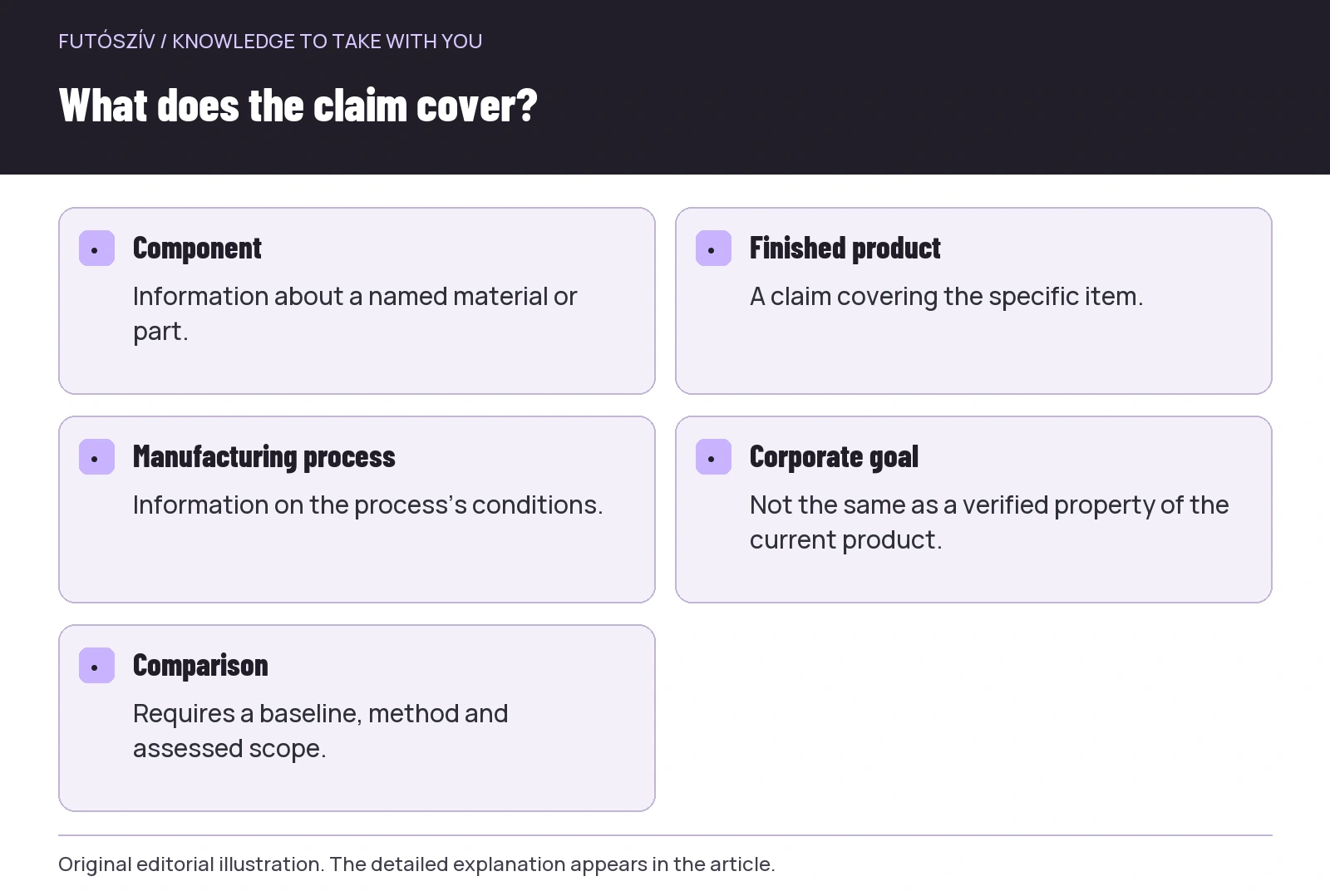 Enlarge diagram
Text version of the illustration
- Component
- Information about a named material or part.
- Finished product
- A claim covering the specific item.
- Manufacturing process
- Information on the process’s conditions.
- Corporate goal
- Not the same as a verified property of the current product.
- Comparison
- Requires a baseline, method and assessed scope.
Product level or one component?
Labels about processes, materials and finished products may operate at different levels. The official bluesign FAQ discusses the system’s role, product- and component-level claims and changes in labels separately. The lesson is not to automatically treat information about a named textile as certification of the whole company or every product. Find the precise term in the system’s current explanation rather than reasoning from an old blog summary.
If only one component is mentioned, record which. For a whole-product claim, find associated conditions and identification. A statement about the manufacturer being a system partner is not itself the same as certification of a particular garment part number. The distinction does not make information worthless, just its use more precise. Keep boundaries intact: component information remains about that component, factory information about that factory, while the specific product follows its own documentation.
| Claim type | First question | Useful additional information |
|---|---|---|
| Recycled content | Which part and what proportion? | Composition breakdown and verification system. |
| Certificate | Exactly which system, covering what? | Identifier and official scope. |
| Smaller footprint | Compared with what, using which method? | Lifecycle stages assessed and conditions. |
| Repairable | For which fault and component? | Genuinely available service or replacement. |
| Corporate goal | Current information or future commitment? | Date, implementation scope and result. |
A smaller footprint: what comparison was made?
For a reduction figure, identify its reference. Is comparison with an earlier model, another material or an assumed average? Are function and quantity equivalent? Which lifecycle stages are included or omitted? Without these, do not use the percentage to rank arbitrary running garments. Values from different studies may not be comparable. Separate the reported number from what its methodology actually establishes in your notes.
Lifecycle thinking means use and later handling matter alongside production. The EEA overview of textile circularity discusses longer use, reuse, repair and better recycling together. This is not a score for one consumer product. It helps you notice that durability and actual use should not disappear in favour of one material-origin figure. Examining the claim and examining need are both part of a good choice.
Make repairability tangible
Behind “repairable”, look for a concrete possibility. Are suitable parts, a repairer, guidance or manufacturer service available? For which faults, in which country and under which conditions? Replacing a garment zip and repairing a complex device internally are different commitments. Exact model matters; a general brand page is only a starting point. Check current service availability even if an older favourable article accompanies the product.
Separate theoretical repairability from solutions available in your situation. A part may look replaceable while its replacement is unidentified or unavailable. The claim becomes a real buying question: what happens if this specific part fails? You need not demand a guaranteed future lifespan, but existing support and documentation can be checked. This thinking applies to later purchases regardless of brand and category.
Let the product page meet your actual need
Define the task missing from existing equipment. If none exists, an interesting claim does not itself make a purchase necessary. If clothing is genuinely needed, size, comfort, pocket arrangement and care deserve the same checks as environmental information. An ill-fitting or quickly abandoned item does not fulfil its potential lifespan. Product-page reading aims at an informed choice suited to the task, not the object with most labels.
Do not automatically give an unclear logo extra monetary value when weighing price and usability. Clarify its meaning first, then decide its importance to you. Label count is not a shared scale because labels may answer different questions. Two certificates do not necessarily represent twice the performance of a third. Clear information helps choose; do not turn unknown or missing data into a confident advantage or automatic disadvantage.
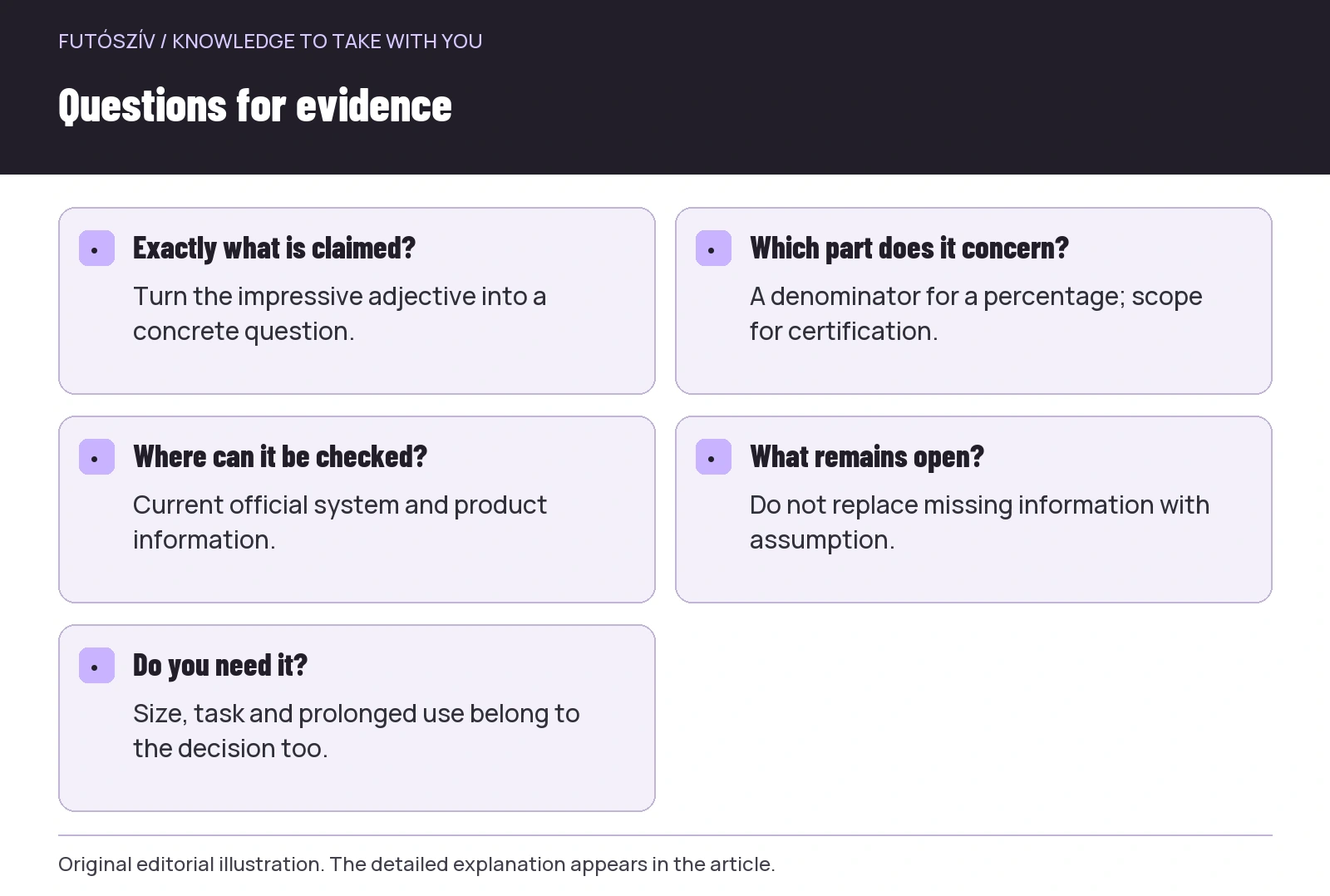 Enlarge diagram
Text version of the illustration
- Exactly what is claimed?
- Turn the impressive adjective into a concrete question.
- Which part does it concern?
- A denominator for a percentage; scope for certification.
- Where can it be checked?
- Current official system and product information.
- What remains open?
- Do not replace missing information with assumption.
- Do you need it?
- Size, task and prolonged use belong to the decision too.
Three editorial reading examples
The first imagined top mentions recycled main fabric, but percentage and product part are unclear. The next step is seeking composition and claim clarification, not confidently rating the whole item. In the second, a certificate’s exact name and identification are available, allowing scope checks on the official system page. This provides better information for that specific question, while size still needs a trial or appropriate chart. A third product claims lower impact without a visible reference.
For the third, do not produce a definite ranking without method and comparison background. Seek the missing information in detailed documentation or ask the manufacturer. These are invented teaching examples, not evaluations of real companies. They link open questions to appropriate actions. Not every incomplete page proves deception, nor is every impressive claim supported. The buyer’s method is factual clarification: precise subject, data, scope and meaningful evidence.
What brief question should you send the manufacturer?
Include the specific product link or part number, the claim read and missing information. For example, ask which product part the recycled-content percentage refers to. Other questions might concern where current verification of the named certificate is available or which baseline a footprint comparison uses. A short clear question invites a more relevant answer than asking how sustainable the entire brand is. Record the response’s date and product scope too.
Without a response, missing information remains missing. Decide how necessary it is for your choice, but do not substitute another product’s data. If the standard or page updates, consider new information alongside its version. Systems named here are not eternal unchanging definitions either; current official guidance matters. Keeping date and scope prevents an older search result automatically becoming proof for today’s purchase.
A minute of checking in the right order
With little time, start with four questions: what does the claim cover, which concrete information does it give, where can it be checked and what do I still not know? Then return to your task: is the product needed, does its design fit and can you use and care for it over time? Every product page need not become a scientific paper. Aim for proportionate certainty: tell yourself only what the evidence actually supports and keep remaining questions separate.
Running-equipment discussions can then become more concrete. Material origin, assessed component, certification, comparison and repair possibilities retain their meanings instead of disappearing into one green adjective. An informed choice brings the product’s task and known evidence into alignment. This means fewer exaggerated conclusions and more answerable questions, while continuing to use suitable existing gear remains a real option.
Sources and further reading
- Textile Exchange: Standards FAQs
- OEKO-TEX: official STANDARD 100 overview
- bluesign: official FAQ and scope of labels
- EEA: Textiles, Circularity Metrics Lab
How Futószív articles are prepared: our editorial guidelines.